If you searched “google snake gitlab,” you’re almost certainly trying to do one of two things: find a Snake game similar to the one hidden inside Google Search, or find actual source code for a Google Snake–style project hosted on GitLab. Here’s the direct answer: there is no official Google-run Snake repository on GitLab. What you’ll find instead are several independent, template-based “unblocked games” websites that use the name “Google Snake” and happen to be hosted — for free — on GitLab’s static-site hosting feature, GitLab Pages. None of them are operated by Google, and none of them expose real open-source code, a license, or a README to visitors.
That’s not a knock on them — free static hosting is a completely normal way to publish a simple browser game. It just means “GitLab” in this search is about where a page is hosted, not a sign of an official or notable open-source codebase.
Is Google Snake Really Hosted on GitLab?
Not by Google. The Snake game you may have encountered directly inside Google Search (searching “snake,” or visiting Google’s own in-Search arcade page) is a first-party Google experience with no public repository anywhere — GitLab, GitHub, or otherwise. Google hasn’t open-sourced it.
What is hosted on GitLab are third-party pages — sites like googlesnake.gitlab.io and similar addresses — that serve their own browser Snake game and label it “Google Snake” to match what people are searching for. Some of these are directly tied to well-known “unblocked games” networks, and a few even publish the exact same page simultaneously on GitLab Pages, GitHub Pages, and Cloudflare Pages, which strongly suggests the goal is redundant hosting rather than a showcase of original code.
Is Any of This Official?
No. To be precise about the three separate things this search can turn up:
- The official Google Snake game inside Google Search — genuinely made and run by Google, but closed-source, with no public repository.
- Third-party browser mods/userscripts for that official game (distributed through places like GitHub and Greasy Fork) — unofficial tools that change how the official game looks or behaves in your browser. They modify the official game rather than replacing it.
- GitLab-hosted “Google Snake” game portals — independent, unofficial recreations with no demonstrated connection to Google or to the modding community above. They’re simply using a recognizable name for a generic Snake game.
None of the second or third category is affiliated with, endorsed by, or maintained by Google.
What Is GitLab Pages, and Why Do So Many Game Sites Use It?
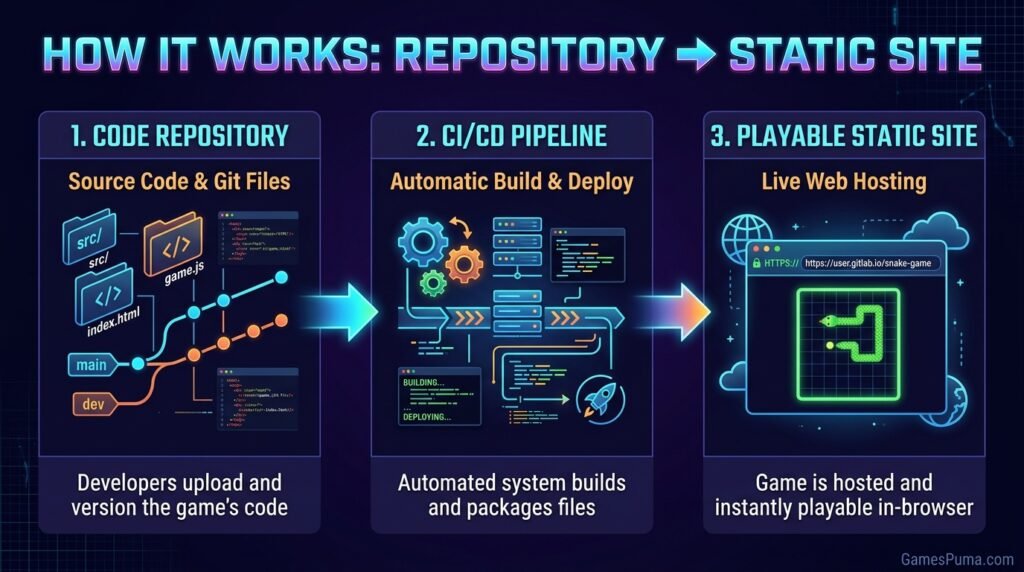
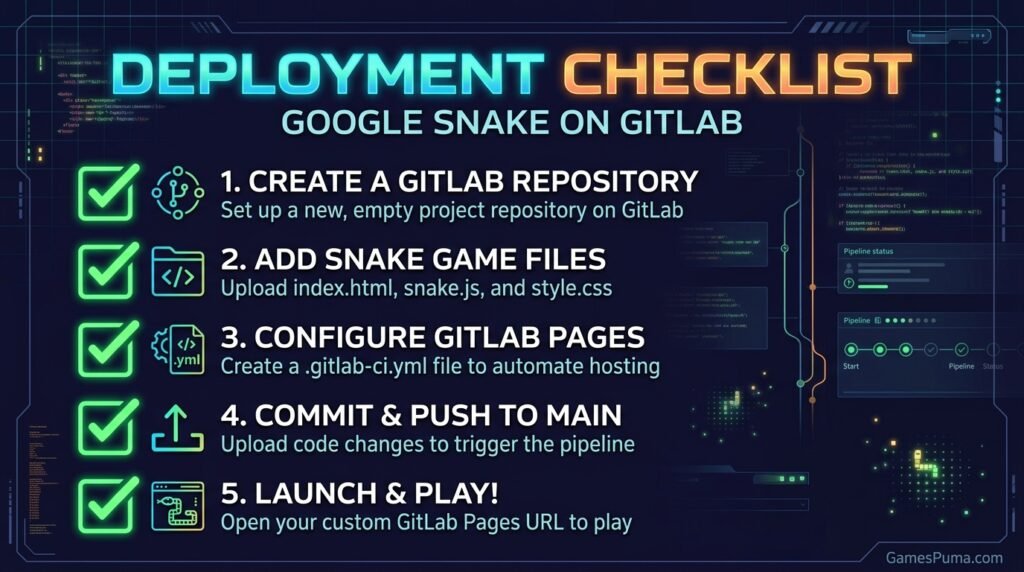
GitLab Pages is a free feature of GitLab (a code-hosting platform, similar in purpose to GitHub) that lets anyone publish a static website — HTML, CSS, and JavaScript files — at a username.gitlab.io address, straight from a repository. It doesn’t require the underlying repository to be public, well-documented, or actively maintained; it’s simply free web hosting. That’s exactly why casual game portals lean on it: it’s a no-cost way to publish a browser game, with no guarantee that anything resembling a proper open-source project sits behind it.
Playing the Actual Official Google Snake
If what you actually want is the real thing, the official version lives inside Google itself. Searching a relevant term on Google Search can surface the game directly in the results page, and Google has also made it available as a standalone in-Search page you can open on its own. It runs entirely in the browser, needs no download, supports keyboard controls on desktop and touch controls on mobile, and includes a basic score/leaderboard element. Because it’s a first-party Google feature rather than an embeddable widget, it can only be played on Google’s own domain — no third-party site, including GitLab-hosted ones, can legitimately claim to host the actual official build.
Related article: https://gamespuma.com/snake-io-unblocked/
Is There Real, Open-Source Code Behind the GitLab Pages?
Based on what’s publicly visible, no verifiable open-source project stands behind the ranking GitLab Pages sites. None of the pages checked for this article expose a repository link, README, or license to visitors — GitLab Pages simply serves the finished website, so there’s no guarantee a matching public repository even exists. Publicly loading a webpage is also not the same as that page’s code being open source: without a visible license, you don’t have permission to copy, reuse, or redistribute it, regardless of whether you can view it in your browser.
If you’re a developer specifically hunting for buildable Snake source code to learn from or modify, you’ll have far better luck searching GitHub or GitLab directly for tagged “snake game” projects from individual developers, who commonly do publish real READMEs, licenses, and language details for their own original Snake implementations — just understand that those are independent educational projects, not “the” Google Snake GitLab repository, because no single one holds that status.
How to Evaluate a GitLab-Hosted Game Page Before Using It
A few quick, practical checks apply to any GitLab Pages game site, not just this one:
- Check whether a repository link is visible. A legitimate open-source project usually links back to its own
gitlab.com/username/projectpage. - Look for a README and license. Their absence doesn’t make a page unsafe to play, but it does mean there’s nothing to verify about who built it or under what terms.
- Notice if the same page exists on multiple unrelated domains. That’s common for large “unblocked games” networks and is a sign you’re looking at a mirrored portal template, not a unique project.
- Treat “Google” in the name as descriptive, not a guarantee. Plenty of independent Snake games use “Google Snake” purely because that’s what people search for.
Google Snake Gameplay Basics
Whichever version you end up playing, the underlying gameplay is standard Snake: you steer a continuously moving snake around an open playing field, eating food items to grow longer while avoiding collisions with the walls, obstacles, or your own body. Games typically track your score based on length or food eaten, and end the moment you collide with something you shouldn’t. The official Google version adds a colorful visual style, smooth animations, and both keyboard and touch controls depending on your device — the core mechanic, however, is unchanged from Snake’s decades-old formula.
Common Problems
- A GitLab-hosted page won’t load: Try a different browser or refresh — static sites hosted this way can occasionally have downtime or caching issues.
- The game looks different from what you remember from Google Search: That’s expected if you’ve landed on a third-party recreation rather than the official in-Search version — they aren’t built from the same code.
- You can’t find any source code or license on a portal page: That’s normal for this category of site — see Section 6 above; it doesn’t necessarily mean anything is wrong, just that there’s nothing to verify.
- A page seems to redirect through several different domains: This usually reflects a mirrored “unblocked games” network rather than a single dedicated project.
Frequently Asked Questions
What is Google Snake GitLab? It’s a search phrase that mostly leads to independent, unofficial browser game portals hosted for free on GitLab Pages, using “Google Snake” as a descriptive name — not an official Google project.
Is Google Snake available on GitLab? Google’s own in-Search Snake game is not hosted on GitLab and has no public repository anywhere. What’s on GitLab are unrelated third-party recreations.
Is the GitLab Google Snake project official? No. None of the GitLab-hosted “Google Snake” pages found in current search results are operated by or affiliated with Google.
Can I play Google Snake from GitLab? You can play third-party Snake games hosted there, but not the official Google version — that only runs on Google’s own site.
Is Google Snake open source? Google hasn’t published its own Snake game as open source. The third-party GitLab pages examined here don’t expose any license either, so their code shouldn’t be assumed to be freely reusable.
Can I download a Google Snake GitLab project? No specific, verifiable repository was identified to recommend downloading. If you’re looking for genuine open-source Snake code to learn from, search GitHub or GitLab directly for individual developers’ original Snake projects, which are far more likely to include a real README and license.
What programming language do these projects use? Browser-based Snake games like the ones described here are typically built with standard web technologies (HTML, CSS, and JavaScript), since that’s what a static site needs to run in-browser — but no specific project’s tech stack could be verified from its public page alone.
What’s the difference between Google Snake and a GitLab clone? The official version is a first-party Google feature with closed-source code, playable only on Google’s own site. A GitLab-hosted “Google Snake” page is an independent, unofficial recreation with no confirmed connection to Google.

Written by Daniel Carter
Daniel Carter is a dedicated gaming writer who enjoys turning complex gaming topics into clear, useful, and engaging content. He covers game guides, tips, reviews, features, and the latest developments across the gaming world. His approach focuses on research, accuracy, and practical value, helping readers discover new games, improve their gameplay, and stay informed about the industry. For Daniel, great gaming content is not just about information—it is about making every article genuinely worth reading.