Quick Answer
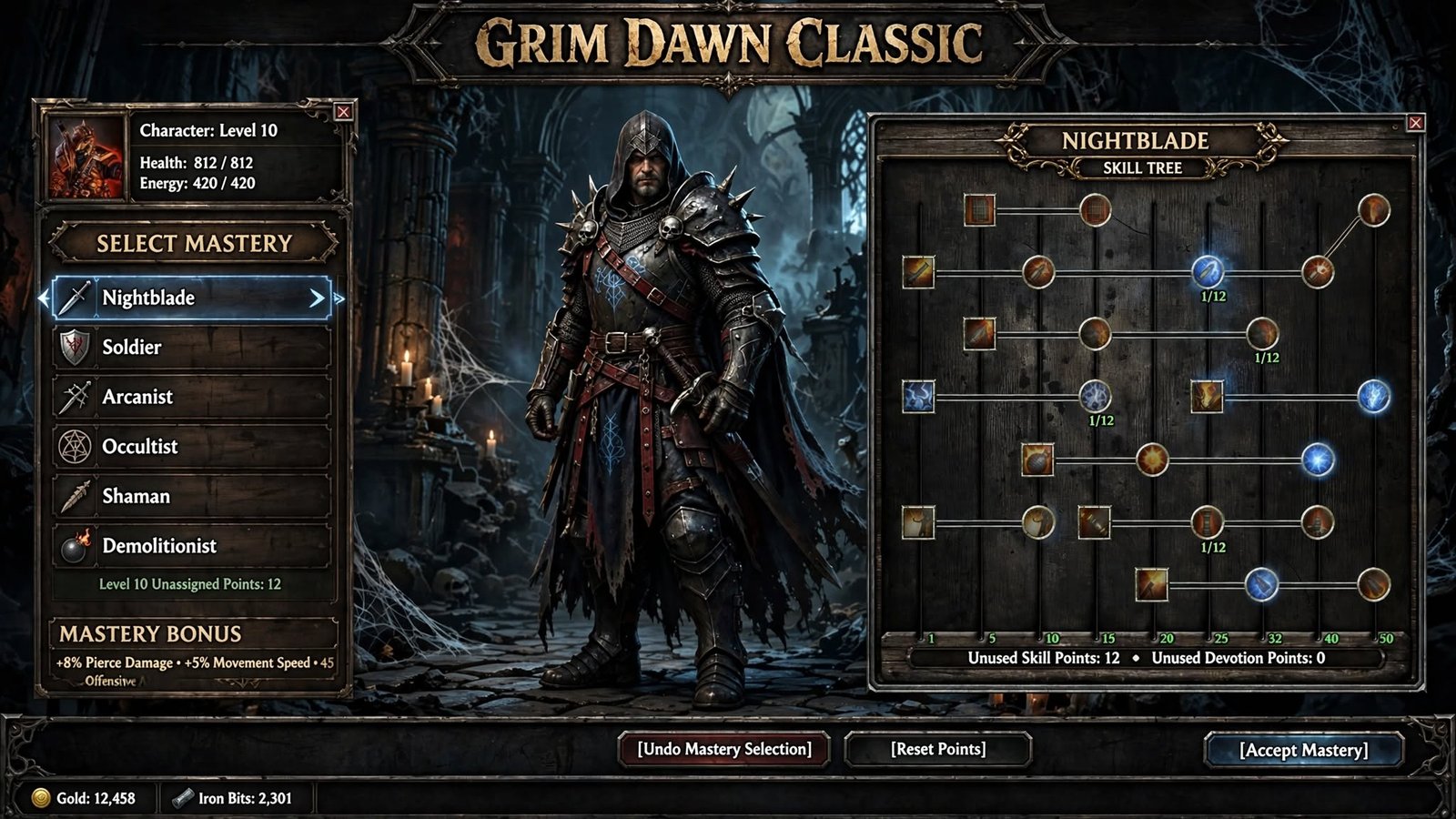
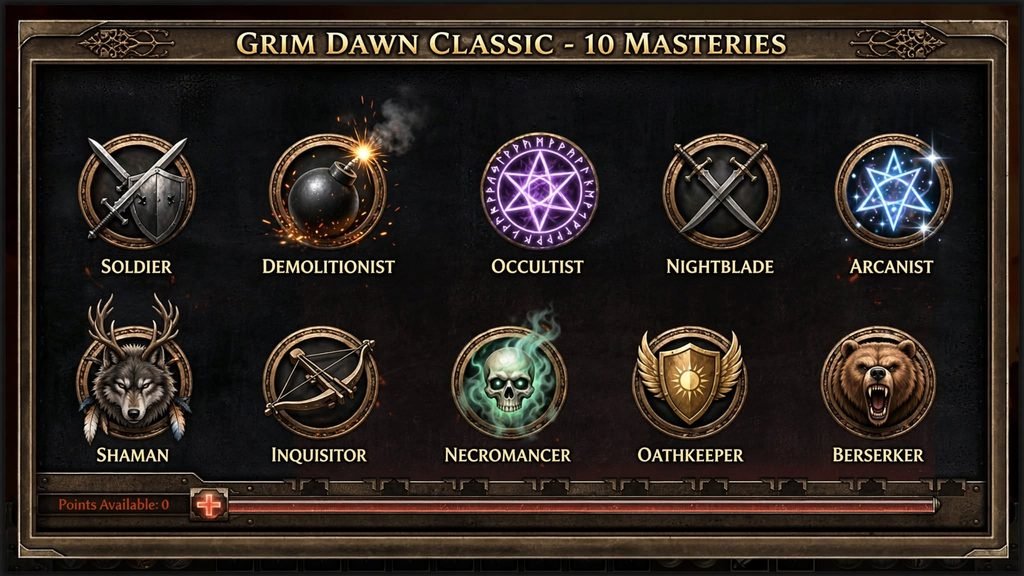
Grim Dawn doesn’t have “classes” in the traditional sense — you don’t pick one at character creation. Instead, you choose a mastery at level 2 and a second mastery at level 10, and the combination of the two is what the community calls a “class” (for example, Soldier + Shaman becomes Warder). As of the Fangs of Asterkarn expansion (patch 1.3.0.8), there are 10 masteries and 45 possible two-mastery combinations. Six masteries come with the base game, two arrive with Ashes of Malmouth, one with Forgotten Gods, and the newest, Berserker, with Fangs of Asterkarn.
Table of Contents
What Are Classes in Grim Dawn?
If you’re coming from a game where you pick a class on the character-creation screen, Grim Dawn’s system needs a quick reframe. There is no class list before you start playing. Instead, the game gives every new character a set of mastery bars — skill trees representing broad archetypes like a soldier, a spellcaster, or a pet-focused occultist.
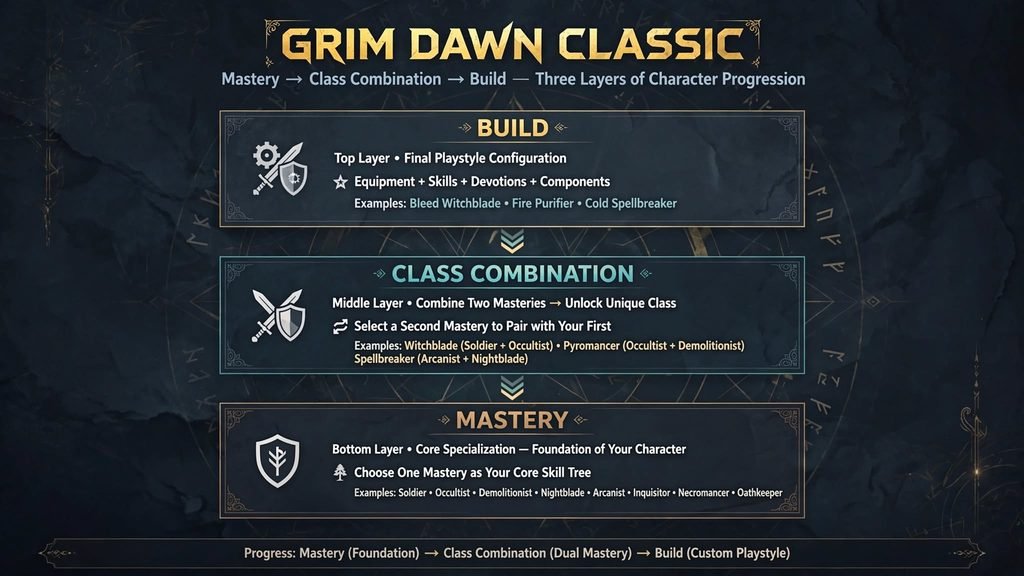
Three terms get used almost interchangeably by players, but they mean different things:
- Mastery — one of the 10 individual skill trees (Soldier, Arcanist, Necromancer, and so on). Each mastery has its own skills, stat bonuses, and playstyle identity.
- Class combination — the pairing of two masteries on one character. The community has given most of these pairings their own name (Warder, Spellbinder, Reaper), which is what people usually mean when they say “class” in Grim Dawn.
- Build — a specific way of playing a class combination: which skills you invest in, which devotion constellations you take, which gear and damage type you build around. Two players can both be playing a Reaper (Nightblade + Necromancer) and end up with completely different builds — one leaning on cold damage and pets, another on vitality and dual-wielding.
That distinction matters because a class combination only tells you the broad shape of a character. The actual strength, survivability, and feel of the character comes down to the build layered on top of it.
How the Dual-Class System Works
- Level 2: You unlock your first mastery bar and start putting points into it. This is your primary mastery, and it usually defines your character’s core damage type and playstyle.
- Level 10: A second mastery bar unlocks. You can pick a different mastery to complement your first, creating a dual-class character, or you can choose to stay single-mastery.
- Staying single-mastery: Nothing forces you to pick a second mastery. Some players run a single mastery for a simpler skill bar or a specific thematic build, though most endgame builds use two masteries for access to more skills, more devotion synergy, and more defensive tools.
- Respeccing: You can refund skill points in either mastery at a Spirit Guide NPC for a gold fee that scales with how many points you’ve spent. This lets you rework how you’ve invested inside a mastery you already have. What you cannot do is remove or swap a mastery once it’s chosen — if you want a different pair of masteries, you need a new character.
- Devotions: Separate from mastery skills, the devotion system lets you spend points earned from shrines on a constellation map, unlocking additional skills and passive bonuses. Devotion choices aren’t tied to your masteries, but the damage types and playstyle of your class combination heavily influence which constellations are worth taking.
Complete List of Grim Dawn Masteries
Base game masteries
- Soldier — Weapon-based melee focused on Physical, Pierce, and Bleeding damage, with strong built-in defense (armor, health, a movement skill, and an automatic heal at low health). Broadly considered the most beginner-friendly and forgiving mastery, and one of the most common “second mastery” picks for exactly that reason.
- Demolitionist — Explosives and firearms built around Fire, Lightning, and Physical damage, with an emphasis on burst damage and area-of-effect skills. Plays at close-to-mid range and pairs well with almost any other mastery.
- Occultist — A curse- and debuff-focused hybrid mastery leaning on Chaos, Vitality, and Acid/Poison damage, with some pet support through a summoned Familiar. Offense is strong, but base defenses are lighter than Soldier’s.
- Nightblade — Fast, crit-focused melee built around Cold, Pierce, and Bleeding damage, with dual-wield support and mobility skills. Rewards aggressive, high-uptime playstyles.
- Arcanist — A spellcaster mastery channeling Aether and elemental (Fire/Cold/Lightning) damage, with some of the game’s strongest defensive cooldowns (a temporary invulnerability shield and a large damage-absorption bubble). Squishy without those defensive skills active, but very powerful once built around them.
- Shaman — A hybrid melee/pet mastery built around Physical and Lightning damage, totems, and Bleeding effects. Comfortable for players who like two-handed weapon combat with a companion pet on the side.
Expansion masteries
- Inquisitor (requires Ashes of Malmouth) — A precision ranged/caster hybrid focused on Pierce, Lightning, and Fire damage, built around firearms and rune-based spells, plus a support skill that can revive fallen allies.
- Necromancer (requires Ashes of Malmouth) — A summoning-heavy mastery centered on Vitality and Chaos damage, raising skeleton minions and draining life from enemies. One of the strongest pet options in the game.
- Oathkeeper (requires Forgotten Gods) — A holy-warrior mastery mixing Physical, Fire, and Aether damage, built around shields, retaliation damage, and defensive/support magic.
- Berserker (requires Fangs of Asterkarn) — A shapeshifting dual-wield mastery focused on Cold, Bleeding, and Piercing damage (with a Chaos conversion option). Its signature mechanic lets you transform into a melee Werewolf form or a ranged, caster-style Wereraven form, on top of a stacking buff (Onslaught) that boosts cooldown-based skills.
Related Artical: https://gamespuma.com/grim-dawn-builds/
Mastery Comparison Table
| Mastery | Core Playstyle | Common Damage Themes | Typical Role | Requires |
|---|---|---|---|---|
| Soldier | Weapon-based melee | Physical, Pierce, Bleed | Tank / durable melee | Base game |
| Demolitionist | Explosives & firearms | Fire, Lightning, Physical | Burst damage / AoE | Base game |
| Occultist | Curses & debuffs | Chaos, Vitality, Acid/Poison | Caster hybrid / light pets | Base game |
| Nightblade | Fast crit melee | Cold, Pierce, Bleed | Mobile DPS | Base game |
| Arcanist | Elemental spellcasting | Fire, Cold, Lightning, Aether | Caster / defensive utility | Base game |
| Shaman | Melee + totems/pets | Physical, Lightning, Bleed | Hybrid melee-support | Base game |
| Inquisitor | Ranged precision hybrid | Pierce, Lightning, Fire | Ranged DPS / support | Ashes of Malmouth |
| Necromancer | Pet summoner | Vitality, Chaos | Pet DPS / sustain | Ashes of Malmouth |
| Oathkeeper | Shield-based holy warrior | Physical, Fire, Aether | Tank / retaliation | Forgotten Gods |
| Berserker | Shapeshifting dual-wield | Cold, Bleed, Pierce (Chaos option) | Melee/caster hybrid | Fangs of Asterkarn |
How Two Masteries Combine Into a Class
Once you have points in two masteries, the community refers to that pairing by an informal “class” name rather than by listing both mastery names every time. These names aren’t shown in-game as a title — they come from years of community convention, and Crate Entertainment has adopted several of them in official patch notes and marketing. A few examples:
- Soldier + Shaman → Warder
- Nightblade + Necromancer → Reaper
- Arcanist + Necromancer → Spellbinder
- Occultist + Shaman → Conjurer
- Nightblade + Oathkeeper → Dervish
The name doesn’t change what your character can do — it’s shorthand for “a character with these two mastery bars.” Two Warders can still play completely differently depending on skill points, devotions, and gear.
Class Combination Reference
Grim Dawn currently supports 45 mastery pairings. The 36 combinations that predate Fangs of Asterkarn have settled, community-standard names. The 9 new pairings involving Berserker are recent enough that naming isn’t fully standardized across the community yet — where sources disagree, that’s noted below.
Soldier combinations: Commando (+Demolitionist), Witchblade (+Occultist), Blademaster (+Nightblade), Battlemage (+Arcanist), Warder (+Shaman), Tactician (+Inquisitor), Death Knight (+Necromancer), Warlord (+Oathkeeper), and a Berserker pairing that several community sources call Thane (not yet officially confirmed).
Demolitionist combinations: Pyromancer (+Occultist), Saboteur (+Nightblade), Sorcerer (+Arcanist), Elementalist (+Shaman), Purifier (+Inquisitor), Defiler (+Necromancer), Shieldbreaker (+Oathkeeper), and a Berserker pairing sometimes labeled Dreadnaught (unofficial).
Occultist combinations: Witch Hunter (+Nightblade), Warlock (+Arcanist), Conjurer (+Shaman), Deceiver (+Inquisitor), Cabalist (+Necromancer), Sentinel (+Oathkeeper), and a Berserker pairing sometimes labeled Mystic (unofficial).
Nightblade combinations: Spellbreaker (+Arcanist), Trickster (+Shaman), Infiltrator (+Inquisitor), Reaper (+Necromancer), Dervish (+Oathkeeper), and a Berserker pairing sometimes labeled Reaver (unofficial).
Arcanist combinations: Druid (+Shaman), Mage Hunter (+Inquisitor), Spellbinder (+Necromancer), Templar (+Oathkeeper), and a Berserker pairing sometimes labeled Evoker (unofficial).
Shaman combinations: Vindicator (+Inquisitor), Ritualist (+Necromancer), Archon (+Oathkeeper), plus an as-yet unsettled Shaman + Berserker pairing.
Inquisitor combinations: Apostate (+Necromancer), Paladin (+Oathkeeper), plus an as-yet unsettled Inquisitor + Berserker pairing.
Necromancer combinations: Oppressor (+Oathkeeper), and a Berserker pairing that appears in early Fangs of Asterkarn build discussions as Veilwalker — one of the more consistently used unofficial Berserker names so far.
Oathkeeper + Berserker: name not yet settled in the community.
Because a name isn’t official until Crate Entertainment uses it consistently, treat any Berserker combination name you see (including the ones above) as a working label rather than a confirmed title, and expect it to firm up as more players reach Fangs of Asterkarn’s endgame.
Choosing Your First Mastery: A Beginner’s Guide
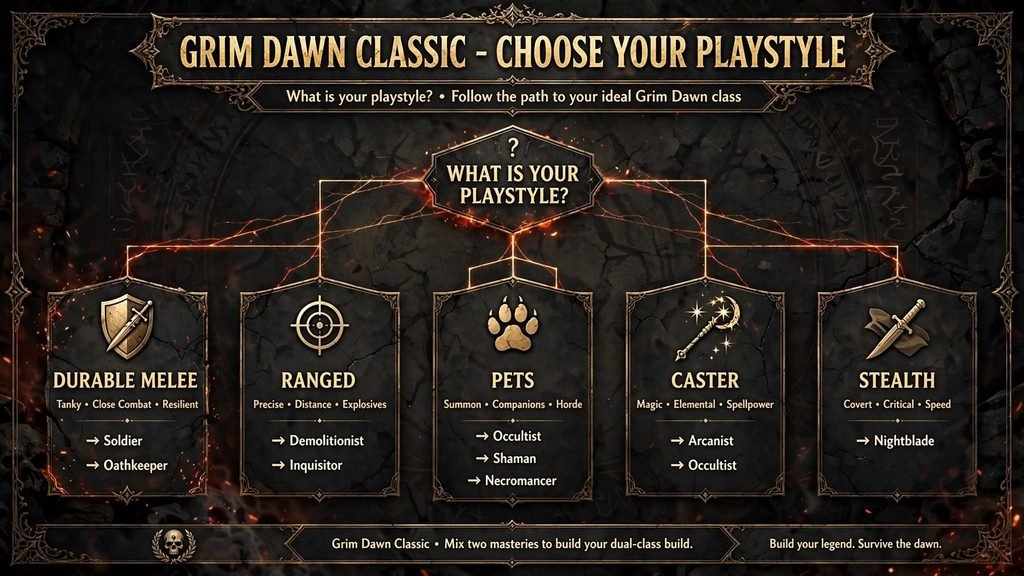
There’s no wrong first mastery, but some are easier to level and forgive early mistakes better than others. Rather than chasing a “strongest” pick, match a mastery to how you actually like to play:
- Prefer durable, up-close melee combat → Soldier or Oathkeeper. Both have strong built-in defenses, so you can learn the game’s mechanics without dying constantly while you figure out gear and resistances.
- Prefer firearms, grenades, or explosions → Demolitionist. High burst damage and area skills make early leveling fast, though it’s less tanky than Soldier on its own.
- Prefer having a pet or minions do a lot of the work → Necromancer or Shaman. Necromancer’s skeletons in particular can carry a lot of the early game while you’re still learning your own active skills.
- Prefer elemental or arcane spellcasting → Arcanist. Its defensive cooldowns (an invulnerability shield and a damage-absorbing bubble) make squishy caster gameplay much safer than it looks on paper.
- Prefer stealthy, fast, high-crit melee → Nightblade. Rewards active dodging and mobility over standing and tanking hits.
- Prefer curses, debuffs, and poison/chaos damage → Occultist. A flexible offense-first mastery that can go pet-light or pet-heavy depending on skill choices.
- Prefer precision ranged combat with some caster utility → Inquisitor. Requires Ashes of Malmouth.
- Prefer shapeshifting and switching between melee and ranged on the fly → Berserker. Requires Fangs of Asterkarn (and, to reach it, both prior expansions), and is the newest mastery, so expect less community build knowledge around it for now.
A practical, low-risk approach for a first character: pick your primary mastery based on the list above, and pair it with Soldier or Shaman as your second mastery. Both add survivability without requiring much extra gear, which buys you room to learn Grim Dawn’s devotion and resistance systems before committing to a more gear-dependent combination later.
Why “Best Class” Doesn’t Have One Answer
“What’s the best Grim Dawn class” is one of the most common searches around this topic, and it doesn’t have a single correct answer, for a few concrete reasons:
- Content type matters. A class combination that clears normal-difficulty content easily can still struggle in the Shattered Realm or Crucible without the right gear and devotions.
- Gear dependence varies enormously. Some combinations (particularly caster-heavy pairings using Arcanist) are strong once properly geared but noticeably weaker in early leveling gear.
- Expansion ownership changes the option pool. A comparison that ignores Inquisitor, Necromancer, Oathkeeper, or Berserker because the player doesn’t own those expansions isn’t wrong — it’s just answering a narrower question.
- Playstyle preference is not a balance question. A mechanically “stronger” combination that plays in a way you don’t enjoy is a worse pick for you than a slightly weaker one that does.
If you want current, ranked build recommendations rather than the mastery-level overview here, that’s a separate, faster-moving topic best covered in a dedicated build or tier-list guide, since those rankings shift with balance patches in a way the mastery system itself doesn’t.
FAQ
How many classes are in Grim Dawn? There are 10 masteries as of the Fangs of Asterkarn expansion, and 45 possible two-mastery combinations, which is what most players mean by “classes.”
What are the masteries in Grim Dawn? Soldier, Demolitionist, Occultist, Nightblade, Arcanist, Shaman, Inquisitor, Necromancer, Oathkeeper, and Berserker.
How does the dual-class system work? You choose your first mastery at level 2 and can add a second at level 10. The two masteries together form your “class,” while your build is the specific skills, devotions, and gear you choose within that class.
Can you choose only one mastery? Yes. A second mastery is optional, not required, though most endgame builds use two for access to more skills and devotion synergy.
What is the best Grim Dawn class? There isn’t a single best answer — it depends on your playstyle, expansion ownership, gear, and which content (leveling, Shattered Realm, Crucible) you’re playing.
Which Grim Dawn class is easiest for beginners? Soldier is generally considered the most forgiving mastery to start with because of its built-in survivability, and pairing it with Shaman or Demolitionist as a second mastery is a common beginner recommendation.
Which mastery is best for pet builds? Necromancer is the strongest dedicated pet mastery, with Shaman and Occultist offering lighter pet support alongside other playstyles.
Can you change your mastery after choosing it? No. You can respec skill points within a mastery you already have at a Spirit Guide, but you cannot remove or swap out a mastery itself once chosen.
Do Grim Dawn expansions add new classes? Yes. Ashes of Malmouth added Inquisitor and Necromancer, Forgotten Gods added Oathkeeper, and Fangs of Asterkarn added Berserker.
What is the difference between a mastery and a build? A mastery is one of the 10 skill trees. A build is the specific combination of skill points, devotions, gear, and damage type chosen within one or two masteries — two players in the same class combination can have very different builds.
Which class combinations are available in Grim Dawn? All 45 two-mastery pairings are valid; see the Class Combination Reference section above for the full list and their community names.
Source List
| Source | Page/Title | URL | What Was Verified | Date / Version Context |
|---|---|---|---|---|
| Official | Grim Dawn Guide – Masteries | grimdawn.com/guide/character/masteries | Core mastery/dual-class mechanic (level 2 / level 10) | Current as of Fangs of Asterkarn |
| Official | Grim Dawn Guide – Fangs of Asterkarn | grimdawn.com/guide/about/fangs-of-asterkarn | Berserker addition, 45 total combinations, release framing | Released July 23–24, 2026 |
| Community wiki | Fangs of Asterkarn — Grim Dawn Wiki (Fandom) | grimdawn.fandom.com/wiki/Fangs_of_Asterkarn | Expansion release date, features list, tenth mastery | Updated ~2 weeks prior to research |
| Community wiki | Masteries — Grim Dawn Wiki (Fandom) | grimdawn.fandom.com/wiki/Masteries | Which masteries require which expansion; total skill points | Updated ~2 weeks prior to research |
| Community wiki | Necromancer — Grim Dawn Wiki (Fandom) | grimdawn.fandom.com/wiki/Necromancer | Necromancer’s 8 official class-combination names | Updated ~2 weeks prior to research |
| Community wiki | Berserker (mastery) — Grim Dawn Wiki (Fandom) | grimdawn.fandom.com/wiki/Berserker_(mastery) | Berserker lore and shapeshifting identity | Updated shortly after Fangs of Asterkarn launch |
| Press/guide | Grim Dawn: Fangs of Asterkarn — Everything the Final Expansion Adds (Gamerfuzion) | gamerfuzion.com | Berserker damage themes, Onslaught mechanic, note that Berserker combo names were not yet standardized at launch | Published July 24, 2026 |
| Community discussion | “Guess the Oathkeeper Class Combo Names!” — Crate Entertainment Forums | forums.crateentertainment.com | Cross-check of the 8 Oathkeeper combination names against the official wiki | Thread from 2018, cross-verified against current wiki |
| Community guide | Grim Dawn Masteries archetypes — Steam Community Guide | steamcommunity.com | Community-suggested (unofficial) Berserker combination names | Long-running guide, periodically updated |
| Community forum | [Fangs of Asterkarn] Calcium Crew — Veilwalker build thread — Crate Entertainment Forums | forums.crateentertainment.com | Corroboration of “Veilwalker” as a Necromancer + Berserker community name | Posted ~1 month after Fangs of Asterkarn launch |
| Internal | GamesPuma — Grim Dawn Builds | gamespuma.com/grim-dawn-builds |

Written by Daniel Carter
Daniel Carter is a dedicated gaming writer who enjoys turning complex gaming topics into clear, useful, and engaging content. He covers game guides, tips, reviews, features, and the latest developments across the gaming world. His approach focuses on research, accuracy, and practical value, helping readers discover new games, improve their gameplay, and stay informed about the industry. For Daniel, great gaming content is not just about information—it is about making every article genuinely worth reading.