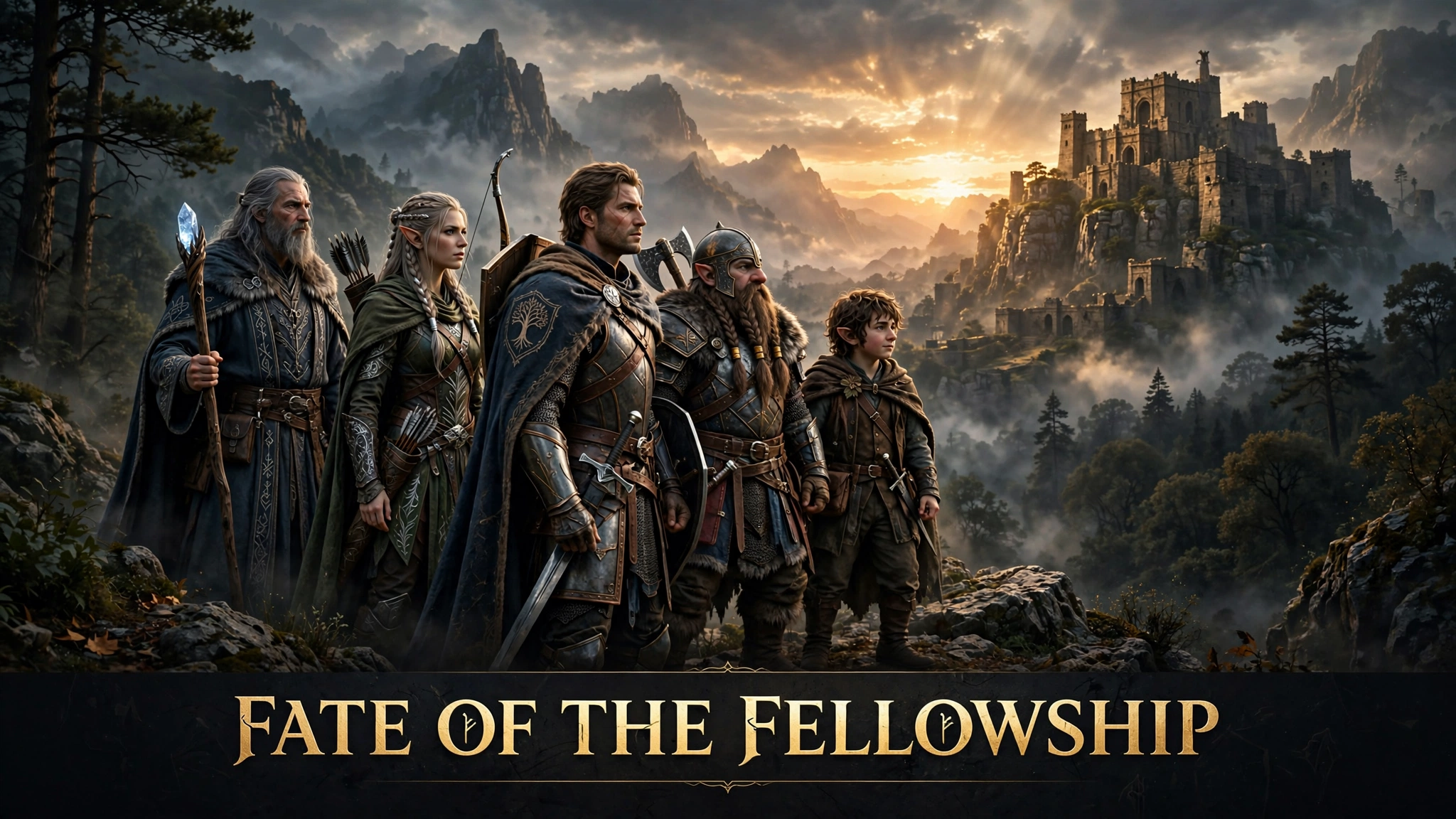
The Lord of the Rings: Fate of the Fellowship is a cooperative tabletop board game for one to five players, designed by Matt Leacock and published by Z-Man Games in 2025. Players work together as members of the Fellowship, guiding Frodo toward Mount Doom while defending Middle-earth’s havens from Sauron’s shadow armies. It’s built on Leacock’s Pandemic System but reworked so heavily that it plays like its own game rather than a reskin.
If you’re trying to figure out what this game actually is, how it plays, whether it’s difficult, or whether it’s worth buying, this guide answers all of that in order — with facts drawn from the official rulebook, BoardGameGeek, and verified reviews, clearly separated from opinion.
Table of Contents
Quick Facts
| Detail | Information |
| Game | The Lord of the Rings: Fate of the Fellowship |
| Designer | Matt Leacock |
| Publisher | Z-Man Games (Asmodee) |
| Released | June 2025 |
| Players | 1–5 |
| Recommended Age | 14+ |
| Play Time | 60–150 minutes |
| Type | Cooperative board game |
| System | Pandemic System (heavily modified) |
| Playable Characters | 13 character cards |
| Objectives | 24, drawn 3–5 per game depending on difficulty |
| Solo Mode | Yes, designed by Matt Leacock |
| BoardGameGeek Complexity | Roughly 3.1 out of 5 (medium-heavy) |
What Is The Lord of the Rings: Fate of the Fellowship?
It’s a cooperative board game, not a video game and not a card-only game. Everyone is on the same team, working against the game system itself rather than against each other. Each player controls two characters at once — one “primary” hero who gets four actions per turn and one “secondary” hero who gets one action — chosen from a roster of thirteen character cards drawn from across the trilogy.
The central goal is twofold. First, the group must complete several objective cards, each representing a storyline from the books — rallying Rohan, retaking Isengard, redeeming Boromir, and so on — with the exact mix changing every game. Second, once those objectives are cleared, Frodo and Sam (who are always in play, no matter who else is chosen) must reach Mount Doom and destroy the One Ring in a final, tense dice roll.
Standing in the way are shadow troops spreading across the map, nine Nazgûl hunting for Frodo, and the Eye of Sauron sweeping the land in search of the Ring-bearer. Every player turn is followed by the game revealing Shadow cards that move enemies, reinforce their numbers, or shift Sauron’s gaze — so the board gets more dangerous the longer the game runs. The party loses if a shared Hope track ever drops to zero; it wins by destroying the Ring while Hope still remains.
Read More: https://gamespuma.com/exit-the-lord-of-the-rings/
How Does Fate of the Fellowship Work?
At a high level, each round works like this: a player takes their two characters’ turns, the game punishes stalling by revealing Shadow cards, and the cycle repeats until the group either wins or Hope collapses. That loop — human turn, then automated “evil” turn — is inherited from Pandemic, but almost everything inside it has been redesigned around Middle-earth: dice-based combat and search checks, physical Nazgûl miniatures that hunt Frodo across the map, and a resource-icon system (Friendship, Valor, Stealth, Resistance) that replaces Pandemic’s simple card-matching.
How to Play Fate of the Fellowship
A turn breaks down into a few repeatable steps:
- Take actions with your primary character — up to four actions, chosen from moving, battling shadow troops, recruiting friendly troops, searching, using a character’s unique ability, or trading region cards for resource tokens.
- Take one action with your secondary character.
- Draw two player cards to refill your hand (hand limit is seven cards).
- Reveal Shadow cards — the number depends on the current threat rate. These cards move or add shadow troops, trigger battles along “battle lines” toward havens, and can shift the Eye of Sauron or the Nazgûl.
- Play passes to the next player, and the cycle repeats.
Moving Frodo and Sam is the game’s tensest routine: to move without attracting attention, they must spend a Stealth icon. Skip that cost, and the player must roll Search dice based on the number of enemy troops and Nazgûl nearby — a roll that can cost the party Hope. Other characters can help by drawing attention away, sharing cards, or granting stealth.
Characters and the Fellowship
There are 13 character cards, representing more heroes than that number suggests because two are permanently paired: Frodo & Sam (mandatory in every game) and Merry & Pippin (a linked pair). The remaining solo character cards include figures such as Gandalf, Aragorn, Legolas, Gimli, Boromir, Arwen, Faramir, Galadriel, Éomer, Éowyn, and Gollum. Each has a unique ability tied to their role in the books — for example, some characters excel at battling shadow troops, others at drawing the Eye away from Frodo, and others at helping the Fellowship move unseen.
Every player controls two of these character cards for the whole game, and characters begin in locations that match the story — Frodo and Sam start in the Shire, Arwen in Rivendell, Faramir in Minas Tirith, and so on.
Objectives and the One Ring
Instead of one fixed scenario, Fate of the Fellowship draws from a pool of 24 objective cards. A game typically uses “Destroy the One Ring” (the mandatory final objective) plus three to five other randomly or manually selected objectives, depending on difficulty. These secondary objectives cover story beats like liberating a region, mustering troops, or protecting specific havens, and each has its own completion requirements printed on the card.
Only after every other selected objective is completed can the party attempt the final objective: getting Frodo and Sam to Mount Doom with enough Resistance icons banked, then making one last Search roll. If that roll doesn’t drain the remaining Hope to zero, the Ring is destroyed and the group wins.
Frodo, Sam, and the Nazgûl
Frodo and Sam function differently from every other character. Their two key resource icons are Stealth (needed to move safely) and Resistance (needed for the endgame push into Mount Doom). Nine Nazgûl miniatures roam the board hunting for them; if the Eye of Sauron lands in Frodo’s own region, the party immediately loses Hope. Because of this, a large part of the game’s tension comes from balancing when to move Frodo quietly versus when to let other characters create diversions — battles elsewhere on the map pull the Eye’s attention away from him, buying time to sneak toward Mordor.
Shadow Troops, Sauron, and the Eye
The “villain” side of the game is represented by three interlocking systems: shadow troops spreading across the map toward havens, the Nazgûl hunting Frodo, and the Eye of Sauron scanning the land. After each player’s turn, Shadow cards are revealed based on the current threat rate; these cards can reinforce shadow troops, march them along colored battle lines toward friendly havens, or reposition the Eye and the Nazgûl. If shadow troops occupy a haven with no defenders present, it becomes a Shadow Stronghold and the party loses Hope — one of the game’s steadiest sources of pressure.
Game Setup
A full setup (based on the official rulebook) generally involves:
- Assembling the board and placing the Threat Rate marker and Hope marker on their starting positions.
- Setting aside two special Shadow cards (Sauron and Saruman) into the discard pile, then shuffling the rest into the Shadow deck.
- Placing starting friendly troops at their home regions (Elven, Dwarven, Rohirrim, and Gondor locations).
- Placing starting shadow troops at designated dark locations, then drawing nine Shadow cards to seed one additional shadow troop per revealed location.
- Selecting the “Destroy the One Ring” objective plus the appropriate number of additional objective cards for your chosen difficulty.
- Dealing two character cards to each player (Frodo & Sam always included) and giving each player their starting hand of region cards.
Setup takes most groups roughly fifteen to twenty minutes the first few times, dropping to under ten once you’re familiar with the board.
Actions and Core Mechanics
Key actions available on a turn include:
- Move — travel to an adjacent region, paying a Stealth icon if you’re Frodo/Sam and want to avoid a Search roll.
- Battle — roll Battle Dice against shadow troops in your region; also pulls the Eye of Sauron toward that location.
- Muster — recruit friendly troops at matching hub locations by spending a Friendship icon.
- Search — roll Search Dice, often tied to Frodo’s movement or the game’s final objective, with several outcomes costing Hope.
- Prepare — convert a region card into a resource token (Friendship, Valor, Stealth, or Resistance) for later use, useful once your hand nears its seven-card limit.
- Fellowship — trade region cards with another character sharing your location, functioning as a cooperative “sharing” action similar to Pandemic’s classic knowledge-transfer mechanic (this action is disabled in the solo variant).
- Capture — spend Valor to retake a Shadow Stronghold, restoring Hope in the process.
How to Win
The party wins when Frodo successfully destroys the One Ring at Mount Doom — but only after every other selected objective card has already been completed. The final attempt requires Frodo and Sam to be at Mount Doom with the required Resistance icons and to survive one last Search roll without Hope reaching zero.
How You Can Lose
The primary loss condition is the Hope track reaching zero. Hope can be lost in several ways: failed Search rolls, a haven falling to shadow troops and becoming a Shadow Stronghold, running out of shadow troops or player cards when the rules require adding one, and the Eye of Sauron landing directly on Frodo’s region. Multiple reviewers have flagged that Hope can drop unexpectedly fast for new groups, so managing it carefully from turn one — rather than treating it as a late-game concern — is important.
Solo Mode
Fate of the Fellowship includes an official one-player mode designed by Matt Leacock. In solo play, you control four character cards plus the mandatory Frodo & Sam pair, cycling through one character each turn using a solo token to track whose turn it is; the activated character takes four actions, and Frodo & Sam take one bonus action, just as in multiplayer. Because there’s only one hand of cards to manage across every character, the Fellowship card-sharing action is disabled in solo mode, and the seven-card hand limit applies per character rather than as a shared pool.
Player reception of the solo mode is mixed: some reviewers found it enjoyable, while others reported that a “two-handed” approach — playing solo but following the standard multiplayer rules with two players’ worth of characters — felt more flexible and less restrictive than the built-in solo variant. That’s a subjective take rather than an official rule, but it’s a genuinely useful tip for anyone trying solo play for the first time.
Difficulty and Replayability
Difficulty is adjusted primarily through the number of secondary objectives selected (commonly three, four, or five beyond the mandatory Ring objective) and which specific objectives you choose, since some are notably harder than others. Combined with 24 possible objectives, 13 character cards, and randomized shadow-troop setup, the game rarely plays out the same way twice — a point echoed across the reviews checked for this guide. That said, the amount of dice-based randomness (Search and Battle dice, plus the shuffled Shadow deck) means outcomes can swing heavily based on luck, which some reviewers see as tense and thematic and others see as frustrating.
Fate of the Fellowship Strategy Tips
These are practical, non-guaranteed suggestions based on how the mechanics function — not a promise of victory:
- Treat Hope as a resource to protect from turn one, not just something to worry about near the end.
- Use battles deliberately to pull the Eye of Sauron away from Frodo’s actual route before he needs to move.
- Don’t neglect the Prepare action — banking resource tokens prevents you from being stuck at the seven-card hand limit right when you need a specific icon.
- Assign at least one character early to muster and defend havens near the shadow troops’ starting battle lines, since losing a haven is one of the fastest ways to bleed Hope.
- Coordinate objective order: some objectives are easier to complete opportunistically while your characters are already nearby, rather than as a dedicated trip.
- Save a strong Resistance-icon push for Frodo’s final approach to Mount Doom rather than spending those tokens early.
Is Fate of the Fellowship Good for Lord of the Rings Fans?
For readers or film fans of the trilogy, the theming is one of the most consistently praised aspects across reviews — objectives, character abilities, and the map are built directly around specific book and film moments rather than generic fantasy tropes. That said, this is a genuine strategy board game with dice-based combat, resource management, and a fairly steep rules overhead; fans expecting a light, purely narrative experience may find the mechanical density more demanding than anticipated. Whether that trade-off is worth it is a matter of personal taste rather than an objective fact.
Fate of the Fellowship vs Pandemic
| Aspect | Fate of the Fellowship | Original Pandemic |
| Core system | Pandemic System (heavily modified) | Pandemic System (original) |
| Goal structure | Rotating objective cards plus a fixed final goal (destroy the Ring) | Cure four diseases |
| Combat | Dice-based battles against shadow troops | None |
| Enemy tracking | Nine Nazgûl miniatures actively hunt a specific character | No equivalent unit-hunting mechanic |
| Character control | Each player controls two characters at once | Each player controls one role |
| Randomness | Dice rolls plus card draws (higher variance) | Primarily card draws |
| Loss condition | Hope track reaches zero (several trigger sources) | Outbreaks/infection cubes run out, or player deck empties |
| Complexity | Medium-heavy (~3.1/5 on BGG) | Medium-light (~2.4/5 on BGG) |
In short, Fate of the Fellowship keeps Pandemic’s “cooperative race against an escalating board state” DNA but layers in combat, unit movement, and a much richer variable-objective structure, making it noticeably heavier and more tactical.
Fate of the Fellowship vs Other Lord of the Rings Board Games
To avoid confusion with similarly named products: The Lord of the Rings: The Card Game is a deck-building, scenario-based card game, not a board-and-miniatures game. Journeys in Middle-earth is an app-driven dungeon-crawl adventure game. War of the Ring is a large-scale asymmetric conflict game where one side plays as Sauron’s forces against the Free Peoples. Fate of the Fellowship is distinct from all three: it’s a fully cooperative Pandemic-System game where every player is on the same side against the game itself, with no app requirement and no player controlling the forces of evil.
Who Should Play It?
- Tolkien fans who enjoy strategy games will likely appreciate the thematic depth built into objectives and character abilities.
- Pandemic fans looking for a heavier, more tactical evolution of the system they already know.
- Cooperative board-game groups who enjoy tense, escalating-threat games with real stakes.
- Strategy gamers comfortable with dice-based combat and resource management.
- Solo players who want an official one-player mode, with the caveat that some find the built-in solo variant less satisfying than a two-handed approach.
- Groups wanting a casual, low-rules-overhead game night or younger players unfamiliar with cooperative strategy games may find the rules density and playtime (up to 150 minutes) more than they’re looking for.
FAQ
What exactly is The Lord of the Rings: Fate of the Fellowship?It’s a cooperative tabletop board game for 1–5 players, designed by Matt Leacock and published by Z-Man Games, in which players guide Frodo to destroy the One Ring while defending Middle-earth from Sauron’s forces.
Is Fate of the Fellowship a board game or a video game? It’s a physical tabletop board game. It also has an official digital implementation on Board Game Arena, but the core product is a board game.
How many players can play Fate of the Fellowship? One to five players. Each player controls two characters, so even a small group manages several heroes.
How long does a game of Fate of the Fellowship take? Roughly 60 to 150 minutes, depending on player count and experience level.
What is the goal of the game? Complete a set of randomly or manually selected objective cards, then get Frodo and Sam to Mount Doom to destroy the One Ring before the shared Hope track drops to zero.
How does Frodo work in Fate of the Fellowship? Frodo and Sam are mandatory in every game and function as a single, always-present character pair. They rely on Stealth to move unseen and Resistance to eventually attempt destroying the Ring.
Is Fate of the Fellowship cooperative? Yes. All players are on the same team, working together against the game’s automated shadow-troop, Nazgûl, and Eye of Sauron systems.
Does Fate of the Fellowship have a solo mode? Yes. It includes an official solo variant designed by Matt Leacock, in which one player controls Frodo & Sam plus four other characters, cycling through them turn by turn.
How many characters are available? Thirteen character cards, including the paired Frodo & Sam and Merry & Pippin, plus solo heroes such as Gandalf, Aragorn, Legolas, Gimli, Boromir, Arwen, Faramir, Galadriel, Éomer, Éowyn, and Gollum.
Is Fate of the Fellowship like Pandemic? It’s built on the same underlying Pandemic System, but adds dice-based combat, unit movement, Nazgûl that actively hunt a specific character, and a much larger pool of variable objectives — making it a noticeably heavier, more tactical game than the original Pandemic.
Is Fate of the Fellowship difficult? It’s rated as medium-heavy in complexity, and its Hope-loss mechanics can catch new groups off guard, leading to some surprisingly fast losses. Difficulty can be adjusted by choosing fewer or easier objective cards.
Is Fate of the Fellowship good for beginners? It’s approachable for players with some cooperative-game experience, but its rules density, dice-based mechanics, and multiple loss triggers make it more demanding than lighter cooperative games — first-time players should expect a learning game or two.
Is Fate of the Fellowship worth buying? That depends on personal taste. Reviewers consistently praise its theming, character variety, and replayability, while some note its heavier rules overhead and dice-driven randomness as drawbacks. It’s best suited to groups who already enjoy cooperative strategy games and want strong LOTR theming.
Verified Sources
- Z-Man Games official product page (zmangames.com) — game description, component list, designer/publisher credit.
- BoardGameGeek game entry (boardgamegeek.com/boardgame/436217) — player count, playtime, age, complexity weight, release year, ranking, community rules threads.
- Miniature Market and Board Game Bliss retailer listings — component list cross-check, age/playtime cross-check.
- Merchants of Play “How to Play” guide — setup sequence, action list, win-condition detail.
- The Esoteric Order of Gamers rules summary — turn structure (4+1 actions), objective-mixing explanation.
- Board Game Quest review — Search/Stealth mechanics, final Ring-destruction requirements, Nazgûl/Eye interaction.
- Wargamer review and preview articles — Nazgûl/Eye mechanics, objective count, Pandemic-lineage commentary.
- coopgestalt review — solo-mode mechanical walkthrough and its criticisms.
- GamingTrend review — objective selection by difficulty, solo-mode structure, recommended player count commentary.
- BoardGameGeek solo-mode rules thread — solo turn-order and action confirmation.
- The One Wiki to Rule Them All (LOTR Fandom) — release date (June 6, 2025) cross-check.
- There Will Be Games and Big Boss Battle reviews — balanced pros/cons and Pandemic-lineage analysis for editorial balance.

Written by Daniel Carter
Daniel Carter is a dedicated gaming writer who enjoys turning complex gaming topics into clear, useful, and engaging content. He covers game guides, tips, reviews, features, and the latest developments across the gaming world. His approach focuses on research, accuracy, and practical value, helping readers discover new games, improve their gameplay, and stay informed about the industry. For Daniel, great gaming content is not just about information—it is about making every article genuinely worth reading.
1 thought on “The Lord of the Rings: Fate of the Fellowship – Complete Guide”