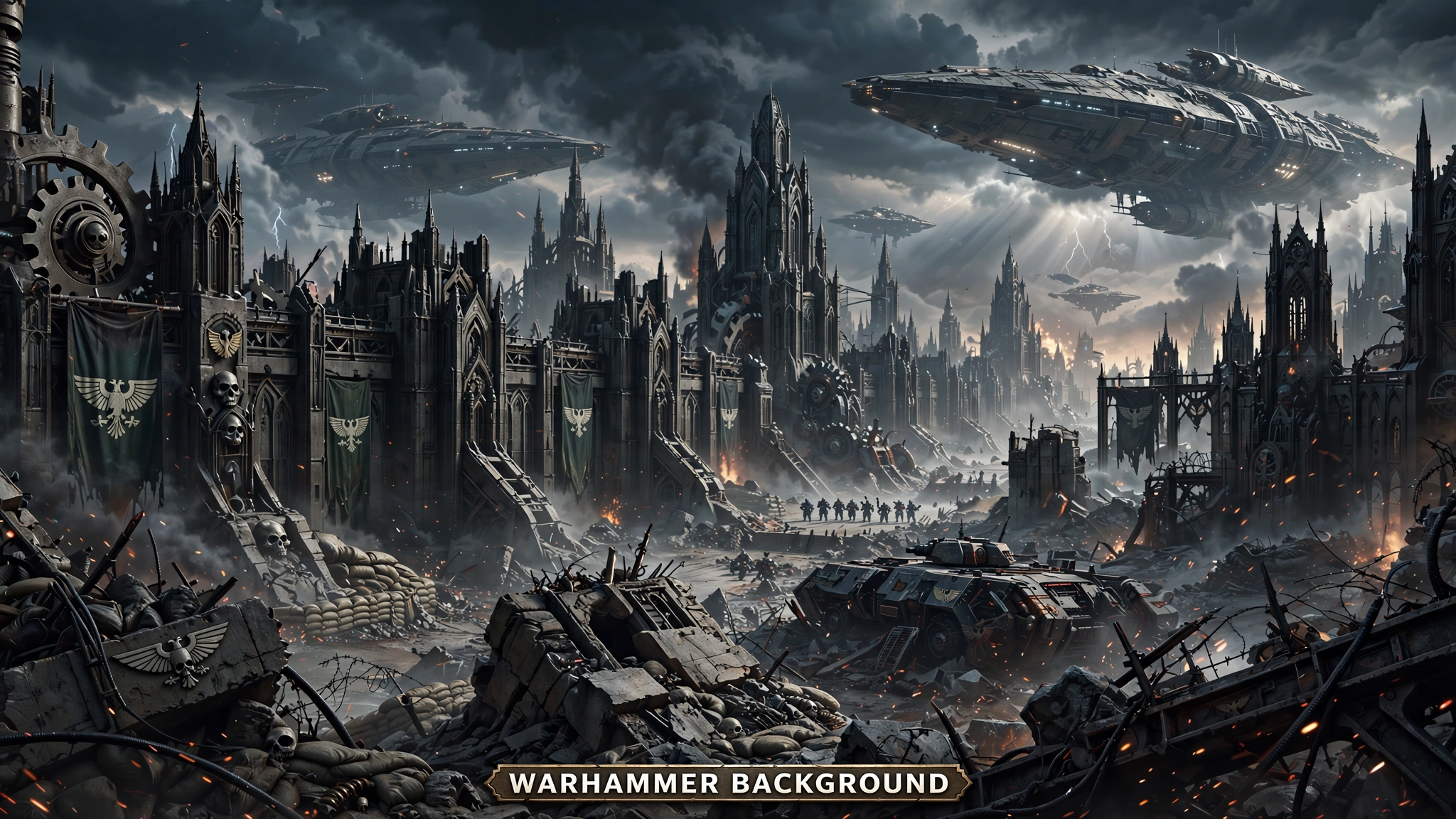
If you’ve searched for “warhammer background,” you’ve probably landed in the middle of a franchise with three major fictional universes, each with its own history, gods, and armies. In short: Warhammer isn’t one story — it’s an umbrella brand from Games Workshop covering Warhammer 40,000 (grimdark science fiction set in the far future), Warhammer Age of Sigmar (mythic fantasy set across the Mortal Realms), and Warhammer: The Old World (classic dark fantasy set in the original Warhammer World). “Background” is simply the term long-time fans and Games Workshop itself use for a setting’s fictional history and lore.
This guide breaks down what each universe is about, how they relate to one another, and where a beginner should actually start — without merging timelines that don’t belong together.
Table of Contents
What Is Warhammer?
Warhammer began in 1983 as a tabletop miniature wargame from Games Workshop, a British company that designs rules, sculpts miniatures, and publishes fiction. Over four decades, that single game grew into a family of settings, novels, video games, and hobby products, which is why “Warhammer” today refers to a brand rather than one continuous story.
Fans use the word background to mean the fictional history behind a setting: its wars, gods, timelines, and factions. You’ll see it used almost interchangeably with “lore.” Games Workshop builds this background through several channels that all feed into each other:
- Core rulebooks and battletomes/codexes – rulebooks for each faction that include narrative sections
- Black Library novels and short stories – Games Workshop’s fiction imprint
- Warhammer Community articles – official news, previews, and lore explainers
- Video games and animated media – often adapted or simplified versions of the tabletop lore
Because multiple teams and writers contribute across decades, some details evolve, get retconned, or are told from an unreliable in-universe perspective. That’s normal for a long-running franchise, and it’s one reason a clear beginner’s map is genuinely useful.
Read More: https://gamespuma.com/warhammer-40k-art/
Read More: https://gamespuma.com/tabletop-miniature-wargames/
The Main Warhammer Universes
These settings are not one continuous timeline. Treat them as separate universes that happen to share a publisher, some thematic DNA, and — in the case of Age of Sigmar and the original Warhammer Fantasy — a shared origin point before their paths diverged.
| Warhammer 40,000 | Warhammer Age of Sigmar | Warhammer: The Old World | |
| Genre | Grimdark science fiction | Mythic/heroic fantasy | Classic dark fantasy |
| Setting | The far-future galaxy, 41st–42nd Millennium | The Mortal Realms (eight realms of magic) | The Old World, a pre-Age of Sigmar fantasy world |
| Central conflict | Humanity’s Imperium vs. Chaos, aliens (xenos), and internal decay | Order, Chaos, Death, and Destruction battling for the realms | Human nations, greenskins, undead, and other factions warring across a classic fantasy continent |
| Tone | Bleak, oppressive, “there is only war” | Epic, mythic, high fantasy with cosmic stakes | Grounded dark fantasy, closer to traditional sword-and-sorcery |
| Best starting point | A Space Marines vs. Orks or Space Marines vs. Chaos codex/box | The current edition’s launch box and Core Book | An Old World army box and rulebook |
Warhammer 40,000 and Age of Sigmar are Games Workshop’s two current flagship tabletop games. The Old World is a separate, more niche current game that revisits the pre-Age of Sigmar fantasy setting for players who want that classic dark-fantasy tone.
Warhammer Background
Warhammer 40,000 is set roughly 38,000–40,000 years in the future, in a galaxy consumed by near-constant war — hence the franchise’s “grimdark” reputation and its famous tagline that in the far future, “there is only war.”
The Imperium of Man is the sprawling, authoritarian human empire at the story’s center, ruled in name by the Emperor of Mankind, an immortal psychic being who founded the Imperium millennia ago and now exists in a state between life and death, sustained on the Golden Throne. The Imperium survives through brutal discipline, blind faith, and constant warfare rather than genuine stability.
Key elements of the setting include:
- Space Marines – genetically enhanced super-soldiers organized into Chapters, created to defend humanity
- Chaos – corrupting entities and their followers who originate from the Warp, a parallel dimension of raw psychic energy that also enables faster-than-light travel
- Xenos factions – non-human species such as the Aeldari, Orks, Necrons, Tyranids, and T’au, each with wildly different goals and cultures
- The Horus Heresy – a galaxy-spanning civil war roughly 10,000 years before the current setting, in which the Emperor’s own son and favored commander, Horus, was corrupted by Chaos and led half of the Emperor’s Space Marine Legions in rebellion. This war is treated as the foundational historical trauma of the entire 40K setting.
Warhammer 40,000 is an ongoing, actively updated setting — Games Workshop periodically releases new editions of the core rules alongside new narrative developments, so the “current state” of the galaxy continues to move forward rather than staying frozen in one era.
Warhammer Age of Sigmar Background
Age of Sigmar is set in the Mortal Realms, eight interconnected dimensions of magic, each tied to a different force of existence (fire, life, death, light, and so on). This setting effectively succeeded the original Warhammer Fantasy Battles game and grew out of a cataclysmic event that destroyed the old fantasy world (covered below).
The broad narrative arc of the setting is usually described across several ages:
- The Age of Myth – an early golden age when the god Sigmar and his allies helped civilizations flourish across the realms
- The Age of Chaos – Chaos invaded and overran much of the realms, and Sigmar withdrew to regroup
- The Age of Sigmar – Sigmar’s counterattack, built around the Stormcast Eternals, warriors resurrected and empowered on Sigmar’s Anvil of Apotheosis to reclaim the realms
The setting is organized around four Grand Alliances — Order, Chaos, Death, and Destruction — broad banners under which its many factions fight for control of the realms. This isn’t a simple good-versus-evil split; each Grand Alliance contains factions with their own agendas, and alliances between them shift depending on the current narrative campaign. As of the current edition, the setting’s story continues to move forward with new campaigns and factions, so specific plot details are best checked against the latest Warhammer Community coverage rather than treated as fixed.
Warhammer Fantasy and The Old World Background
Before Age of Sigmar existed, Games Workshop’s fantasy line was simply called Warhammer Fantasy Battles, set in the Old World — a continent-spanning dark fantasy setting with nations modeled loosely on real-world cultures (the Empire, Bretonnia, Kislev, and others), alongside Dwarfs, Elves, Orcs and Goblins, Skaven, and the undead.
This original setting came to a dramatic close through a story arc known as the End Times, a series of releases in which the Old World was largely destroyed by the forces of Chaos. This event marked the transition point between the old fantasy setting and the launch of Age of Sigmar.
Years later, Games Workshop launched Warhammer: The Old World as a separate current tabletop game. It’s important to distinguish two things here:
- Warhammer Fantasy Battles — the discontinued historical game and its “classic” background, largely set before the End Times
- Warhammer: The Old World — the current tabletop game that revisits that pre-Age of Sigmar setting and continues to receive rulebook and army support
The Old World game draws on the classic setting’s atmosphere and factions, but it should be treated as its own current product rather than assumed to carry every detail of the old Fantasy Battles continuity forward automatically.
Important Warhammer Factions
A few of the most recognizable factions, organized by setting:
Warhammer 40,000
- Imperium of Man – the vast, faith-driven human empire trying to hold the galaxy together through military force and religious fervor
- Space Marines – elite genetically-modified soldiers organized into independent Chapters loyal to the Imperium
- Chaos – corrupted humans, daemons, and renegade Space Marines serving dark powers born from the Warp
- Aeldari – an ancient, dying alien civilization of psychic warriors and seers
- Orks – a boisterous, war-loving alien species that thrives on conflict
- Tyranids – a hive-mind alien species that consumes entire worlds for biological resources
Warhammer Age of Sigmar
- Stormcast Eternals – Sigmar’s resurrected champions, the flagship faction of Order
- Cities of Sigmar – human (and allied) settlements and militias defending mortal civilization in the realms
- Skaven – a scheming, technologically inventive rat-like species pursuing its own agendas, often against everyone
- Additional factions represent the Chaos, Death, and Destruction Grand Alliances, each with several sub-factions of their own
Warhammer: The Old World
- Human kingdoms such as the Empire and Bretonnia
- Dwarfs, Orcs and Goblins, High Elves, Dark Elves, and undead factions such as the Tomb Kings and Vampire Counts
None of these factions are simply “good” or “evil” — Warhammer’s settings are built on competing perspectives, internal politics, and morally complicated motivations, even within factions nominally on the “same side.”
A Simple Warhammer Timeline
Because these are separate continuities, here’s a simplified timeline for each, using broad eras rather than exact in-universe dates (which vary by source and aren’t always precisely fixed).
Warhammer Fantasy / The Old World
- Founding of the Old World’s nations and long-running wars between humans, Orcs, Elves, Dwarfs, and the undead
- Centuries of escalating Chaos incursions from the northern Chaos Wastes
- The End Times – Chaos overwhelms and largely destroys the Old World, ending the classic setting
- Warhammer: The Old World (current game) revisits this pre-End Times setting for tabletop play
Warhammer Age of Sigmar
- Age of Myth – Sigmar and allied civilizations flourish across the newly-formed Mortal Realms
- Age of Chaos – Chaos conquers much of the realms; Sigmar withdraws
- Age of Sigmar – Sigmar’s Stormcast Eternals launch the reconquest of the realms; the story continues through ongoing campaigns in the current edition
Warhammer 40,000
- Humanity’s early interstellar expansion under the Emperor of Mankind
- The Horus Heresy – civil war as Horus and corrupted Space Marine Legions rebel against the Emperor
- Roughly ten millennia of Imperial consolidation, decline, and constant war that make up the “current” 41st–42nd Millennium setting
- Ongoing narrative developments tracked through each new tabletop edition
Is Warhammer 40K Connected to Age of Sigmar?
No — not directly. They are separate fictional universes with different cosmologies, different timelines, and different core games. Fans compare them because they share a publisher, some naming conventions, and a similar tone of large-scale, faction-driven conflict, but 40K’s galaxy and the Mortal Realms of Age of Sigmar are not depicted as being the same continuity.
Where the connection does exist is historical: Age of Sigmar is the successor to the original Warhammer Fantasy Battles setting, which was destroyed in the End Times. Warhammer 40,000, by contrast, has always been its own separate science-fiction universe since its creation, unconnected to either fantasy setting’s continuity. Unless Games Workshop makes an explicit official statement linking specific events across settings, it’s safest to treat 40K, Age of Sigmar, and The Old World as three distinct universes.
Where Should Beginners Start With Warhammer Lore?
There’s no single “correct” entry point — it depends on which flavor of Warhammer appeals to you:
- Prefer sci-fi and dystopian warfare? Start with Warhammer 40,000 — a current codex or the current edition’s Core Book, plus a beginner-friendly novel, will get you oriented fast.
- Prefer mythic, high-fantasy stakes? Start with Warhammer Age of Sigmar — the current edition’s launch box and Core Book are built specifically to introduce new players.
- Prefer classic, grounded dark fantasy? Start with Warhammer: The Old World — an army box plus the core rulebook covers both rules and setting.
- Already like a specific faction from games or art? Look up that faction’s current codex or battletome — Games Workshop writes these to work as standalone introductions.
- Not ready to buy anything yet? Official Warhammer Community lore articles and faction pages are free and regularly updated.
Since product lines and starter sets change with each new edition, always check the current status of a specific starter set or box before assuming it’s still available.
Best Ways to Learn Warhammer Background
- Official Warhammer Community articles – free, current, and written directly by Games Workshop
- Core rulebooks, codexes, and battletomes – contain dedicated lore sections alongside game rules
- Black Library novels – full-length fiction that dives much deeper into specific characters, factions, and eras than any rulebook can
- Faction-focused guides – useful once you’ve picked an army or character you’re drawn to
- Video games – a fun, low-commitment introduction, though adaptations often simplify or adjust lore details to fit gameplay, so treat them as a taste, not the full picture
- Community discussions and wikis – helpful for quick reference, but verify major claims against official sources, since community summaries sometimes blend outdated or non-canon material with current lore
Common Questions About Warhammer Background
What is Warhammer background? It’s the fan and official term for the fictional history and setting lore behind a Warhammer universe — its wars, gods, timelines, and factions — as opposed to the tabletop rules themselves.
What is the difference between Warhammer 40K and Age of Sigmar? Warhammer 40,000 is grimdark science fiction set in a far-future galaxy; Age of Sigmar is mythic fantasy set in the Mortal Realms. They are separate universes with different tones, timelines, and games.
Is Warhammer 40K set in the future? Yes. It’s set roughly in the 41st–42nd Millennium, tens of thousands of years from now.
What happened to Warhammer Fantasy? The original Warhammer Fantasy Battles setting ended with the End Times storyline, which led into the launch of Warhammer Age of Sigmar as its successor game.
Is The Old World the same as Warhammer Fantasy? Warhammer: The Old World is a current tabletop game set in the pre-Age of Sigmar fantasy world. It revisits that classic setting, but it’s a distinct current product rather than a straight continuation of the discontinued Warhammer Fantasy Battles game.
Which Warhammer universe should beginners start with? Whichever tone appeals most: 40K for sci-fi grimdark, Age of Sigmar for mythic fantasy, or The Old World for classic dark fantasy. There’s no requirement to know one setting before starting another.
Is Warhammer lore difficult to understand? It can feel overwhelming because of its scale and decades of material, but each setting can be understood on its own without needing to learn the others first.
Are Warhammer games connected to the tabletop lore? Many video games are set within the tabletop universes and draw on the same background, though they sometimes simplify or adjust details for gameplay purposes.
What is the Horus Heresy? A galaxy-spanning civil war in the Warhammer 40,000 background, in which the Emperor of Mankind’s son and favored commander, Horus, was corrupted by Chaos and led a rebellion against the Imperium. It’s treated as the foundational historical trauma of the entire 40K setting.
What are the Mortal Realms? Eight interconnected magical dimensions that make up the setting of Warhammer Age of Sigmar, each tied to a different force of existence.
Is Warhammer background still expanding? Yes. All three current settings (40K, Age of Sigmar, and The Old World) continue to receive new narrative material through rulebooks, novels, and Warhammer Community articles as new editions and campaigns are released.

Written by Daniel Carter
Daniel Carter is a dedicated gaming writer who enjoys turning complex gaming topics into clear, useful, and engaging content. He covers game guides, tips, reviews, features, and the latest developments across the gaming world. His approach focuses on research, accuracy, and practical value, helping readers discover new games, improve their gameplay, and stay informed about the industry. For Daniel, great gaming content is not just about information—it is about making every article genuinely worth reading.
2 thoughts on “Warhammer Background Explained: A Beginner’s Guide to the Lore”