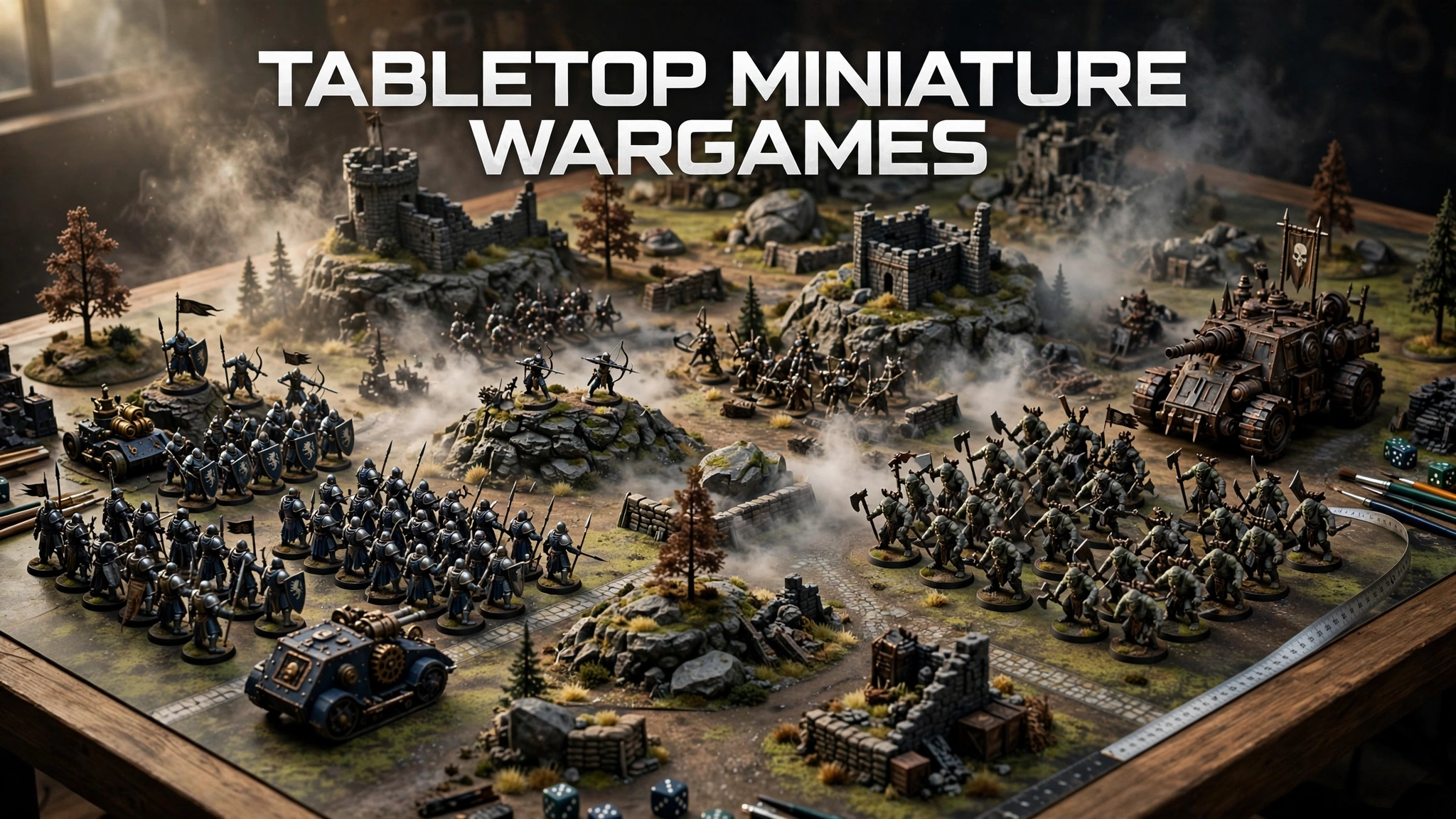
Small painted armies clashing across a tabletop battlefield look intimidating from the outside — a wall of jargon, dozens of tiny models, and rulebooks that seem written for people who already know the game. But underneath that surface, tabletop miniature wargaming is a hobby built from a few simple, learnable pieces: models, a battlefield, dice, and a set of rules that turns your decisions into outcomes.
This guide explains what the hobby actually is, how a typical game plays out, what separates the major types of miniature wargames on the market today, what it actually costs to start, and how to pick a first game that fits your budget, your space, and the players near you.
Table of Contents
Quick Answer
Tabletop miniature wargames are strategy games where players move small models across a tabletop battlefield filled with terrain, using dice and rulebooks to resolve movement, combat, and objectives. A beginner typically needs a small set of miniatures, a copy of the rules, dice, a measuring tool, and a table with some terrain to fight over. Games range from small skirmish formats with a handful of models to large army-scale battles with dozens or hundreds, and settings span science fiction, fantasy, and real historical conflicts — so the “best” first game depends heavily on your budget, the type of setting you enjoy, and whether other players near you already play a particular system.
What Are Tabletop Miniature Wargames?
A tabletop miniature wargame is a strategy game played on a physical surface using small models — called miniatures — that represent soldiers, creatures, vehicles, or other combatants. Players position these models on a battlefield, usually decorated with terrain pieces such as buildings, hills, ruins, or forests, and take turns moving models, attacking, and completing objectives according to a rulebook.
It’s worth distinguishing the hobby from a few things it’s often confused with:
- Traditional board games use a fixed board and standardized pieces; miniature wargames use an open table where players build their own battlefield layout with terrain, and movement is measured freely rather than restricted to marked squares or spaces.
- Tabletop role-playing games (like Dungeons & Dragons) focus on individual character stories and improvisation guided by a game master; miniature wargames are typically head-to-head strategy contests between two or more players with no game master.
- Historical reenactment involves people physically acting out historical events or combat; miniature wargaming simulates battles abstractly using models and dice rather than live action.
- Collectible card games center on building a deck of cards; miniature wargames center on physical models and a shared battlefield, though some games use cards for special abilities.
- Digital strategy games run the simulation on a screen; miniature wargames require in-person physical setup, models, and manual dice rolling (though some games offer companion apps for army building or rules lookup).
None of these hobbies is “better” than another — many hobbyists enjoy several at once. Miniature wargaming’s specific appeal comes from combining strategic decision-making with a physical collecting and painting hobby and a social, in-person format.
How Do Miniature Wargames Work?
Exact rules differ significantly between games, but most tabletop miniature wargames follow a broadly similar sequence:
- Choose forces. Each player selects which miniatures they’ll use, sometimes from a fixed starter roster and sometimes by building a custom list within a point or model limit.
- Prepare the battlefield. Players set up terrain on the table and agree on a scenario or objective.
- Deploy models. Each side places their models in a starting area, usually on opposite sides of the table.
- Take turns or activate units. Depending on the game, players either alternate full turns or activate individual units one at a time.
- Move and measure distances. Models move across the table using a ruler or measuring tape, since most games have no fixed grid.
- Resolve attacks using rules and dice. Ranged and melee attacks are typically resolved by rolling dice, modified by a model’s stats and any special rules, to determine hits, wounds, and saves.
- Complete objectives. Many modern miniature wargames are won by holding map objectives or completing scenario-specific goals, not simply by destroying the enemy.
- Calculate the winner. At the end of the game (usually after a set number of turns), points are tallied to determine the winner.
Some games add extra layers — morale checks when units take heavy losses, command abilities that let a leader boost nearby units, or special terrain effects that block sightlines. The key point for beginners: every game has its own specific version of this sequence, so learning one system doesn’t mean you already know another, even if the overall flow feels familiar.
Main Types of Tabletop Miniature Wargames
| Type | Typical Setting | Model Count | Game Length | Common Appeal | Example Systems |
| Skirmish | Any | ~5–20 models | 45–90 minutes | Fast to learn, cheaper to start, character-driven | Kill Team, Necromunda, Malifaux |
| Army-scale | Any | 20–100+ models | 90 minutes–3+ hours | Deep list-building, large-scale tactics | Warhammer 40,000, Age of Sigmar, Kings of War, Bolt Action |
| Sci-fi | Futuristic/space | Varies by game | Varies | Advanced weapons, aliens, big lore universes | Warhammer 40,000, Kill Team, Infinity |
| Fantasy | Magic/mythical | Varies by game | Varies | Monsters, magic, medieval-style combat | Age of Sigmar, Kings of War |
| Historical | Real-world conflict | Varies by game | Varies | Grounded, research-driven army building | Bolt Action |
| Mecha/vehicle-scale | Sci-fi | Small unit counts | Slower, tactical | Deep per-unit tactical decisions | BattleTech |
| Narrative/campaign | Any | Varies | Ongoing, session to session | Persistent characters, evolving storylines | Necromunda, Malifaux |
| Competitive/tournament | Any | Varies, often fixed point limits | Fixed rounds | Balanced matched play, ranked events | 40k and Age of Sigmar matched play, Bolt Action events |
Current Examples of Popular Miniature Wargames
The table below reflects verified information as of September 2026. Editions and starter products change regularly — always confirm current details on the publisher’s official site before buying.
| Game | Setting | Scale | Current Edition | Good For | Consider Before Buying |
| Warhammer 40,000 | Sci-fi | Army-scale | 11th Edition (June 2026) | Players who want deep lore, big model collections, and a large competitive/organized-play scene | Highest long-term cost of the games listed here; large learning curve for full matched play |
| Kill Team | Sci-fi (40k universe) | Skirmish (~10–14 models) | New edition/Starter Set (2026) | Players who want the 40k aesthetic without committing to a full army | Uses different rules from full 40k — models aren’t interchangeable between the two games in play terms |
| Warhammer Age of Sigmar | Fantasy | Army-scale (Spearhead is smaller) | 4th Edition (2024) | Fantasy fans; free core rules and free army rules reduce cost of trying the game | Full matched-play armies still require a meaningful model and paint investment |
| Necromunda | Sci-fi gang warfare | Skirmish | New edition (August 2026) | Players who want ongoing campaign play with characters that grow over time | Newer edition means less third-party content is written for it yet |
| Bolt Action | Historical (WWII) | Army-scale (smaller than 40k) | 3rd Edition | History-minded players who prefer real-world equipment and tactics | Requires comfort with historical subject matter as the game’s core theme |
| Star Wars: Legion | Sci-fi (licensed) | Army-scale | Actively supported (2025–2026 refresh) | Existing Star Wars fans | Some older units have been discontinued/retooled — check current availability |
| Malifaux | Fantasy/horror | Skirmish (crew-based) | 4th Edition (2025) | Players who want shorter games (roughly two hours) and strong character narratives | Smaller model count means each individual miniature’s rules matter more, adding some complexity |
| BattleTech | Sci-fi (mecha combat) | Small unit counts | New Core Rulebook, Starter/Core Boxes (2026) | Players who enjoy slower, highly tactical vehicle-vs-vehicle combat | Different pace and feel from infantry-focused skirmish/army games |
| Kings of War | Fantasy | Army-scale (unit trays) | 4th Edition (2024) | Players who want army-scale fantasy battles without the cost of individually basing every model | Smaller official community than Age of Sigmar in many regions |
| Infinity | Sci-fi | Skirmish (CodeOne is a simplified subset) | Active; CodeOne covers limited factions | Players who want a detailed, reaction-based turn system in a smaller model count | Full Infinity has a steep rules learning curve; CodeOne currently supports fewer factions |
No game on this list is objectively “the best” — the right system depends on your budget, preferred setting, available time, and (importantly) who else near you already plays it.
Skirmish Games vs. Large Army Games
This is often the single most useful decision a beginner can make before buying anything.
| Factor | Skirmish Games | Army-Scale Games |
| Model count | Roughly 5–20 models | Often 20–100+ models |
| Starting cost | Generally lower | Generally higher |
| Setup time | Faster | Slower |
| Painting workload | Smaller — each model can get more attention | Larger — painting an entire army takes much longer |
| Rules complexity | Often simpler, since fewer models interact at once | Can involve more list-building and unit interactions |
| Table space needed | Smaller playing area | Often a full-size table |
| Game length | Usually shorter | Usually longer |
| Customization | Deep customization per individual model | Deep customization at the army-composition level |
| Campaign potential | Very common — characters often persist and grow between games | Present in some games, but less central to the format |
If you have limited time, limited space, or want to see a finished, fully painted force sooner, a skirmish game is usually the easier entry point. If you’re drawn to large-scale tactics, big battlefields, and building out an army over months or years, an army-scale game may suit you better from the start.
What Do You Need to Start?
Essential:
- Miniatures (enough for the smallest legal force in your chosen game)
- The rules (physical rulebook, free PDF, or starter-set booklet, depending on the game)
- Dice
- A measuring tool (ruler or tape, in the unit the game uses)
- A playing surface (a table is enough to begin with)
- Basic terrain or scenery (even simple boxes or books can substitute early on)
Optional (useful, but not required for your very first game):
- Paints and brushes
- Plastic glue or super glue (needed for some multi-part kits; many newer kits are “push-fit” and need no glue at all)
- Clippers, for removing models from their plastic sprues
- Primer, to prepare a model’s surface for paint
- A storage case or foam tray
- A dedicated transport case
- Tokens or objective markers (many starter sets include cardboard versions)
- More advanced or scenic terrain
Many starter sets bundle several of these items together — dice, a ruler, some terrain, and the core rules — while others sell them separately. Always check a specific starter set’s contents before assuming what’s included.
How Much Does Miniature Wargaming Cost?
Cost varies by publisher, country, currency, and how much of a starter kit you buy versus building a collection piece by piece. Rather than quoting one universal number, it helps to think in categories:
- Initial purchase: the starter set or first small force. As one verified example, Games Workshop’s smaller Warhammer 40,000 Starter Set has retailed around $110 USD, while its larger 11th Edition launch box (Armageddon) retails at $295 USD — showing how much a single game line’s entry price can range depending on which product you choose.
- Assembly supplies: glue and clippers, if your chosen kit needs them.
- Painting supplies: paints, brushes, and primer, if you choose to paint.
- Terrain: ranges from free (cardboard, books, household objects) to a significant ongoing cost if you buy dedicated scenery kits.
- Additional army/collection growth: buying more models beyond your starter set.
- Rulebooks or supplements: some games offer free digital core rules; others require a purchased rulebook or army-specific book.
- Storage and transport: cases and foam trays become relevant once a collection grows.
- Event or tournament costs: entry fees, if you choose to attend organized play — optional for casual hobbyists.
Ways to start more affordably:
- Choose a skirmish game over an army-scale game
- Buy a two-player starter box instead of building an army from individual kits
- Use improvised terrain at first
- Borrow tools before buying your own
- Look for secondhand miniatures through reputable community marketplaces
- Attend a demo game at a local store before spending anything
- Resist buying a full army before you’ve tried the core rules with a small force
- Paint only what you need for your next game, not your entire collection at once
Because prices change with product cycles and vary by region, always check the publisher’s current listing or a trusted local retailer before budgeting a specific amount.
Do You Have to Paint the Miniatures?
No — painting is not universally required to play. Here’s a direct breakdown:
- Many casual groups happily play with unpainted or partially painted models.
- Some hobbyists enjoy collecting and painting far more than playing games, and never take their models to a table.
- Some players use paint mainly to make it easier to tell units apart during a game, rather than for display-quality results.
- A simple beginner paint job (a base color and a wash or two) is enough for most casual games and doesn’t require advanced technique.
- If you plan to attend organized events or tournaments, check that specific event’s rules — painting requirements vary from event to event and are not identical across the hobby, so don’t assume one tournament’s rule applies everywhere.
In short: painting is a valuable, optional part of the hobby, not a barrier to your first game.
How to Choose Your First Miniature Wargame
Work through these factors in roughly this order:
- Local player availability. A fantastic game with no one to play against locally is a harder start than a good-enough game that several people near you already play. Check local game stores and community groups first.
- Preferred setting. Sci-fi, fantasy, historical, or licensed — pick a theme you’ll want to look at for months.
- Budget. Decide roughly what you’re willing to spend before browsing, and let that guide you toward skirmish or army-scale.
- Available space and time. Skirmish games suit smaller tables and shorter sessions; army-scale games generally need more of both.
- Rules complexity you’re comfortable with. Some systems are designed to be simple from the first box; others have a steeper learning curve.
- Painting interest. If you want to paint extensively, a smaller skirmish force lets you finish faster; if painting isn’t a priority, that’s fine too.
- Competitive vs. narrative preference. Do you want balanced, matched-points play, or persistent campaigns and storytelling?
- Solo or cooperative needs, if relevant. A small number of games officially support solo or cooperative play — check the publisher’s own materials rather than assuming this is available.
- Availability of a genuine starter product. Games with a well-designed two-player starter set are generally easier and cheaper to try than games you’d need to piece together from individual kits.
- Publisher support. Active publishers regularly release new rules, models, and community content; less-supported games can be harder to learn and find current information for.
The best first game is often, quite simply, the one someone near you can teach you and play against — rules quality and model count matter less than having a genuine opponent starting out.
Common Beginner Mistakes
- Buying a large army before trying the core rules with a small force
- Choosing a game purely because it’s the most popular, without checking whether it fits your budget or space
- Ignoring whether other players are actually available nearby
- Buying more paints and tools than a first project needs
- Trying to memorize an entire rulebook before playing a single game
- Spending heavily on terrain before playing a single match
- Comparing only the sticker price of starter boxes without checking what’s actually included
- Buying miniatures without confirming they’re compatible with your intended ruleset
- Following advice written for an older, now-superseded edition
- Expecting fluency after one game — most players need several games to get comfortable
How to Find Other Players
- Local game stores — many host regular game nights, demo days, or beginner leagues
- Hobby clubs — independent of retail stores, often meeting at community centers or online-organized venues
- Organized play programs — publisher-run events designed to connect players
- Beginner nights or demo events — low-pressure sessions aimed specifically at new players
- Online communities — forums, Discord servers, and social groups dedicated to a specific game
- Friends and family — often the easiest first opponent, even with borrowed or shared models
- Solo or cooperative modes, where officially supported by the specific game — check the publisher’s own materials rather than assuming a game has this option
Availability of stores, clubs, and events varies a great deal by city and country, so treat this as a starting checklist to investigate locally rather than an assumption that a scene definitely exists near you.
FAQ
What are tabletop miniature wargames? They’re strategy games where players move small models across a tabletop battlefield, using dice and rules to resolve movement, combat, and objectives, usually while also collecting and optionally painting the miniatures.
Is Warhammer a tabletop miniature wargame? Yes. Warhammer 40,000 and Warhammer Age of Sigmar, both published by Games Workshop, are two of the most widely played tabletop miniature wargames, but they are not the only ones — the hobby includes many other publishers and systems.
What is the easiest miniature wargame to learn? Smaller skirmish games with fewer models and a dedicated starter set — such as Kill Team or Necromunda — are generally easier to pick up than large army-scale games, since there’s less to track per turn. Exact difficulty still depends on the specific rules of each system.
What is the cheapest miniature wargame to start? Cost depends on the specific starter product and region, but skirmish games generally cost less to begin than army-scale games because they require fewer miniatures. Check current pricing directly from the publisher, since it changes over time.
How many miniatures do beginners need? It depends entirely on the game: skirmish games can start with as few as 5–15 models, while army-scale games may need 20 or more just to reach a legal starting force. Most starter sets are built to give both players a playable force out of the box.
Do miniature wargames require painting? No. Many groups play with unpainted or partially painted models. Painting is a popular, optional part of the hobby, though some organized events set their own painting requirements.
How long do miniature wargames take? This varies widely — some skirmish games can be finished in under an hour, while larger army-scale games can run several hours, especially for new players still learning the rules.
Are miniature wargames good for children? Many games list a recommended minimum age (often in the young-teen range) due to small parts and rules complexity; check the specific product’s age recommendation and consider starting with a simpler skirmish format and adult supervision for younger players.
Can miniature wargames be played solo? A small number of games officially support solo or cooperative play. This isn’t universal, so check the specific game’s own materials rather than assuming it’s supported.
What is the difference between skirmish and army-scale games? Skirmish games use small forces (roughly 5–20 models) and focus on individual models; army-scale games use larger forces (often 20–100+) and focus more on unit composition and large-scale tactics.
What supplies are needed for miniature wargaming? At minimum: miniatures, the rules, dice, a measuring tool, a playing surface, and some terrain. Painting and assembly supplies (paint, brushes, glue, clippers, primer) are optional additions.
How do you find miniature wargaming opponents? Local game stores, hobby clubs, organized play events, online communities, and friends or family are the most common starting points; availability varies significantly by location.

Written by Daniel Carter
Daniel Carter is a dedicated gaming writer who enjoys turning complex gaming topics into clear, useful, and engaging content. He covers game guides, tips, reviews, features, and the latest developments across the gaming world. His approach focuses on research, accuracy, and practical value, helping readers discover new games, improve their gameplay, and stay informed about the industry. For Daniel, great gaming content is not just about information—it is about making every article genuinely worth reading.
1 thought on “Tabletop Miniature Wargames: A Beginner’s Guide to Rules, Games, and Getting Started”