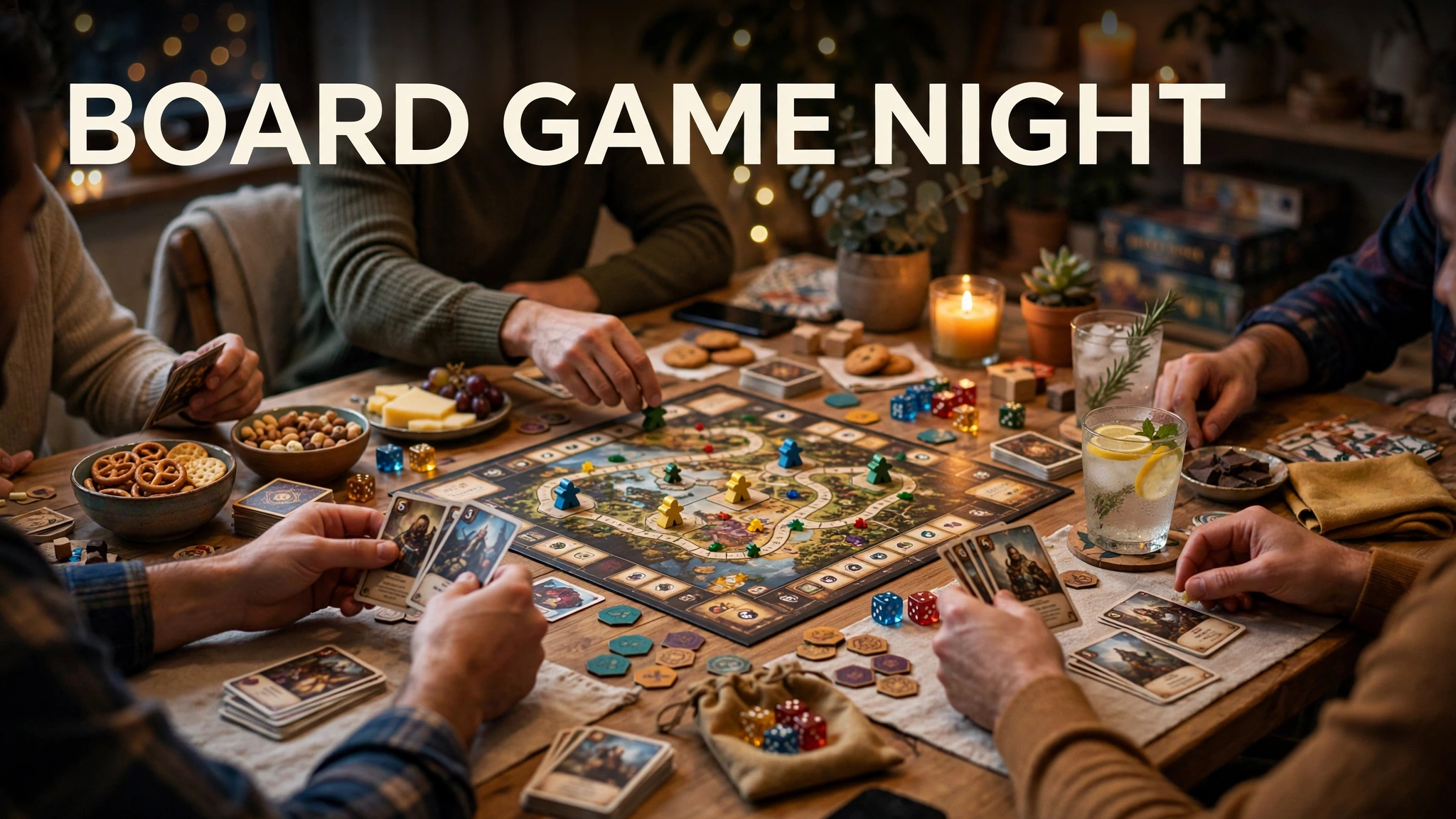
A great board game night comes down to a few things working together: a group whose size and experience match the games on the table, a comfortable spot to sit and spread out, simple food that won’t wreck anyone’s cards, rules explained clearly before the first turn, and a schedule loose enough to adjust on the fly. Add one backup game in case the main event runs short or falls flat, and you’ve got everything you need for a night people actually want to repeat.
This guide walks through the planning, the games, the snacks, the themes, and the small problems that come up almost every time — so you can host with confidence whether it’s your first game night or your fiftieth.
Table of Contents
What Is a Board Game Night?
A board game night is simply a gathering built around playing tabletop games together — as opposed to a general party (where games might be optional background activity) or a video game night (where the focus is a screen rather than a table). The appeal is straightforward: board games force face-to-face interaction, give everyone something to do with their hands and attention, and work for almost any group — friends, family, couples, coworkers, or a mix of ages.
Game nights can take a lot of different shapes. Some are casual and social, built around light party games and conversation. Others are more competitive, centered on one meaty strategy game played seriously. Cooperative game nights have everyone working against the game itself rather than each other, which tends to lower the stakes and the tension. And plenty of hosts build a themed night around a season, a genre, or a specific mood. None of these approaches is more “correct” than another — the right format depends on the group.
How to Plan a Board Game Night
Planning a board game night is mostly about matching games to people, then handling the logistics around them. Here’s a practical order to work through:
- Choose the date and time. Evenings and weekends tend to work best; give people at least a few days’ notice for a casual night, more for a larger gathering.
- Decide how many people to invite. A smaller group (2–6) supports longer, more strategic games and quieter conversation. A larger group (8+) works better with quick party games or multiple simultaneous tables.
- Select the location. A dining table or any flat surface with good lighting and enough elbow room for cards and boxes is really all you need.
- Ask about player preferences and experience. A quick “anyone played X before?” message beforehand saves a lot of rule-explaining time on the night itself.
- Choose games in advance. Pick two or three options based on group size and experience rather than deciding at the door.
- Prepare the table and seating. Clear clutter, make sure there’s a chair for everyone, and check that the surface is clean and dry.
- Organize food and drinks. Simple, low-mess options that can sit off to the side of the playing area.
- Explain rules before starting. Walk through the goal and a sample turn rather than reading the rulebook cover to cover.
- Create a flexible schedule. Plan roughly what order games will happen in, but leave room to adjust.
- Prepare a backup game. Something quick and easy in case the group loses interest in the main game or finishes early.
Read More: https://gamespuma.com/zap-card-game/
Read More: https://gamespuma.com/date-night-the-game/
Quick Planning Checklist
- [ ] Date, time, and location confirmed
- [ ] Guest list finalized and headcount known
- [ ] 2–3 games selected based on group size and experience
- [ ] Table cleared and seating arranged for everyone
- [ ] Snacks and drinks prepped ahead of time
- [ ] Rules reviewed by the host beforehand
- [ ] One backup game on standby
- [ ] Rough schedule in mind (not set in stone)
Choose Games Based on Group Size
Player count is usually the first filter for picking a game — there’s no point falling in love with a game that officially tops out below your headcount. A few notes before the breakdown: some games support larger groups by splitting into teams (like Codenames), and a handful of “party” versions of a game raise the player cap over the original (Sushi Go’s base game supports 2–5, while Sushi Go Party! goes up to 8). Don’t stretch a game past its stated maximum — most board games are balanced around a specific range, and going over it usually just means long waits between turns.
| Group Size | What Tends to Work Well |
|---|---|
| 2 players | Two-player-specific or two-player-friendly designs: Codenames Duet, 7 Wonders Duel, Splendor Duel, Skull |
| 3–4 players | Most gateway strategy games: Catan, Ticket to Ride, Splendor, Azul, Sushi Go |
| 5–6 players | Party and social games plus larger-capacity strategy games: Codenames, Just One, Skull, Pandemic, 7 Wonders |
| 7–10 players | Team-based party games and social deduction: Codenames, Wavelength, One Night Ultimate Werewolf, Telestrations |
| Large groups (10+) | Split into two simultaneous tables of a smaller game, or use a game explicitly built for a crowd like Wavelength or Werewolf-style games |
| Mixed-age groups | Simple rules with light strategy: Sushi Go, Ticket to Ride, Dixit, cooperative games like Pandemic |
| People new to board games | Short, low-rules-overhead games: Sushi Go, Skull, Just One, Dixit |
Best Board Games for Game Night
The “best” board game for a game night depends entirely on group size, experience level, available time, and the kind of energy you want in the room — a rowdy party game and a quiet two-hour strategy game aren’t competing for the same slot. Below are games organized by category, with player count, playtime, and age range as listed by their publishers, along with what makes each one work and where it falls short.
Easy Party Games
Codenames
- Best for: mixed groups who like wordplay
- Players: 4–8+ (6 is often considered the sweet spot; two-team format)
- Play time: about 15–30 minutes
- Age range: most editions list 14+ (some newer editions list 10+)
- Style: team-based word-association guessing game
- Why it works: fast to teach, endlessly replayable, scales from a small group to a full table
- Drawback: with 8+ players, some people spend more time watching than playing — consider running two boards at once for larger groups
Wavelength
- Best for: groups who enjoy debate and reading each other
- Players: 2–12 (best around 4–12, played in two teams)
- Play time: about 30–45 minutes
- Age range: 14+
- Style: team guessing game based on a hidden spectrum dial
- Why it works: no reading or drawing skill required, and disagreements between teammates are half the fun
- Drawback: teams sitting out between turns can feel a little passive in a very large group
Skull
- Best for: adults who enjoy bluffing and psychology
- Players: 3–6
- Play time: about 15–45 minutes
- Age range: around 10+ on most editions (some party editions list 13+)
- Style: bluffing/wagering card game
- Why it works: tiny box, no reading required, and tension builds naturally each round
- Drawback: can feel anticlimactic for players who dislike high-stakes bluffing
Fast Games
Sushi Go!
- Best for: quick rounds between bigger games
- Players: 2–5 (Sushi Go Party! extends this to 2–8)
- Play time: about 15–20 minutes
- Age range: 7/8+
- Style: card drafting and set collection
- Why it works: dead simple rules, colorful art, plays fast enough for repeat rounds
- Drawback: light strategy depth means experienced gamers may find it too simple as a main event
Just One
- Best for: cooperative groups who like wordplay without competition
- Players: 3–7
- Play time: about 20 minutes
- Age range: 8+
- Style: cooperative party word game
- Why it works: everyone wins or loses together, which keeps the mood light and social
- Drawback: needs at least 3 players and loses some magic with a very small group
Coup
- Best for: players who enjoy bluffing and elimination
- Players: 2–6
- Play time: about 15 minutes
- Age range: varies by edition/retailer, generally listed 10+ to 14+ — check the box for the specific printing
- Style: bluffing card game with player elimination
- Why it works: extremely quick to teach and replay, rewards reading people rather than luck
- Drawback: eliminated players wait out the rest of the round, which can be a downside in smaller groups
Strategy Games
Catan
- Best for: groups who enjoy trading and negotiation
- Players: 3–4 in the base game (5–6 with the official expansion)
- Play time: about 60–90 minutes
- Age range: 10+
- Style: resource management and trading strategy
- Why it works: different board layout every game keeps it fresh, and trading creates natural table talk
- Drawback: dice-based resource generation can frustrate players who prefer pure strategy over luck
Ticket to Ride
- Best for: groups who want strategy without heavy negotiation
- Players: 2–5
- Play time: about 30–60 minutes
- Age range: 8+ (some editions list 10+)
- Style: route-building strategy
- Why it works: simple turn structure, low rules overhead, and a satisfying sense of visible progress
- Drawback: less direct player interaction than Catan, which some groups miss
7 Wonders
- Best for: groups who want a meatier strategy game that still plays fast
- Players: 3–7 (a two-player variant, 7 Wonders Duel, is sold separately)
- Play time: around 30 minutes
- Age range: 10+
- Style: card drafting and civilization building
- Why it works: every player acts simultaneously, so there’s no long waiting between turns even at a full table
- Drawback: the icon-heavy cards take a round or two to get comfortable reading
Splendor
- Best for: players who like an engine-building puzzle
- Players: 2–4
- Play time: about 30 minutes
- Age range: 10+
- Style: gem-trading engine builder
- Why it works: simple three-action turns hide real long-term strategy
- Drawback: turns can occasionally slow down as the board fills with tempting options
Cooperative Games
Pandemic
- Best for: groups who want to work together instead of against each other
- Players: 2–4
- Play time: about 45–60 minutes
- Age range: 8+
- Style: cooperative disease-fighting strategy game
- Why it works: everyone wins or loses as a team, which suits groups who dislike direct confrontation
- Drawback: one dominant player can end up quarterbacking everyone else’s turns unless the group actively guards against it
Family-Friendly Games
Azul
- Best for: families and mixed-experience groups
- Players: 2–4
- Play time: about 30–45 minutes
- Age range: 8+
- Style: tile-drafting and pattern-building
- Why it works: gorgeous components, simple rules, and just enough strategy to stay interesting for adults
- Drawback: only supports up to 4 players, so it’s not a fit for larger gatherings
Dixit
- Best for: imaginative, mixed-age groups
- Players: 3–6
- Play time: about 30 minutes
- Age range: 8+
- Style: storytelling and guessing game
- Why it works: no reading required beyond simple words, and the beautiful artwork makes every round different
- Drawback: shy players may need encouragement to give creative clues
Social Deduction Games
One Night Ultimate Werewolf
- Best for: larger groups who want a fast round of bluffing
- Players: 3–10
- Play time: about 10 minutes per round
- Age range: 8+ on most listings
- Style: hidden-role social deduction
- Why it works: no elimination, no long wait between games, and it’s easy to squeeze in several rounds
- Drawback: benefits from a moderator (an app or a designated player) to keep the “night phase” running smoothly
Word and Trivia Games
Telestrations
- Best for: groups who enjoy silly, low-stakes creativity
- Players: 4–8
- Play time: about 30 minutes
- Age range: 12+
- Style: drawing and guessing party game
- Why it works: the “broken telephone” effect of the game almost always produces something funny
- Drawback: drawing ability isn’t required, but very shy players may be hesitant at first
Board Game Night Ideas for Different Groups
Friends: Mix a party game (Codenames or Wavelength) with a slightly longer strategy game (Catan or 7 Wonders) so the night has both social energy and a meatier centerpiece.
Families: Lean into games with short rules and forgiving mechanics — Sushi Go, Ticket to Ride, Dixit, or a cooperative game like Pandemic that avoids direct competition between kids and adults.
Adults: Adult game nights don’t need to revolve around alcohol or mature content — plenty of adults simply want a quiet, focused strategy game or a sharp bluffing game like Skull or Coup. If drinking is part of the plan, keep it optional and keep drinks away from the components.
Couples: Two-player games shine here: Codenames Duet, 7 Wonders Duel, Splendor Duel, or a quick round of Skull.
Children: Stick to simple, visual games with short rules and quick rounds — Sushi Go and Dixit both work well with younger players.
Mixed-age groups: Cooperative games remove the competitive pressure that can make mixed-age play awkward; Pandemic and Just One both work across a wide age range.
Beginners: Start with something under 20 minutes and easy to explain in two sentences — Sushi Go, Skull, or Just One are good entry points.
Competitive players: Strategy-heavy games with clear winners work well — Catan, 7 Wonders, Splendor.
Cooperative players: Pandemic and Just One both replace “everyone against everyone” with “everyone against the game.”
Large groups: Team-based party games (Codenames, Wavelength) or splitting into two simultaneous tables of a smaller game both scale well.
Limited space: Card-based games with no board (Coup, Sushi Go, Skull) take up far less table space than box-based strategy games.
Remote or online groups: Many of these games have official or community-made digital versions (Codenames and Sushi Go both have popular online implementations), which can keep a group’s game night going even when everyone can’t be in the same room.
Board Game Night Themes
A theme is optional, but it’s a low-cost way to make a recurring game night feel fresh. A few ideas:
- Classic games night: Pull out well-known family classics; simple snacks, no dress code needed.
- Mystery night: Pair a deduction game like Skull or a social deduction game with dim lighting and a few candles.
- Fantasy night: Choose a fantasy-themed strategy game and let guests come as their favorite fantasy archetype if they want to dress up.
- Retro game night: Dig out older classics from a closet or thrift store and pair with a simple retro-style snack spread.
- Halloween game night: Lean into bluffing and deduction games, which naturally suit a spooky mood; pumpkin-shaped snacks are an easy touch.
- Holiday game night: Build the evening around a favorite seasonal party game and holiday-appropriate finger foods.
- Cooperative challenge night: Build the whole evening around cooperative games like Pandemic, framing the night as “everyone vs. the game.”
- Tournament night: Run a bracket of a fast game like Skull or Coup, with a simple scoreboard.
- Bring-your-own-game night: Ask each guest to bring one favorite game — this naturally builds variety without the host having to own everything.
- Beginner-friendly discovery night: Choose only games under 20 minutes with minimal rules, aimed at introducing non-gamers to the hobby.
For any theme, keep decorations simple (a tablecloth, some string lights, a themed playlist) and avoid using copyrighted characters or logos in anything you’re printing, sharing, or selling — stick to your own words and generic imagery.
Board Game Night Snacks and Drinks
The main rule for game night food is simple: keep it away from the cards. A few practical guidelines:
- Serve finger foods that don’t leave grease or crumbs — pretzels, popcorn, cut fruit, vegetable trays, and cookies are all safe bets.
- Small sandwiches or individually portioned snacks work better than shared bowls of anything sticky or saucy.
- Pizza is a game-night staple, but serve it on its own table or side surface, not next to the board.
- Use napkins and small plates rather than relying on people to keep their hands clean.
- Offer water and non-alcoholic drinks alongside anything else, and use spill-resistant cups or lids where you can.
- Ask guests about dietary needs in advance and label snacks accordingly — don’t guess at what’s safe for someone to eat.
- Give the table a quick wipe-down before the first game starts.
Board Game Night Schedule Example
Schedules are just a starting point — adjust based on how the group is actually enjoying itself.
A two-hour casual game night
- Arrival and snacks: 20 minutes
- Quick party game (Codenames or Sushi Go): 20–30 minutes
- Main game (Ticket to Ride or Splendor): 45–60 minutes
- Optional closer (Skull or Just One): 15–20 minutes
A four-hour weekend game night
- Arrival and mingling: 30 minutes
- Opener game: 20–30 minutes
- Main strategy game (Catan or 7 Wonders): 60–90 minutes
- Break with food: 20–30 minutes
- Second game or rematch: 45–60 minutes
- Closer/wind-down game: 15–20 minutes
A family game night
- Arrival: 15 minutes
- Game explanation: 10 minutes
- Family-friendly game (Sushi Go or Dixit): 20–30 minutes
- Second round or new game: 20–30 minutes
- Cleanup and wind-down: 15 minutes
A tournament-style evening
- Arrival and bracket setup: 15 minutes
- Round 1 (multiple quick games running in parallel): 30–40 minutes
- Round 2: 30–40 minutes
- Final round: 20 minutes
- Awards/wrap-up: 10 minutes
A beginner discovery night
- Arrival and easy icebreaker: 15 minutes
- Game 1 (Sushi Go): 20 minutes
- Game 2 (Skull): 20 minutes
- Game 3 (Just One): 20 minutes
- Wrap-up and vote on a favorite: 10 minutes
Tips for Explaining Board Game Rules
- Explain the objective first — what does winning actually look like?
- Walk through one example turn before opening the floor to questions.
- Only introduce the rules needed to begin; save minor exceptions for when they come up naturally.
- Mention the most common beginner mistakes up front, so people don’t repeat them.
- Keep the rulebook within reach for anyone who wants to double-check something mid-game.
- Don’t correct every small mistake — a minor rules slip rarely changes the outcome and interrupting too often kills momentum.
- Use a practice round for anything with real complexity.
- Before starting for real, ask if everyone feels ready rather than assuming they do.
- To keep experienced players from overwhelming beginners, consider having them play a slightly reduced role (skip early aggressive strategies) for the first game.
How to Make Board Game Night More Fun
- Rotate who chooses the next game so no one person dominates the picks.
- Keep a simple scoreboard or a running list of games played, just for fun.
- Run a friendly, low-stakes tournament with a small, optional prize — nothing that resembles gambling or real-money betting.
- Try one new game each month to keep the group’s collection growing.
- Let people join or leave between games rather than locking everyone in for the whole night.
- Mix short games with longer ones so the pacing doesn’t feel heavy the entire time.
- Build in a break, especially for longer sessions — people play better and argue less after a short breather.
- Watch for signs that the competitive energy has tipped from fun into frustration, and shift to a cooperative game if needed.
Common Board Game Night Problems and Solutions
A game is too complicated. Switch to a simpler backup game rather than pushing through — nobody has fun being confused for an hour.
Someone arrives late. Start with a casual game people can join mid-stream, and save anything with a strict setup for once everyone has arrived.
The group is larger than expected. Split into two tables running the same or different games rather than cramming everyone around one board.
A game takes too long. Set a soft time limit going in, or choose games with a known, predictable playtime for future nights.
Players disagree about rules. Check the rulebook together and move on — house-rule it if the rulebook is ambiguous, and note the decision for next time.
One player dominates. Rotate who explains rules and who goes first each game, and consider cooperative games where “winning” is shared.
Children and adults have different preferences. Alternate between a kid-friendly game and a slightly more complex one, or choose cooperative games that naturally bridge the gap.
Someone doesn’t enjoy competitive games. Keep at least one cooperative option in your regular rotation.
There isn’t enough table space. Favor card-based games over big-box board games when space is tight.
A game is missing pieces. Keep a small kit of spare dice, tokens, and blank cards on hand as generic substitutes.
The group loses interest. Switch to something shorter and more social rather than trying to force the current game to a finish.
Frequently Asked Questions
How do you host a board game night? Pick a date, invite a group whose size matches your games, choose two or three games in advance based on everyone’s experience, prepare simple snacks, clear a comfortable table, and explain rules clearly before starting.
What games are best for game night? It depends on the group. Sushi Go and Skull work well for beginners and quick rounds, Catan and 7 Wonders suit groups who want deeper strategy, and Codenames or Wavelength are strong picks for larger, more social gatherings.
How many people do you need for a board game night? As few as two (with the right two-player games) or as many as ten or more, depending on which games you choose. Check each game’s stated player range before planning around it.
What should I bring to a board game night? If asked to bring something, a favorite game, a simple snack to share, and an open mind about trying something new are usually welcome.
What snacks are good for board game night? Low-mess finger foods — pretzels, popcorn, fruit, vegetables, small sandwiches, cookies — kept away from the actual playing surface.
What are the best board games for beginners? Short, simply explained games like Sushi Go, Skull, and Just One are a good starting point before moving to longer strategy games.
What games work for large groups? Team-based party games like Codenames and Wavelength scale well, or split a larger group into two tables playing a smaller-capacity game simultaneously.
How long should a board game night last? Anywhere from two hours for a casual weeknight gathering to four or more hours for a weekend event — it depends entirely on the group and the games chosen.
How do you make board game night fun? Mix game lengths and styles, rotate who picks the next game, keep the mood relaxed rather than intensely competitive, and have a backup game ready.
What is a good board game for two people? Codenames Duet, Splendor Duel, 7 Wonders Duel, and Skull are all designed with two players specifically in mind.
How often should you host a game night? There’s no fixed rule — some groups meet weekly, others monthly. A recurring, predictable schedule tends to make it easier for people to keep showing up.
Conclusion
A memorable board game night doesn’t require an enormous game collection or an elaborate setup — it requires matching the right games to the people in the room, keeping the food simple, and staying flexible about the schedule. Start with one or two games that fit your group’s size and experience level, keep a backup on hand, and let the night find its own rhythm from there.

Written by Daniel Carter
Daniel Carter is a dedicated gaming writer who enjoys turning complex gaming topics into clear, useful, and engaging content. He covers game guides, tips, reviews, features, and the latest developments across the gaming world. His approach focuses on research, accuracy, and practical value, helping readers discover new games, improve their gameplay, and stay informed about the industry. For Daniel, great gaming content is not just about information—it is about making every article genuinely worth reading.
1 thought on “Board Game Night: Ideas, Best Games, Snacks, and Hosting Tips”