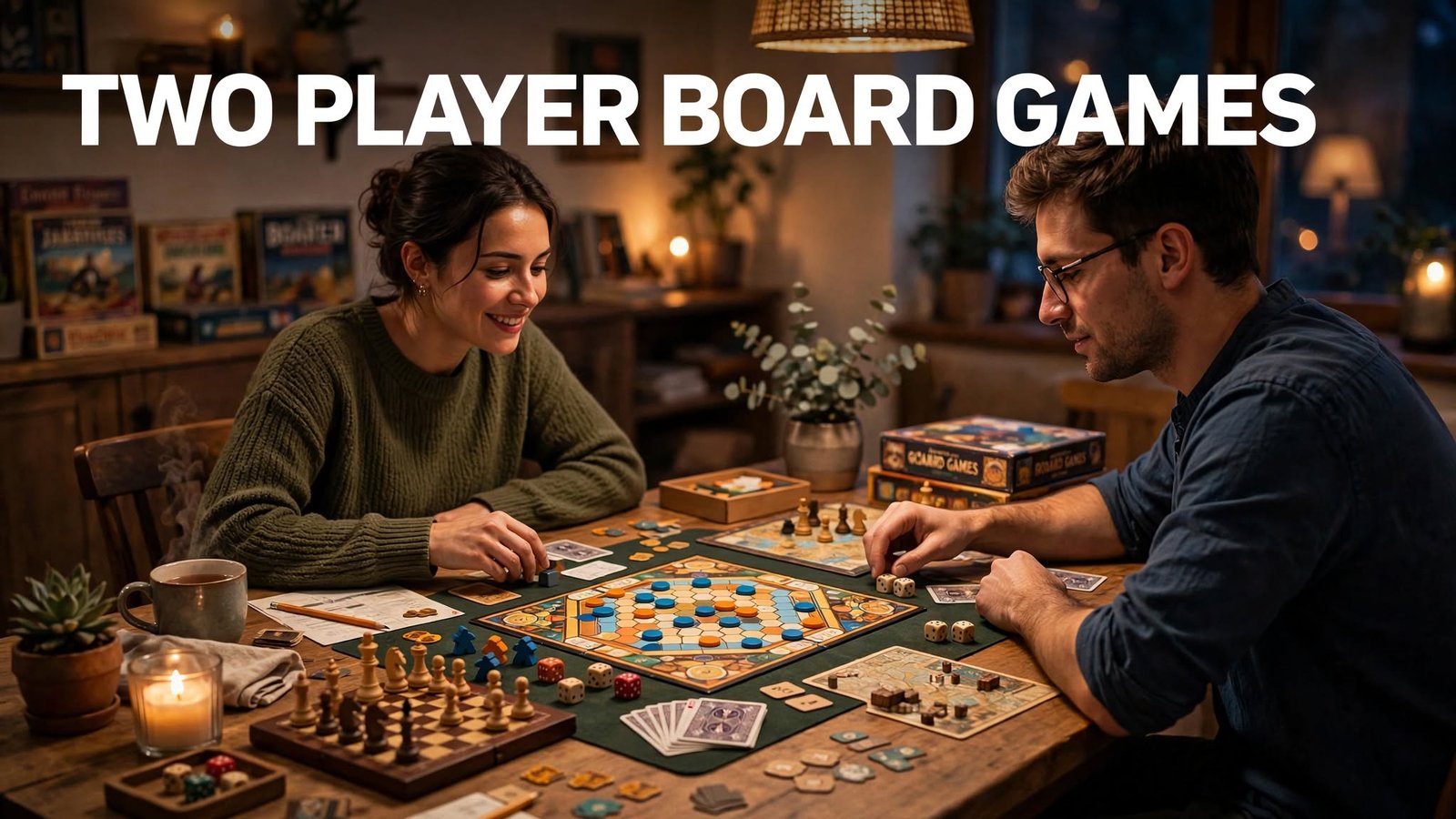
The best two-player board game depends less on “best” in any universal sense and more on what you and your opponent (or teammate) actually want from an evening: a fast, low-stakes filler; a slow-burning strategic duel; a cooperative puzzle you solve together; or something easy enough to teach in five minutes. There isn’t one correct answer — but there is a right answer for your situation, and this guide is organized to help you find it quickly.
Quick picks if you’re in a hurry:
- Easiest to learn: Patchwork
- Best strategy duel: 7 Wonders Duel
- Best cooperative game: Sky Team
- Best quick competitive game: Onitama or Hive
- Best for couples: Patchwork or Jaipur
- Best for a long, meaty game night: Twilight Struggle
Below, every game is organized by the kind of experience it delivers, with verified player counts, playing times, and age ratings, and an honest note on how each one actually feels at exactly two players — because a lot of games that technically allow two players are a noticeably worse experience at that count than a game designed for it from the start.
Table of Contents
What Makes a Good Two-Player Board Game?
Not every board game that lists “2” on the box is actually good with two people. Multiplayer games often rely on shifting alliances, hidden competition between three or more rivals, or a sense of “the table” reacting together — all of which can collapse when there’s only one opponent to read. A few things separate a genuinely good two-player game from one that merely tolerates the player count:
- Official two-player support. Some games (like Codenames in its original party form, or many 4–6 player negotiation games) simply don’t have rules built for two. Always check whether “2” is the minimum player count the designer built around, or an awkward accommodation.
- Balanced gameplay at exactly two. With only one opponent, any built-in first-player advantage, turn-order quirk, or asymmetry matters much more than it would with a larger group diluting it.
- Meaningful decisions for both players, every turn. Games with a lot of “downtime” while other players act don’t have that problem at two — but games that rely on group dynamics to create tension can feel flat.
- Suitable playing time for a duo. A 90-minute game can be a great date night if you both want that; it can also be a slog if one of you just wants a quick filler.
- Clear, teachable rules. Two-player sessions often happen spontaneously (a rainy afternoon, a slow evening), so a shorter rules-to-play ratio matters more than it does for a planned game night with a group.
- Replayability. Since you’ll likely be playing the same game repeatedly with the same one person, variability in setup, strategy, or scenario matters more than for a game you might only play once with a rotating group.
- Appropriate complexity for both players. A mismatch in gaming experience between two players is felt much more sharply than in a group, where a stronger player’s dominance gets spread across multiple opponents.
- Component and production quality. With more focused attention on the table (just two people, not six), thin cards or fiddly pieces stand out more.
- Designed for two, not merely allowing two. This is the single biggest differentiator. A dedicated two-player game (7 Wonders Duel, Jaipur, Patchwork, Hive, Onitama, Sky Team) has every rule, card, and mechanic tuned around exactly one opponent. A multiplayer game that “also supports 2” (many area-control or negotiation-heavy euros) often loses its central tension — direct conflict gets less interesting without a third party to triangulate against, and negotiation mechanics can disappear entirely.
Read More: https://gamespuma.com/board-game-night/
Best Two-Player Board Games at a Glance
| Game | Best For | Players | Play Time | Difficulty | Style | Competitive/Co-op | Why Choose It |
|---|---|---|---|---|---|---|---|
| Patchwork | Couples, beginners | 2 | 15–30 min | Light | Tile placement, puzzle | Competitive | Simple rules, deep spatial puzzle |
| Jaipur | Couples, quick games | 2 | 30 min | Light | Set collection, trading | Competitive | Fast, tense, easy to teach |
| Lost Cities | Easy, quick games | 2 | 30 min | Light | Card game, push-your-luck | Competitive | Built for two from the ground up |
| Codenames: Duet | Cooperative, beginners | 2 (or more) | 15–30 min | Light | Word deduction | Cooperative | Purpose-built teamwork puzzle |
| Sky Team | Cooperative | 2 only | 15–20 min | Light-medium | Dice placement | Cooperative | Silent teamwork, huge replay value |
| Pandemic | Cooperative | 2–4 | 45 min | Medium | Cooperative strategy | Cooperative | Classic co-op that scales well to two |
| 7 Wonders Duel | Strategy | 2 only | 30 min | Medium | Card drafting, engine building | Competitive | Deep strategy built exclusively for two |
| Hive | Strategy, quick games | 2 | ~20 min | Medium | Abstract strategy | Competitive | Chess-like, no board needed |
| Onitama | Strategy, quick games | 2 | 15–20 min | Light-medium | Abstract strategy | Competitive | Elegant, portable, endlessly replayable |
| Santorini | Beginners, strategy | 2–4 (best at 2) | 15–20 min | Light-medium | Abstract strategy | Competitive | Easy core rules, deep with god powers |
| The Fox in the Forest | Couples, competitive | 2 only | 30 min | Light-medium | Trick-taking | Competitive | Elegant trick-taking made for two |
| Star Realms | Competitive, quick games | 2 (base set) | ~20 min | Medium | Deck building | Competitive | Fast, aggressive head-to-head duels |
| Twilight Struggle | Adults, long strategy | 2 only | 2–3 hours | Heavy | Card-driven wargame | Competitive | The gold standard for deep 2-player strategy |
Playing times are approximate and reflect typical full games among players who already know the rules; add extra time for a first play while learning.
Best Easy Two-Player Board Games
These are games you can teach in a couple of minutes and have on the table within thirty, with no prior board-game experience required.
Patchwork. Published by Lookout Games and designed by Uwe Rosenberg, Patchwork gives each player a personal 9×9 quilt board and has you compete to buy Tetris-shaped fabric patches from a shared, rotating selection. It plays in 15–30 minutes and is rated for ages 8 and up. The genius of the design is its time-track: instead of alternating turns evenly, whichever player is furthest behind on the track takes the next turn — so a string of small, cheap moves can give you several actions in a row. The rules are genuinely simple (each turn is just “buy a patch” or “pass and collect income”), but the spatial puzzle of fitting oddly shaped pieces into a limited grid keeps it interesting well past the first few plays.
Jaipur. Designed by Sébastien Pauchon and published by Space Cowboys, Jaipur is a fast trading card game for exactly two players, playing in about 30 minutes and rated for ages 10 and up (some editions list 12+). Each round, you take goods from a shared market or sell your own goods for rupees, racing to fill large sales for bonus rewards before your opponent corners the market. There’s no reading or math beyond basic addition, and a full round of Jaipur can finish in five to ten minutes, making it an easy game to fit into an evening or replay two or three times in a row.
Lost Cities. Designed by Reiner Knizia and published by Kosmos, Lost Cities was originally built specifically as a two-player card game (a later four-player board variant exists, but the core card game is a two-player design). It plays in about 30 minutes and is rated for ages 10 and up. Each turn you play or discard a single card toward one of several “expeditions,” then draw a replacement — the tension comes from deciding whether an expedition is worth starting at all, since an unfinished one costs you points. It’s quick to teach, and because interaction is indirect (you can’t attack your opponent’s expeditions directly, only use their discards), it stays low-conflict, which suits players who want strategy without confrontation.
A note on limitations: all three of these games are intentionally light — they reward a good decision here and there rather than long-term planning across many turns. If you find yourself wanting deeper strategic layers after a few plays, see the strategy section below.
Best Two-Player Strategy Board Games
For players who want tactical decisions, resource management, or long-term planning, these games hold up to repeat play and reward improving skill.
7 Wonders Duel. Designed by Antoine Bauza and Bruno Cathala and published by Repos Production, 7 Wonders Duel is built exclusively for two players — there’s no way to play it with a third — and plays in about 30 minutes for ages 10 and up. Rather than drafting cards from a hand, players take cards from a face-up and face-down pyramid, so timing which card to grab (and which to deny your opponent) becomes a central skill. You can win through building the most valuable civilization, achieving military dominance, or completing six of seven science symbols, which gives every game multiple viable strategic paths. It’s a genuine strategy game — card drafting, resource management, and engine building are all present — but its rules are compact enough to teach a new player in about ten minutes.
Hive. Designed by John Yianni and published by Gen42 Games, Hive is an abstract strategy game for two players with no board at all: you place and slide hexagonal insect tiles directly on the table, building the “board” as you go. A typical game runs about 20 minutes (experienced players can finish faster; two beginners weighing every move may take longer), and it’s rated for ages 9 and up. The objective — surround your opponent’s Queen Bee — has a chess-like feel, with each insect (ants, spiders, beetles, grasshoppers) moving differently. There’s zero luck involved, so outcomes are determined entirely by positional skill, and the small tile set packs into a bag small enough for travel.
Onitama. Designed by Shimpei Sato and published by Arcane Wonders, Onitama is played on a 5×5 grid with five pieces per side and takes about 15–20 minutes, suitable for ages 8 and up. Each turn, you move a piece according to one of two movement cards you currently hold, then pass that card to your opponent — meaning the available moves are constantly rotating between both players, which keeps the tactical picture fresh from game to game since the deck of movement cards is large and only a handful are used each session. It’s an easy game to learn (the core rule fits on one card) but rewards the kind of forward-planning found in chess, just in a much shorter session.
Santorini. Designed by Gordon Hamilton and published by Roxley Games, Santorini supports 2–4 players but is primarily designed for and best played at two, taking 15–20 minutes for ages 8 and up. On your turn, you move one of your two builders and then construct on the grid, trying to be the first to get a builder to the third level of a structure. The base game has genuinely simple rules, but the wide range of optional “god power” cards (each granting a unique special ability) adds substantial strategic depth once you’ve mastered the basics — making it a rare example of a game that’s both an excellent beginner pick and a game experienced players keep coming back to.
All four of these are suitable for beginners in terms of rules complexity, but reward experienced players through skill expression rather than luck — none of them use dice or hidden randomness to determine outcomes.
Best Cooperative Board Games for Two Players
Not every two-player game needs to be a duel. Cooperative games put both players on the same team, working toward a shared objective instead of against each other.
Sky Team. Designed by Luc Rémond and published by Le Scorpion Masqué, Sky Team is a cooperative game built exclusively for two players — one plays pilot, the other co-pilot — and won the 2024 Spiel des Jahres (Game of the Year), one of the tabletop hobby’s most prestigious awards. It plays in about 15–20 minutes and is rated for ages 12 and up. Each round, both players roll dice privately and place them on their own control panel without speaking, then reveal simultaneously — meaning all your coordination has to happen through prior planning and a handful of limited communication tokens, not free conversation. The tension of silently trying to land a plane together, and the near-instant urge to try again after a crash, gives it exceptional replay value for a 20-minute box.
Pandemic. Designed by Matt Leacock and published by Z-Man Games, Pandemic supports 2–4 players and plays in about 45 minutes. It isn’t built exclusively for two the way Sky Team is, but it scales down comfortably — with two players, each of you typically controls the actions needed to manage more of the board, and the disease-spread mechanics don’t require a specific player count to function. You and your partner take on roles (each with a unique special ability) and work together against the game itself, trying to cure four global diseases before outbreaks spiral out of control. Because you’re fighting the game rather than each other, difficulty is adjustable via the number of “epidemic” cards shuffled into the deck, so you can scale the challenge as you improve.
Codenames: Duet. Designed by Vlaada Chvátil (with the cooperative Duet variant credited to the Codenames design team) and published by Czech Games Edition, Codenames: Duet is explicitly built for two players (with rules allowing more), playing in 15–30 minutes and rated for ages 11 and up. Both of you act as spymasters simultaneously, each seeing only half of a shared key card, and take turns giving one-word clues to help your partner find your shared secret agents — while avoiding the assassin tiles that end the game instantly. Because you each hold information the other doesn’t, the “aha” moment of a good clue landing is a genuinely different experience from party-style Codenames, and there’s no risk of one dominant player making every decision, since both of you are working from incomplete, separate information.
A distinction worth noting: fully cooperative games like these have shared win/lose conditions and require ongoing communication and joint decision-making. That’s different from games that only have optional cooperative elements bolted onto a competitive core — those are covered separately, since they don’t deliver the same team-based experience throughout.
Best Competitive Board Games for Two Players
For players who want direct, head-to-head competition, these games cover a range of intensity from light tactical positioning to sustained strategic pressure.
The Fox in the Forest. Designed by Joshua Buergel and published by Foxtrot Games (in partnership with Renegade Game Studios), this is a trick-taking card game designed exclusively for two players, playing in about 30 minutes for ages 10 and up. If you’ve played a trick-taking game like Hearts or Spades in a larger group, The Fox in the Forest adapts that same core mechanic — winning tricks with higher cards, managing suits — into a tight two-player format with its own scoring twists (winning too many or too few tricks in a round can both cost you points). It’s light on rules but rewards reading your opponent’s remaining cards, and its competition is more of a shared puzzle than a confrontational one, making it a comfortable choice for players who don’t want aggressive conflict.
Star Realms. Designed by Rob Dougherty and Darwin Kastle and published by Wise Wizard Games, Star Realms is a deck-building card game for two players in its base set (additional sets allow more), playing in about 20 minutes and rated for ages 12 and up. Both players start with an identical small deck and take turns buying more powerful cards from a shared, rotating “trade row,” using those cards to attack your opponent’s health total directly. The competition here is more direct and aggressive than Jaipur or The Fox in the Forest — you’re actively racing to build an efficient engine while chipping away at your opponent’s total, so it suits players who enjoy a livelier, more combative back-and-forth.
Hive and Onitama (covered above in the strategy section) also belong here if your priority is head-to-head competition rather than deep long-term strategy — both are pure abstract duels with no cooperative element and no hidden information beyond your opponent’s plans.
The intensity of competition varies significantly across this list: Fox in the Forest is light, indirect competition; Star Realms is faster and more aggressive; and Twilight Struggle (below) is a sustained, tense strategic contest that can take hours. Match the intensity to your mood, not just the mechanic.
Best Two-Player Board Games for Couples
For date nights or a regular couple’s game rotation, the priority usually shifts toward low setup time, an easy learning curve, and gameplay that doesn’t require aggressive confrontation.
Patchwork remains a strong pick here: its 15–30 minute runtime, simple rules, and light conflict (you’re racing for patches, not attacking each other) make it an easy recurring choice, and its puzzle-like quilt-building has enough variety to stay interesting over many plays.
Jaipur also fits well — its trading theme and quick rounds create conversational pacing (you can chat between rounds without losing the thread of the game), and its 30-minute length makes it easy to fit alongside dinner or a show.
The Fox in the Forest is a good pick for couples who want something with more strategic bite but still low direct conflict, since its trick-taking competition is more of a shared puzzle than a confrontation.
Not every couple wants the same thing from a game night — some want something calm and conversational, others want a genuine competitive challenge — so there’s no single “couples game.” If you’re looking for something with a heavier or more mature theme, see the Adults section below; if you want something purely cooperative so you’re never on opposing sides, see the Cooperative section above.
Best Two-Player Board Games for Adults
These games involve longer sessions, more complex decision trees, or thematic depth better suited to experienced players or those wanting a meatier challenge.
Twilight Struggle. Designed by Ananda Gupta and Jason Matthews and published by GMT Games, Twilight Struggle is a card-driven strategy game for exactly two players simulating the Cold War (1945–1989), with one player controlling the United States and the other the Soviet Union. It plays in roughly 2–3 hours and is rated for ages 13 and up. For years it held the top overall ranking on BoardGameGeek, and it’s still widely regarded as one of the deepest two-player strategy games ever published — every card has both an in-game effect and a historical event, forcing constant trade-off decisions about when to use a card for its power versus risk triggering its (sometimes harmful) historical event. This is a genuinely heavy game: expect a real time commitment and a learning curve of a session or two before the systems click, but its reputation among two-player strategy fans is well earned.
7 Wonders Duel (covered in the strategy section above) also works well here if you want strategic depth without committing to a multi-hour session — its 30-minute runtime with genuine tactical complexity makes it a good “adult strategy game on a weeknight” option.
Age ratings above reflect publisher recommendations for rules comprehension and component safety, not content maturity — none of these games contain explicit adult content; “for adults” here refers to strategic depth and time commitment rather than subject matter.
Best Quick Two-Player Board Games
Sometimes you want something you can start and finish in the time it takes to make dinner.
10–20 minutes: Onitama (15–20 min) and Sky Team (15–20 min) are both genuinely quick without feeling shallow — Onitama through elegant, chess-like rules, Sky Team through its tight round structure. Star Realms typically wraps in around 20 minutes once both players know the cards.
20–40 minutes: Hive (around 20 minutes, sometimes longer for two cautious beginners), Patchwork (15–30 minutes), Jaipur (30 minutes), Lost Cities (30 minutes), 7 Wonders Duel (30 minutes), The Fox in the Forest (30 minutes), and Codenames: Duet (15–30 minutes) all fall comfortably in this range.
Around one hour: Pandemic (about 45 minutes) is the closest thing on this list to an hour-long session, and its cooperative structure means that time is spent actively problem-solving together rather than waiting between turns.
The times above reflect actual gameplay for players who already know the rules; for your very first play of any of these, budget an additional 10–15 minutes for rules explanation, and expect the first game to run a little longer than subsequent ones as you settle into the flow of turns.
Best Two-Player Board Games for Beginners
If you or your opponent have never played a modern board game before, look for simple rules, low setup time, and a forgiving learning curve.
Patchwork is a strong starting point: the entire turn structure boils down to one of two choices (buy a patch, or pass to collect income), so new players are making meaningful decisions within the first minute, without needing to reference the rulebook repeatedly.
Santorini works similarly well — its base rules (move a builder, then build) are minimal, and it plays in under 20 minutes, so a first-time player can lose a quick game, immediately understand why, and want to try again rather than feeling overwhelmed.
Codenames: Duet is an easy entry point for players nervous about “strategy games,” since its core skill (word association) doesn’t require prior board-game experience, and the cooperative format means there’s no risk of a new player feeling outmatched by a more experienced one.
For all three, the games remain enjoyable well past the first few sessions — Patchwork’s spatial puzzle, Santorini’s optional god-power cards, and Codenames: Duet’s ever-changing word combinations all provide enough depth to avoid feeling solved after one or two plays, which isn’t true of every “beginner” game.
How to Choose the Right Two-Player Board Game
Use this as a quick decision guide:
- Have less than 20 minutes? → Onitama, Sky Team, or Star Realms
- Want something with zero direct conflict? → Codenames: Duet, Sky Team, or Pandemic (cooperative) or Patchwork (low-conflict competitive)
- Want a real strategic challenge but not a multi-hour commitment? → 7 Wonders Duel or Hive
- Have a full evening and want your money’s worth in depth? → Twilight Struggle
- One of you has never played a modern board game? → Patchwork, Santorini, or Codenames: Duet
- Want to feel like teammates instead of opponents? → Sky Team, Pandemic, or Codenames: Duet
- Want a fast-paced, aggressive head-to-head fight? → Star Realms
- Planning a casual date night? → Jaipur, Patchwork, or The Fox in the Forest
Other practical factors worth weighing: table space (Twilight Struggle needs a large map; Hive and Onitama need almost none), whether you want a single session or an ongoing campaign (all games on this list are one-off sessions rather than campaigns), and whether pricing fits your budget — current prices vary by retailer and edition, so check availability before buying.
Tips for Playing Board Games With Two People
- Learn the rules together rather than one person teaching the other from memory. Reading the rulebook side by side (or watching an official how-to-play video together) tends to produce fewer disputes than one player explaining from recollection.
- Start with a shorter game before committing to a long one. If you’re unsure whether a heavier game like Twilight Struggle is for you, try a lighter title first to confirm you both enjoy that style of play.
- Play a practice round with open information for games with hidden hands or secret information, so you can both ask questions without it affecting the “real” outcome.
- Watch for analysis paralysis in strategy games. If one player is taking a long time on every decision, agreeing on a soft time limit per turn (as an optional house rule, not an official one) can keep the pace enjoyable for both of you.
- Take turns choosing the game. Alternating who picks the next title helps make sure a two-player collection doesn’t skew entirely toward one person’s preferences.
- Use official difficulty adjustments where the game provides them. Pandemic’s epidemic-card count and similar built-in scaling options are the intended way to change challenge level — treat unofficial house rules as optional add-ons, not replacements for the printed rules.
- Keep score consistently in games where it matters, especially trick-taking or set-collection games where small miscounts compound over several rounds.
- Try genres outside your comfort zone occasionally. A couple who mostly plays competitive games might be surprised by how much they enjoy a cooperative title like Sky Team, and vice versa.
- Take breaks during longer games. Twilight Struggle and similar heavier titles are usually played across a clearly defined pause point (like the end of a turn) rather than mid-decision.
- Respect different competitive temperaments. Not everyone enjoys the same intensity of competition — if one of you finds aggressive games stressful rather than fun, lean toward cooperative or low-conflict titles instead of pushing through discomfort for the sake of “finishing” a game night.
Common Questions About Two-Player Board Games
What are the best board games for two people? It depends on what you want from the session. For an easy, low-conflict game, Patchwork or Jaipur are strong choices. For strategic depth, 7 Wonders Duel or Hive stand out. For teamwork instead of competition, Sky Team and Codenames: Duet are excellent picks.
What is the best two-player board game for beginners? Patchwork and Santorini are both good starting points because their core rules can be explained in a couple of minutes, while still offering enough depth to stay interesting after several plays.
Are cooperative board games good for two players? Yes. Games like Sky Team, Codenames: Duet, and Pandemic are specifically strong at two players because there’s no third player to dilute communication or split the decision-making — coordination happens directly between the two of you.
What board games are good for couples? Games with an easy learning curve, short setup, and low direct conflict tend to work well for couples, such as Patchwork, Jaipur, or The Fox in the Forest. That said, couples who enjoy competitive challenge may prefer something with more strategic bite, like 7 Wonders Duel.
What is a quick board game for two people? Onitama and Sky Team both typically play in 15–20 minutes, and Star Realms usually wraps up in around 20 minutes once both players are familiar with the cards.
Which two-player board games have the most replay value? Onitama’s rotating movement-card system, Santorini’s optional god powers, and Codenames: Duet’s changing word combinations all give those games strong variability from one session to the next.
Can multiplayer board games be played with only two people? Some can, but not all multiplayer games hold up well at two. Games that rely on shifting alliances, negotiation between three or more parties, or diluted competition often lose their central tension with just one opponent. Pandemic is a notable exception, since its cooperative structure functions well across its supported player range, including two.
What is the difference between a two-player game and a game that supports two players? A dedicated two-player game (like 7 Wonders Duel, Jaipur, Hive, or Sky Team) is designed exclusively around one-on-one play, with every rule and mechanic tuned for that exact matchup. A game that merely “supports” two players is usually designed for a wider range (often 3–5), and the two-player experience can feel thinner or play differently than the designer’s primary vision.
Are strategy board games suitable for beginners? Some are. Santorini and Patchwork both have simple core rules despite involving genuine strategic decisions, making them good entry points. Heavier strategy games like Twilight Struggle are better suited to players already comfortable with more complex rule sets.
What should I look for in a two-player board game? Confirm the game officially supports two players (rather than merely allowing it), check that the playing time fits your available time, and consider whether you want a cooperative or competitive experience. Beyond that, match the complexity level to both players’ experience, since a mismatch is felt more sharply at two players than in a larger group.
Conclusion
The right two-player board game isn’t a single title — it’s a match between the game and the moment. A quick filler like Onitama or Jaipur suits a spontaneous evening; a deep strategic duel like 7 Wonders Duel or Twilight Struggle suits a night you’ve set aside for exactly that; and a cooperative game like Sky Team or Codenames: Duet suits an evening where you’d rather be teammates than rivals. Start from what you actually want out of the session — quick or immersive, cooperative or competitive, easy or challenging — and the right pick from this list should follow naturally.
10. Best-Games Comparison Table
(See Section 9 above — the comparison table is embedded in the article as required for on-page use. Reproduced standalone below for easy reuse in other formats.)
| Game | Best For | Players | Play Time | Difficulty | Style | Competitive/Co-op | Why Choose It |
|---|---|---|---|---|---|---|---|
| Patchwork | Couples, beginners | 2 | 15–30 min | Light | Tile placement, puzzle | Competitive | Simple rules, deep spatial puzzle |
| Jaipur | Couples, quick games | 2 | 30 min | Light | Set collection, trading | Competitive | Fast, tense, easy to teach |
| Lost Cities | Easy, quick games | 2 | 30 min | Light | Card game, push-your-luck | Competitive | Built for two from the ground up |
| Codenames: Duet | Cooperative, beginners | 2 (or more) | 15–30 min | Light | Word deduction | Cooperative | Purpose-built teamwork puzzle |
| Sky Team | Cooperative | 2 only | 15–20 min | Light-medium | Dice placement | Cooperative | Silent teamwork, huge replay value |
| Pandemic | Cooperative | 2–4 | 45 min | Medium | Cooperative strategy | Cooperative | Classic co-op that scales well to two |
| 7 Wonders Duel | Strategy | 2 only | 30 min | Medium | Card drafting, engine building | Competitive | Deep strategy built exclusively for two |
| Hive | Strategy, quick games | 2 | ~20 min | Medium | Abstract strategy | Competitive | Chess-like, no board needed |
| Onitama | Strategy, quick games | 2 | 15–20 min | Light-medium | Abstract strategy | Competitive | Elegant, portable, endlessly replayable |
| Santorini | Beginners, strategy | 2–4 (best at 2) | 15–20 min | Light-medium | Abstract strategy | Competitive | Easy core rules, deep with god powers |
| The Fox in the Forest | Couples, competitive | 2 only | 30 min | Light-medium | Trick-taking | Competitive | Elegant trick-taking made for two |
| Star Realms | Competitive, quick games | 2 (base set) | ~20 min | Medium | Deck building | Competitive | Fast, aggressive head-to-head duels |
| Twilight Struggle | Adults, long strategy | 2 only | 2–3 hours | Heavy | Card-driven wargame |

Written by Daniel Carter
Daniel Carter is a dedicated gaming writer who enjoys turning complex gaming topics into clear, useful, and engaging content. He covers game guides, tips, reviews, features, and the latest developments across the gaming world. His approach focuses on research, accuracy, and practical value, helping readers discover new games, improve their gameplay, and stay informed about the industry. For Daniel, great gaming content is not just about information—it is about making every article genuinely worth reading.