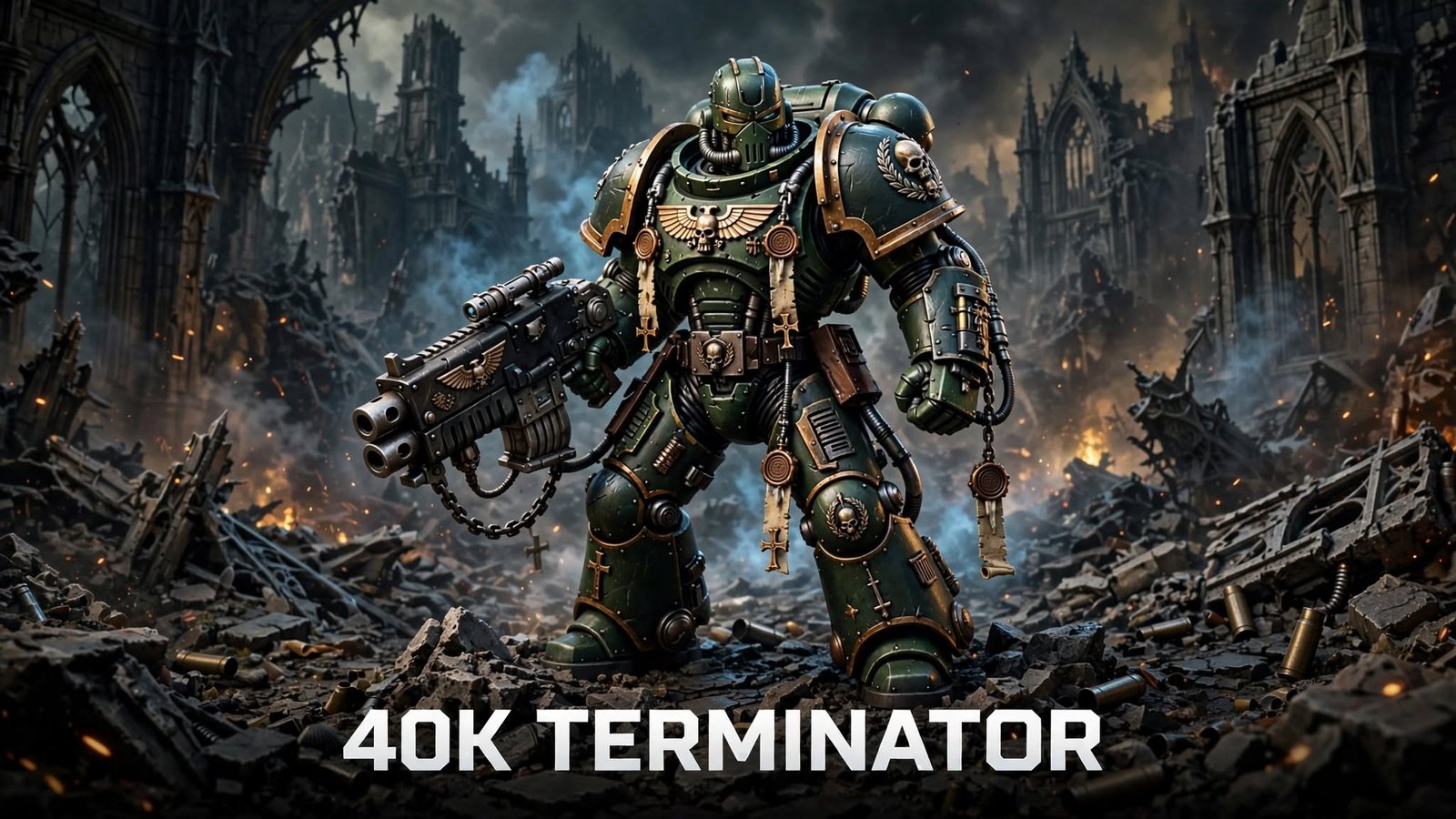
Warhammer 40,000 is currently in its 11th Edition, which launched in June 2026. Rules details below reflect that edition as of September 2026, with clear notes wherever older or upcoming information applies.
Quick Answer: What Is a 40K Terminator?
A 40k Terminator in Warhammer 40,000 is an elite infantry model wearing Tactical Dreadnought Armour, the heaviest and most protective form of powered armor used by the Space Marines and several other Imperial and Chaos factions. Terminators are built for the most dangerous jobs in the Imperium’s wars: boarding hostile starships, smashing through fortified positions, and leading shock assaults where lighter troops would be cut down. They are famous for their thick, boxy silhouette, oversized weapons, and ability to arrive on the battlefield by teleportation rather than walking in from the table edge.
Terminators are not unique to Space Marines. Chaos Space Marines, Grey Knights, and several individual Space Marine Chapters (such as the Dark Angels’ “Deathwing”) field their own named Terminator units, each with different lore and rules. This guide focuses primarily on Space Marine Terminators, while clearly separating out the Chaos and Grey Knights versions.
Table of Contents
40k Terminator Armor Explained
The full name for 40k Terminator armor is Tactical Dreadnought Armour. It is distinct from the more common power armor worn by ordinary Space Marines in several important ways:
- Far heavier protection. Tactical Dreadnought Armour is built from thicker ceramite plating than standard power armor, making its wearer significantly harder to kill with small-arms fire.
- Reduced mobility. The trade-off for that protection is that Terminators move and react more slowly than regular Space Marines, and they cannot use jump packs or most vehicle transports built for standard infantry.
- Integrated life support. The armor is effectively a self-contained survival suit, letting its wearer function in the vacuum of space or in toxic atmospheres — essential for its original purpose.
- Built-in weapon mounts. Many 40k Terminator suits have a weapon, such as a storm bolter, physically integrated into one arm, alongside a close-combat weapon on the other.
Because of its bulk and specialized systems, Tactical Dreadnought Armour is not something every Space Marine wears. It is typically reserved for specific squads and senior or veteran-status individuals within a Chapter, though the exact rules for who may wear it vary between different Space Marine Chapters and other factions.
The History and Lore of Space Marine 40k Terminators
Tactical Dreadnought Armour was originally developed for boarding actions — close-quarters fighting inside the cramped, low-visibility corridors of starships, where its heavy protection and integrated systems matter more than speed. Over thousands of years of the setting’s fictional history, its use expanded to ground warfare, where Terminators are now deployed against the toughest enemy strongpoints and units a battle can offer.
40k Terminator squads are generally treated as a veteran-level or elite formation within a Space Marine Chapter, though the specific organizational rank (such as the Chapter’s First Company in many Chapters’ traditions) differs by Chapter and by source material. It’s inaccurate to describe every single Terminator across every faction as an elite veteran in the same formal sense — the details depend on the specific Chapter or army being discussed.
A defining feature of 40k Terminator warfare is the teleport strike: rather than marching across open ground under fire, 40k Terminator squads can be teleported directly into combat, appearing suddenly among the enemy or right where they’re needed most. This ability is central to both their lore and their tabletop role, and it directly ties back to their origins as ship-boarding specialists suited for sudden, violent insertions.
Chaos Space Marines who fell from the Imperium during the setting’s ancient civil war retained access to their own Terminator armor, and Chaos Terminators exist as a dark mirror of the loyalist version — same basic concept and origin, but corrupted equipment, different unit rules, and different thematic weapons (see the Chaos comparison section below).
Read More: https://gamespuma.com/death-company-40k/
40k Terminator Squads and Their Battlefield Role
On the tabletop, a Terminator Squad functions as heavy, durable infantry meant to be dropped into the fight at a decisive moment rather than advancing slowly across the board. Their general battlefield role includes:
- Absorbing punishment that would wipe out lighter infantry, thanks to their armor save and toughness
- Delivering strong short-to-medium range firepower and dangerous melee attacks in the same unit
- Threatening priority targets — characters, vehicles, or objectives — by teleporting in close rather than walking there
- Holding or contesting objectives once they arrive, since they can survive return fire better than most infantry
Their main limitations are cost (in both points and modeling investment) and mobility once they’re on foot, since they cannot keep pace with fast-moving forces without support.
40k Terminator Weapons and Equipment
40k Terminator loadouts vary by unit and faction, but the most common options across Space Marine 40k Terminator units include:
- Storm bolter — a rapid-firing, twin-linked boltgun and the standard ranged weapon for most Terminator Squad members
- Power fist — a close-combat weapon that trades speed for devastating strength against armor and tough targets
- Chainfist — a heavier variant of the power fist with a rotating chainsaw-like blade, especially effective against vehicles and fortifications
- Thunder hammer — a high-impact melee weapon typically paired with a storm shield, used by Assault-oriented Terminators
- Storm shield — a personal energy shield that significantly boosts survivability against both shooting and melee attacks
- Assault cannon / Cyclone Missile Launcher / heavy flamer — heavier support weapons available as squad upgrades, giving a Terminator Squad extra firepower at range
Which of these are legally available depends entirely on the specific datasheet for that unit and edition — a Terminator Squad, a Terminator Assault Squad, and a Chaos Terminator Squad each have their own distinct wargear lists.
40k Terminator Captains and Other Characters
Beyond the standard squads, several character models are built around Tactical Dreadnought Armour:
- Captain in Terminator Armour — a Space Marine Captain who leads from the front in Terminator plate rather than standard power armor, combining strong melee options with leadership abilities for the army
- Terminator Librarian — a psychic character wearing Terminator armor, bringing psychic powers into a close-support role
- Terminator Chaplain — a Chaplain equipped in Terminator armor, focused on melee combat and morale-boosting abilities for nearby units
These characters typically attach to or fight alongside Terminator squads, and they share the same core armor traits (heavy protection, teleport capability) described above.
Terminators in the Current Warhammer 40,000 Rules
This is the section where edition accuracy matters most, so here is the current state of play as of September 2026:
- Warhammer 40,000 is in its 11th Edition, which launched in June 2026 with the Warhammer 40,000: Armageddon starter set (Space Marines vs. Orks).
- When 11th Edition launched, Games Workshop confirmed that existing 10th Edition codex books remained usable, updated through free digital Faction Packs rather than requiring an immediate full rules rewrite for every army.
- The Space Marines’ 11th Edition Faction Pack (released June 2026) already introduced several Terminator-specific adjustments compared to 10th Edition, including a stat and weapon-profile refresh and a shortened teleport-arrival distance for the Teleport Homer ability.
- On September 7, 2026, Games Workshop announced a full Codex: Space Marines (11th Edition), scheduled for release in October 2026, which will bring another round of stat changes across Space Marine units, including Terminators.
Because that codex had not yet released as of this writing, this guide intentionally avoids quoting specific current stat lines, points costs, or exact weapon profiles for Terminator units — those numbers are set to shift again within weeks. For up-to-the-day figures, always check the official Warhammer Community site or the free Warhammer 40,000 app, which is the authoritative live source for datasheets once the new codex is out.
The practical takeaway: Terminator Squads remain a core, currently-supported part of Space Marine armies in 11th Edition. Their broad identity — tough, teleport-capable, strong in melee and at short range — has been consistent across recent editions, even as exact numbers change.
Terminator Squad vs. Assault Terminator Squad
Space Marines field two related but distinct Terminator infantry units:
- Terminator Squad — the standard, ranged-and-melee hybrid unit, typically built around storm bolters paired with power fists or chainfists, giving it flexible firepower plus solid melee punch.
- Terminator Assault Squad — a dedicated close-combat unit, trading ranged storm bolters for pairs of lightning claws or thunder hammers with storm shields, built to devastate the enemy in melee rather than provide shooting support.
The core difference to remember: the standard squad is a flexible, dual-purpose unit, while the Assault variant commits fully to close combat in exchange for losing most of its ranged capability.
Space Marine Terminators vs. Chaos Terminators
Loyalist Space Marine Terminators and Chaos Terminators share the same basic origin — both use variants of Tactical Dreadnought Armour — but they are entirely separate factions on the tabletop with their own datasheets, keywords, and thematic weapons:
- Space Marine Terminators use standard Imperial wargear such as storm bolters, power fists, and chainfists, and their abilities revolve around Imperial mechanics like Oath of the Moment-style target focus.
- Chaos Terminators field corrupted equivalents, including combi-weapons and accursed weapons (Chaos-touched melee weapons), and their abilities are tied to Chaos-specific mechanics such as Dark Pacts, reflecting their fallen, ritualistic warband culture.
- Other factions field their own Terminator-style elites as well: Grey Knights have their own Terminator Squad built around psychic abilities and anti-daemon warfare, and certain Space Marine Chapters — most notably the Dark Angels, whose Terminators are known as the Deathwing — have unique named variants layered on top of the base Terminator concept.
None of these units share rules directly; each has its own faction-specific datasheet, so army lists cannot mix and match Terminator wargear or abilities across factions.
How Terminators Are Used in an Army
Within a Space Marine army list, Terminators are generally treated as a mid-to-late-game hammer rather than a front-line screening unit. Typical usage patterns include:
- Holding Terminators in reserve and teleporting them in once a priority target or weak point in the enemy line is identified
- Pairing a Terminator Squad with a Captain or Librarian in Terminator Armour so the character benefits from the same durability and deployment method
- Using the standard Terminator Squad for a flexible mix of shooting and melee, and the Assault variant when the plan calls for committing hard to close combat
- Accepting the higher points and modeling cost of Terminators as the price for a unit that survives longer and hits harder than standard infantry
Because Terminators are comparatively expensive in points, most army lists field them in smaller numbers alongside cheaper troops rather than building an entire force around them — though “all-Terminator” themed armies are a popular and viable narrative or hobby project for many players.
Terminator Models, Kits, and Collecting
Games Workshop produces Terminators as multi-part plastic kits, giving hobbyists options for how each model is equipped and posed. Commonly available kit types include:
- Terminator Squad boxed kits, which build a small unit of Terminators with interchangeable ranged and melee weapon options
- Terminator Assault Squad kits, focused on close-combat loadouts like lightning claws and thunder hammer-and-storm-shield combinations
- Captain in Terminator Armour as a standalone character kit
- Faction-specific Terminator kits for Chaos Space Marines, Grey Knights, and Chapter-specific variants such as Dark Angels’ Deathwing
Terminators also frequently appear in boxed starter and Combat Patrol sets, which bundle a small Terminator unit alongside other infantry and vehicles at a discount compared to buying kits separately. Exact current box contents, prices, and availability change often, so always confirm details on the official Games Workshop store or Warhammer Community before buying, rather than relying on older articles.
Painting and Customizing Terminator Armor
Terminators are popular showcase models for hobby painters because their large, flat armor plates give plenty of room for detail work. Common approaches include:
- Painting the model in the correct Chapter color scheme, since Terminator armor typically follows the same heraldry rules as the rest of a Chapter’s Space Marines
- Highlighting the Crux Terminatus badge, a symbol traditionally worn by Terminators to mark their elite status
- Adding weathering effects such as battle damage, scorch marks, or mud to emphasize the “veteran, battle-worn” theme
- Using free-hand squad markings, honor studs, or transfer sheets (often included with the kit) to distinguish individual squads within a larger army
Because Terminator kits tend to be simpler to assemble than more articulated infantry, they’re often recommended as a good subject for painters who want a large, rewarding canvas without an overly complex build.
Are Terminators Suitable for Beginners?
Terminators can be a reasonable choice for new players and new hobbyists, with some caveats worth knowing up front:
- For collecting and painting: Yes — their large, simple surfaces make them a forgiving and satisfying first “elite unit” to paint.
- For learning the game: Moderately — Terminator units tend to have several wargear and ability options to track, which can add a layer of complexity beyond a basic Tactical or Intercessor squad.
- For army building on a budget: Less ideal as a starting point — Terminators are priced at the higher end in both real-world cost per model and in-game points cost, so building an entire army around them from scratch is a bigger investment than starting with standard infantry.
A common approach is to start with a core of standard infantry to learn the game’s basics, then add a Terminator Squad once the fundamentals feel comfortable.
Common Questions About 40K Terminators
What are Terminators in Warhammer 40K?
Terminators are elite infantry units that wear Tactical Dreadnought Armour, the heaviest personal armor used in the setting, built for close-quarters assaults, boarding actions, and teleport-strike deployment.
What is Terminator armor?
Terminator armor, formally called Tactical Dreadnought Armour, is a heavily protected, life-support-equipped suit that trades mobility for durability and is typically restricted to specific squads and characters within a faction.
Are 40K Terminators Space Marines?
Space Marine Terminators are the most well-known version, but Terminators are not exclusive to Space Marines. Chaos Space Marines and Grey Knights also field their own distinct Terminator units.
What weapons do Terminators use?
Common Terminator weapons include storm bolters, power fists, chainfists, thunder hammers, and storm shields, along with heavier support weapons like assault cannons or missile launchers depending on the specific unit.
What is the difference between Terminator Squad and Assault Terminators?
A standard Terminator Squad mixes ranged storm bolters with melee weapons for flexibility, while a Terminator Assault Squad drops ranged weapons in favor of paired melee weapons like lightning claws or thunder hammers for dedicated close combat.
Can Terminators teleport onto the battlefield?
Yes — teleportation, represented on the tabletop through deep strike and Teleport Homer-style abilities, is a signature deployment method for Terminator units, reflecting their lore as boarding-action specialists.
Are Terminators good for beginners?
They’re a solid choice for painting and hobby purposes, but their wargear options add some rules complexity, and their cost makes them a better addition to an existing army than a first purchase for most new players.
Can Chaos Space Marines use Terminators?
Yes. Chaos Terminator Squads exist as their own distinct unit with corrupted wargear like accursed weapons and combi-weapons, separate from the loyalist Space Marine version.
How do Terminators differ from regular Space Marines?
Terminators wear far heavier armor than standard Space Marine power armor, move more slowly, and typically arrive via teleportation rather than on-foot deployment, trading mobility for survivability and hitting power.
Are older Terminator rules still valid?
Rules change between editions, and Warhammer 40,000 moved to its 11th Edition in June 2026. Always check the current Warhammer 40,000 app or official Games Workshop resources for the up-to-date datasheet rather than relying on rules from 10th Edition or earlier sources.
Final Summary
A 40K Terminator is, at its core, a heavily armored elite fighter built for the most dangerous close-range jobs a battle can offer — originally designed for boarding hostile ships, and now a staple shock-assault unit across several Imperial and Chaos factions. Space Marine Terminators remain the most recognizable version, built around Tactical Dreadnought Armour, teleport-strike deployment, and a mix of hard-hitting ranged and melee wargear, with the Terminator Squad and Terminator Assault Squad covering flexible and dedicated-melee roles respectively. Chaos Terminators and Grey Knights Terminators share the same armor concept but bring entirely separate rules and thematic equipment. As Warhammer 40,000 continues its transition into 11th Edition through 2026, the exact numbers on Terminator datasheets will keep evolving — but their identity as the Imperium’s armored veterans hasn’t changed.
This article reflects publicly available information as of September 2026. Warhammer 40,000 rules are updated regularly by Games Workshop; always confirm current datasheets, points, and legality through official sources before competitive play.
Source List
| Source | Title | URL | Verified Info | Date |
|---|---|---|---|---|
| Bell of Lost Souls | AdeptiCon 2026 – 11th Edition Announced | www.belloflostsouls.net | 11th Edition launch, June 2026, Armageddon box | Mar 26, 2026 |
| Wargamer | 11th edition starter guide | wargamer.com/warhammer-40k/11th-edition | Edition timing, codex validity rules | Aug 10, 2026 |
| Spikey Bits | Codex Release Dates tracker | spikeybits.com/codex-release-dates | Space Marines codex Oct 2026, Orks codex Sept 5, 2026 | Sept 2026 |
| Spikey Bits | 11th Edition Space Marine Faction Packs | spikeybits.com | Terminator Teleport Homer range change (9″→8″) | Jun 12, 2026 |
| Wargamer | Guilliman 11th edition datasheet coverage | wargamer.com | Terminator stat notes (Toughness, Strength, AP) | Sept 2026 |
| TechTimes | Space Marines 11th Edition Codex reveal | techtimes.com | Oct 2026 codex, 15 detachments, Strength 5 overhaul | Sept 8, 2026 |
| Wahapedia | Terminator Squad, Chaos Terminator Squad, Grey Knights datasheets (10th & 11th ed.) | wahapedia.ru | Unit composition, keywords, wargear structure | Ongoing |
| Games Workshop | Captain in Terminator Armour product page | warhammer.com | Kit contents, model options | 2023 listing |
Official Games Workshop/Warhammer Community sources and current codex/app data should be treated as the highest authority for anything time-sensitive; secondary outlets above are used for reporting on recent announcements.

Written by Daniel Carter
Daniel Carter is a dedicated gaming writer who enjoys turning complex gaming topics into clear, useful, and engaging content. He covers game guides, tips, reviews, features, and the latest developments across the gaming world. His approach focuses on research, accuracy, and practical value, helping readers discover new games, improve their gameplay, and stay informed about the industry. For Daniel, great gaming content is not just about information—it is about making every article genuinely worth reading.