Warhammer 40,000 background · Blood Angels · Space Marines
Quick Answer
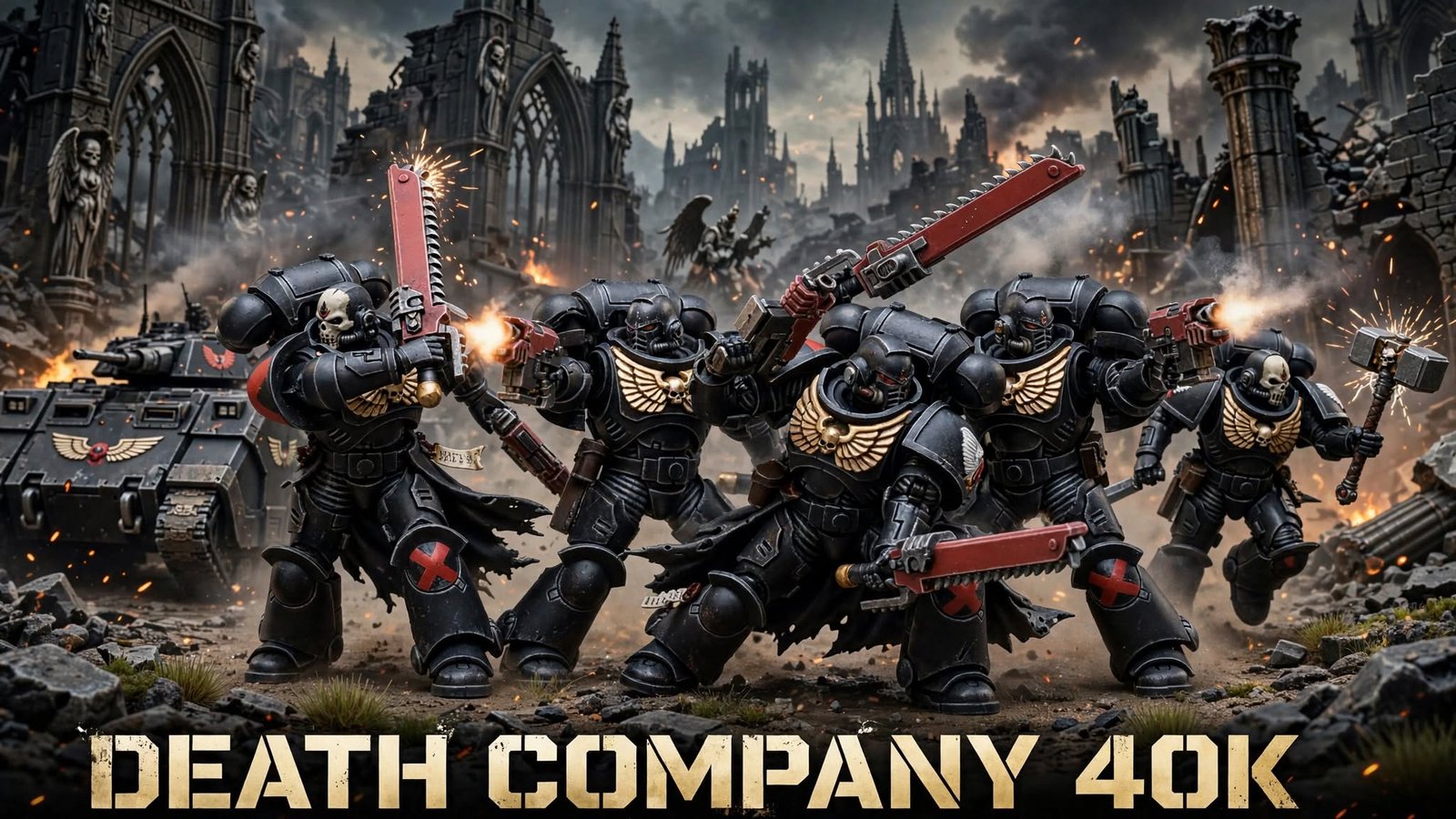
Death Company 40k in Warhammer 40,000 is a formation of Blood Angels (and some Blood Angels successor Chapter) Space Marines who have succumbed to the Black Rage, a hereditary psychic affliction rooted in the death of the primarch Sanguinius during the Horus Heresy. Marines lost to the Black Rage lose their higher reasoning and are consumed by a compulsion to relive Sanguinius’s final battle against the Chaos god Horus. Rather than being executed or exiled, they are gathered into the Death Company, painted in black, and led into battle by a Chaplain — usually as one final, devastating charge from which few are expected to return. As of September 2026, Death Company units are actively supported in Warhammer 40,000 11th Edition through the Blood Angels’ Codex Supplement, updated for the new edition, and remain a defining, currently-collectible part of the Blood Angels army.
Table of Contents
Death Company 40k and the Blood Angels
What Is Death Company 40k in Warhammer 40,000?
Death Company 40k is not a single model, a single unit, or a stand-alone faction. It’s a battlefield formation drawn from the Blood Angels Space Marine Chapter (and, less commonly, from Blood Angels successor Chapters such as the Flesh Tearers), made up of battle-brothers who have fallen to the Black Rage.
These marines have effectively lost themselves. They no longer function as disciplined squad members; instead they are gripped by hallucinatory memories of Sanguinius’s death and driven into a berserk, single-minded need for violence. Rather than discard these marines, the Blood Angels give them one final purpose: a place in the Death Company, where their fury is turned toward the Chapter’s enemies under the guidance of specialist Chaplains.
In game terms, “Death Company 40k” also refers to a specific in-game keyword and a family of datasheets — Death Company Marines, Death Company Marines with Jump Packs, and the Death Company Dreadnought — all fielded as part of a Blood Angels army list. So the term operates on two levels at once: a piece of Blood Angels lore, and a named set of current tabletop units.
The Blood Angels are one of the First Founding Space Marine Chapters, created from the gene-seed of the primarch Sanguinius. They are renowned in Warhammer 40,000 lore as noble, artistic, and ferociously skilled in close combat — but also as a Chapter carrying a hidden, chapter-wide genetic curse.
That curse traces back to the Horus Heresy, the galaxy-spanning civil war in which Sanguinius was killed in single combat by the arch-traitor Horus. The trauma of that death was somehow imprinted into the Blood Angels’ gene-seed, and it resurfaces in successive generations of the Chapter as two related conditions: the Red Thirst and the Black Rage.
Death Company 40k exists specifically because the Blood Angels refuse to simply put down battle-brothers who succumb to this curse. Instead, the Chapter has built an entire tradition — complete with dedicated Chaplains, black armor, and battlefield doctrine — around giving these lost warriors a final, meaningful death in service of the Imperium.
The Black Rage Explained
The Black Rage is the more severe and irreversible of the two Sanguinius-linked afflictions. A Blood Angel who succumbs to it experiences intrusive, dream-like memories of Sanguinius’s final moments against Horus, as though the marine is reliving that death over and over. Over time, this overwhelms the marine’s own identity.
In plain terms:
- The marine stops recognizing squad-mates, orders, or even their own name.
- They become fixated on refighting — and dying in — the battle that killed their primarch.
- The condition is considered permanent. There is no known cure in current Blood Angels lore.
- Marines afflicted this way are moved into the Death Company rather than left in normal squads, both to protect other battle-brothers and to make use of their otherwise wasted potential.
The Black Rage is distinct from ordinary battle trauma or anger — it is described in Blood Angels lore as a specific, gene-seed-linked condition unique to Sanguinius’s sons, not a generic Space Marine flaw.
Read More: https://gamespuma.com/death-guard-40k/
The Red Thirst and Its Connection to Death Company 40k
The Red Thirst is the milder, more common cousin of the Black Rage. Many Blood Angels experience periodic surges of bloodlust and aggression in combat — a controllable, if unsettling, symptom that most battle-brothers learn to manage with discipline, ritual, and the guidance of Chaplains.
The relationship between the two conditions matters for understanding Death Company:
- The Red Thirst is usually survivable and manageable across a marine’s career.
- The Black Rage is not manageable — it is a one-way trip.
- A marine experiencing worsening Red Thirst symptoms is watched closely, because it can be an early warning sign that the Black Rage is beginning to take hold.
- Once full Black Rage sets in, the marine is transferred to the Death Company rather than continuing in a standard company.
So the Red Thirst and Black Rage sit on the same spectrum of the Blood Angels’ inherited condition, with Death Company representing the endpoint of that spectrum.
Death Company 40k Lore and Battlefield Purpose
Within Blood Angels doctrine, being assigned to the Death Company isn’t treated as a punishment — it’s framed as a grim honor and a final act of service. Death Company marines are typically committed to battle in one of two ways:
- As a decisive shock assault, thrown at a critical moment to break an enemy line or destroy a priority target.
- As a controlled “mercy” deployment, where the Chapter deliberately gives these lost warriors a chance to die gloriously in combat rather than fade away in confinement.
Because Black Rage sufferers are extremely difficult to command in any conventional sense, they are never sent into battle without supervision. A Chaplain — most often Chaplain Lemartes, the traditional “Guardian of the Lost” — accompanies the Death Company 40k to direct their fury toward the enemy and keep them from turning on their own side. If a Death Company 40k marine’s rage becomes completely unmanageable even for a Chaplain, that duty falls to Astorath the Grim, the Blood Angels’ High Chaplain, whose grim role includes ending the suffering of the truly lost.
Despite their condition, Death Company marines are still considered loyal servants of the Imperium and the Blood Angels Chapter. They are not traitors, and their affliction is treated as a tragic hereditary burden rather than a moral failing.
Death Company 40k Units and Models
On the tabletop, “Death Company” corresponds to a specific family of units within a Blood Angels army. Based on the current Blood Angels Codex Supplement (introduced in 2024 and carried into 11th Edition with an updated Faction Pack), the core Death Company unit types are:
- Death Company 40k Marines — bolt rifle/bolt pistol-armed infantry, the current name for units previously marketed as “Death Company Intercessors.”
- Death Company 40k Marines with Jump Packs — the same troop type equipped for rapid, mobile assault deployment.
- Death Company Dreadnought — a Death Company marine interred in Dreadnought war-plate after their body could no longer sustain them, still lost to the Black Rage.
- Death Company Captain — an officer-level model built specifically to lead Death Company formations.
- Chaplain Lemartes and Astorath the Grim — named characters closely tied to leading, controlling, and (when necessary) ending the Death Company.
All of these units share the Death Company 40k keyword and several common rules threads, such as Feel No Pain-style damage mitigation and abilities that reward aggressive, close-in play — reflecting their berserk, hard-to-kill battlefield identity.
A note on naming: “Death Company 40k Intercessors”
Many searches use the term “Death Company 40k Intercessors,” which reflects how the unit was marketed and named earlier in Warhammer 40,000’s 10th Edition (2023–2024), when Primaris-based Death Company troops were sold and referred to under that name. With the 2024 Blood Angels Codex Supplement, Games Workshop renamed the datasheet to Death Company Marines, aligning it with the standard equipment-based naming used for other Death Company loadouts. If you see “Death Company Intercessors” in an older article or product listing, it refers to the same underlying troop type now called Death Company Marines.
Death Company 40k Marines
Death Company 40k Marines are the backbone infantry of the formation — battle-brothers lost to the Black Rage, equipped with boltguns and combat blades, sent forward in a tight, aggressive line. Their battlefield role is close-range shock infantry: they are not meant to hold ground or play a slow, defensive game. Their in-game identity emphasizes surviving incoming fire long enough to reach the enemy and then inflicting disproportionate melee damage once they arrive.
A jump pack-equipped variant exists for players who want a faster, more mobile Death Company 40k element capable of covering ground quickly and engaging priority targets early in a game.
Death Company 40k Intercessors
As noted above, “Death Company 40k Intercessors” is the earlier (10th Edition-era) name for what is now called Death Company Marines. The underlying concept — Primaris-scale Blood Angels marines afflicted by the Black Rage, geared for melee — has not changed; only the datasheet name and some of its rules details have been updated across Games Workshop’s Blood Angels releases. Collectors and list-builders searching for “Death Company Intercessors” today should look for Death Company 40k Marines in current Blood Angels army-building tools and official resources.
Death Company 40k Dreadnoughts
When a Death Company 40k marine’s body is destroyed beyond recovery but the Chapter still judges their gene-seed and remains worth preserving, they may be interred within a Dreadnought war-machine — a walking sarcophagus that keeps a critically wounded or dying Space Marine in the fight indefinitely. A Death Company 40k Dreadnought is this outcome applied to a Black Rage sufferer: a towering, heavily armored combat walker still driven by the same uncontrollable fury that consumed the marine inside it.
On the tabletop, Death Company 40 kDreadnoughts function as durable, close-combat-focused vehicles, built around a current Blood Angels Dreadnought chassis and equipped with heavy melee weaponry rather than long-range firepower. They represent one of the most visually distinctive and thematically resonant units in the Blood Angels range, combining raw physical durability with the same berserk battlefield behavior as their infantry counterparts.
Chaplains and Death Company
No Death Company unit goes to war unsupervised — the relationship between Chaplains and Death Company is central to how the formation actually functions in the fiction.
- Chaplain Lemartes, known as the Guardian of the Lost, is the definitive Death Company leader. His role is to march at the head of the Death Company, using ritual, litany, and personal example to direct their rage at the enemy rather than at their own side.
- Astorath the Grim, the Blood Angels’ High Chaplain, holds a more severe duty: he is empowered to grant the “Emperor’s Peace” to any Blood Angel whose Black Rage has become so complete that even Death Company service can no longer contain them. In practice, this means Astorath can end the life of a battle-brother who is beyond saving, sparing the Chapter and the individual further suffering.
This chaplain oversight is treated in Blood Angels lore as essential — without it, the Death Company would be an unguided mob rather than a directed weapon.
Death Company Weapons and Equipment
Death Company equipment loadouts emphasize close-quarters lethality over ranged firepower, consistent with their role as shock assault troops:
- Boltguns, bolt pistols, and bolt rifles for closing distance under fire.
- Combat blades, chainswords, and power weapons for their preferred melee engagements.
- Jump packs on mobility-focused variants, allowing rapid deployment across the battlefield.
- Heavy melee weaponry on the Death Company Dreadnought, reflecting its role as a walking wrecking machine rather than a fire-support platform.
Exact wargear options, points costs, and stratagem interactions change between edition updates and errata releases, so players should always check the current official datasheet or the Warhammer 40,000 app for exact, up-to-date loadouts rather than relying on older product listings.
Death Company in the Current Warhammer 40,000 Rules
As of September 2026, Warhammer 40,000 is in its 11th Edition, which launched in June 2026 with the Warhammer 40,000: Armageddon starter set. Games Workshop has confirmed that existing 10th Edition codexes, including the Blood Angels Codex Supplement, remain usable in 11th Edition, updated through free digital Faction Pack rules rather than requiring an immediate all-new physical book.
Key current-edition facts, as verified through official and closely-tracked community sources:
- Blood Angels retain Death Company Marines, Death Company Marines with Jump Packs, the Death Company Dreadnought, and a Death Company Captain as active, currently-playable datasheets.
- The Blood Angels have access to multiple detachments, including one built specifically around Death Company-themed play, alongside more general Blood Angels and character-focused detachment options.
- Detailed ability names and specific wargear interactions (for example, the Death Company Dreadnought’s charge-related ability) have received minor wording updates as part of the 11th Edition transition — a normal part of edition changeovers rather than a sign the unit has been removed.
- A full, standalone 11th Edition Blood Angels codex book had not been published as of this writing; Blood Angels players should check Games Workshop’s official Warhammer 40,000 app or Warhammer Community site for the latest confirmed detachment list and points values before building a list.
This article intentionally does not list exact points costs or full stat-line numbers, since these values are updated periodically through balance passes and are best checked directly against the current official datasheet at the time you’re building a list.
Death Company Army-Building Considerations
When including Death Company units in a Blood Angels army, a few structural considerations recur across current and recent editions:
- Chaplain support matters. Death Company units typically benefit from being led by, or kept near, a Chaplain — reflecting their in-fiction need for supervision.
- They are a melee-first commitment. Death Company units are built to close the distance and fight in combat, not to sit back and trade ranged fire, so they generally reward aggressive deployment and target prioritization rather than a purely defensive playstyle.
- Durability comes from damage mitigation, not raw toughness. Death Company units commonly rely on Feel No Pain-style rules to survive incoming damage on their way into combat, rather than high raw Toughness or heavy armor saves alone.
- Detachment choice shapes their effectiveness. Because Blood Angels detachments differ in theme (character-focused, Sanguinary Guard-focused, or Death Company-focused), the detachment chosen for a given list meaningfully changes how well Death Company units are supported.
None of this should be read as a claim that Death Company is “the best” or “guaranteed effective” choice — competitive performance depends on points costs, the current meta, opponent match-ups, and rules updates that change over time. Players wanting exact competitive analysis should consult current tournament data and official points updates directly.
Painting and Customizing Death Company Models
Death Company models are painted distinctly from the rest of the Blood Angels Chapter, and this distinction is meaningful in the lore, not just an aesthetic choice:
- Black power armor marks a Death Company marine as having been “claimed” by the Black Rage, separating them visually from the Chapter’s usual red-and-black scheme.
- Red details, red crosses, and blood-drop iconography are commonly used as accent markings, referencing the marine’s fallen state and the blood-themed symbolism of the Chapter.
- Weathering and battle damage (chipped edges, dust, scorch marks) are popular choices for conveying the desperate, hard-fought nature of Death Company deployments.
- Basing often leans into battlefield wreckage or fallen enemies to reinforce the “final glorious charge” narrative associated with the formation.
Hobbyists customizing Death Company squads often mix jump pack and non-jump pack loadouts within the same collection to represent both the footslogging and rapid-assault roles described in their army-building options, and many use the included transfer sheets from official Blood Angels kits to add chapter and squad-specific markings.
Death Company Compared With Regular Blood Angels
| Aspect | Regular Blood Angels | Death Company |
|---|---|---|
| Mental state | Disciplined, self-aware, follows orders normally | Consumed by the Black Rage; lost higher reasoning |
| Armor color | Standard Blood Angels red and black | Distinct black armor marking their condition |
| Command structure | Normal Chapter command hierarchy | Requires direct Chaplain oversight in battle |
| Battlefield role | Varied — can include ranged support, objective play, etc. | Close-combat shock assault, typically one-way commitment |
| Long-term outlook | Continues normal service career | Condition is permanent; deployment is often a final act |
This comparison reflects documented lore and general battlefield roles rather than a claim about which choice performs better in competitive play — the two categories exist for different narrative and tactical purposes within the same Chapter.
Common Questions About Death Company 40K
What is Death Company in Warhammer 40K? Death Company is a formation of Blood Angels Space Marines who have succumbed to the Black Rage, a hereditary condition tied to the death of their primarch Sanguinius. They are gathered together, painted black, and led into battle by a Chaplain for what is usually a final, decisive assault.
Why do Blood Angels become part of the Death Company? A Blood Angel enters the Death Company when the Black Rage fully takes hold, causing them to lose their identity and become consumed by an uncontrollable urge to relive Sanguinius’s death in combat. Rather than exile or execute these marines, the Chapter gives them a structured final purpose in battle.
What is the Black Rage? The Black Rage is a psychic, hereditary condition unique to the Blood Angels’ gene-seed, in which a marine relives Sanguinius’s death against Horus so intensely that it overwrites their own personality and judgment. It is considered permanent and untreatable in current Blood Angels lore.
Are Death Company Space Marines still loyal to the Imperium? Yes. Despite losing rational control, Death Company marines are not treated as traitors or renegades. Their condition is viewed as a tragic hereditary burden, and their final battles are framed as continued, honorable service to the Imperium and their Chapter.
What units can be part of the Death Company? Current Blood Angels army rules include Death Company Marines, Death Company Marines with Jump Packs, a Death Company Captain, and the Death Company Dreadnought, alongside Chaplain characters closely tied to leading or ending Death Company deployments, such as Lemartes and Astorath the Grim.
What is the difference between Death Company and regular Blood Angels? Regular Blood Angels are disciplined battle-brothers who can serve in any battlefield role. Death Company marines have lost that discipline to the Black Rage, wear distinct black armor, require direct Chaplain supervision in battle, and are almost always deployed for close-combat shock assaults rather than varied tactical roles.
Can Death Company be used in a Blood Angels army? Yes. Death Company units are a core, currently-supported part of Blood Angels army-building in Warhammer 40,000, including in 11th Edition, using the Blood Angels Codex Supplement and its associated detachments.
What is a Death Company Dreadnought? A Death Company Dreadnought is a Death Company marine whose gravely wounded body has been interred within a Dreadnought war-machine, allowing them to keep fighting despite their injuries — while still consumed by the same Black Rage that placed them in the Death Company to begin with.
Why are Death Company models painted black? Black armor is used specifically to mark Death Company marines as having succumbed to the Black Rage, visually distinguishing them from the standard red-and-black Blood Angels color scheme and signaling their altered status within the Chapter.
Are older Death Company rules still valid? No — rules from previous Warhammer 40,000 editions, including earlier 8th and 9th Edition Death Company datasheets, are not valid for current games. Only the current Blood Angels Codex Supplement rules, as updated for the current edition, should be used for matched or organized play. Always check the official Warhammer 40,000 app or Games Workshop’s site for the latest confirmed version before playing.
Final Summary
Death Company is one of the most distinctive and lore-rich elements of the Blood Angels Space Marine Chapter in Warhammer 40,000. It exists at the intersection of tragedy and battlefield necessity: marines lost to the Black Rage, a hereditary condition tracing back to Sanguinius’s death in the Horus Heresy, are not discarded but instead given one final, meaningful role in the Chapter’s wars. On the tabletop, this translates into a family of close-combat-focused units — Death Company Marines, their jump pack variant, the Death Company Dreadnought, and dedicated Chaplain leadership from characters like Lemartes and Astorath the Grim — all currently supported in Warhammer 40,000 11th Edition through the Blood Angels Codex Supplement. Whether you’re approaching Death Company for its lore, its models, or its place in a Blood Angels army list, the throughline is the same: warriors who have lost themselves, given one last chance to serve.
Source List
| Source | Page/Title | URL | What Was Verified | Date |
|---|---|---|---|---|
| Lexicanum (community wiki) | Death Company | https://wh40k.lexicanum.com/wiki/Death_Company | Unit history, naming lineage | Accessed Sept 2026 |
| Wahapedia | Space Marines — Death Company Dreadnought, Marines, Captain (10th Ed) | wahapedia.ru/wh40k10ed/factions/space-marines/ | Current datasheet names, wargear options | 2024–2026 |
| GrimSlate | Death Company Intercessors — Blood Angels Datasheet | grimslate.com/factions/blood-angels/death-company-intercessors | Confirms renaming, points reference, Legends status note | Dec 2024 |
| Tabletop Battles (Goonhammer-affiliated) | Codex Blood Angels 10th Edition Review | tabletopbattles.com/codex-blood-angels-10th-edition-the-goonhammer-review | Renaming of Death Company Intercessors to Death Company Marines, unit changes | 2024 |
| Tabletop Battles | 11th Edition Faction Pack Review: Blood Angels | tabletopbattles.com/40k-11th-edition-faction-pack-review-blood-angels | Confirms Death Company units/detachments carried into 11th Edition with minor updates | Sept 2026 |
| Wargamer | Warhammer 40k 11th edition starter guide | wargamer.com/warhammer-40k/11th-edition | Confirms 11th Edition launch (June 2026), codex-carryover policy | Aug 2026 |
| Bell of Lost Souls | AdeptiCon 2026 – 11th Edition Announced | belloflostsouls.net/2026/03/… | 11th Edition announcement details | Mar 2026 |
| Bell of Lost Souls | Blood & Dark Angels Update Missing Chapter-Specific Detachments | belloflostsouls.net/2026/09/… | 11th Edition Blood Angels detachment status | Sept 2026 |
| Wargamer | Blood Angels Death Company box announcement | wargamer.com/warhammer-40k/blood-angels-army-set-codex-reveal | 2024 codex supplement and army set contents | Jul 2024 |
| Tale of Painters | Review: Blood Angels Death Company army set | taleofpainters.com/2024/08/review-blood-angels-death-company-army-set | Confirms one-time production run for the 2024 army set | Sept 2024 |
| Mind Games and Magic / official product listing | Blood Angels Army Box | mindgamesandmagic.com/products/blood-angels-army-box | Full box contents list | 2024 |

Written by Daniel Carter
Daniel Carter is a dedicated gaming writer who enjoys turning complex gaming topics into clear, useful, and engaging content. He covers game guides, tips, reviews, features, and the latest developments across the gaming world. His approach focuses on research, accuracy, and practical value, helping readers discover new games, improve their gameplay, and stay informed about the industry. For Daniel, great gaming content is not just about information—it is about making every article genuinely worth reading.
1 thought on “Death Company 40K: The Blood Angels’ Doomed Warriors, Explained”