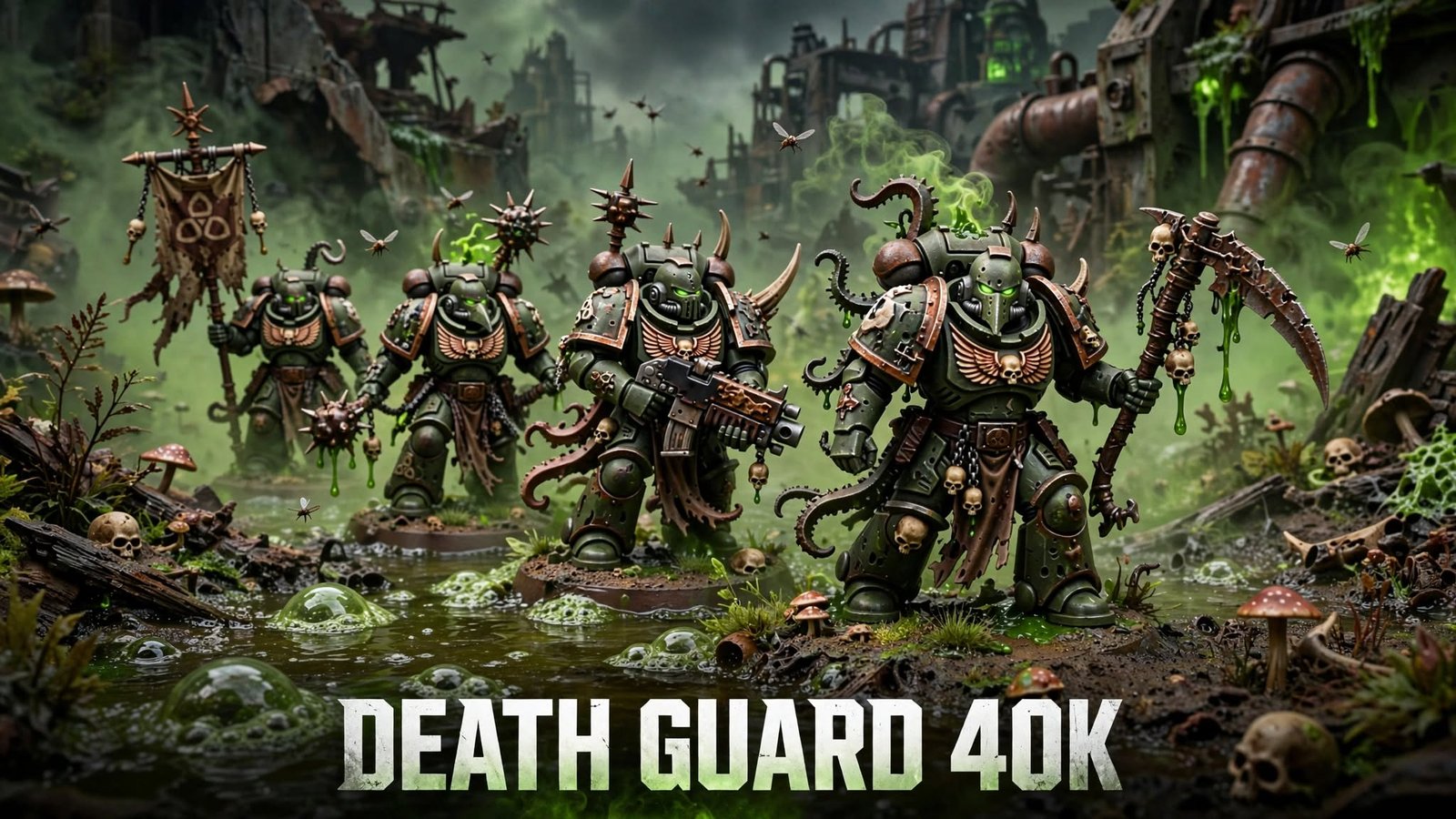
Death Guard 40K Warhammer is currently in 11th Edition (launched June 2026). Death Guard are playing from their 10th Edition codex as updated by the free Death Guard Faction Pack; they have not yet received a new-format 11th Edition codex. Rules, points, and product details below are noted with their source and date — always check Warhammer Community for the latest updates before building a list.
Table of Contents
Quick Answer: Who Are the Death Guard 40k?
The Death Guard are a Chaos Space Marine faction in Warhammer 40,000 — the corrupted remnants of the XIV Space Marine Legion, once led by the Primarch Mortarion, now bound to Nurgle, the Chaos God of disease, decay, and stubborn endurance. On the tabletop they’re a slow, nearly unkillable army built around spreading a worsening aura of contagion called Contagion Range, wearing enemies down through attrition rather than speed.
What Is Death Guard 40k in Warhammer 40,000?
Death Guard 40k are one of several Chaos Space Marine factions with their own dedicated codex, sitting alongside forces such as the World Eaters, Thousand Sons, and Emperor’s Children as a Legion wholly given over to a single Chaos God. Where those factions lean into fury or sorcery, Death Guard lean into resilience and rot: bloated Plague Marines who shrug off wounds that would kill lesser troops, support characters who spread supernatural disease, and daemon engines fused with rusted armour plate.
Codex: Death Guard 40k is a 128-page hardback containing 36 datasheets, six Detachments, two army-wide rules, Crusade narrative-campaign content, and Combat Patrol rules for the faction’s starter box, alongside background material and painting guidance for the “Maggot Lords” warband featured in that box.
Death Guard 40k Lore and History
The Death Guard 40k began as the XIV Legion of Space Marines, one of twenty Legions created during the Emperor’s Great Crusade to reunite humanity’s lost colonies. Under their Primarch Mortarion, they earned a reputation as some of the most disciplined and durable warriors in the Imperium, prized for their ability to endure conditions — toxic atmospheres, brutal sieges, catastrophic losses — that would break other forces.
That resilience curdled during the Horus Heresy, the galaxy-spanning civil war in which half the Space Marine Legions turned against the Emperor. Mortarion, harbouring long-standing resentment toward the Emperor, sided with the Warmaster Horus. En route to reinforce the assault on Terra, the Death Guard fleet became trapped adrift in the Warp — the immaterial dimension underlying Chaos — where a mysterious and lethal contagion, the Destroyer Plague, began to spread through the Legion’s ranks.
Facing the annihilation of his sons, Mortarion made a desperate pact with Nurgle, the Chaos God of disease and despair. Nurgle answered: the disease stopped killing the Death Guard, but it never really left. Their bodies were remade — bloated, rotting, riddled with corruption, yet functionally immune to the pain and debilitation that would incapacitate an ordinary warrior. The Death Guard became Plague Marines, and Mortarion himself was ultimately transformed into one of Nurgle’s greatest Daemon Princes, ruling a corrupted Plague Planet deep within the Eye of Terror.
In the current 41st-Millennium setting, the Death Guard continue to wage war against the Imperium and its allies, spreading Nurgle’s “gifts” across worlds and star systems in campaigns of plague and conquest, occasionally alongside — and occasionally in competition with — other Nurgle-aligned forces such as the Chaos Daemons of the Plague God.
Read More: https://gamespuma.com/kill-team/
Mortarion and the Death Guard’s Connection to Nurgle
Mortarion is the Death Guard’s Daemon Primarch and the single most important figure in their lore. Raised on the toxic, tyrant-ruled world of Barbarus before his discovery by the Emperor, he carried a lifelong hatred of weakness and of those who ruled through fear — an outlook that shaped the Death Guard’s unyielding, march-forward philosophy long before Nurgle entered the picture.
His fall is inseparable from Nurgle’s nature as the god of decay, disease, and — perhaps counterintuitively — a grim, patient endurance. Nurgle didn’t just infect the Death Guard; he offered them a way to survive infection forever, at the cost of their humanity. That bargain defines the faction: Death Guard armies aren’t fast or subtle, but they are agonisingly difficult to remove from an objective, mechanically expressing Mortarion’s own transformation from a Legion that endured hardship to one that has become hardship itself.
Death Guard 40k Visual Style and Themes
Death Guard 40k miniatures and artwork lean into grotesque decay: corroded, verdigris-streaked power armour, bloated and swollen bodies barely contained by their war-plate, and weapons and vehicles that appear to be rusting and rotting even as they remain lethally functional. Common visual motifs include:
- Flies, maggots, and other carrion imagery worked into iconography and basing
- Sickly green, brown, and bone colour palettes, often finished with grime, rust, and “slime” weathering effects
- The number seven and bell/tocsin imagery, tied to Nurgle’s associations with plague and mourning
- Weapon and equipment names built around disease and rot (“blight,” “plague,” “contagion”)
How a Death Guard 40k Army Plays
Death Guard are built around one central idea: the longer the fight goes on, the worse it gets for the enemy. Their army-wide rule, Nurgle’s Gift, gives every Death Guard model a Contagion Range that starts small and grows automatically as the battle progresses. Any enemy unit caught within that range becomes Afflicted — suffering a Toughness reduction plus the effect of a Plague chosen before the battle (options include making enemy shooting worse, degrading their armour save, or slowing their movement, Leadership, and objective control).
Beyond that shared foundation, players choose from nine currently available Detachments, each built around a different playstyle:
| Detachment | Focus | Source |
|---|---|---|
| Virulent Vectorium | Balanced mixed-arms toolbox; secures objectives and spreads Contagion | Codex |
| Mortarion’s Hammer | Vehicles and Daemon Engines with pre-battle bombardment | Codex |
| Champions of Contagion | Stacking multiple special-character “champions” for compounding debuffs | Codex |
| Tallyband Summoners | Summoned Nurgle Daemons fighting alongside Death Guard | Codex |
| Shamblerot Vectorium | Poxwalker hordes that keep reinforcing every turn | Codex |
| Death Lord’s Chosen | Terminator-heavy elite strike force | Codex |
| Contagion Engines | Daemon-engine vehicle spearhead | 11th Ed. Faction Pack |
| Flyblown Host | Infiltrating Plague Marine gunline | 11th Ed. Faction Pack |
| Paragons of Putrescence | Character-driven, extended Contagion Range | 11th Ed. Faction Pack |
Regardless of Detachment, beginners should expect a slow-moving, foot- or transport-based army that wins by attrition and objective control rather than alpha-strike damage — patience and target prioritisation matter more than raw speed.
Important Death Guard 40k Units and Characters
The current codex includes 36 datasheets. Representative categories for new players include:
- Characters: Mortarion (the Daemon Primarch himself, an Epic Hero-tier centrepiece), Typhus (Herald of Nurgle, the former First Captain responsible for the Legion’s fall), Lord of Virulence, Malignant Plaguecaster (the faction’s psyker), Biologus Putrifier, Plague Surgeon, Noxious Blightbringer, Foul Blightspawn, and the Tallyman (a battlefield support character).
- Battleline infantry: Plague Marines, the faction’s core troops, prized for their durability and flexible weapon options; Poxwalkers, cheap shambling mutant hordes that can be reinforced turn after turn in some Detachments.
- Terminator elites: Deathshroud Terminators (Mortarion’s bodyguard) and Blightlord Terminators, both slow but extremely hard to shift in melee.
- Vehicles and daemon engines: Foetid Bloat-drones, Myphitic Blight-haulers, Helbrutes, Plagueburst Crawlers, and a range of Rhino- and Land Raider-pattern transports and tanks.
- Daemon allies: Under the Tallyband Summoners Detachment, Nurgle Daemons such as Plaguebearers, Nurglings, Beasts of Nurgle, Plague Drones, and the towering Great Unclean One can fight alongside Death Guard.
Each unit’s exact points cost, wargear options, and abilities are defined on its official datasheet and the current Munitorum Field Manual — always confirm the latest version before finalising a list, since points and rules are periodically updated.
Death Guard 40k Rules and Current Edition
As of September 2026, Warhammer 40,000 is in 11th Edition, which launched with a free Core Rules download in June 2026. Games Workshop designed 11th Edition as a refinement of 10th Edition rather than a full rules reset: existing codexes stay legal, and each faction receives a free digital Faction Pack that updates its Detachments and rules for the new edition ahead of getting a full printed codex later.
For Death Guard specifically, that means:
- The printed Codex: Death Guard 40k (10th Edition) remains the core rules source, providing 36 datasheets and the faction’s original six Detachments.
- The Death Guard Faction Pack (11th Edition, currently version 1.2 as of August 2026) is a free download that adjusts existing rules for 11th Edition and adds three further Detachments: Contagion Engines, Flyblown Host, and Paragons of Putrescence.
- Death Guard have not yet received a full new-format 11th Edition codex. Orks were first to get one (September 2026), with Space Marines confirmed next — a Death Guard 11th Edition codex will presumably follow later in the rollout, though Games Workshop has not announced a date.
Because faction packs and points updates change periodically, treat any specific stratagem, points cost, or Detachment rule as a snapshot in time and verify it against Warhammer Community or your rules-reference tool of choice before a tournament or pickup game.
Starting a Death Guard 40k Army
There’s no single “correct” way to begin collecting Death Guard, but a common, practical sequence looks like this:
- Pick up the Combat Patrol box (see below) for a ready-made small force plus rules for Combat Patrol-sized games.
- Read (or download) the current Death Guard 40k Faction Pack alongside the codex so your rules knowledge matches the current edition.
- Decide on a playstyle — infantry attrition, Poxwalker hordes, Terminator elites, or a vehicle-heavy Mortarion’s Hammer force — and expand your Combat Patrol force in that direction.
- Add a Warlord-tier character such as a Lord of Virulence, Daemon Prince, or eventually Mortarion himself as your collection grows.
- Build up to Incursion or Strike Force-sized games (the standard matched-play battle sizes) once you’re comfortable with the faction’s core mechanics.
Beginners should also budget for assembly tools, plastic glue, and Citadel-brand (or comparable) paints and primer, since Death Guard kits are supplied unpainted and require assembly.
Death Guard 40k Models, Boxes, and Hobby Requirements
Combat Patrol: Death Guard, nicknamed the “Maggot Lords” box, is the faction’s current dedicated starter set. It contains 13 plastic miniatures forming a complete small-scale force:
- 1× Lord of Virulence (the named character Sholgor the Putrid), acting as Warlord
- 1× Tallyman (the named character Septimol Fulg)
- 3× Deathshroud Terminators
- 6× Plague Marines, with extensive weapon options (boltguns, a blight launcher, a plasma gun, a meltagun, a plaguebelcher, a heavy plaguespewer, and assorted melee weapons)
- 1× Chaos Rhino transport
The box includes rules for fielding this specific force in Combat Patrol-format games and has been listed at various points as in and out of stock at Games Workshop’s own store — check current availability before ordering, as boxes are periodically discontinued or temporarily out of print. Beyond the Combat Patrol box, individual kits exist for most of the units listed above (Plague Marines, Poxwalkers, Terminators, daemon engines, and characters including Typhus and Mortarion), letting you expand a collection unit by unit rather than committing to a single large box.
Always confirm current box contents and pricing directly with Games Workshop or an authorised retailer before purchasing, since contents and prices can change between print runs.
Painting Death Guard Miniatures
Death Guard are a popular faction for painters specifically because “sloppy” and “grimy” often look intentional rather than like a mistake. A practical, beginner-friendly approach:
- Base coat armour plates in a mid-tone green or bone colour, then apply heavy washes/shades to pool in recesses and simulate grime.
- Layer highlights sparingly on raised armour edges to keep the model readable under tabletop lighting.
- Add texture effects — many hobbyists use dedicated “sludge,” “rot,” or “slime” technical paints to build up dripping, oozing surfaces on weapons, wounds, and vehicle hulls.
- Finish with rust and grime washes on metal areas (bolters, blades, vehicle treads) to tie the model into the faction’s overall corroded aesthetic.
- Base your models with muck, bones, or overgrowth to match the “world rots at their touch” theme.
Because the faction rewards heavier weathering, it’s a forgiving army for less experienced painters to get a strong tabletop-ready result relatively quickly.
Death Guard Beyond the Tabletop
While the core meaning of “Death Guard 40K” is the tabletop faction above, the name also comes up in a couple of adjacent contexts worth distinguishing clearly:
- Horus Heresy (30K): Death Guard also appear as a playable Legion in Games Workshop’s Horus Heresy tabletop game, representing the Legion during the Horus Heresy era rather than their fully corrupted 41st-Millennium form. Horus Heresy rules and datasheets are a separate rules system from 40K and should not be mixed with current 40K army lists.
- Digital games: Nurgle-aligned Chaos Space Marine antagonists strongly evocative of the Death Guard appear in Warhammer 40,000: Space Marine 2, particularly in its Chaos-focused content; some community-made mods and content additions go further and let players field Death Guard directly. These digital appearances are separate from, and don’t affect, official tabletop rules.
- Kill Team: Death Guard-themed content has appeared in Kill Team, Games Workshop’s skirmish-scale spin-off, under its own separate rules system.
If you’re researching any of these specifically, search for them by name (e.g., “Death Guard Horus Heresy” or “Death Guard Kill Team”) rather than assuming tabletop 40K rules apply.
Common Beginner Questions
Are Death Guard a good faction for a first army? They’re a reasonable beginner pick if you enjoy a slower, resilience-focused playstyle and don’t mind losing some races to fast objective-grabbing armies in exchange for being very hard to remove from a fight. Whether they’re currently strong in a competitive sense changes with points and balance updates, so treat any specific competitive claim as time-stamped rather than permanent.
Do I need the codex if I already have the Combat Patrol box? The Combat Patrol box includes enough rules to play Combat Patrol-format games with its included models, but you’ll want the codex (plus the free Faction Pack) once you expand beyond that box or want access to the full range of Detachments and units.
Can I mix Death Guard with other Chaos factions? Certain Detachments (Tallyband Summoners) explicitly allow Nurgle Daemon “Plague Legions” units alongside Death Guard; mixing with other Chaos Space Marine Legions generally is not supported under the Death Guard Faction Faction rules and should be checked against the current codex and Core Rules for allied detachment options.
Frequently Asked Questions
What is Death Guard 40K? Death Guard 40K refers to the Death Guard, a Chaos Space Marine faction in Games Workshop’s Warhammer 40,000 tabletop wargame, built around Nurgle-themed disease, decay, and battlefield resilience.
Who is the Death Guard’s Primarch? Mortarion, originally the loyalist Primarch of the XIV Legion, later transformed into a Daemon Prince of Nurgle after the Legion’s corruption during the Horus Heresy.
What edition of Warhammer 40,000 are Death Guard currently in? 11th Edition, using their 10th Edition printed codex updated by the free Death Guard Faction Pack (version 1.2 as of August 2026), pending a future full 11th Edition codex.
What’s in the Death Guard Combat Patrol box? Thirteen miniatures: a Lord of Virulence, a Tallyman, three Deathshroud Terminators, six Plague Marines, and a Chaos Rhino transport.
Are Death Guard the same in 40K and Horus Heresy? No. Horus Heresy Death Guard represent the Legion before their full transformation, using a separate rules system (30K) from current Warhammer 40,000.
Final Summary
The Death Guard are one of Warhammer 40,000’s most visually and thematically distinctive factions: a once-proud Space Marine Legion turned into an army of unkillable, disease-ridden zealots serving Nurgle. On the tabletop, they play a patient, attritional game built around a spreading contagion aura and extremely durable troops, with nine Detachments (six from their 10th Edition codex, three added by the free 11th Edition Faction Pack) offering different tactical flavours. New collectors have a clear on-ramp via the Combat Patrol: Death Guard box, and the faction’s grimy, weathered aesthetic makes it a genuinely forgiving army to paint. As Warhammer 40,000’s 11th Edition rollout continues, expect further rules refinements and, eventually, a dedicated new-format Death Guard codex — until then, the codex-plus-Faction Pack combination is the accurate, current way to build and play the army.

Written by Daniel Carter
Daniel Carter is a dedicated gaming writer who enjoys turning complex gaming topics into clear, useful, and engaging content. He covers game guides, tips, reviews, features, and the latest developments across the gaming world. His approach focuses on research, accuracy, and practical value, helping readers discover new games, improve their gameplay, and stay informed about the industry. For Daniel, great gaming content is not just about information—it is about making every article genuinely worth reading.
1 thought on “Death Guard 40K: Lore, Rules, Units, and a Beginner’s Guide”