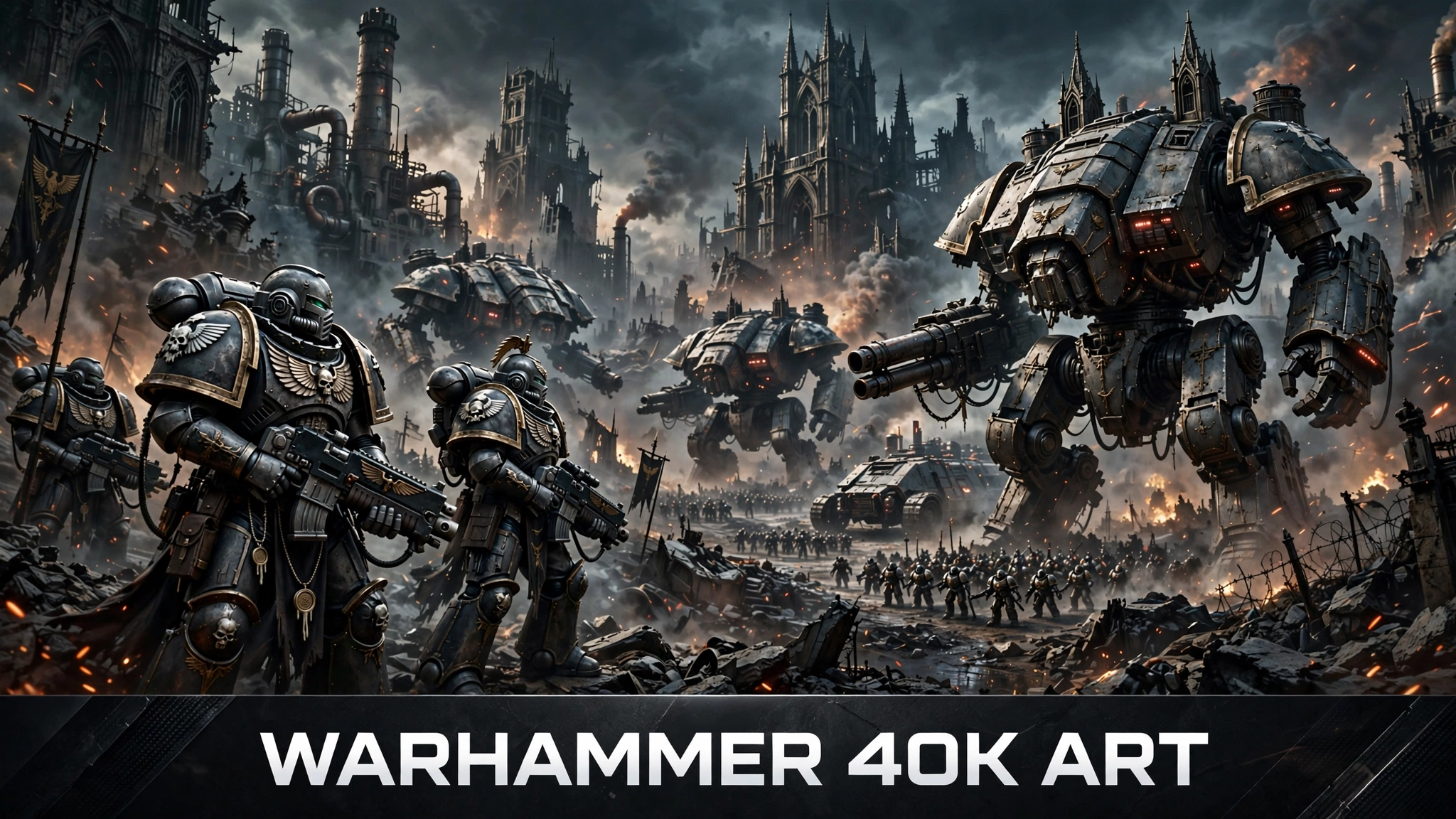
Warhammer 40,000 has built one of the most recognizable visual worlds in tabletop gaming, and its artwork is a huge part of why. Whether you’re browsing official illustrations, hunting for a new desktop wallpaper, looking for painting inspiration for your next army, or just trying to figure out whether it’s okay to share a piece of fan art you found online, this guide covers the full picture: what Warhammer 40K art actually includes, where to find it legitimately, how different factions are visually distinct, who creates it, and how to think about copyright before you download, edit, or repost anything.
Table of Contents
Quick Answer
Warhammer 40K art covers everything from official codex and rulebook illustrations to fan-made digital paintings and miniature photography. Official artwork lives on Games Workshop’s own channels — Warhammer Community, the licensed Warhammer Art print site, and Black Library — where you’ll also find official wallpapers and art books. Faction art styles differ deliberately: Space Marines lean heroic and heraldic, Chaos factions lean corrupted and grotesque, and Xenos factions each get their own alien visual language. Not all Warhammer 40K art is free to reuse — viewing or personally downloading an image is different from republishing, editing, or selling it, and Games Workshop actively enforces its intellectual property rights.
What Is Warhammer 40K Art?
“Warhammer 40K art” isn’t one single thing — it’s an umbrella term covering several distinct formats that all serve the same universe:
- Codex and rulebook illustrations — the paintings that appear throughout official rules publications, setting the tone for each faction.
- Character portraits — close-up depictions of named characters, from Primarchs to Inquisitors.
- Battle scenes — large, dynamic compositions showing armies clashing, usually the most dramatic pieces in a book.
- Vehicle and weapon art — tanks, aircraft, and war engines rendered in detail.
- Faction art — pieces designed specifically to establish a faction’s identity and mood.
- Concept art — early-stage design work used internally to develop a miniature or character before it’s finalized.
- Miniature photography — professional photos of painted Citadel Miniatures, which function alongside illustration in official materials.
- Wallpapers — desktop and mobile backgrounds, often adapted from existing illustrations.
- Art prints — physical, licensed reproductions of official art for framing.
- Fan art — original works created by hobbyists and independent artists, inspired by the setting.
- Digital paintings — the dominant modern production method for official 40K illustration.
Read More: https://gamespuma.com/warhammer-background-explaind/
What Makes Warhammer 40K Art Distinctive?
A handful of consistent visual choices give Warhammer 40K its instantly recognizable look:
- Grimdark atmosphere. “Grimdark” describes a tone where the setting offers no easy victories — war is constant, and even the “good guys” are extreme, brutal, and often morally compromised. Visually, this shows up as dark palettes, oppressive scale, and a general sense of dread rather than triumph.
- Gothic design. Cathedrals, skulls, gargoyles, and religious iconography are everywhere — borrowed from medieval and Gothic architecture and scaled up to a spacefaring empire.
- Huge scale. Individual characters are frequently dwarfed by towering war machines, starships, and architecture, reinforcing how small a single life is against the setting’s endless wars.
- Religious symbolism. The Imperium of Man is depicted as a quasi-religious theocracy, and its art leans heavily on saints, litanies, relics, and devotional imagery.
- Industrial machinery and horror elements. Rusted metal, exposed cabling, and decayed infrastructure sit alongside body-horror imagery in Chaos and Tyranid artwork.
- Military detail. Weapons, armor plating, and insignia are rendered with enough specificity that painters can use the art as reference material.
- Decay and destruction. Ruined cityscapes and battle-scarred environments are a recurring backdrop, reinforcing the sense of a civilization in perpetual decline.
- Faction-specific silhouettes. Each faction has a recognizable shape language — bulky and rectangular for Space Marines, jagged and asymmetrical for Chaos, sleek and curved for Aeldari — so a reader can identify a faction even in a small thumbnail.
- Contrast between technology and superstition. Advanced technology is frequently treated with religious reverence rather than scientific understanding, which artists use to create a unique blend of sci-fi and quasi-medieval imagery.
Read More: https://gamespuma.com/tabletop-miniature-wargames/
Major Warhammer 40K Factions and Their Art Styles
Different factions are given deliberately distinct visual identities so players and readers can tell them apart instantly. Here’s how the major factions typically differ — note that individual artworks vary, and not every piece for a faction uses identical colors or elements.
| Faction | Visual Style | Common Themes | Typical Imagery | Painting Inspiration |
|---|---|---|---|---|
| Space Marines | Bulky ceramite armor, heraldic chapter iconography | Duty, brotherhood, superhuman resolve | Power armor, bolters, chapter banners | Chapter color schemes, edge highlighting |
| Adeptus Mechanicus | Red robes, brass/copper machinery | Faith in technology | Servitors, cog symbolism | Metallic layering, glowing lenses |
| Astra Militarum | Trench-war uniforms, tanks | Human sacrifice, sheer numbers | Lasguns, Leman Russ tanks | Weathering, mud basing |
| Adepta Sororitas | Ornate white/black armor, flame motifs | Zealotry, purification | Flamers, holy relics | Clean armor vs. battle damage contrast |
| Custodes | Gold armor, halberds | Elite guardianship | The Golden Throne setting | True-metallic gold techniques |
| Grey Knights | Silver/storm-grey armor | Secrecy, daemon-hunting | Nemesis force weapons | Blue/purple psychic glow effects |
| Imperial Knights | Towering walkers, banners | Feudal honor | Heraldic freehand designs | Large-panel painting, heraldry |
| Chaos Space Marines | Spiked, corrupted armor | Betrayal, fallen glory | Chaos stars, daemonic faces | Rust and corruption texturing |
| Death Guard | Bloated, rotting armor | Disease, resilience | Plague weapons | Verdigris and grime layering |
| Thousand Sons | Blue/gold armor, sorcery | Knowledge, tragedy | Rubric marines, glowing runes | Blue NMM with gold accents |
| World Eaters | Red armor, brass skulls | Rage, ritual combat | Chainaxes, skull trophies | High-saturation red |
| Chaos Daemons | Organic, otherworldly forms | Corruption of the four gods | Warp energy, twisted anatomy | Glow/translucency effects |
| Aeldari | Sleek armor, vibrant colors | Ancient civilization, sorrow | Wraithbone, holo-fields | Sharp color blocking |
| Drukhari | Dark, spiked armor, neon accents | Cruelty, raiding culture | Torture-themed gear | Neon highlights on dark base |
| Orks | Crude machinery, bold colors | Brutal humor, love of violence | Scrap-built vehicles | Bold primaries, intentional roughness |
| Necrons | Metallic skeletal forms | Ancient, undying menace | Gauss weaponry | True metallics, green glow |
| T’au Empire | Angular armor, blue/orange schemes | Unity, technological optimism | Battlesuits, drones | Smooth gradients, sharp masking |
| Tyranids | Organic, chitinous forms | Hive-mind horror | Swarming bio-weapons | Carapace shading, bio-glow |
| Genestealer Cults | Human/xenos hybrids | Infiltration, hidden corruption | Cult symbology | Blending human and alien tones |
| Leagues of Votann | Dwarf-inspired exosuits | Ancestral tradition | Ion weaponry, mining motifs | Industrial metallics |
Where to Find Official Warhammer 40K Art
If you want artwork you can trust is genuinely official, these are the verified sources:
- Warhammer Community — Games Workshop’s main news hub, which regularly publishes art-focused features, faction previews, and official wallpaper roundups.
- Warhammer Art — an officially licensed print and merchandise site offering limited-edition fine-art prints and a “Classic” collection built from codex-cover artwork, along with short profiles of the artists behind the setting’s visual identity.
- Black Library — the publisher of 40K fiction, whose novel covers and dedicated art-book releases showcase decades of character and battle illustration.
- Games Workshop’s own product pages — current codexes and rulebooks contain the newest official artwork tied directly to the models and rules they support.
Best Places to Find Warhammer 40K Wallpapers
Warhammer Community publishes official wallpaper collections directly — past examples include general Warhammer 40,000/Age of Sigmar wallpaper roundups and dedicated Horus Heresy legion wallpapers, each offered in separate desktop and mobile-friendly formats. Starting here is the safest way to get wallpapers, since they come straight from the rights holder.
A few things worth understanding before you download or share:
- Desktop vs. mobile formats — official wallpaper articles typically provide both, sized appropriately for each device.
- Personal-use restrictions — downloading a wallpaper for your own device is generally covered by a limited personal-use licence, not a broad right to redistribute it.
- Download safety — third-party wallpaper aggregator sites host huge collections of “Warhammer 40K” images, but these aren’t official Games Workshop channels, and it’s often unclear whether the original uploader had the right to redistribute the art. Treat them as a place to browse, not a safe source to re-embed on your own site.
- Easy to download doesn’t mean free to republish. Just because an image is publicly downloadable doesn’t mean you have permission to post it on a blog, product listing, or social media account as your own content.
Warhammer 40K Artists and How the Artwork Is Made
Games Workshop maintains an in-house illustration team at its Nottingham Design Studio. According to the company’s own job listings for the role, illustrators there work predominantly in digital media (primarily Photoshop), producing highly rendered artwork for codexes, rulebooks, and packaging while working closely with writers and graphic designers — and faithfully matching the actual Citadel Miniatures so the art and the models stay visually consistent.
Historically, the person most associated with defining 40K’s visual identity is John Blanche, who served as Games Workshop’s Art Director for decades and pioneered the gothic-punk, “grimdark” aesthetic that still defines the setting; he passed away in 2026. Early illustrators Adrian Smith and Ian Miller are credited with helping establish 40K’s serious, dark tone in the game’s earliest years. Other artists whose work has shaped the setting’s visual history include Karl Kopinski, John Sibbick, Mark Gibbons, and Jim Burns, among many others credited across Black Library covers and Games Workshop products over the decades.
Concept art and miniature design typically develop together: early concept illustrations often guide how a new miniature is sculpted, and once a model exists, later “hero” illustrations of that character are commissioned to match the physical model — keeping the painted-art version and the tabletop version of a character recognizably the same.
Warhammer 40K Art for Miniature Painting Inspiration
Official and fan artwork is one of the best free references available to miniature painters, because it shows how light, texture, and color behave on a faction’s armor and gear before you pick up a brush. It’s a reference tool, not a substitute for step-by-step official painting guides — but it’s genuinely useful for:
- Color palettes — seeing how a faction balances a dominant color against a secondary accent and a metallic trim.
- Lighting and glow effects — plasma weapons, psychic energy, and engine exhaust in illustrations show believable light falloff that translates into layered highlighting techniques on a model.
- Weathering and battle damage — chipped paint, scorch marks, and rust in art can guide edge-highlighting, stippling, and pigment-weathering choices.
- Materials — noticing how cloth, leather, and metal are rendered differently in a painting helps with choosing matte finishes versus metallics.
- Basing and atmosphere — background elements like rubble, mud, or ash can inspire a simple, cohesive basing theme across a whole army.
- Faction identity at a glance — studying how silhouette and color communicate faction identity is useful when planning an army’s overall visual consistency, not just individual models.
Official Art vs. Fan Art vs. AI-Generated Art
Not all Warhammer 40K art you find online comes from the same place, and telling the difference matters for both authenticity and legality.
| Official Art | Fan Art | AI-Generated Art | |
|---|---|---|---|
| Source | Games Workshop / Black Library / licensed partners | Independent artists and hobbyists | AI image generators prompted with 40K terms |
| Creator | In-house or commissioned professionals | Individual fans | No traditional artist of record |
| Copyright status | Owned/controlled by Games Workshop | Original expression, but based on GW’s copyrighted setting — cannot be sold under GW’s guidelines | Legally unsettled; still likely built on copyrighted designs |
| Typical use | Codexes, rulebooks, marketing, licensed prints | Personal expression, portfolios, community sharing | Personal experimentation |
| Attribution needs | Never claim it as your own | Always credit the original artist | Disclose it’s AI-generated |
| Commercial-use concerns | Requires a licence from GW | Selling it isn’t permitted per GW’s IP guidelines | High risk on multiple fronts |
| How to verify | Hosted on Games Workshop, Warhammer Community, Black Library, or Warhammer Art | Found on the artist’s own portfolio/social account | Watch for AI-disclosure tags and rendering artifacts |
Can You Use Warhammer 40K Art on a Website?
This is where a lot of people get tripped up, so it’s worth being precise:
- Viewing is not the same as owning a right to copy. Seeing an image online doesn’t grant you reuse rights.
- Downloading for personal use is different from publishing. Saving a wallpaper for your own desktop isn’t the same as having clearance to post it on a blog, thumbnail, or product page.
- Personal use is different from commercial use. Commercial use — using art to sell a product, promote a business, or monetize content — carries much higher risk.
- A blog post may need permission or a specific licence. Some official terms (for example, Warhammer Community’s press-room terms) describe limited conditions under which “Authorised Intellectual Property” can be used for news, commentary, or similar editorial purposes — but these terms are specific and can change, so check the current version directly before relying on them.
- Games Workshop enforces its IP actively. Its published guidelines state that fan content based on its settings and characters cannot be sold or otherwise monetized, and its legal terms describe a zero-tolerance approach to infringement, including material that imitates its artwork or products.
- Safer choices for your own content are original illustrations, commissioned artwork, properly licensed stock images, or an official embed only where a platform explicitly allows it.
This is general information to help you understand the landscape, not legal advice. If you’re planning to publish or monetize content featuring Warhammer 40K art, check Games Workshop’s current Intellectual Property Guidelines and terms of use, and seek direct permission where it’s required.
Best Warhammer 40K Art Books and Collections
| Title | Publisher | What It Covers |
|---|---|---|
| Black Library: The Art of Warhammer 40,000 | Black Library (Games Workshop) | A hardback collection spanning more than 20 years of Black Library cover and interior illustration, with behind-the-scenes notes and case studies on specific pieces. First released in 2020. |
Games Workshop and Black Library periodically release additional art volumes and reprints across the wider Warhammer line, so it’s worth checking Black Library’s current catalogue and the Games Workshop shop directly for the latest availability before buying.
FAQ
Where can I find official Warhammer 40K art? Warhammer Community, the licensed Warhammer Art print site, and Black Library are the main verified official sources, alongside current Games Workshop codexes and rulebooks.
What makes Warhammer 40K art grimdark? “Grimdark” refers to a tone of relentless, hopeless conflict. Visually, it shows up through dark color palettes, oppressive scale, gothic religious imagery, and decayed environments rather than triumphant or hopeful compositions.
Where can I download Warhammer 40K wallpapers? Warhammer Community has published official wallpaper roundups with both desktop and mobile downloads. Third-party wallpaper sites also host large collections, but these aren’t official channels.
Is Warhammer 40K art copyrighted? Yes. Official Warhammer 40K artwork is generally protected by copyright and other intellectual property rights controlled by Games Workshop, which actively enforces those rights.
Can I use Warhammer 40K art on my blog? Be cautious. Viewing an image is different from having permission to republish it. Some official terms allow limited editorial use under specific conditions, but these should be checked directly and current terms confirmed before publishing.
Can I sell Warhammer 40K fan art? Games Workshop’s published guidelines state that fan content based on its settings and characters cannot be sold or otherwise monetized.
Who creates Warhammer 40K artwork? Games Workshop’s in-house illustration team, working alongside writers and graphic designers, produces most current official 40K art. Historically, artists like John Blanche shaped the setting’s core visual identity, alongside contributors such as Adrian Smith, Ian Miller, Karl Kopinski, John Sibbick, Mark Gibbons, and Jim Burns.
What faction has the most distinctive art style? It depends on taste, but factions like the Death Guard (decay and disease), Aeldari (elegant, sorrowful elegance), and Necrons (ancient metallic menace) are often cited for having especially strong, cohesive visual identities.
Can Warhammer 40K art help with miniature painting? Yes — as a reference for color palettes, lighting, weathering, and material rendering. It’s a useful supplement to, not a replacement for, official step-by-step painting guides.
How can I identify official Warhammer 40K artwork? Check whether it’s hosted on a Games Workshop, Warhammer Community, Black Library, or officially licensed page (like Warhammer Art). If it only appears on a fan gallery or aggregator without sourcing, treat it as unverified.
What is the difference between official art and fan art? Official art is created or commissioned by Games Workshop and used in its own products; fan art is created independently by hobbyists inspired by the setting and generally cannot legally be sold, since it’s based on Games Workshop’s copyrighted IP.
Sources (Checked During Research)
- Warhammer Art — official licensed print site and artist profiles (warhammerart.com)
- Warhammer Community — official wallpaper articles and press-room Terms of Use (warhammer-community.com)
- Warhammer.com — legal/IP guidelines page (warhammer.com/en-GB/legal)
- Warhammer Digital — Terms of Use for downloadable material (warhammerdigital.com)
- Black Library — The Art of Warhammer 40,000 product listings and description
- Games Workshop careers page — Warhammer 40,000 Artist job listing describing the in-house art team’s workflow
- Wikipedia — Games Workshop; John Blanche; Adrian Smith (illustrator); John Sibbick
- Lexicanum — Artists (Warhammer 40K) listing
- Grimdark Magazine — artist interview referencing Mark Gibbons and Jim Burns
- Games Workshop Wiki (Fandom) — Warhammer Art overview (background context; not treated as an official primary source)

Written by Daniel Carter
Daniel Carter is a dedicated gaming writer who enjoys turning complex gaming topics into clear, useful, and engaging content. He covers game guides, tips, reviews, features, and the latest developments across the gaming world. His approach focuses on research, accuracy, and practical value, helping readers discover new games, improve their gameplay, and stay informed about the industry. For Daniel, great gaming content is not just about information—it is about making every article genuinely worth reading.
2 thoughts on “Warhammer 40K Art: Official Galleries, Faction Styles, Wallpapers, and Fan Art”