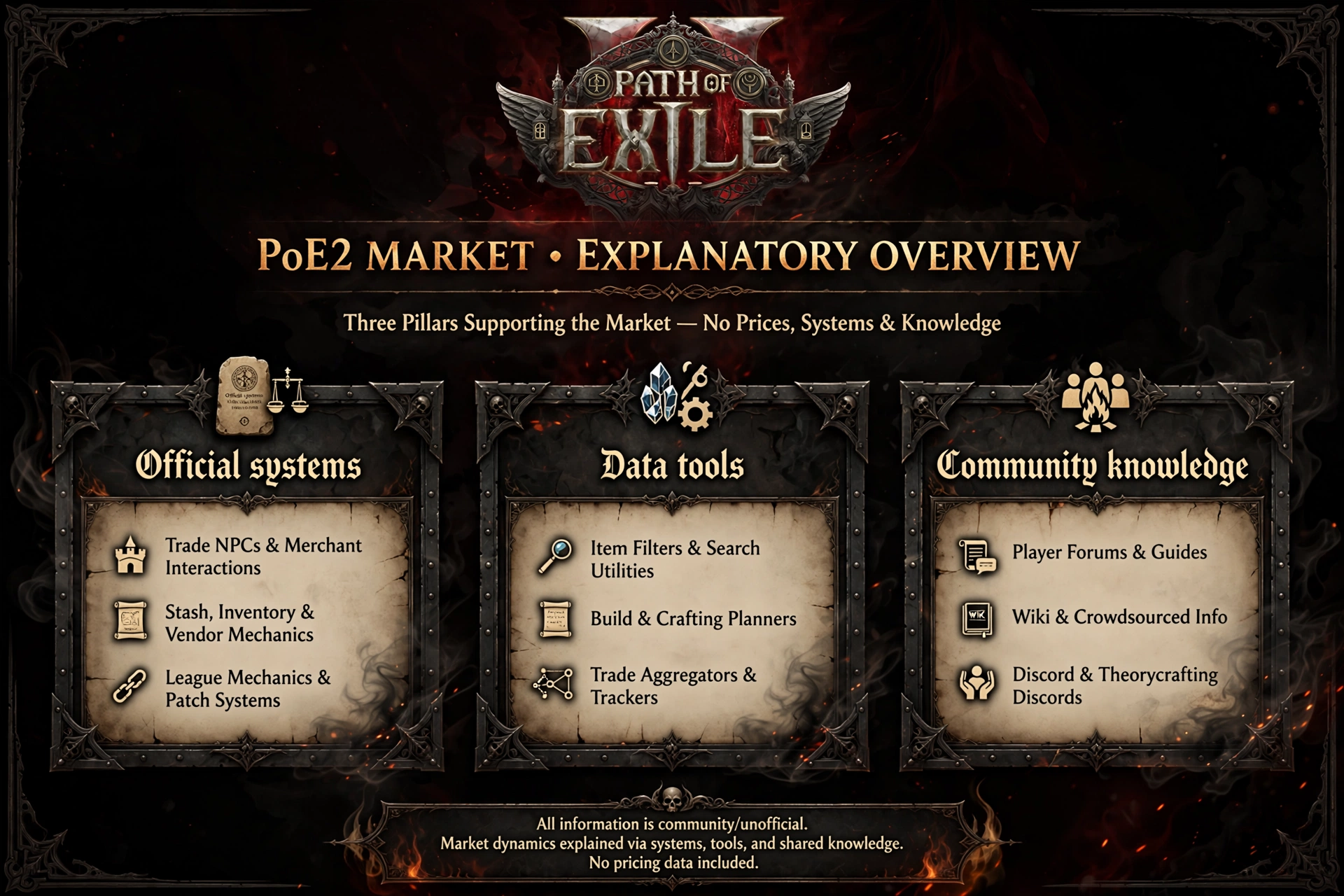
The PoE2 Market is the player-driven trading economy of Path of Exile 2, where players buy and sell currency, gear and other items through the official trade site, the in-game Market Panel, the Currency Exchange and direct trades. When most players search for the PoE2 Market, they want one of two answers: what something is worth, or where to trade it. This guide covers both, plus the tools that help, and it is honest about what those tools cannot tell you.
One clarification up front. The phrase “PoE2 Market” does not point to a single official website. It describes the trading economy as a whole, and it is also the name of at least one small third-party plugin, covered later in this article. This guide treats the PoE2 Market as the economy and the systems around it. It does not include live prices, because prices move constantly and a number that is correct today can be wrong tomorrow.
Research note: this article was researched on October 15, 2026. Game systems, leagues and tools change, so check the dates on anything you rely on.
Table of Contents
What Is the PoE2 Market?
The PoE2 Market is the combined set of ways Path of Exile 2 players exchange goods with each other. There is no single storefront. Instead, several systems work side by side, and each suits a different kind of item.
According to a Path of Exile 2 trade guide covering the Runes of Aldur era, the game has three trade methods: the automated Currency Exchange for stackable currency, asynchronous Merchant’s Tab listings for gear and other non-stackables, and direct player-to-player trades. The same guide notes that Solo Self-Found characters cannot trade at all, which matters if you play that mode.
It helps to separate three layers when you think about the PoE2 Market:
- Official systems: the trade website, the in-game Market Panel, the Currency Exchange and direct trading.
- Third-party data tools: websites that display estimated or tracked prices, such as poe.ninja’s Economy section.
- Community knowledge: guides, forum threads and videos that explain how to use the first two layers.
Only the first layer actually moves items. The second and third help you decide what to ask for or pay.
How the Path of Exile 2 Market Works
The PoE2 Market works through listings and offers. Sellers list items or currency at a price, buyers search or accept those listings, and the exchange happens either automatically or through a direct trade.
The official trade site and in-game Market Panel
Third-party guides give the official trade site address as pathofexile.com/trade2, and say you sign in with the Path of Exile account your copy of the game is registered to. One guide describes the in-game version as identical to the website and says you can open it from the Market Panel in the interface. Check the official Path of Exile site before you publish or follow these steps, because layouts and entry points change between patches.
The trade site lets you search listings by category, name, stat filters and price. Most players use it for equipment, where modifiers matter a great deal.
The Currency Exchange
The Currency Exchange is the part of the PoE2 Market most beginners meet first. A Maxroll guide describes it as an asynchronous trading system for stackable items. You choose what you want and what you are offering, and the exchange matches you with other players, even if they are offline.
Mobalytics, in a guide last updated in January 2025, says the exchange costs Gold, with the amount depending on the size of the trade and the rarity of the items involved. It also says that if the exchange finds a better rate than the one you listed, you may get some Gold and currency back. Treat those details as a starting point and confirm them in the game today.
Merchant’s Tab listings and direct trades
For gear, the trade guide mentioned above describes asynchronous listings through a Merchant’s Tab. Direct trades still work too: a Maxroll guide says you can trade with other players by traveling to their hideout, and it advises waiting for the other player to open the trade window.
Limits to remember
- You need a Path of Exile account, and the PoE2 Market only works for characters allowed to trade.
- Different leagues have separate economies, so a price in one league does not apply in another.
- Fees, such as Gold costs, can change the real cost of a trade.
PoE2 Market Prices Explained
PoE2 Market prices are set by players, not by the game. That means a price is only as meaningful as the supply, demand and context behind it.
The most useful factors to understand are:
- Usefulness and rarity: items that many builds want, and that few players can obtain, tend to cost more.
- Build demand: when a build becomes popular, items it needs are in more demand. Guides and build content can shift attention quickly.
- Supply and availability: how many are listed and how easily they drop.
- League conditions: a new league usually starts a fresh economy. Reporting on the Forbidden Rites event league says it began with a fresh economy and runs separately from Runes of Aldur.
- Game updates: balance changes and new content can change what players want.
- Crafting demand: items used as crafting inputs are priced by what players can make from them.
A listed price is not a sale price
This is the most important idea in this article. A listing in the PoE2 Market shows what a seller is asking. It does not show what a buyer paid. Some listings are optimistic, some are placeholders and some are priced to test the market.
Use listings as evidence, not as proof. The more similar listings you can compare, and the more consistent they are, the more you can trust the picture.
How to Check PoE2 Market Prices
Checking PoE2 Market prices is a repeatable process. The steps below describe the general method, and they work whichever official or third-party resource you use. Where a tool offers a feature, use it. If it does not, skip that step rather than guessing.
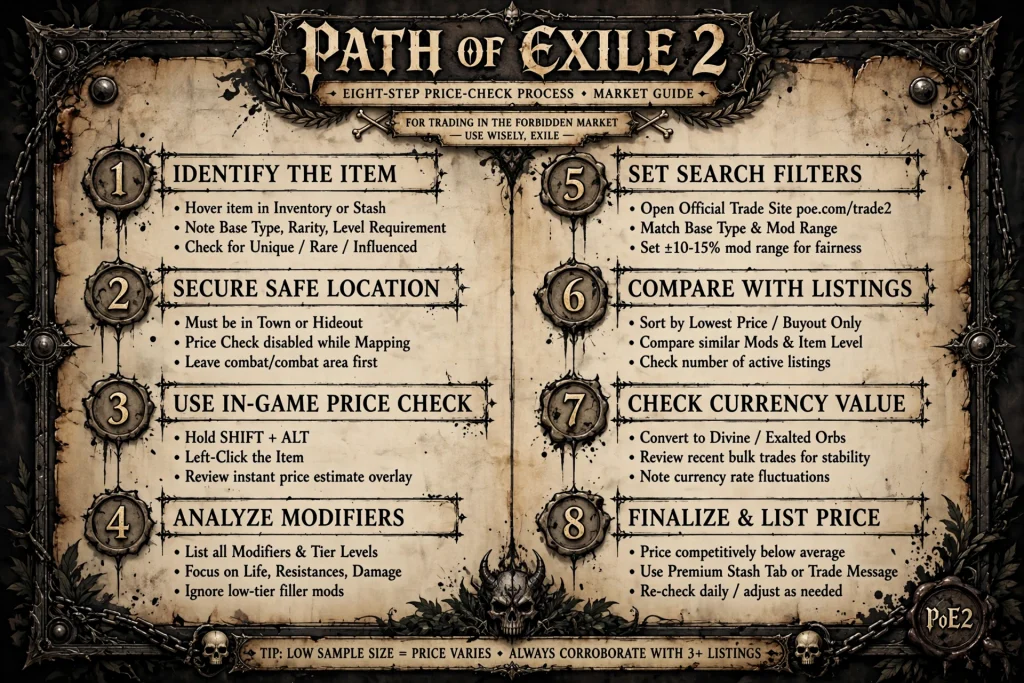
- Identify exactly what you have. Note the item type, base, modifiers and their rolls. For currency or stackable items, note the exact name.
- Pick the right resource. Use the Currency Exchange or an exchange-rate tool for stackable currency, and the trade site or Market Panel for individual gear.
- Search for the item or currency. Start with a broad search, then narrow it.
- Apply filters where available. The official trade site supports stat filters, according to Sportskeeda’s guide, which helps with jewels, rings and armor.
- Compare several similar listings. Look at a spread, not a single result.
- Weigh modifiers and rolls. Two items with the same name can have very different values.
- Check how current the data is. Confirm the league and look for a timestamp or the sort order of listings.
- Do not treat one listing as definitive. The lowest price can be a mistake, a trap or a bait listing.
For stackable currency, the Currency Exchange shows common market ratios in its interface, according to Maxroll. Mobalytics adds that hovering over the Market Ratio and pressing Alt shows information about available and competing trades. Confirm both in your client.
If you want a deeper look at overlay and desktop price-check tools, see our guide to the best PoE2 price checker options.
Best PoE2 Market Tools and Websites
Only a small number of resources could be verified in this research, so this list is short on purpose. “Useful” here means three things: it supports Path of Exile 2, it tells you what its data is, and its limits are stated by the tool or by reliable coverage.
The official trade site and Market Panel
- URL: pathofexile.com/trade2 (reported by third-party guides; verify on the official site).
- Purpose: searching live player listings.
- Data type: player listings, which are asking prices.
- Good for: players who want to buy specific gear or compare real listings.
- Limits: needs an account, and listings are not completed sales.
The in-game Currency Exchange
- Purpose: exchanging stackable currency and related items asynchronously.
- Data type: exchange orders and ratios shown in the interface.
- Good for: everyday currency conversion.
- Limits: Gold cost and the rules for which items qualify. Equippable items are not traded through it, according to Mobalytics.
poe.ninja Economy (Path of Exile 2 section)
- URL: poe.ninja.
- Purpose: tracked prices for currency exchange categories and, since a post dated May 14, unique items.
- Data type: estimated. The post says there is no River API for Path of Exile 2 yet, so unique item prices are estimated from the official trade API. It also describes a seven-day sparkline and up to 120 days of price history on item pages.
- Good for: quick price orientation and trend spotting.
- Limits: estimates, not completed sales. poe.ninja’s API documentation also describes its public economy endpoints as incidental rather than a product, so do not build anything important on them.
The “PoE2 Market” guild plugin
- URL: guildorder.com/plugins/poe2-market.
- Purpose: showing exchange rates on a guild website. Per its own page, it covers currencies, fragments, runes, essences and soul cores, quoted in exalted orbs and scoped per league, with supply counts.
- Data type: it credits poe.ninja and says rates refresh on an hourly sweep, which is the vendor’s own statement.
- Good for: guild leaders who want shared rates on a guild site.
- Limits: the page itself states that it is exchange-rate data, not the trade site, and does not include individual item listings or unique equipment. It also requires Path of Exile 2 to be set as one of your guild’s games.
PoE2 Market Currency Prices and Exchange Rates
PoE2 Market currency prices are expressed as ratios of other currencies. There is no fixed price list, and the unit used to quote prices can change as a league ages. The PoE2 Market plugin page, for example, notes that the reference currency tends to drift from exalted early in a league to divine later, and holds its own rates in exalted orbs to stay consistent.
To research PoE2 currency prices yourself:
- Open the in-game Currency Exchange and look at the displayed ratios for the pair you care about.
- Compare with a tracker such as poe.ninja for the same league.
- If the two differ, remember they measure different things: live exchange orders versus tracked or estimated data.
- Note the time you checked. Rates can move within hours.
This article does not quote a current exchange rate. None was checked and timestamped, and an old number presented as current would mislead you. If you see a rate on any site, look for a date and a league name.
Two resources can disagree for ordinary reasons: different snapshot times, different leagues, different reference currencies, or different ways of handling small or thin listings. Neither is automatically “right”.
How to Evaluate PoE2 Item Values
To value an item in the PoE2 Market, compare it against genuinely similar items, not just items with the same name.
Look at:
- Item type and base: the same unique or rare on a different base is not the same item.
- Modifiers and their values: high rolls and desirable combinations can change price dramatically.
- Item level and other attributes where they affect what the item can do.
- Current demand: is the item wanted by builds people are playing now?
- Current supply: how many are listed and how fast they appear?
- Asking versus completed: listings are asks, not sales.
- Automated estimates: helpful for orientation, weak for rare items with unusual modifier mixes.
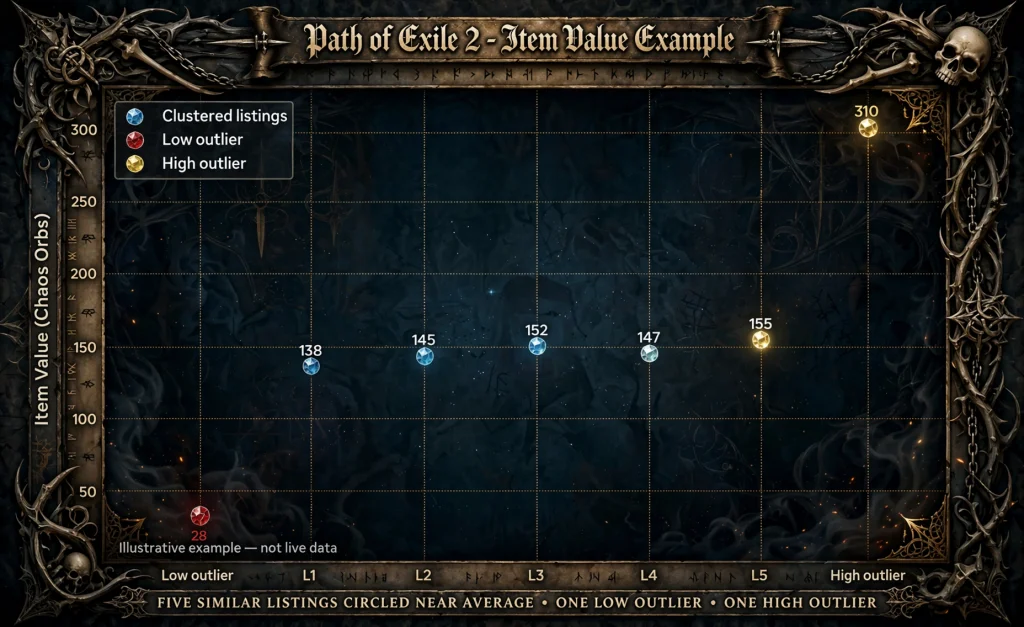
An illustrative example
Imagine you find a rare ring and see five listings of similar rings. Three are close together, one is far lower and one is far higher. The sensible read is that the cluster is your best guide, the low one may be a mistake or an item missing a key modifier, and the high one may be optimistic. This is a made-up illustration, not live data.
If you are weighing how your item compares to the wider game, a database or build guide may also help. See our explanation of how a PoE database helps with item research.
PoE2 Market Trends and Price Changes
Trends in the PoE2 Market come from supply, demand, updates and league timing. No reliable, dated trend data was gathered for this article, so it does not claim that any item is rising or falling.
What can be said, based on reporting, is that structural events matter. Forbidden Rites started a fresh economy on September 4, 2026, according to PCGamesN, while Runes of Aldur continues separately. Coverage also reports that Path of Exile 2 1.0 launches on December 11, 2026, bringing a new Duelist class and the Sword weapon type. Whether those changes move prices is not something this research can show. Wait for data before drawing conclusions.
To monitor trends yourself:
- Use the history on a tracker such as poe.ninja, which describes up to 120 days of history for unique items.
- Re-check the same item on separate days.
- Compare the same item across your league and a different league only to see the difference, not to transfer prices.
- Read patch notes and announcements when something changes.
For community discussion that adds context, not proof, see our guide to Path of Exile 2 community resources.
Common PoE2 Market Trading Mistakes
Most mistakes in the PoE2 Market come from trusting a number without understanding it.
- Mixing up PoE 1 and PoE 2. Some tools cover both games. The poe.ninja API documentation, for instance, covers both and uses separate paths. Always confirm you are looking at the Path of Exile 2 section.
- Using an outdated price guide. A guide written for an earlier league may describe a different economy.
- Treating the cheapest listing as the value. It may be a mistake, a bait listing or an item missing something important.
- Ignoring modifiers. The name of an item says little about its worth.
- Confusing asking prices with completed trades.
- Trusting unverified sites. Some pages found while researching were promotional or reposted content.
- Forgetting costs and restrictions. Gold fees and trade restrictions can change the outcome.
- Following predictions. Unsupported forecasts are not evidence.
PoE2 Market Safety and Scam Awareness
Safe trading in the PoE2 Market is mostly about slowing down and checking details.
- Check every item. One guide advises hovering over every item in a direct trade window before you accept.
- Confirm the terms. Be sure you and the other player agree on the price, currency and item before the trade window opens.
- Follow etiquette. Maxroll advises waiting for the other player to offer the trade window when you visit their hideout.
- Be careful with downloads. Only install tools from sources you can identify and trust.
- Be skeptical of odd offers. If a trade stalls or feels wrong, you can politely walk away.
- Treat third-party currency sellers carefully. Sites that sell currency are not part of the official PoE2 Market. Check Grinding Gear Games’ terms before using any of them.
This guide does not claim any specific tool is unsafe and does not cite scam statistics, because none were verified.
PoE2 Market vs. Other Trading Resources
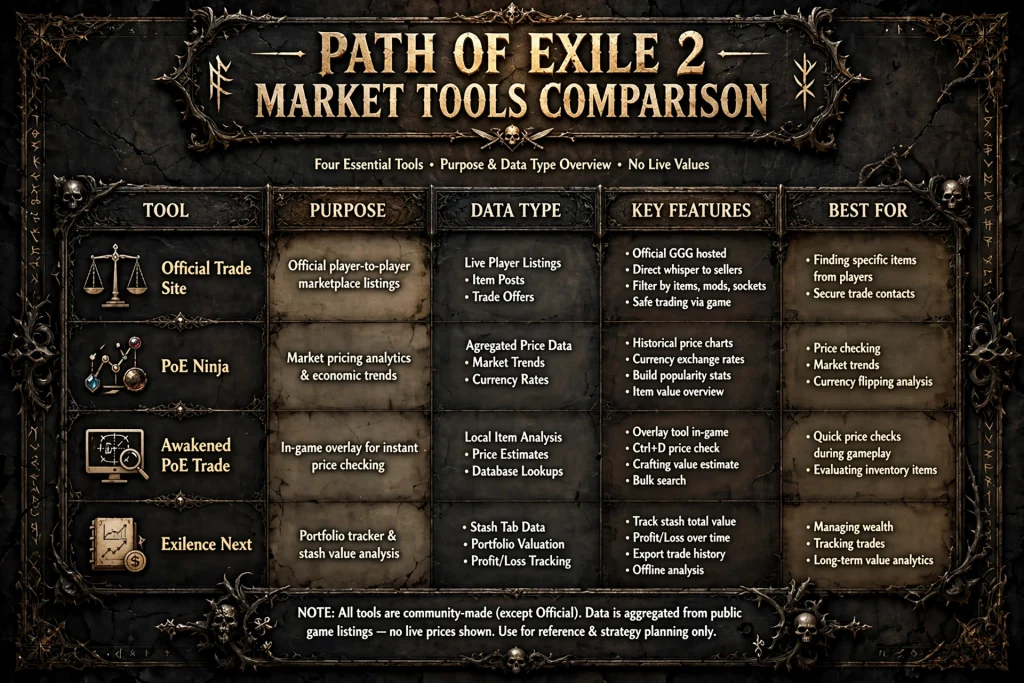
The table compares the resources covered above. It describes what each does, not a ranking.
| Resource | Main purpose | Data type | Best use case | Limitations |
|---|---|---|---|---|
| Official trade site / Market Panel | Search player listings | Live asking prices | Buying specific gear | Needs an account; asks are not sales |
| In-game Currency Exchange | Swap stackable items | Exchange orders and ratios | Converting currency | Gold cost; not for equippable items |
| poe.ninja Economy | Track prices | Estimated, with history | Price orientation and trends | Estimates, not completed sales |
| “PoE2 Market” guild plugin | Show rates on a guild site | Rates sourced from poe.ninja, per vendor | Guild shared rates | Not item listings; needs guild setup |
A third-party price is never an official value. It is an estimate, and the PoE2 Market itself is always the final judge.
For a closer look at the official trading flow, see our guide to how Path of Exile 2 trade works.
How to Get Better Results From the PoE2 Market
Better results in the PoE2 Market come from habits, not secrets. Use this checklist:
- Confirm your league before you search.
- Search with specific modifiers, not just item names.
- Compare at least several similar listings.
- Cross-check one official source and one tracker.
- Note when you checked, and recheck before large trades.
- Decide what you actually need: an upgrade, a sale or a currency swap.
- Keep a record of prices you used, so you can see changes.
- Avoid chasing profit claims you cannot verify.
Nothing here guarantees profit. Markets move, and even careful players misjudge them.
Frequently Asked Questions
What is the PoE2 Market?
The PoE2 Market is the player-driven trading economy of Path of Exile 2. It includes the official trade site, the in-game Market Panel, the Currency Exchange and direct trades. It is not a single website, though a small guild plugin shares the name.
Where can I check PoE2 Market prices?
You can check PoE2 Market prices on the official trade site or Market Panel for listings, and on trackers such as poe.ninja for estimates. Use more than one source and note the league.
Is there an official Path of Exile 2 market?
Yes, there is an official trading system, with the trade site reported at pathofexile.com/trade2 and an in-game Market Panel. Verify the address on the official Path of Exile website before relying on it.
How do I check the value of an item in PoE 2?
Compare it with several similar listings that share its base and key modifiers. Do not rely on one listing, and remember asks are not sales.
Are PoE2 currency prices updated live?
It depends on the source. The in-game Currency Exchange reflects its own orders, while trackers use snapshots. The “PoE2 Market” plugin states an hourly refresh, which is the vendor’s claim.
Can I use Path of Exile 1 market tools for PoE 2?
Not safely. The two games have separate economies, and some tools have separate PoE 1 and PoE 2 sections. Use only the Path of Exile 2 section.
Why do PoE2 item prices change?
PoE2 item prices change with supply, demand, build popularity, updates and league timing. A new league can start a fresh economy.
Are third-party PoE2 market tools accurate?
They can be useful but are not official. poe.ninja, for example, says its Path of Exile 2 unique prices are estimated from the official trade API, so treat them as a guide.
Final Verdict
The PoE2 Market is best understood as a set of systems, not a place. Use the official trade site or Market Panel for real listings, the Currency Exchange for stackable currency, and a tracker such as poe.ninja for orientation and history.
Remember the limits: a listing is an ask, a tracker is an estimate, and a league can reset an economy. If you are new, start with the Currency Exchange and one trade-site search. If you are experienced, build a repeatable price-checking routine and keep checking your sources. The PoE2 Market rewards patience more than speed.
Sources and Research Notes
This guide was researched on October 15, 2026. Game systems, leagues and third-party tools change often, so check each source for its own date before relying on it.
Trading systems and the official trade site
- Path of Exile 2 Trade Guide (Runes of Aldur): How to Buy, Sell, and Use the Currency Exchange, nexttier.pro for the three trade methods and the Market Panel.
- Path of Exile 2 trade site guide, Sportskeeda for the trade site address, sign-in and stat filters.
- Trade in Path of Exile 2, Maxroll for the asynchronous Currency Exchange and trade etiquette.
- PoE 2: Currency Exchange, Mobalytics for Gold costs and Market Ratio details. This guide was last updated in January 2025, so confirm menu details in the game.
Price data and trackers
- Unique Items in the Economy Section, poe.ninja for estimated unique prices and price history.
- poe.ninja API documentation for the separate Path of Exile 1 and Path of Exile 2 economy endpoints.
- PoE2 Market plugin, guildorder.com for the plugin’s features and limits. These are the vendor’s own statements.
Leagues and release timing
- Path of Exile 2 update and Forbidden Rites league, PCGamesN for the event league and its fresh economy.
- Challenge leagues, Path of Exile 2 Wiki for league names and dates.
- Path of Exile 2 Leaves Early Access on December 11, Digital Citizen for the 1.0 date, Duelist class and Swords.
What this article does not include: live prices, exchange rates and trend figures. None were checked and timestamped, so none are quoted. The official trade site address comes from third-party guides, so confirm it on the official Path of Exile website.

Written by Daniel Carter
Daniel Carter is a dedicated gaming writer who enjoys turning complex gaming topics into clear, useful, and engaging content. He covers game guides, tips, reviews, features, and the latest developments across the gaming world. His approach focuses on research, accuracy, and practical value, helping readers discover new games, improve their gameplay, and stay informed about the industry. For Daniel, great gaming content is not just about information—it is about making every article genuinely worth reading.