Diablo 4 classes now number eight: Barbarian, Druid, Necromancer, Rogue, Sorcerer, Spiritborn, Paladin and Warlock. The first five are in the base game, Spiritborn comes with the Vessel of Hatred expansion, and Paladin and Warlock come with the Lord of Hatred expansion. This guide explains how each of the Diablo 4 classes plays, what it does well, where it struggles and how to pick one without relying on a tier list that may already be outdated.
Scope and research date: this guide was researched on October 19, 2026. Season 15 (Season of Hell’s Legacy) was the live season, and the newest entry on Blizzard’s official patch notes page was 3.2.3 (Build #73883), dated October 14, 2026. Class facts below come mainly from Blizzard’s official pages. Playstyle impressions are editorial, and anything about strength is labeled as patch-dependent.
Table of Contents
How Many Classes Are in Diablo 4?
There are eight playable classes in Diablo IV today. Blizzard’s official site lists the Barbarian, Druid, Necromancer, Rogue and Sorcerer as the original five, then the Spiritborn (available with Vessel of Hatred), and the Paladin and Warlock (available with Lord of Hatred). If an older guide tells you there are only five or six Diablo 4 classes, it was written before the expansions.
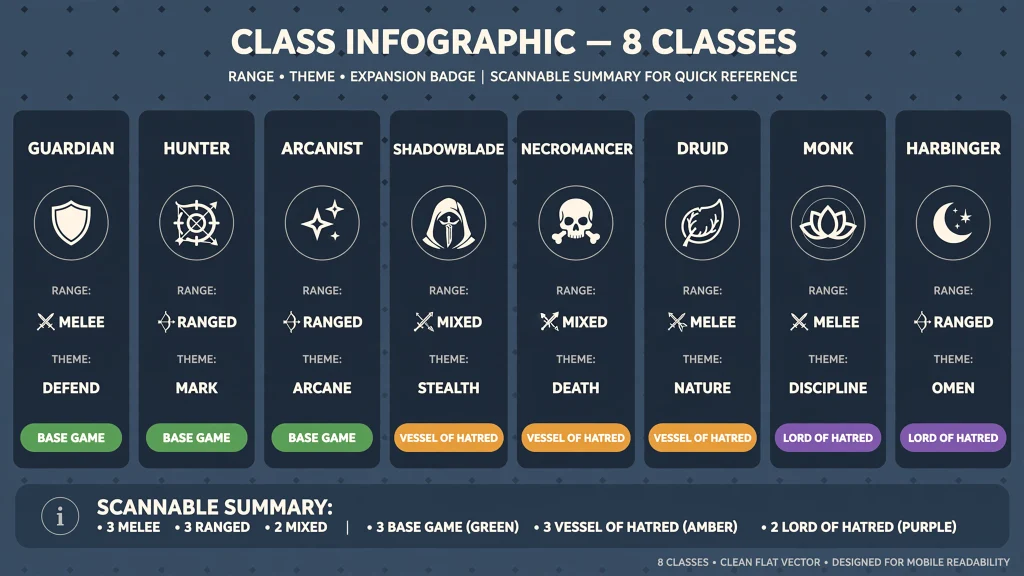
The table below is a quick answer to “what are all the Diablo 4 classes?” The playstyle and range columns are editorial summaries of Blizzard’s class descriptions, not official ratings.
| Class | Main playstyle | Typical combat range | Core identity | Availability |
|---|---|---|---|---|
| Barbarian | Weapon-based brawler | Melee | Strength, war cries, ground slams, a weapon for every occasion | Base game |
| Druid | Shapeshifter and nature caster | Mixed | Bear and werewolf forms plus earth, wind and storm magic | Base game |
| Necromancer | Summoner and dark caster | Mid to long range | Undead minions with Bone, Blood and Shadow magic | Base game |
| Rogue | Agile hybrid | Melee or ranged | Imbued weapons, combos, poison and shadow magic | Base game |
| Sorcerer | Elemental spellcaster | Ranged | Lightning, ice and fire spells | Base game |
| Spiritborn | Fast striker | Close range | Four Spirit Guardians and polearm-style weapons | Vessel of Hatred |
| Paladin | Holy knight | Melee | Holy Light, armor and divine power | Lord of Hatred |
| Warlock | Demon-binding caster | Mixed | Forbidden knowledge and weaponized Hell | Lord of Hatred |
All Diablo 4 Classes Explained
Every one of the Diablo 4 classes has a class resource (the energy its skills spend) and at least one class mechanic (a system unique to that character). Since the Lord of Hatred update reworked the skill tree for all eight classes, specific skill names and numbers can differ from older guides, so treat the mechanics below as the identity of each class and confirm exact tooltips in the game.
Barbarian
The Barbarian is the series’ classic melee brawler. Blizzard describes a character with unparalleled strength who carries an entire arsenal, bellows war cries and uses ground-shaking slams to send crowds reeling. Its signature mechanic has long been the Weapon Arsenal, which lets different skills draw on different weapon types, and its resource is Fury, which builds as you fight.
Strengths: direct, easy-to-read combat; plenty of weapon flexibility; satisfying crowd control. Weaknesses: you must stay close to the action, so positioning and survivability matter more than for a ranged caster. Common playstyles include spinning whirlwind builds, throwing builds and heavy-hitting slam setups, and current build lists change by season.
Among the Diablo 4 classes, the Barbarian is a strong beginner pick for anyone who just wants to hit things at close range, although learning when to use war cries and defensive skills takes practice. This class suits players who enjoy momentum, big impact and uncomplicated power fantasy.
Druid
The Druid is a savage shapeshifter. Blizzard says it can transform into a towering bear or a vicious werewolf and also command earth, wind and storm. Its resource is Spirit, and its identity is the choice between fighting in animal form and casting nature magic in human form.
After the Lord of Hatred rework, community guides report that many Druid skills let you pick which form they use, and that companion skills do not force a form change. Treat those details as third-party reports and check them in your own game.
Strengths: variety, strong theme, and hybrid melee and spell options. Weaknesses: more systems to understand, and some builds ask you to manage forms and positioning together. Beginners can enjoy the class, but it has more moving parts than a straight melee fighter, which makes it one of the more layered Diablo 4 classes. It suits players who like transformation and nature magic and do not mind a learning curve.
Necromancer
Blizzard describes Necromancers as cunning summoners who conjure vengeful hordes of the undead, with Essence flowing into three bastions: Bone, Blood or Shadow. In practice, the Necromancer can be a commander of skeletons, mages and a golem, or a direct-damage caster who uses corpses and curses.
Third-party reports on the Lord of Hatred rework say the old Raise Skeleton skill was split into Raise Skeleton and Raise Mages, with skeletons, mages and the golem each getting their own skill tree spaces. The Book of the Dead, the class’s customization system, also changed how minion sacrifice bonuses work.
Strengths: the ability to fight at a distance while minions absorb attention, plus several distinct build directions. Weaknesses: minion builds depend on managing your army, and direct-damage builds need careful positioning. Of all the Diablo 4 classes, this one suits players who love command-and-control gameplay and dark magic.
Rogue
The Rogue is an adaptable, agile warrior who can specialize in ranged or close-quarters combat. Blizzard highlights imbued weapons, powerful combo attacks, deadly poisons and shadow magic. Its resource is Energy, and its combo-point system rewards players who chain skills in the right order.
Strengths: mobility, flexibility between melee and ranged, and a wide range of build options. Weaknesses: the class asks for execution, because dodging, spacing and resource timing matter. A new player can enjoy a simple bow or crossbow setup while learning, then move to more demanding combos, which is why the Rogue appears on many lists of Diablo 4 classes for beginners who like mobility. It suits players who like speed, tactical movement and mixing attacks.
Sorcerer
The Sorcerer shapes the elements, hurling bolts of lightning, impaling foes on jagged spikes of ice and raining meteors from the sky, according to Blizzard. Fire, Frost and Lightning give it three clear themes, and its resource is Mana. Its enchantment system lets you add special effects to skills.
Strengths: strong ranged damage, area control and crowd control, including freezing and stunning enemies. Weaknesses: a cloth-armor caster feel means survivability depends on barriers, movement skills and distance. Among Diablo 4 classes for beginners who like ranged spells, the Sorcerer is often intuitive, though it punishes standing still in bad spots. It suits players who enjoy big spell effects and tactical spacing.
Spiritborn
The Spiritborn is the apex predator of the Nahantu jungle, and Blizzard’s site lists it as available with the Vessel of Hatred expansion. It is not one of the five base-game Diablo 4 classes. Blizzard describes agility, mobility and visceral ferocity, with glaives, quarterstaves and polearms used as extensions of the body.
The class channels the four Spirit Guardians: Jaguar, Gorilla, Eagle and Centipede. Players have commonly described these as Jaguar for ferocity, Gorilla for toughness, Eagle for speed and Centipede for venom and control, and the Spirit Hall system lets you combine two guardians. Because the skill tree was reworked in 2026, check how the Spirit Hall functions in your current game before planning a build.
Strengths: fast, close-range combat and a tough, mobile feel. Weaknesses: you need to understand how guardian choices fit together, and the class requires an expansion. It suits players who want speed and aggressive melee with a distinctive theme.
Paladin
The Paladin arrives with Lord of Hatred. Blizzard describes holy warriors reborn through the Wardens of Light, an order devoted to defending Sanctuary, who wield divine justice and strike down evil. Combat uses the Holy damage type, with armor, shields and auras, and third-party reports describe an oath system that guides choices.
Blizzard names four specialization paths. The Arbiter ascends into an angelic form with divine speed. The Zealot fuels faith through relentless fury. The Judicator unleashes holy bombardments that chain through enemies. The Juggernaut turns absorbed damage into retribution.
Strengths: armored durability, clear identity and a mix of offense and defense. Weaknesses: build rankings differ widely between sources, and the class requires Lord of Hatred. Players who want a sturdy frontline character will probably find it one of the more approachable Diablo 4 classes. It suits anyone who likes holy knights, shields and steady power.
Warlock
The Warlock also arrives with Lord of Hatred. Blizzard calls Warlocks masters of forbidden knowledge who bend demons and the powers of Hell to their will, and says they do not serve Hell but weaponize it. Its class system uses Soul Shards, which tie a demon to your character, and its resources are Wrath and Dominance according to third-party guides.
The four official specialization paths are Legion, Vanguard, Mastermind and Ritualist. Legion summons swarms of hellspawn. Vanguard transforms into a hulking monstrosity. Mastermind controls the battlefield through fear and suppression. Ritualist chains hexes, sacrifices and rituals into big spell payoffs. Sources disagree on the exact level where Soul Shards unlock, so check the in-game class quest.
Strengths: variety, summoning and control. Weaknesses: more mechanics to learn and a reputation among guides as one of the more complex Diablo 4 classes. It suits players who enjoy tinkering with systems and commanding demons.
Diablo 4 Classes Compared
Use this Diablo 4 class comparison to see the Diablo 4 classes side by side. The challenge and best-fit columns are editorial judgments, not official ratings, and they do not describe which class is strongest this season.
| Class | Core playstyle | Range | Main appeal | Potential challenge | Requirement | Best fit for |
|---|---|---|---|---|---|---|
| Barbarian | Weapon brawler | Melee | Impact and weapon variety | Staying alive up close | Base game | Players who want direct combat |
| Druid | Shapeshifter | Mixed | Forms plus nature magic | Several systems at once | Base game | Players who like hybrids |
| Necromancer | Summoner or caster | Mid to long | Minions and dark magic | Managing summons | Base game | Players who like commanding |
| Rogue | Agile hybrid | Melee or ranged | Mobility and combos | Execution and timing | Base game | Players who like speed |
| Sorcerer | Elemental caster | Ranged | Big spells and control | Fragility if caught | Base game | Players who like spells |
| Spiritborn | Fast striker | Close | Spirit Guardians and speed | Understanding combinations | Vessel of Hatred | Players who like aggressive melee |
| Paladin | Holy knight | Melee | Durability and holy power | Build choice varies by source | Lord of Hatred | Players who like frontline roles |
| Warlock | Demon binder | Mixed | Summons and control | Complexity | Lord of Hatred | Players who like tinkering |
Which Diablo 4 Class Is Best for Beginners?
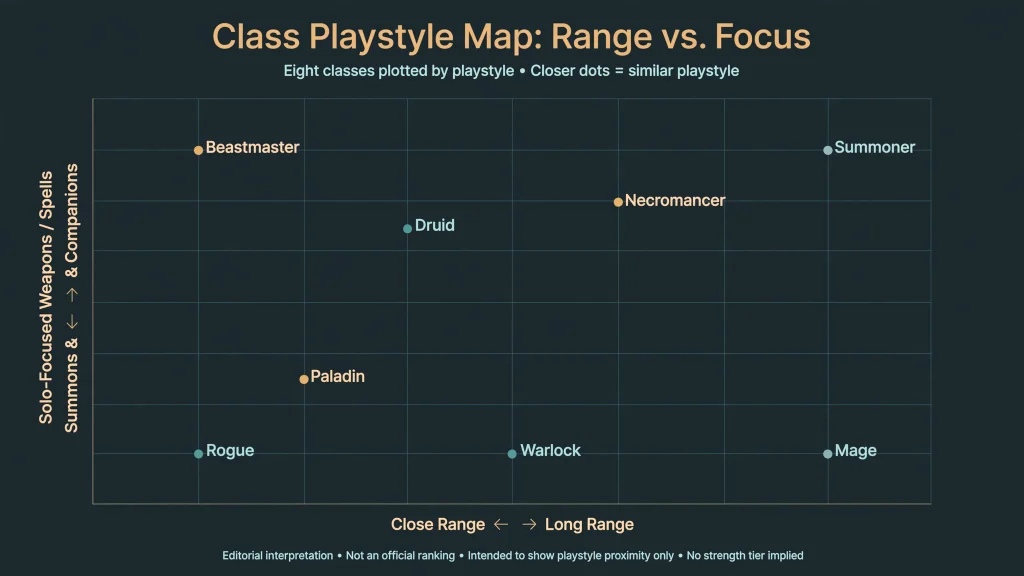
There is no single best beginner class among the Diablo 4 classes, because “easy” depends on what you enjoy. The recommendations below are editorial, not official.
- Straightforward melee: the Barbarian is the simplest to read, with a weapon in hand and enemies in front. The Paladin is another sturdy option if you own Lord of Hatred.
- Ranged spells: the Sorcerer gives you elemental attacks from a distance, and the Rogue can also play at range with a bow or crossbow.
- Minions and summons: the Necromancer is the classic choice, and the Warlock offers a summoning style with more systems.
- Mobility: the Rogue and Spiritborn both reward fast movement.
- Shapeshifting and hybrids: the Druid is the natural fit, with the caveat that it has more mechanics to learn.
- Tactical or complex combat: the Warlock and Rogue suit players who like to optimize.
Whichever you choose, you can always try another, and the character slots are there for exactly that. Many players level a second character after learning one of the Diablo 4 classes well.
Which Diablo 4 Class Is Best for Solo Play?
Solo performance depends on survivability, mobility, damage uptime, resource management and build flexibility. A durable character can forgive mistakes, while a fragile caster may deal more damage but needs better positioning. Because an “all-purpose best solo class” changes with patches and seasons, the safest approach is to pick one of the Diablo 4 classes that matches your comfort level, then read a current build guide for the activity you want to do.
For example, a Paladin or Barbarian may feel safer if you dislike dodging, while a Sorcerer or Rogue may feel better if you prefer to keep your distance. Pet-based classes such as the Necromancer and Warlock can use summons to soak up attention. These are general design tendencies, not guarantees. For specific current rankings, read our Diablo 4 builds guide, which tracks Season 15 builds and explains how to check them against the latest patch.
Which Diablo 4 Classes Have Minions or Summons?
Several of the Diablo 4 classes use allies, but they do not all work the same way.
- Necromancer: the most dedicated minion class, with skeletons, mages and a golem, according to third-party reports on the reworked skill tree. It can also be played without minions.
- Warlock: a summoner and caster. Soul Shards bind a demon to you, and Blizzard’s Legion path emphasizes swarms of hellspawn.
- Druid: Blizzard describes the Druid fighting alongside the creatures of the wild, and community guides mention companion skills.
- Other classes: the Barbarian, Rogue, Sorcerer, Spiritborn and Paladin are not centered on minions, though individual skills or items may add temporary effects.
A temporary summon is not the same as a full minion build, so read what a skill or aspect actually does before assuming it supports an army.
Which Diablo 4 Classes Are Included in Each Expansion?
The base game includes five classes, and the Diablo 4 expansion classes are Spiritborn, Paladin and Warlock. Spiritborn belongs to Vessel of Hatred, and Paladin and Warlock belong to Lord of Hatred. Blizzard’s page states that buying any edition of Lord of Hatred instantly unlocks Vessel of Hatred, and that both expansions require the base game.
| Class | What you need to play it |
|---|---|
| Barbarian, Druid, Necromancer, Rogue, Sorcerer | Diablo IV base game |
| Spiritborn | Vessel of Hatred (included with any Lord of Hatred edition) |
| Paladin | Lord of Hatred |
| Warlock | Lord of Hatred |
For a new buyer, Blizzard’s Age of Hatred Collection bundles the base game with both expansions, so it unlocks all Diablo 4 classes at once. Blizzard also notes that purchases are per platform, so you need Lord of Hatred on each platform you want to play on. Prices vary by region and store, so check the official page before buying. For a deeper look at what each expansion adds, see our Diablo 4 expansions guide.
Class availability is separate from seasons. Blizzard says seasonal and eternal characters can both access class offerings, and that base-game updates continue even without the expansion. Cosmetic bundles in the Ultimate Edition do not unlock classes.

Are Diablo 4 Classes Balanced?
Balance is not fixed. The strength of the Diablo 4 classes can shift with patches, seasons, items, skills and endgame activities. A class can be excellent for leveling but average at boss fights, or strong solo and weaker in a group. For the Diablo 4 classes as a group, the most recent patch I could verify, 3.2.3 on October 14, 2026, was a bug-fix update and did not list balance changes for specific classes. Patch 3.2.2 listed a few small class fixes for the Druid and Sorcerer.
That means any permanent ranking of the Diablo 4 classes can mislead you. Separate these questions: general playstyle, leveling performance, endgame performance, solo versus group play, and current-season rankings. Third-party tier lists such as Maxroll’s are useful snapshots, but they can disagree with each other and are not official. I have not published a tier list here because I could not verify a single ranking across sources. For build-specific rankings, check the guide linked above and compare its date with the newest patch.
How to Choose the Right Diablo 4 Class
Here is a practical decision guide for picking among the Diablo 4 classes:
- Pick a distance. Melee players should look at the Barbarian, Paladin or Spiritborn. Ranged players should look at the Sorcerer, Rogue or Necromancer.
- Pick a theme. Spells, weapons, minions or shapeshifting each point to a different class.
- Pick a complexity level. The Barbarian and Paladin are simpler to read, while the Druid, Rogue and Warlock ask you to juggle more systems.
- Consider solo or group play. Durable or self-sufficient characters tend to be easier alone.
- Check what you own. Spiritborn, Paladin and Warlock need expansions.
- Decide how much to experiment. The skill tree rework gave every class new variants, so there is room to try builds.
- Match your goal. Campaign progress, endgame activities and seasonal play can favor different setups, so read a current guide.
Most importantly, choose the class you want to play for dozens of hours. The enjoyment of the Diablo 4 classes matters more than chasing the latest meta, and you can always roll another character later. If you enjoy the series history, you might also like our Diablo franchise overview and our look at the original Diablo 1 classes.
Frequently Asked Questions About Diablo 4 Classes
How many Diablo 4 classes are there?
There are eight: Barbarian, Druid, Necromancer, Rogue, Sorcerer, Spiritborn, Paladin and Warlock. Five are in the base game and three require expansions.
What are all the Diablo 4 classes?
The full list is Barbarian, Druid, Necromancer, Rogue, Sorcerer, Spiritborn, Paladin and Warlock. Blizzard’s official site lists all eight Diablo 4 classes.
Which Diablo 4 classes are included in the base game?
The Barbarian, Druid, Necromancer, Rogue and Sorcerer are the original base-game classes. Blizzard’s page marks the other three as expansion classes.
Which expansion unlocks Spiritborn?
The Spiritborn is available with Vessel of Hatred. Blizzard says any edition of Lord of Hatred also unlocks Vessel of Hatred.
Which expansion unlocks Paladin and Warlock?
Both come with Lord of Hatred, Diablo IV’s second expansion. They still require the base game.
What is the easiest Diablo 4 class for beginners?
It depends on your taste. The Barbarian is often a good fit for simple melee, and the Sorcerer for ranged spells, but this is an editorial judgment rather than an official rating.
Which Diablo 4 class is best for solo play?
No single class is best for every activity or every season. Durable or mobile characters can feel safer alone, so check a current build guide for the content you want to run.
Which Diablo 4 class uses minions?
The Necromancer is the dedicated minion class, and the Warlock summons demons. The Druid also has companion options.
Which Diablo 4 class is best for ranged combat?
Among the Diablo 4 classes, the Sorcerer is the clearest ranged caster, and the Rogue can fight at range with bows or crossbows. The Necromancer can also stay back while minions fight.
Are Diablo 4 classes balanced?
They are adjusted over time, so strength changes by patch, season and activity. Compare any ranking’s date with the latest official patch notes.
Can you change your class after creating a character?
As far as I could verify, Diablo 4 classes cannot be swapped on an existing character, because a Diablo IV character keeps its class, so changing class means creating a new character. Respeccing your skills is a different thing, and it does not change your class.
Do I need an expansion to play every Diablo 4 class?
Yes. The base game covers five classes, Vessel of Hatred is needed for Spiritborn, and Lord of Hatred is needed for Paladin and Warlock. Lord of Hatred includes Vessel of Hatred.
Final Verdict
Diablo IV now offers eight characters, and the clearest way to understand the Diablo 4 classes is by how they fight. Barbarian, Paladin and Spiritborn live in melee, Sorcerer and Rogue offer distance and mobility, Necromancer and Warlock lean on summons, and the Druid blends forms with nature magic.
To choose, decide on your preferred range, then your preferred theme, then check what you own. If you only have the base game, start with one of the five original characters. If you own Lord of Hatred, all eight are open to you. Whatever you pick, confirm current builds against the official patch notes, and remember that the best of the Diablo 4 classes is the one you enjoy playing.
Sources and Verification Notes
| Source | URL | Supports | Type |
|---|---|---|---|
| Diablo IV official homepage | https://diablo4.blizzard.com/en-us/ | Eight-class roster, class descriptions, expansion labels, Season of Hell’s Legacy, Age of Hatred Collection | Official |
| Diablo IV: Lord of Hatred | https://diablo4.blizzard.com/en-us/lord-of-hatred | Paladin and Warlock paths, Vessel of Hatred included, base game required, per-platform purchase, skill tree reworks | Official |
| Diablo IV Patch Notes | https://news.blizzard.com/en-us/article/24295395/diablo-iv-patch-notes | Patch 3.2.3 (Oct 14, 2026) and 3.2.2 contents | Official |
| Everything You Need to Know About Lord of Hatred (Mobalytics) | https://mobalytics.gg/diablo-4/guides/everything-lord-of-hatred | Druid and Necromancer rework details, level cap, War Plans | Independent |
| Warlock Full Reveal Guide (Mobalytics) | https://mobalytics.gg/diablo-4/guides/warlock-reveal-guide | Wrath and Dominance, Soul Shards | Independent |
| Diablo 4’s Warlock Class Lets You Command Hell Itself (Icy Veins) | https://www.icy-veins.com/d4/news/diablo-4s-warlock-class-lets-you-command-hell-itself/ | Warlock resources, class quest | Independent |
| Diablo 4 Overview: Warlock and Paladin (Space4Games) | https://space4games.com/en/games-en/diablo-4-overview-warlock-and-paladin-in-lord-of-hatred/ | Paladin oath system, Holy damage | Independent |
| Diablo 4 Builds guide (GamesPuma) | https://gamespuma.com/diablo-4-builds/ | Internal links, Season 15 context | Own site |
Discrepancy: Mobalytics says the Warlock class mechanic unlocks at level 30, while other guides say the class quest at level 15 unlocks Soul Shards. The article tells readers to check in game.

Written by Daniel Carter
Daniel Carter is a dedicated gaming writer who enjoys turning complex gaming topics into clear, useful, and engaging content. He covers game guides, tips, reviews, features, and the latest developments across the gaming world. His approach focuses on research, accuracy, and practical value, helping readers discover new games, improve their gameplay, and stay informed about the industry. For Daniel, great gaming content is not just about information—it is about making every article genuinely worth reading.