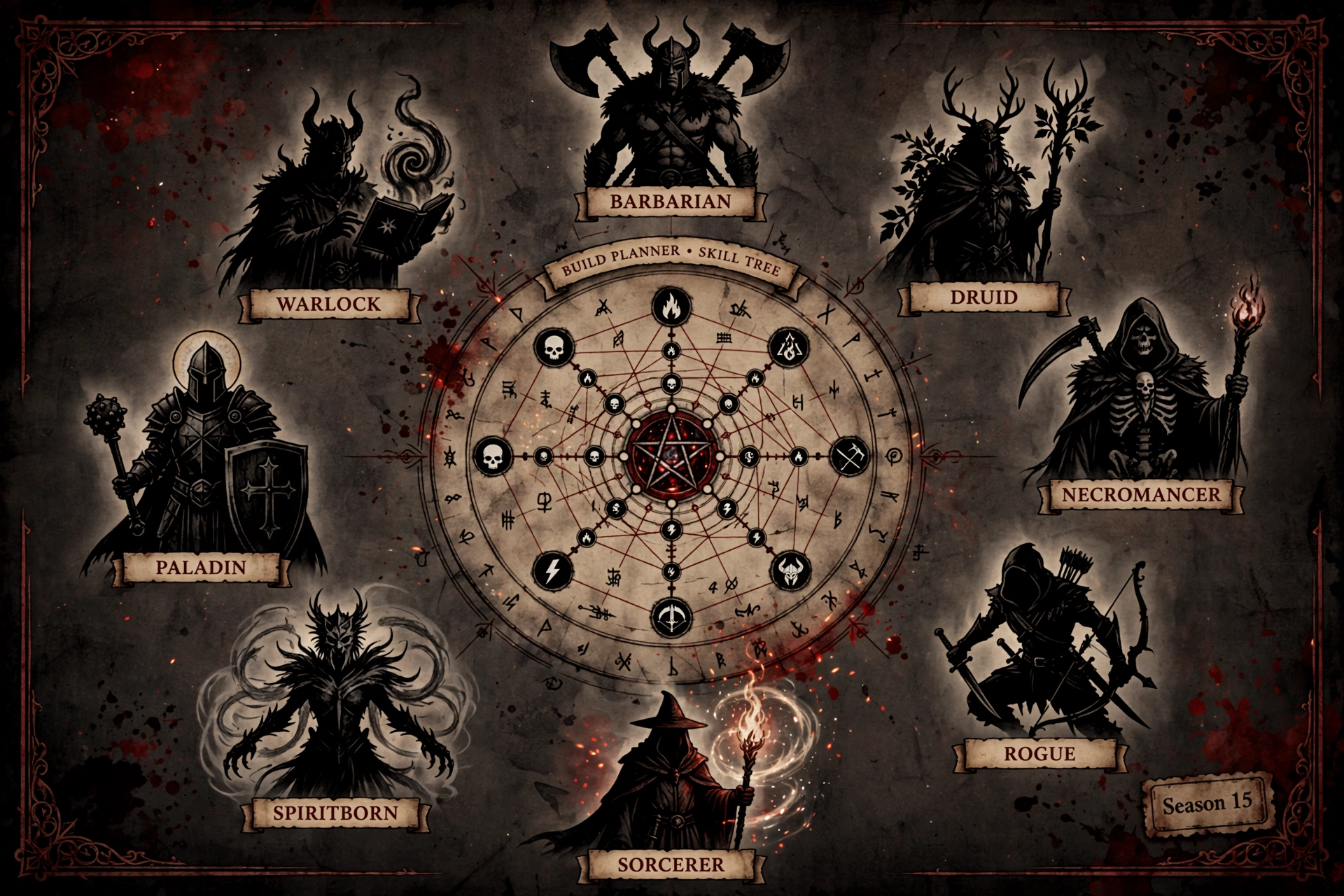
Diablo 4 Builds are the combinations of skills, skill upgrades, gear, unique items, crafting choices and Paragon progression that turn a Diablo IV character into a working damage-and-survival machine. The right setup depends on your class, your level, your gear and what you want to do in the game, which is why no single list of Diablo 4 Builds can be correct for everyone. Searches for Diablo 4 best builds usually mean a class list, a tier list or a leveling plan, so this guide explains how to find, compare, choose and maintain Diablo 4 Builds without blindly copying a guide that may already be out of date.
Scope and research date: this article was researched on October 16, 2026. At that point, Season 15 (Season of Hell’s Legacy) was the live season, and the most recent patch listed on Blizzard’s official Diablo IV patch notes page was 3.2.3 (Build #73883), dated October 14, 2026. The third-party build rankings cited below were last updated between September 14 and September 28, 2026, so treat them as snapshots rather than permanent truth.
Table of Contents
What Are Diablo 4 Builds?
In plain terms, Diablo 4 Builds are the plan behind a character. A build names the skills you level, the upgrades you pick for those skills, the equipment and unique items you wear, and the long-term progression you invest in once you reach the level cap. Good Diablo 4 Builds make those parts reinforce each other, so your resource generation, damage and defense all point in the same direction.
The systems that make up Diablo 4 Builds changed significantly in 2026. Blizzard’s official Lord of Hatred page states that every player received major skill tree reworks, new skill variants for every class and level cap increases, while expansion owners also get bonus skill variants, the Horadric Cube and the Talisman set-bonus system. Third-party guides report that the level cap is now 70 with Paragon levels following it, and that most passive bonuses moved off the skill tree into items and Paragon. Those details come from community guides rather than Blizzard’s page, so confirm them in game before planning around them.
This matters because older advice can be wrong. Any guide that describes the pre-rework skill tree or passives that no longer exist cannot describe today’s Diablo 4 Builds accurately, however good it once was.
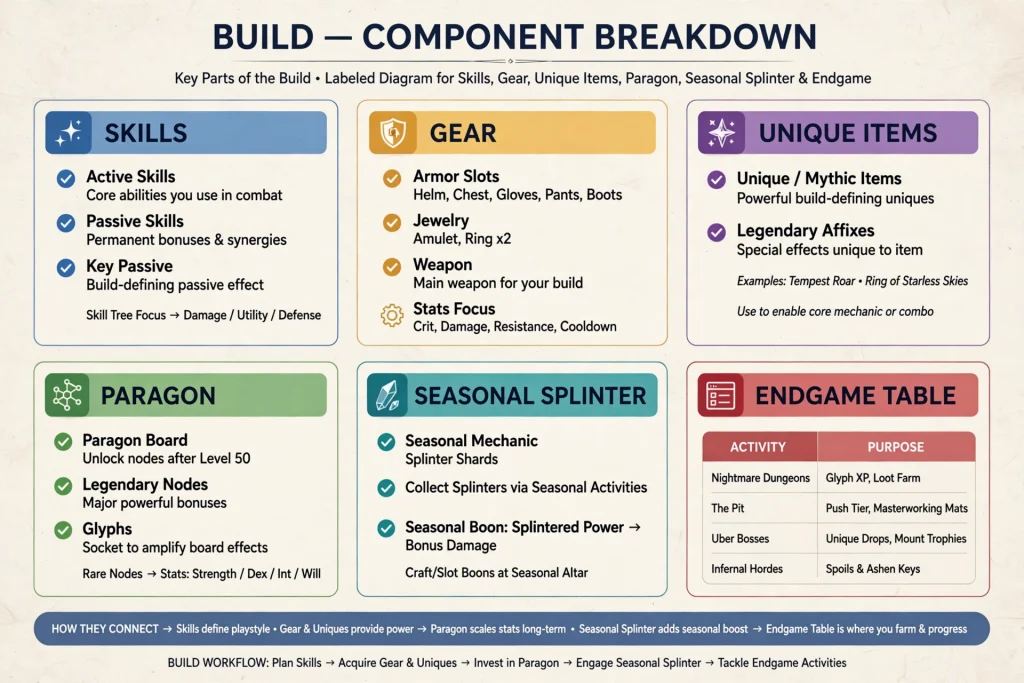
The main parts of a build
- Skills and skill variants: your active abilities and the branches or variants you choose for them.
- Gear and affixes: the stats on your items, plus tempering and crafting options where the guide uses them.
- Unique items, aspects and Runewords: build-defining effects that often decide whether a build works.
- Paragon: long-term character scaling after the level cap.
- Seasonal systems: in Season 15, the Prime Evil Splinter you carry and the powers attached to it.
Which Classes Exist in the Current Game?
Diablo IV currently has eight playable classes. The Barbarian, Druid, Necromancer, Rogue and Sorcerer came with the base game, the Spiritborn arrived with Vessel of Hatred, and the Paladin and Warlock arrived with the Lord of Hatred expansion on April 28, 2026. Blizzard’s own BlizzCon recap also refers to a future class, the Amazon, as being in development, so it should not be treated as part of current Diablo 4 Builds until Blizzard releases it. If you want the bigger picture of the series before choosing a class, read our Diablo franchise overview.
How to Choose the Right Diablo 4 Build
The best way to choose among Diablo 4 Builds is to start with your goal, not a tier letter. A build that dominates a speed-farming list may feel awkward against bosses, and a boss specialist may be slow at clearing packs. Ask yourself the following questions before you commit.
Character level and progression stage
If you are starting a new character, you need a setup that works with few items, not a late-game build that depends on a rare unique. Many guides therefore publish separate leveling and endgame versions. Treat the endgame guide as the destination, not the starting point.
Class and playstyle
Pick a class whose movement and combat rhythm you enjoy. Some Diablo 4 Builds reward standing in a pack and channeling a skill, while others demand constant dashing, trap placement or minion management. A technically stronger build you dislike playing is usually a worse choice in practice.
Solo or group play
Group-oriented Diablo 4 Builds can offer buffs or crowd control that a solo player will not benefit from as much. If you mostly play alone, favor builds with their own survivability and resource generation.
Boss damage versus area clearing
Single-target damage and wide pack clearing are different jobs. Third-party tier lists reflect this by publishing separate rankings for overall endgame, bossing and speed-farming. If you only read one list, you may miss that a build is strong in one activity and average in another.
Gear availability and time investment
Check how many unique items a guide treats as essential, how many are optional and how you obtain them. If a build needs several hard-to-find items, it is a long-term project, and a simpler setup may be a better use of your first weeks.

Diablo 4 Builds by Class
These Diablo 4 class builds come from build resources that were current for Season 15. They are attributed to their sources and are not official Blizzard rankings. Maxroll’s tier lists were the most detailed source I could verify, and I cross-checked their general direction against other community guides.
| Class | Build examples named by current sources | Where the source places it |
|---|---|---|
| Warlock | Blazing Scream, Apocalypse | Maxroll S tier for endgame; Blazing Scream also S for bossing |
| Rogue | Dance of Knives, Poison Penetrating Shot | Maxroll S tier for endgame; Dance of Knives also S for leveling |
| Barbarian | Whirlwind, Frenzy Throw (leveling) | Whirlwind S for endgame, A for leveling; Frenzy Throw S for leveling |
| Necromancer | Blood Wave, Minion | Blood Wave S for endgame; Minion S for leveling |
| Spiritborn | Counterswarm, Stinger | Both S for endgame; Stinger also S for leveling |
| Paladin | Shield of Retribution | S for endgame and leveling |
| Sorcerer | Firewall, Blizzard | Firewall S for endgame; Blizzard S for leveling |
| Druid | Lacerate, Storm Strike | A for endgame on Maxroll; Storm Strike is S for bossing |
Warlock Diablo 4 Builds
The Warlock is one of the two classes added by Lord of Hatred. Maxroll lists Blazing Scream as S tier for overall endgame, bossing and speed-farming, and lists Apocalypse as S tier for endgame and bossing. A Mobalytics creator guide describes the Elegy weapon as required for the endgame version and says Blazing Scream’s Orbital Scream variant unlocks at level 15 for leveling. Those are the guide author’s claims, so check them against your own skill tree.
The limitation is gearing. Blazing Scream guides lean heavily on specific unique items and resource management, so the build is better suited to players willing to farm. Maxroll places the Hell Fracture Warlock in a lower tier than Blazing Scream and Apocalypse.
Rogue Diablo 4 Builds
Maxroll places Dance of Knives in S tier for overall endgame and for leveling, and Poison Penetrating Shot in S tier for endgame and bossing. One community class ranking calls the Rogue the safest pick with the widest list of playable builds, which is useful if you want options as the season goes on. Rogue builds usually reward mobility and positioning, so they suit players who like to keep moving.
Barbarian Diablo 4 Builds
Whirlwind is S tier for endgame on Maxroll and A tier for leveling, while Frenzy Throw is S tier for leveling. If you want a straightforward melee approach with a long-established identity, this is a natural place to look. As with every class, the best Barbarian choice depends on whether you are leveling, pushing deeper content or farming quickly.
Necromancer Diablo 4 Builds
Maxroll lists Blood Wave as S tier for endgame and bossing, and the Minion Necromancer as S tier for leveling. Sportskeeda’s class ranking, by contrast, places the Necromancer in its B tier while still recommending a Minion or Golem setup for leveling. That is a good example of why one ranking should not be your only source: classes can look different depending on what the author weighs.
Spiritborn Diablo 4 Builds
The Spiritborn arrived with Vessel of Hatred. Maxroll lists Counterswarm and Stinger as S tier for endgame, and Stinger as S tier for leveling. Sportskeeda’s guide describes Rock Splitter and Stinger as smooth leveling options that can transition later into other builds. If you prefer a tanky class with fast movement, these are worth reading about.
Paladin Diablo 4 Builds
The Paladin returned in Lord of Hatred. Maxroll’s Paladin-specific list places Shield of Retribution in S tier and gives several other builds, such as Divine Lance, Shield Charge and Blessed Hammer, A tier. Sportskeeda notes that Shield of Retribution received a damage boost in the latest balance pass and remains a good leveling choice. A different ranking, from allthings.how, places the whole Paladin class in its C tier, which shows how much rankings can vary.
Sorcerer Diablo 4 Builds
Maxroll lists Firewall as S tier for endgame and bossing and Blizzard as S tier for leveling, and Sportskeeda’s leveling advice also centers on cold damage and Blizzard. Some class rankings place the Sorcerer lower overall, so Sorcerer players should look at the specific build and activity rather than the class label, because Diablo 4 Builds within one class can rank very differently.
Druid Diablo 4 Builds
Maxroll places Lacerate and Storm Strike in A tier for endgame, and lists Storm Strike among its S tier boss builds. Community rankings put the class in their lower tiers, so Druid Diablo 4 Builds are a reasonable choice if you enjoy the class but may require more attention to current guides.
Best Diablo 4 Builds for Leveling
A leveling build has different requirements from an endgame build. It needs to work with low-level gear, manage its resource without special items and stay survivable while you are still collecting skill points. Maxroll’s leveling list was last updated on September 14, 2026, the day before Season 15 began, and it ranks builds such as Dance of Knives Rogue, Frenzy Throw Barbarian, Minion Necromancer, Blizzard Sorcerer, Shield of Retribution Paladin and Stinger Spiritborn in S tier.
Do not assume your favorite endgame setup is a good leveler. One Warlock leveling guide recommends Dread Claws for a smoother campaign and treats Blazing Scream as the choice if you want a build that carries into endgame, even though it starts slower. In other words, the best Diablo 4 leveling builds are often a stepping stone, and respeccing at a milestone is normal.
What to look for
- A skill that works without unique items.
- Reliable resource generation.
- A clear milestone where the build becomes smoother.
- A path into your intended endgame build, if you have one.
Best Diablo 4 Endgame Builds
Endgame is not one activity. Blizzard describes Lord of Hatred’s endgame as built around War Plans and the Echoing Hatred horde challenge, and the game still has dungeons, Helltides, bosses and other activities. Because these reward different things, Diablo 4 endgame builds should be evaluated by role.
| Build | Class | Role according to source | Evidence type |
|---|---|---|---|
| Blazing Scream | Warlock | Overall endgame, bossing, speed-farming | Maxroll tier lists; Mobalytics guide for gear |
| Counterswarm | Spiritborn | Overall endgame; speed-farming | Maxroll tier lists |
| Blood Wave | Necromancer | Endgame and bossing | Maxroll tier lists |
| Poison Penetrating Shot | Rogue | Endgame and bossing | Maxroll tier lists |
| Shield of Retribution | Paladin | Endgame and leveling | Maxroll tier lists |
| Firewall | Sorcerer | Endgame and bossing | Maxroll tier lists |
None of these placements are Blizzard rankings, and I did not test the builds myself. They represent a snapshot of what one established resource listed in late September 2026.
Bossing, Speed Farming and Group Builds
Maxroll publishes separate lists for bossing and speed-farming, which is a useful reminder that these are different jobs. A bossing list rewards sustained single-target damage and survivability, while a speed-farming list rewards fast movement and area clearing in activities such as Whispers, Helltide and lower Pit tiers.
Some builds appear in both. Blazing Scream Warlock is S tier on Maxroll’s overall, bossing and speed-farming lists, which makes it a flexible choice if you can gear it. Others are more specialized: Maxroll’s speed-farming list includes builds such as Death Trap Rogue and Cataclysm Druid, while its bossing list highlights builds such as Storm Strike Druid and Quill Volley Spiritborn.
I could not verify group-specific rankings for Season 15, so this guide does not make group build claims beyond the general principle that supportive or crowd-control builds matter more in a party. Look for a group-focused guide if that is your main way to play.
Skills, Gear, Aspects and Paragon Setup
Reading a build guide well is a skill in itself. Most guides organize information into a skill tree allocation, a gear list with priorities, stat or affix targets, a Paragon plan and a playstyle section. Your job is to understand which parts are essential and which are flexible.
Skills and skill variants
After the skill tree rework, skills have branches and variants that change how they behave. Third-party explainers describe each active skill as having three branches, with expansion owners getting extra bonus skill variants. If a guide tells you to take a particular variant, check that it exists in your version of the game and that you own the expansion if the variant requires it.
Gear, unique items and Runewords
Gear is where most builds become expensive. A guide may name unique items, Runewords or Talisman components as essential, and some of these may be hard to obtain. Blizzard’s own notes confirm that Runewords exist in Season 15, since a recent fix refers to the Lore Runeword helm. Third-party sources also describe the Horadric Cube as the crafting tool for many of these. Rather than assuming every listed item is mandatory, read what the guide says each one does, because the strongest Diablo 4 Builds usually explain why an item matters. Runewords will also be familiar to fans of Diablo 2: Lord of Destruction, where the system has long been a part of character building.
Paragon
Paragon is the long-term progression layer after the level cap. Guides typically give a board order and glyph priorities, and the general principle is to follow the plan once you have the gear it assumes. If you are far below the level the guide expects, prioritize the earliest boards and revisit the rest later.
Seasonal Splinters and Prime Evil Powers
Season 15 introduced Splinters of Evil tied to Diablo, Baal and Mephisto. Blizzard’s season announcement says you choose which Prime Evil’s power to carry, and that the Splinter also makes you more vulnerable to that Prime Evil. Because this is a seasonal system, a guide that ignores it may be written for an earlier season.
How to Make a Build Work Without Perfect Gear
You rarely need perfect gear to enjoy a build. What you need is the right foundation. The following approaches are general strategic advice, not verified item substitutions.
- Start with the core skill. Most Diablo 4 Builds revolve around one main skill or mechanic. Make sure that is working before chasing minor upgrades.
- Identify the true dependencies. Some guides say a particular item is required, which usually means the build’s central mechanic depends on it. Treat that as a real requirement.
- Use the guide’s lower-priority slots as flexible. Items listed late in a priority list are often easier to replace.
- Use a leveling or budget version first. Many creators publish early-game or mid-game variants of the same build.
- Upgrade gradually. Crafting through the Horadric Cube can help tailor a base item, according to third-party guides, but it does not replace the need to understand the build.
Be careful with substitutions. If you change a key unique, you may change how the build plays, not just how strong it is. Without a source confirming a substitute works, do not assume it does. If you enjoy planning characters around limited gear, you may also like our Project Diablo 2 guide.
How to Keep Diablo 4 Builds Updated After Patches
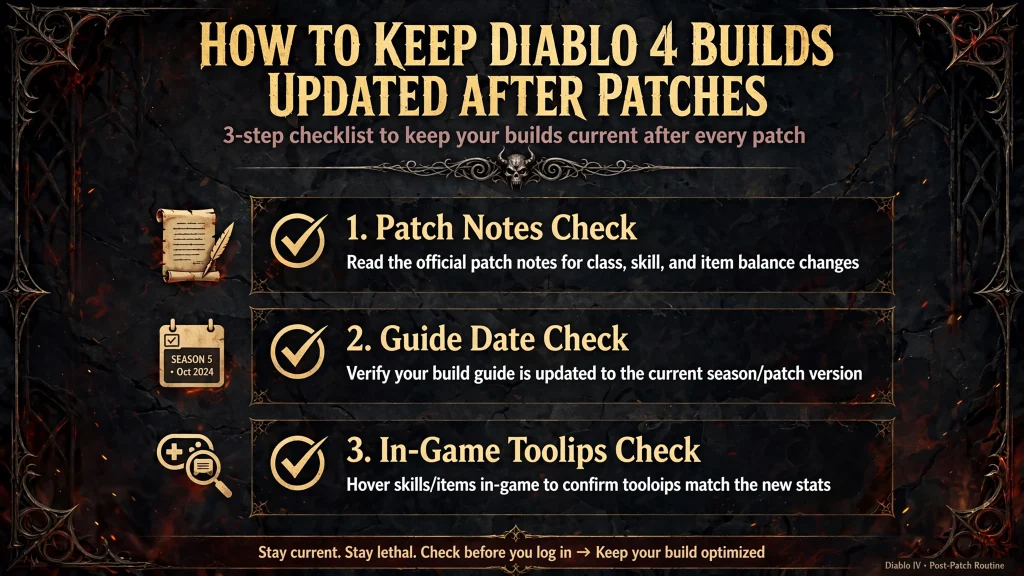
Patches can change numbers, fix bugs or alter how a skill interacts with an item. The best habit is to check the official notes first, then compare the date of any build guide to the date of the latest patch.
A quick checklist
- Check Blizzard’s Diablo IV patch notes page for the latest build number and date.
- Note the date and season on the build guide you are reading.
- Search the patch notes for your class, skill and key items by name.
- Look for effects described as changed, fixed or removed.
- Compare your in-game tooltips with the guide before you invest resources.
- Look for a “last updated” note or changelog on the guide.
For context, the 3.2.3 patch from October 14, 2026 was described in Blizzard’s notes as a bug-fix update covering a seasonal quest issue, Horadric Cube affix rerolling, boss encounters and similar fixes. Several secondary sources described the preceding 3.2.2 patch as bug fixes only, but one of them published a correction after listing changes that did not appear in Blizzard’s notes, which is a good reminder to prefer official sources. Based on the sources I could verify, the late-September build rankings had not been contradicted by a balance patch as of October 16, 2026, but I could not confirm that for every build, so verify the ones you plan to play.
Seasons also end. I could not verify an official end date for Season 15, and different sites gave different estimates, so check Blizzard before investing in a long project. For patch-by-patch coverage, see our [Diablo 4 patch notes guide]([INTERNAL LINK URL TO BE CONFIRMED: GamesPuma Diablo 4 patch notes article]).
Frequently Asked Questions About Diablo 4 Builds
What are Diablo 4 Builds?
Diablo 4 Builds are character setups that combine skills, skill variants, gear, unique items, crafting choices and Paragon progression around a main strategy. A good build gives you a clear way to deal damage and survive in a specific activity.
How do I choose a good build in Diablo IV?
Choose based on your class preference, current level, available gear and the activity you want to do. Then read a current guide for that class and compare its date with the latest patch.
Are leveling builds different from endgame builds?
Often, yes. Leveling builds usually need less gear and manage resources more easily, while endgame builds may depend on specific unique items and Paragon investment. Many guides publish both versions for the same skill.
Do the best Diablo 4 Builds change after patches?
They can. Balance changes, item changes and seasonal systems can all shift which Diablo 4 Builds perform well. A bug-fix-only patch is less likely to change rankings than a balance patch, but you should still check.
Can I use a build without all its recommended items?
Sometimes. If the missing item is a core dependency, the build may not function as intended. If it is a lower-priority slot, you can often use a placeholder while you farm.
Where can I find updated Diablo IV build guides?
Start with Blizzard’s official site and patch notes for mechanics, then use established build resources such as Maxroll, Mobalytics or Icy Veins for build detail, always checking the update date and season.
Is one build best for every activity?
No. Different Diablo 4 Builds excel at bossing, speed-farming or general endgame. Even sources that rank one build highly in several lists treat the activity as part of the ranking.
How can I check whether a build is still current?
Compare the guide’s update date with the most recent patch notes, search the notes for your skills and items, and check your tooltips in game.
Final Verdict
The best Diablo 4 Builds for you are the ones that match your class, your progression stage, your preferred activity and the gear you can realistically obtain. Use leveling guides to get started, move to an endgame guide once your character is ready and treat tier lists as one input rather than a verdict. Because Season 15 is still the current season as of October 16, 2026, the examples in this guide may change when Blizzard releases new balance updates or a new season begins.
Before you commit, read the official patch notes, confirm the guide’s date and make sure the build’s core mechanic works in your version of the game. Then keep exploring more Diablo 4 Builds through our other GamesPuma guides, and come back to this page when you want a framework for choosing your next one. To see where the series began, you can also read our Diablo 1 guide.
Sources and Further Reading
Research date: October 16, 2026. The pages below were verified during research. Rankings are third-party and are not official Blizzard rankings.
Official Blizzard Sources
- Diablo IV Patch Notes (3.2.3, Build #73883, Oct 14, 2026)
- Diablo IV: Lord of Hatred
- Diablo IV: What’s Next Panel Recap
Build Resources and Tier Lists (Third-Party)
- Maxroll: Overall Endgame Tier List, Season 15 (updated Sep 26, 2026)
- Maxroll: Leveling Tier List, Season 15 (updated Sep 14, 2026)
- Maxroll: Bossing Tier List, Season 15 (updated Sep 26, 2026)
- Maxroll: Speedfarming Tier List, Season 15 (updated Sep 26, 2026)
- Maxroll: Paladin Endgame Tier List, Season 15 (updated Sep 28, 2026)
- Mobalytics: Blazing Scream Warlock Endgame Build (updated Sep 15, 2026)
- Mobalytics: Blazing Scream Warlock Leveling Build
Class Rankings and Community Guides (Opinion, Not Official)
- Sportskeeda: Season 15 Class Tier List
- allthings.how: Season 15 Class Tier List
- allthings.how: Best Warlock Leveling Build, Level 1 to 70
Systems and Season Explainers (Third-Party)
- Mobalytics: Everything You Need to Know About Lord of Hatred
- Icy Veins: Lord of Hatred, All the New Systems
- D4Guides: Lord of Hatred, Every New Feature
- D4Guides: Season 15 Start Date, Content and Rewards
Patch Commentary and Season-End Estimates (Secondary, Verify with Blizzard)
- DiabloBytes: Patch 3.2.2 Notes (the article itself carries a correction notice)
- GGSeason: Season 15 End Date Estimate
- ARPG Timeline: Diablo IV
Note: an official end date for Season 15 could not be verified, and sites give different estimates.

Written by Daniel Carter
Daniel Carter is a dedicated gaming writer who enjoys turning complex gaming topics into clear, useful, and engaging content. He covers game guides, tips, reviews, features, and the latest developments across the gaming world. His approach focuses on research, accuracy, and practical value, helping readers discover new games, improve their gameplay, and stay informed about the industry. For Daniel, great gaming content is not just about information—it is about making every article genuinely worth reading.