Diablo 1 is the original Diablo, the isometric action role-playing game from Blizzard that sent players beneath the town of Tristram in the mid-1990s. It is a single-hero dungeon crawler with randomly generated levels, a small cast of townsfolk, and a loot-driven loop that later defined an entire genre. This guide explains what Diablo 1 is, how its classes and systems work, how it differs from the Hellfire expansion and from later games, and what is known about playing it legally on a modern PC. Historical facts, current availability information, and community-project notes are labeled separately so you can tell them apart.
Table of Contents
What Is Diablo 1?
Diablo 1 is the first game in Blizzard’s Diablo series, released in the mid-1990s as a real-time action role-playing game viewed from an isometric perspective. Players choose a hero, visit the town of Tristram for supplies, and descend through a dungeon of randomly generated levels to confront Diablo, the Lord of Terror. According to the game’s Wikipedia entry, the story takes place in the fictional Kingdom of Khanduras, and the design credits include Erich Schaefer and David Brevik, with Bill Roper as producer.
Many readers search for Diablo 1 simply because they want to know which game it is. It is not Diablo II, Diablo III, Diablo IV, or Diablo Immortal. Those are later entries in the series. The original Diablo game is the one with three playable classes, one town, and a single descent through four dungeon themes.
The basic loop of Diablo 1 is easy to describe: fight monsters, collect gear and gold, return to town to sell, repair, and buy, then go deeper. Because dungeon layouts, monster placement, and many items are randomized, each new character gets a different run. That randomization is the main reason the original Diablo game still has a dedicated audience.
A note on dating: sources disagree. The game’s own copyright notice is 1996, and many articles refer to Diablo 1996, while other databases and summaries list a January 1997 release. The disagreement likely reflects regional or format release dates, but we could not confirm an exact day from an official Blizzard source, so check Blizzard’s materials before quoting one.
The History and Legacy of Diablo 1
Diablo was developed by Blizzard North and published by Blizzard Entertainment. Wikipedia credits the game’s creation to David Brevik and the Schaefer brothers, Erich and Max, and notes that the design drew inspiration from early computer dungeon crawlers such as Rogue and NetHack. A description of the PlayStation release makes the same connection, calling Diablo an action RPG with randomly generated dungeons, items, and monsters.
The history of Diablo 1 also includes a console release. Electronic Arts published a PlayStation version in 1998, which kept the three classes and the randomized dungeons while changing the interface for a controller. The PC game remains the version most readers mean when they search for Diablo 1.
Its legacy is often described in strong terms. GameSpot, in a retrospective, argued that the game helped create the action-RPG genre as we know it and spawned many imitators, and that point-and-click combat, hordes of monsters, character development, and collectible loot are still compared against it. Treat that as one respected publication’s assessment rather than a universal rule, but it is a fair summary of how the industry has talked about Diablo 1 for decades.
The series that followed grew large. Diablo II arrived in 2000, Diablo III in 2012, Diablo Immortal in 2022, and Diablo IV in 2023. If you are exploring the modern entries, see our Diablo 4 builds guide for current coverage. This article stays focused on the original.
Diablo 1 Story and Setting
Spoiler note: this section keeps to the opening premise. Later story beats are not described.
The story of Diablo 1 begins in Tristram, a troubled town in Khanduras. A hero arrives to find the settlement afraid and a cathedral sealed over a dungeon. Townsfolk such as Cain, Adria, Griswold, Pepin, Ogden, and Gillian provide services, rumors, and quests, and each helps shape the mood of the place.
The dungeon is a descent. The player moves from the cathedral into the catacombs, then through the caves, and finally into Hell itself, ultimately facing Archbishop Lazarus and then Diablo, as the TASVideos description of the game outlines. Each theme looks and sounds different, which gives the descent a sense of progress even though the underlying loop stays the same.
The tone is gothic and bleak. There is no large open world and no cinematic cast. The atmosphere comes from sparse dialogue, a persistent soundtrack, and the feeling that Tristram is the last safe place. That restraint is part of why Diablo 1 feels different from later, more story-heavy games.
Diablo 1 Classes Explained
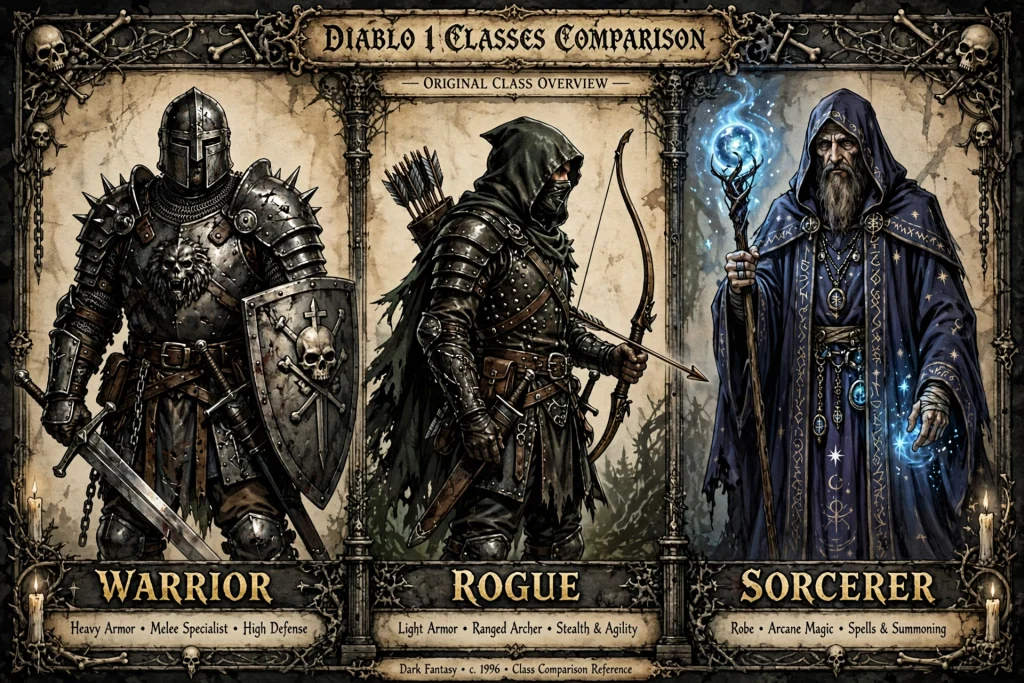
Diablo 1 has three playable classes: the Warrior, the Rogue, and the Sorcerer. Wikipedia notes that, unlike later Diablo games, each class can use almost all of the same items and spells, so the differences are about starting statistics and special abilities rather than locked equipment lists. This is a defining feature of Diablo 1 classes and one of the biggest contrasts with Diablo II.
Warrior
The Warrior is the straightforward melee fighter, with the highest starting strength and vitality. In practice, the Warrior is widely considered the most forgiving choice for beginners because he can absorb more damage than the others. His weakness is that his starting ranged and magical options are limited compared with the other two heroes.
Rogue
The Rogue is the ranged specialist, a bow user with strong dexterity. She is the most flexible in terms of approach, but her survivability depends on keeping distance and managing positioning. Players who enjoy kiting enemies often prefer her.
Sorcerer
The Sorcerer is the spellcaster, starting with the highest magic and a bonus to mana. He begins with a spell and a staff, and his power depends heavily on collecting spell books and managing mana. He is the most fragile early on, and also the class most likely to reward careful play and good gear.
A PlayStation database description notes that each hero is rated in strength, vitality, dexterity, and magic, which influence damage, health, armor class, and mana. That four-attribute structure is the same one players use on PC.
Because gear is shared, a Warrior can learn spells from books and a Sorcerer can wield a sword, though stat requirements shape what is practical. The Hellfire expansion adds a fourth class, the Monk, and Wikipedia notes that two unfinished classes, the Bard and Barbarian, remain as hidden content that can be enabled through a hack. Those extras belong to Hellfire, not to the original Diablo 1.
Diablo 1 Gameplay and Character Progression
Diablo 1 gameplay is built around mouse-driven combat. You click to move and attack, use hotkeys for potions and spells, and manage a belt and inventory that fit a limited number of items. Combat is real-time, but the pace is deliberate compared with modern action RPGs, and positioning matters.
Attributes and leveling
Characters earn experience from defeating monsters and gain levels, receiving points to distribute among strength, magic, dexterity, and vitality. Strength and dexterity affect weapon and armor requirements, magic affects mana and spell strength, and vitality affects health. There is no skill tree in Diablo 1. Progression comes from attribute choices, spell books, and equipment.
Spells and items
Spells are learned from books, which are found in the dungeon or purchased in town, and can be improved by finding more copies of the same book. Items come in normal, magic, and unique categories, a structure Wikipedia’s overview also highlights. Magic items carry random bonuses, while unique items are fixed, named, and rare.
Dungeons and exploration
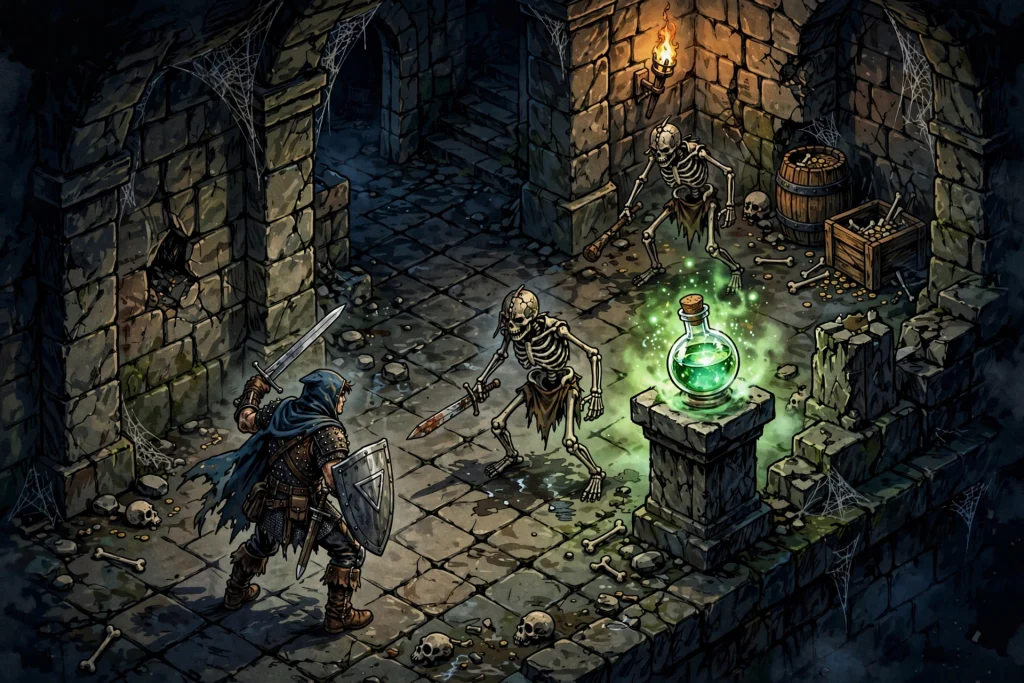
The dungeon is organized into four themed sections, generally documented as sixteen levels in total, and levels are randomized when a new game is created. Town Portal scrolls let you return to Tristram quickly and come back to where you left off. Exploring is slow and tactical: you light your way, listen for enemies, and decide when to retreat.
What Diablo 1 does not include
It helps to know what is missing. Diablo 1 has no skill trees, no class-exclusive gear, no difficulty tiers like Normal, Nightmare, and Hell as in Diablo II, and no huge outdoor zones. Mixing those later mechanics into your expectations leads to confusion, so keep them separate when reading older guides.
Diablo 1 Difficulty, Enemies, and Replayability
The game features over 200 monster types, according to the GOG and PlayStation store descriptions, and enemies range from skeletons and goat men to gargoyles and demons. Many encounters are about reading the room: fighting in corridors, retreating to heal, and avoiding being surrounded.
Difficulty in Diablo 1 is uneven. Early levels are manageable, while certain bosses and enemy groups can punish careless play, especially for a Sorcerer with limited health. Because dungeon layouts and loot change between games, difficulty also depends on luck. We avoid giving a single completion time here, because playstyle, class, and how thoroughly you explore all change it considerably.
Replayability comes from three sources: a different class, a different random dungeon, and different loot. Players who enjoy setting their own goals, such as building a particular spellcaster or testing a new strategy, tend to get the most out of Diablo 1.
Diablo 1 vs. Hellfire
Hellfire was released in November 1997 by Synergistic Software as an expansion. It was made by a different studio from the original game, and Blizzard’s later approval to include it with the GOG release shows it is a recognized add-on. It adds a new class, the Monk, along with new content for the original game.
GOG’s product description says Hellfire offers a non-canonical single-player storyline in which players must defeat a powerful demon called Na-Krul who threatens Tristram. “Non-canonical” is the key term: Hellfire is not treated as part of the main Diablo story, and it should not be presented as a standalone sequel.
| Feature | Diablo 1 (original game) | Hellfire expansion |
|---|---|---|
| Release | 1996/1997 (sources differ) | November 1997 |
| Developer | Blizzard North | Synergistic Software |
| Classes | Warrior, Rogue, Sorcerer | Adds the Monk |
| Story status | Main Diablo story | Non-canonical single-player storyline |
| Needs original game | Not applicable | Expansion for Diablo 1 |
On GOG, Hellfire is currently described as included free with the Diablo purchase and accessible when launching the original game. Check the store page before buying, since bundles and listings can change.
Diablo 1 vs. Diablo II and Later Games
Newer does not automatically mean better, and many players prefer Diablo 1 precisely because it is smaller and slower. The table below summarizes the main differences at a high level.
| Area | Diablo 1 | Diablo II | Later games (III, IV) |
|---|---|---|---|
| Era | Mid-1990s | 2000 | 2012 and 2023 |
| Classes | 3 (Warrior, Rogue, Sorcerer) | More classes with unique identities | Larger, more specialized rosters |
| Gear | Shared across classes | Class-specific items appear | Class-specific systems |
| Progression | Attributes and spell books | Skill trees | Modern skill and build systems |
| World | Town plus one dungeon | Multiple acts and outdoor zones | Larger worlds and live-service features |
| Best for | Retro, minimalist action RPG fans | Players who want deeper builds | Players who want modern presentation |
The practical advice is simple. If you want a compact, atmospheric dungeon crawler, start with Diablo 1. If you want more build variety, move to Diablo II. If you want modern graphics and online features, look at Diablo IV; see our Diablo 2 LOD guide for the classic sequel’s expansion, or read about Project Diablo 2 if you want a heavily modded take on it.
How to Play Diablo 1 Today
Here is what could be verified at the time of writing. These notes cover current access, and they should be re-checked before you buy.
Official or licensed route: GOG. GOG lists the game as “Diablo + Hellfire,” describes it as DRM-free, and states that Blizzard approved including Hellfire as a free add-on. The listing also mentions a Diablo 1 HD mod described on the page as “Belzebub.” User reviews on that page report that the “modern” version runs on Windows 11, but those are customer opinions rather than guarantees, so treat them as anecdotal.
Battle.net. The DevilutionX documentation says you can buy Diablo from GOG or Battle.net. We could not independently verify the current Battle.net storefront listing, so confirm it on Blizzard’s official website before purchasing.
Original discs. If you own an original CD copy, DevilutionX documentation notes that it can supply the required game data. The game files remain the property of Blizzard.
Community source ports. DevilutionX is a community-made source port of Diablo and Hellfire that aims to make the game easier to run, with engine improvements, bug fixes, and optional quality-of-life features. It is not an official Blizzard release. Its documentation says you need data from the original game, for example from an original CD or a GOG purchase. It also describes a shareware option: you can use the shareware data file to play the demo portion only. The project states that its source code is for non-commercial use and that Diablo is a Blizzard trademark.
What we do not recommend. Do not search for unauthorized downloads. They are illegal, frequently unsafe, and unnecessary given the legitimate options above.
Remember that Diablo 1 predates modern operating systems, so running it on current hardware depends on the edition you choose. If you hit errors, read the documentation for your chosen edition or the source port rather than relying on forum shortcuts.
Diablo 1 System Requirements and Compatibility
We cannot give a verified requirements list here. The GOG page lists minimum requirements, but the detailed values were not captured in our research, and we did not want to guess. Check the current store listing directly for the exact edition you plan to buy.
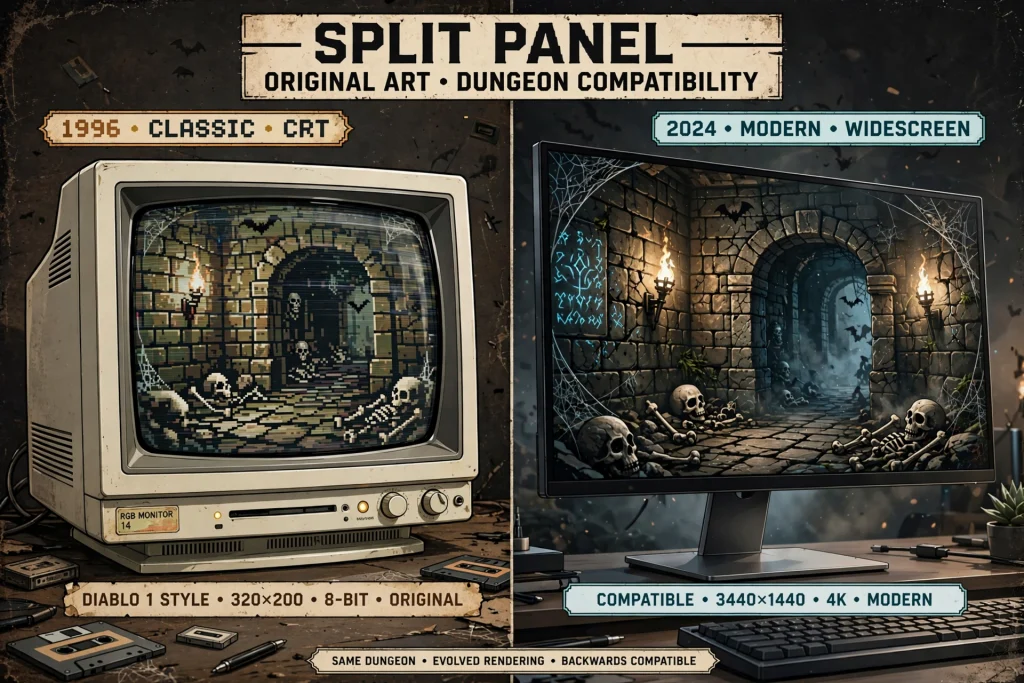
What we can say is that there are two different questions. The first is the original 1990s requirements, which are historical and describe the machines of the era. The second is the practical requirement for a modern setup, which depends on your operating system and on whether you use the GOG edition, an original disc, or a source port such as DevilutionX. DevilutionX is built for several platforms, but you should consult its manual for yours.
If you are playing on a modern PC, a useful rule is to start with the officially licensed edition and only move to community tools if you need features it lacks. We have not personally tested any edition on a modern computer, so we cannot promise perfect compatibility.
Diablo 1 Multiplayer
The original Diablo 1 multiplayer experience supported up to four players, with cooperative play over the Internet and head-to-head play over a local network, as the GOG description states. A PlayStation edition was described as supporting a two-player mode.
The current state of online play is less certain. GOG user reviews contain conflicting comments about whether online services work, and we could not verify a current official statement. We therefore do not promise that historical online services or community methods are functional today. If multiplayer matters to you, check the store page, the support documentation for your edition, and the DevilutionX manual for networking options before buying.
Is Diablo 1 Worth Playing Today?
The honest answer depends on what you want from a game.
Retro RPG enthusiasts will likely enjoy Diablo 1 for its atmosphere, its compact design, and its historical importance. It is a good way to see where the action-RPG formula started.
Franchise newcomers can treat Diablo 1 as a short history lesson, but they should expect a slower, simpler game than later entries. The interface is dated, and some conveniences that modern players expect are not present.
Players who prefer modern action RPGs may find it limited. The lack of skill trees, the shared item pool, and the older presentation can feel basic. For these players, Diablo II or a later game may be a better starting point.
Reviews on GOG illustrate the split. Some users call it a foundational classic, while others describe it as a simple dungeon crawler. Both views are valid, which is why Diablo 1 is best approached with the right expectations.
Frequently Asked Questions About Diablo 1
What year did Diablo 1 release?
Diablo 1 carries a 1996 copyright date and is commonly called a 1996 game, though some databases list January 1997. The Hellfire expansion followed in November 1997.
Who developed the original Diablo?
The original Diablo was developed by Blizzard North and published by Blizzard Entertainment. David Brevik and Erich and Max Schaefer are credited with its creation.
What classes are available in Diablo 1?
The original game has three classes: Warrior, Rogue, and Sorcerer. The Monk is added by the Hellfire expansion.
Is Diablo 1 different from Hellfire?
Yes. Hellfire is an expansion released in November 1997 by Synergistic Software. It adds the Monk and a non-canonical storyline, and it is not a standalone sequel.
Can you play Diablo 1 on a modern PC?
It is possible, but the result depends on the edition. GOG sells a DRM-free version with a modern-compatibility focus, and community ports such as DevilutionX exist, but we could not guarantee flawless performance on every system.
Where can you legally buy or play Diablo 1?
GOG lists Diablo + Hellfire for sale. DevilutionX documentation also mentions Battle.net, which should be confirmed on Blizzard’s website. Avoid unauthorized downloads.
Does Diablo 1 have multiplayer?
Yes, the original game supports multiplayer for up to four players, but the current availability of online services is unverified, so check your edition’s documentation.
Is Diablo 1 worth playing today?
It depends on your tastes. Fans of retro action RPGs and compact dungeon crawlers are the most likely to enjoy Diablo 1, while players seeking modern conveniences may prefer later games.
How is Diablo 1 different from Diablo II?
Diablo 1 has three classes, shared items, and attribute-and-spell progression. Diablo II introduced class-specific features, skill trees, multiple acts, and difficulty tiers.
Final Verdict
Diablo 1 remains a landmark: a compact, atmospheric action RPG that helped shape the genre and still offers a distinct experience. Its strengths are its mood, its randomized dungeons, and its simple but satisfying loop. Its limits are its dated interface and shallow build variety compared with later games.
If you want to try the original Diablo game, start with a legitimate edition, check compatibility notes, and decide whether you want Hellfire. For more classic and modern action RPG coverage, browse the related guides on GamesPuma; see our Diablo franchise guide for more. Whether you come to Diablo 1 for history or for a fresh dungeon run, it is a worthwhile piece of gaming history.
Sources and References
The facts in this guide come from the sources below. Official Blizzard pages were not fetched during research, so please confirm availability and release details with Blizzard before relying on them.
- Wikipedia, “Diablo (video game)”: developer and publisher, design credits, Khanduras setting, three classes, shared items and spells, Hellfire release, Monk class, PlayStation release, and later series dates. https://en.wikipedia.org/wiki/Diablo_(video_game)
- GOG.com, “Diablo + Hellfire” store page: DRM-free edition, Hellfire included with Blizzard’s approval, Na-Krul storyline, multiplayer description, and the listed HD mod. https://www.gog.com/game/diablo
- DevilutionX project (GitHub): community source port, required game data, shareware option, and non-commercial license. This is an unofficial fan project, not a Blizzard release. https://github.com/diasurgical/devilutionX
- PSX Data Center, SLES-01156 entry: PlayStation edition description, attribute ratings, and two-player mode. https://psxdatacenter.com/games/P/D/SLES-01156.html
- TASVideos, Diablo game page: dungeon progression from cathedral to Hell and the final bosses. https://tasvideos.org/Games/4603
- Blizzplanet, “Diablo: Greatest Game of All Time”: summary of GameSpot’s retrospective on the game’s influence. https://blizzplanet.substack.com/p/diablo_greatest_game_of_all_time

Written by Daniel Carter
Daniel Carter is a dedicated gaming writer who enjoys turning complex gaming topics into clear, useful, and engaging content. He covers game guides, tips, reviews, features, and the latest developments across the gaming world. His approach focuses on research, accuracy, and practical value, helping readers discover new games, improve their gameplay, and stay informed about the industry. For Daniel, great gaming content is not just about information—it is about making every article genuinely worth reading.