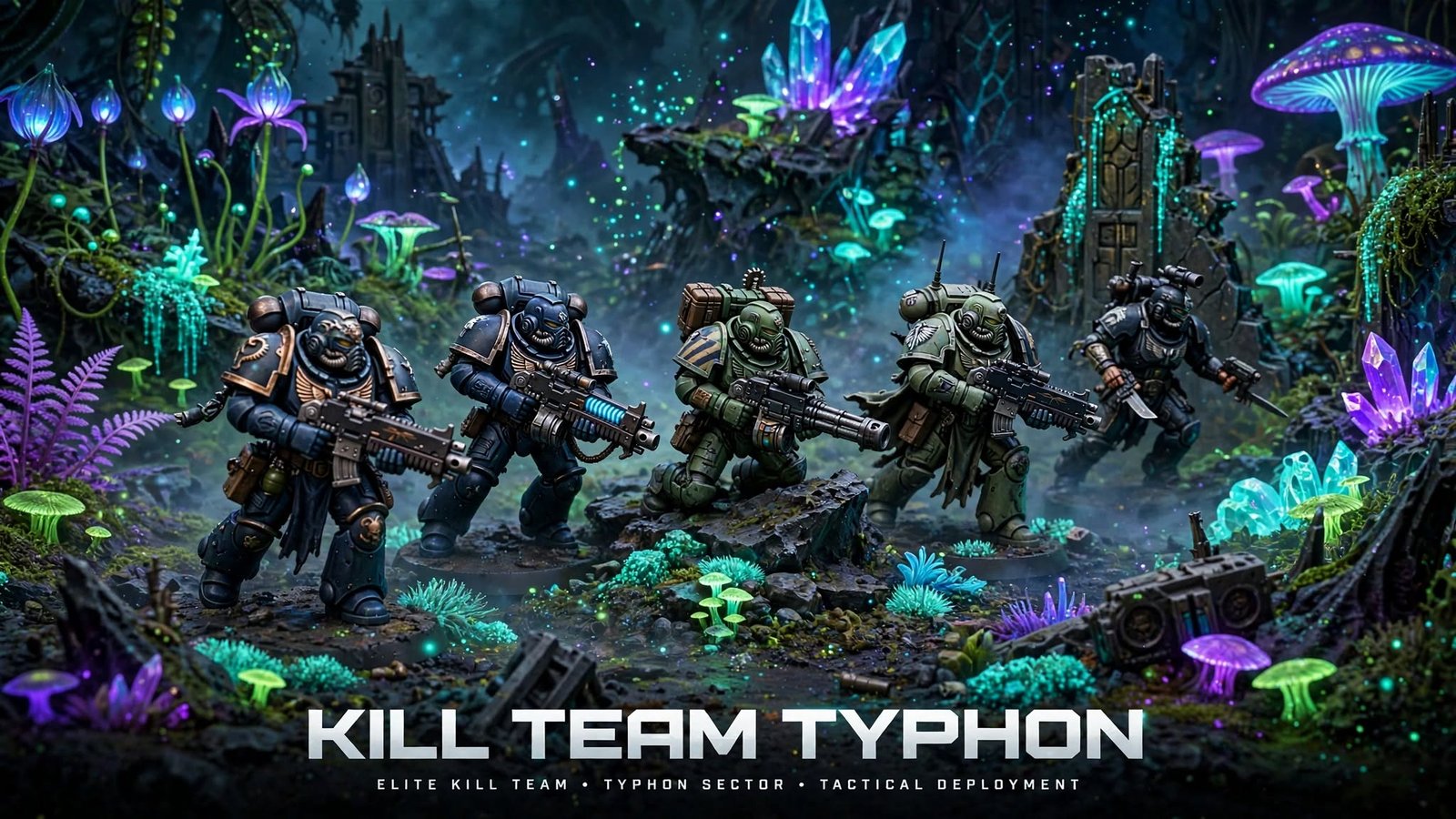
Kill Team: Typhon is a 2025 boxed expansion for the current edition of Warhammer 40,000: Kill Team, pitting an Adeptus Mechanicus Battleclade against a brood of Tyranid Raveners beneath the hive world of Volkus. It is not a standalone starter set — you’ll need the Kill Team: Core Book and Killzone: Volkus to use it fully — but inside the box you get two complete, playable kill teams, a set of Tyranid-themed terrain, and a full mission pack built around solo and cooperative play. Games Workshop released it as a single production run on 28 June 2025, and as of this writing (checked 15 September 2026) it is out of production and sold out through most official channels, so anyone considering it should treat availability as the first real question, not an afterthought.
This guide covers exactly what’s in the box, how the Battleclade and Ravener teams play, how the missions and non-player operatives work, whether it’s a sensible pick for a new player, and what it actually costs to get playing.
Table of Contents
What Is Kill Team: Typhon?
Kill Team: Typhon is an expansion, not a full standalone game. It’s built for the current Kill Team edition (the one launched in 2024 with the Kill Team: Core Book), and it assumes you already own — or plan to buy — that Core Book plus a killzone terrain set, specifically Killzone: Volkus, which the box is designed around.
The narrative setting continues the ongoing Volkus campaign that Kill Team has been building since its 2024 relaunch. In Typhon, the firing of the planet’s “Great Gun” cracks open caverns beneath the hive city of Fissilicus, exposing a dormant Tyranid infestation. The Adeptus Mechanicus sends a Battleclade of cyborg Servitors down to investigate and purge the growths, only to wake a brood of burrowing Ravener bioforms. That’s the fight the box recreates.
Inside, you get:
- Two brand-new, fully playable Kill Teams: the Battleclade and the Raveners.
- A set of Tyranid Infestation terrain themed around the underground setting.
- A pack of Hormagaunts and a Ripper Swarm, used as non-player operatives (NPOs) rather than a third playable team.
- An 80-page Typhon Dossier with lore, rules for both teams, and two full mission packs — one built for solo/co-op play, one for adding Tyranid NPOs into standard matches.
Both the Battleclade and the Raveners are fully legal for regular, competitive Kill Team games once you own the Core Book — they aren’t locked to the missions in this box.
Read More: https://gamespuma.com/kill-team/
Kill Team Typhon Box Contents
Quantities below are drawn from Games Workshop’s own product description as mirrored across its retail partners. Where a source added detail (like exact sprue breakdowns from independent reviewers), that’s noted separately.
| Item | Quantity | Purpose | Required for standard games? | Solo/co-op only? |
|---|---|---|---|---|
| Typhon Dossier | 1 (80-page softcover) | Lore, both teams’ rules, Joint Ops and Adversary Ops mission packs | Yes (for team/mission rules) | No — covers both modes |
| Battleclade Kill Team | 10 operatives (8 Servitors, 1 Servitor Underseer, 1 Technoarcheologist) | Playable Adeptus Mechanicus team | Yes | No |
| Raveners Kill Team | 5 multipart miniatures (build as 4 specialists — Wrecker, Tremorscythe, Felltalon, Venomspitter — led by a Ravener Prime) | Playable Tyranid team | Yes | No |
| Hormagaunts & Ripper Swarm | 10 Hormagaunts + 1 Ripper Swarm (11 non-player operatives) | NPO forces for solo/co-op and Adversary Ops missions | No | Mostly yes |
| Tyranid Infestation terrain | 15 pieces (gestation sacs, shardspewer growths, capillary towers, spore vents, capillary roots, underbrood mounds, and a brood nest/spore chimney option piece) | Killzone terrain themed to the setting | No (supplements Killzone: Volkus) | No |
| Battleclade Datacards | 32 cards | Operative rules, abilities, ploys, equipment | Yes | No |
| Ravener Datacards | 33 cards | Operative rules, abilities, ploys, equipment | Yes | No |
| Typhon Card Pack | 10 Event Cards + 6 NPO datacards | Mission-specific events and NPO behaviour | No | Yes |
| Combined Token Sheet | 78 double-sided tokens (39 per team) | Tracking abilities, objectives, wounds | Yes | No |
| Adeptus Mechanicus Transfer Sheet | 320 waterslide transfers | Decorating Battleclade models | No | No |
The set totals roughly 298 plastic components plus a full run of Citadel bases. Not included: the Kill Team: Core Book and Killzone: Volkus terrain — both are separate purchases and effectively mandatory to get real use out of the box.
One area where you may see conflicting numbers online: some older previews describe the Battleclade sprue as producing “eight Servitors,” while the finished retail description says “10 Battleclade operatives.” That’s not a contradiction — the eight base Servitors are joined by a separate Servitor Underseer and a Technoarcheologist, bringing the playable roster to 10. If you see a listing with different totals, check whether it’s counting only the base Servitor sprue or the full kill team.
The Battleclade Kill Team
The Battleclade represents the Adeptus Mechanicus at its coldest: a Tech-Priest’s cyborg thralls, sent underground to do a dangerous job without complaint. The team is led by a Servitor Underseer, who relays orders, supported by a Technoarcheologist searching the ruins for relics, with a base of eight combat and utility Servitors filling out the roster.
Reviewers who’ve played the kit describe a wide internal weapons spread for a single-box team — melta, flamers, phosphor blasters, heavy arc rifles, and heavy bolters are all represented across the Servitor loadouts, giving the team genuine flexibility between ranged suppression and closer-range demolition work. That range of options is also its main appeal for painters: this is Games Workshop’s first full plastic Servitor kit, giving hobbyists a proper multipart kit to convert and customise rather than an older metal or resin sculpt.
Strengths: solid ranged output across multiple weapon types; durable, disposable-feeling Servitors that can absorb punishment while specialists do the real work. Weaknesses: Servitors aren’t especially fast or independently clever — expect a team that rewards careful positioning and target priority over flashy individual plays. Learning curve: moderate. Newer players should find the ranged-focused kit easier to plan around than a highly mobile melee team. Painting considerations: the mechanical, uniform look of Servitors lends itself well to batch painting, with the Underseer and Technoarcheologist as natural centrepiece models. Ideal player: someone who likes shooting-focused teams, Adeptus Mechanicus lore, or a more methodical, positional playstyle.
The Battleclade is a strong, well-rounded team — it should not be read as the “best” or “worst” of the pair; its identity is simply different from the Raveners’.
The Ravener Kill Team
The Raveners are a small, elite brood of burrowing Tyranid bioforms built around ambush and melee pressure. The kill team consists of five multipart plastic miniatures, built as four specialised Raveners — the Wrecker, Tremorscythe, Felltalon, and Venomspitter — led by a Ravener Prime.
Their signature trick, per the team’s rules and lore, is tunnelling: Raveners can burrow through terrain to reposition and strike from unexpected angles rather than simply walking across the board. That gives the team a strong ambush identity, trading the Battleclade’s ranged consistency for mobility and melee threat.
Strengths: high mobility via burrowing, strong melee output, and a small roster that’s fast to learn operative-by-operative. Weaknesses: a five-model team has less room to absorb losses than a ten-model one — a bad early trade can hurt more. Learning curve: the tunnelling mechanic is a genuinely new rule to internalise, but the small operative count keeps the overall team simple to track. Painting considerations: organic Tyranid biomorphs and carapace textures suit those who enjoy blending and non-metallic textures over hard-edged mechanical painting. Ideal player: fans of aggressive, close-range factions, Tyranid lore enthusiasts, or players who prefer fewer, more powerful models on the table.
Battleclade vs Raveners
| Battleclade | Raveners | |
|---|---|---|
| Faction | Adeptus Mechanicus | Tyranids |
| Operatives | 10 | 5 |
| Playstyle | Positional, ranged-focused | Aggressive, ambush-melee |
| Ranged capability | High | Low |
| Melee capability | Moderate | High |
| Mobility | Standard | High (tunnelling) |
| Durability | Higher model count absorbs losses | Fewer, tougher individual threats |
| Tactical complexity | Moderate (weapon/target choices) | Moderate (positioning/tunnel timing) |
| Beginner suitability | Good for players who like planning shots | Good for players who like decisive melee turns |
| Painting difficulty | Straightforward, batch-friendly | More involved organic textures |
| Best for | Shooting-focused, methodical players | Melee-focused, aggressive players |
Neither team is objectively stronger — reviewers who’ve played both broadly describe them as well-balanced against each other, with the “better” pick coming down to preferred faction, playstyle, and which miniatures you’d rather paint.
Kill Team Typhon Missions
The Typhon Dossier includes two distinct mission packs, and it’s worth being precise about what each one actually does:
- Joint Ops mission pack — six missions built specifically for solo or cooperative play, where one or two human players face off against the Tyranid non-player operatives (Hormagaunts and the Ripper Swarm) controlled by a rules-driven AI-style system rather than a second person.
- Adversary Ops mission pack — six missions that instead add the Tyranid non-player operatives into standard player-versus-player games, effectively turning a normal Battleclade-vs-Ravener (or any two-team) match into a three-way pressure test where the Tyranids threaten both sides.
A deck of Typhon Event Cards adds unpredictable twists to games using this content, and six dedicated non-player operative datacards govern how the Hormagaunts and Ripper Swarm behave without a human controlling them directly.
It’s important not to conflate these Tyranid non-player operatives with a third playable Kill Team: you cannot draft and control the Hormagaunts as your own roster in a standard matched game — they exist purely as scripted opposition or hazards within the Typhon mission content.
Tyranid Non-Player Operatives
The 10 Hormagaunts and single Ripper Swarm included in the box exist to populate the Joint Ops and Adversary Ops missions. In solo and cooperative play, they act as the “enemy” a human player or team must fight through, following behaviour rules from their dedicated NPO datacards rather than player decisions. In Adversary Ops games between two human-controlled teams, they act as a disruptive third force, threatening board control and forcing both sides to split attention between each other and the swarm.
This matters for buying decisions: if solo or co-op play is your main interest, the Joint Ops content is the reason to want this specific box, since it’s one of the more complete solo/co-op packages Kill Team has released to date.
Kill Team Typhon Terrain
The 15-piece Tyranid Infestation terrain set is themed entirely around the underground infestation — gestation sacs, shardspewer growths, capillary towers, spore vents, capillary roots, and underbrood mounds, plus a piece that can be built as either a brood nest or a spore chimney. It’s designed as an upgrade to Killzone: Volkus rather than a complete terrain set on its own, so you’ll want the base Volkus killzone to build a full, playable board.
Functionally, the organic growths behave like other Kill Team terrain features for movement, cover, and line-of-sight purposes, layered on top of Volkus’s existing industrial-hive aesthetic. We can’t verify from official sources whether this terrain is sanctioned for official tournament play beyond what’s stated for standard Volkus terrain, so treat competitive legality as something to confirm with your event’s specific rules pack before an event.
Kill Team Typhon Rules and Gameplay
Typhon doesn’t introduce a new game system — it plugs into the existing Kill Team Core Book structure of operative selection, deployment, alternating activations, movement, shooting, and fighting actions, resolved on objective-based missions. What it adds on top of that foundation is:
- Two new operative rosters (Battleclade and Raveners) with their own abilities, ploys, and equipment options via their datacards.
- A tunnelling mechanic unique to the Raveners for repositioning through terrain.
- Non-player operative rules governing how the Tyranid Hormagaunts and Ripper Swarm act without a human controller.
- Event Cards that inject mission-specific twists into Joint Ops and Adversary Ops games.
If you already know how to play Kill Team’s current edition, adapting to Typhon is mostly a matter of learning two new operative rosters and one new terrain/NPO ruleset, not relearning the base game.
Is Kill Team: Typhon Good for Beginners?
This depends heavily on what “beginner” means in your case.
- If you’ve never played Kill Team at all: Typhon is not the best entry point, because it doesn’t include the Core Book or a full killzone board — you’d need to buy those separately before this box does anything for you.
- If you already own the Core Book and a killzone (or the now out-of-production Hivestorm starter set): Typhon is a reasonable, self-contained way to add two new teams and a genuinely strong solo/co-op mission pack to your collection.
- Rules complexity: moderate. Neither team requires advanced system mastery, but the tunnelling and NPO rules are extra layers on top of the base game.
- Painting workload: meaningful — 15 Battleclade/Ravener operatives plus 11 NPOs plus terrain is a substantial hobby project for a new painter.
A brand-new player is better served starting with the Core Book and a starter-style product that includes it, then picking up Typhon afterward specifically for its teams and its solo/co-op content.
What Else Do You Need to Play Kill Team: Typhon?
- Kill Team: Core Book — required; not included in this box.
- Killzone: Volkus — the terrain set this expansion is designed to upgrade; required for a full board.
- Dice, a tape measure or Kill Team ruler set, and a gaming surface.
- Paints and hobby tools, since all miniatures are supplied unpainted and require assembly.
Everything else — team rules, mission content, tokens, and datacards for the Battleclade and Raveners — is included in the box itself.
Kill Team Typhon Price and Availability
Region/date checked: UK, EU, and US pricing as listed at original release (28 June 2025); availability re-checked 15 September 2026.
At launch, Kill Team: Typhon carried an RRP of roughly £100 / €130 / $170, depending on region. Games Workshop stated from the outset that this would be a single production run, sold “while stocks last” rather than an ongoing catalogue item. In practice, the box reportedly sold out on the official webstore within hours of preorder opening on 14 June 2025, and by the time of writing it shows as out of production or sold out at most retailers checked, with secondary-market listings commonly asking well above the original RRP.
If you’re weighing this purchase now, budget for the real possibility that you’ll be buying secondhand at a premium rather than at retail price, and factor that into whether the box’s contents are worth it to you at that adjusted cost. Missing components (loose sprues, missing cards or tokens) on a used copy meaningfully reduce its value versus a complete boxed set, so check contents carefully before buying secondhand.
Is Kill Team: Typhon Worth It?
Taken as a whole, Typhon packs in two complete kill teams, a themed terrain upgrade, a genuinely substantial solo/co-op mission pack, and all the cards and tokens needed to run both teams — at its original RRP, that’s a strong amount of content for the price. Whether it’s worth pursuing today depends heavily on who you are:
- New players: better to start with the Core Book and a starter product, then add Typhon later for the teams and mission content.
- Existing Kill Team players: a solid pickup for two fresh, well-differentiated teams and one of the more complete solo/co-op packages in the current edition.
- Adeptus Mechanicus fans: the first proper plastic Servitor kit makes this an easy recommendation on theme alone.
- Tyranid fans: a compact, characterful Ravener kill team with a distinct tunnelling identity.
- Solo players: the Joint Ops mission pack is arguably the single best reason to seek this box out specifically.
- Cooperative groups: the same Joint Ops content supports two players against the Tyranid NPOs.
- Competitive players: both teams are usable in standard matched play, but check current balance discussions and any errata before assuming either is a top-tier tournament pick.
- Collectors: the single production run and “OOP” status give it some collectability, though that also means paying above RRP is increasingly likely.
We can’t respond to whether it’s worth any price on the secondhand market — that’s a personal budget call — but at or near its original RRP, for the right buyer, it’s a well-supported, content-rich release rather than a thin cash grab.
Common Kill Team Typhon Questions
Is Kill Team Typhon a starter set? No. It’s an expansion box. It doesn’t include the Kill Team: Core Book or a full killzone board.
Does Typhon include two Kill Teams? Yes — the Adeptus Mechanicus Battleclade and the Tyranid Raveners, both fully playable in standard games.
Does Typhon include terrain? Yes, a 15-piece Tyranid Infestation terrain set, designed as an upgrade to Killzone: Volkus rather than a full standalone board.
Are the Raveners a playable Kill Team? Yes, a five-operative team built from Ravener Warriors into a Prime plus four specialists.
Are Hormagaunts a playable Kill Team? No. The 10 Hormagaunts and Ripper Swarm are non-player operatives used in the Joint Ops and Adversary Ops missions, not a draftable player team.
Can Typhon be played solo? Yes, via the Joint Ops mission pack, which is built specifically around solo and cooperative play against the Tyranid NPOs.
Can Typhon be played cooperatively? Yes, the same Joint Ops pack supports two players teaming up against the Tyranid NPOs.
Does Typhon include the core Kill Team rules? No. You need the separate Kill Team: Core Book.
Do you need another Kill Team box to play? You need the Core Book and Killzone: Volkus at minimum; no other team box is required to use the Battleclade or Raveners.
Is Typhon compatible with Volkus terrain? Yes — the included terrain is explicitly designed to upgrade a Killzone: Volkus board.
Can the teams be used in regular Kill Team games? Yes, both the Battleclade and Raveners are legal for standard matched and narrative play once you own the Core Book.
Is Kill Team Typhon still available? As of 15 September 2026, it’s largely out of production and sold out through official channels, with secondhand copies typically priced above the original RRP. Check current retailer stock directly, as this can change.
Is Kill Team Typhon worth buying? At or near RRP, yes for most existing Kill Team players and fans of either faction; at inflated secondhand prices, it depends on your budget and how much you specifically want this content versus other current teams.
Which team is easier for beginners? Neither is dramatically simpler, but the Battleclade’s ranged-focused playstyle may feel more approachable to players used to planning shots, while the Raveners’ small roster is faster to learn model-by-model.
What is the difference between Typhon and other Kill Team boxes? Unlike starter sets such as the now-discontinued Hivestorm box, Typhon doesn’t include the Core Book — it’s a pure expansion focused on two new teams, terrain, and mission content for players who already have the basics.

Written by Daniel Carter
Daniel Carter is a dedicated gaming writer who enjoys turning complex gaming topics into clear, useful, and engaging content. He covers game guides, tips, reviews, features, and the latest developments across the gaming world. His approach focuses on research, accuracy, and practical value, helping readers discover new games, improve their gameplay, and stay informed about the industry. For Daniel, great gaming content is not just about information—it is about making every article genuinely worth reading.
2 thoughts on “Kill Team: Typhon — Box Contents, Teams, Missions, and Review”