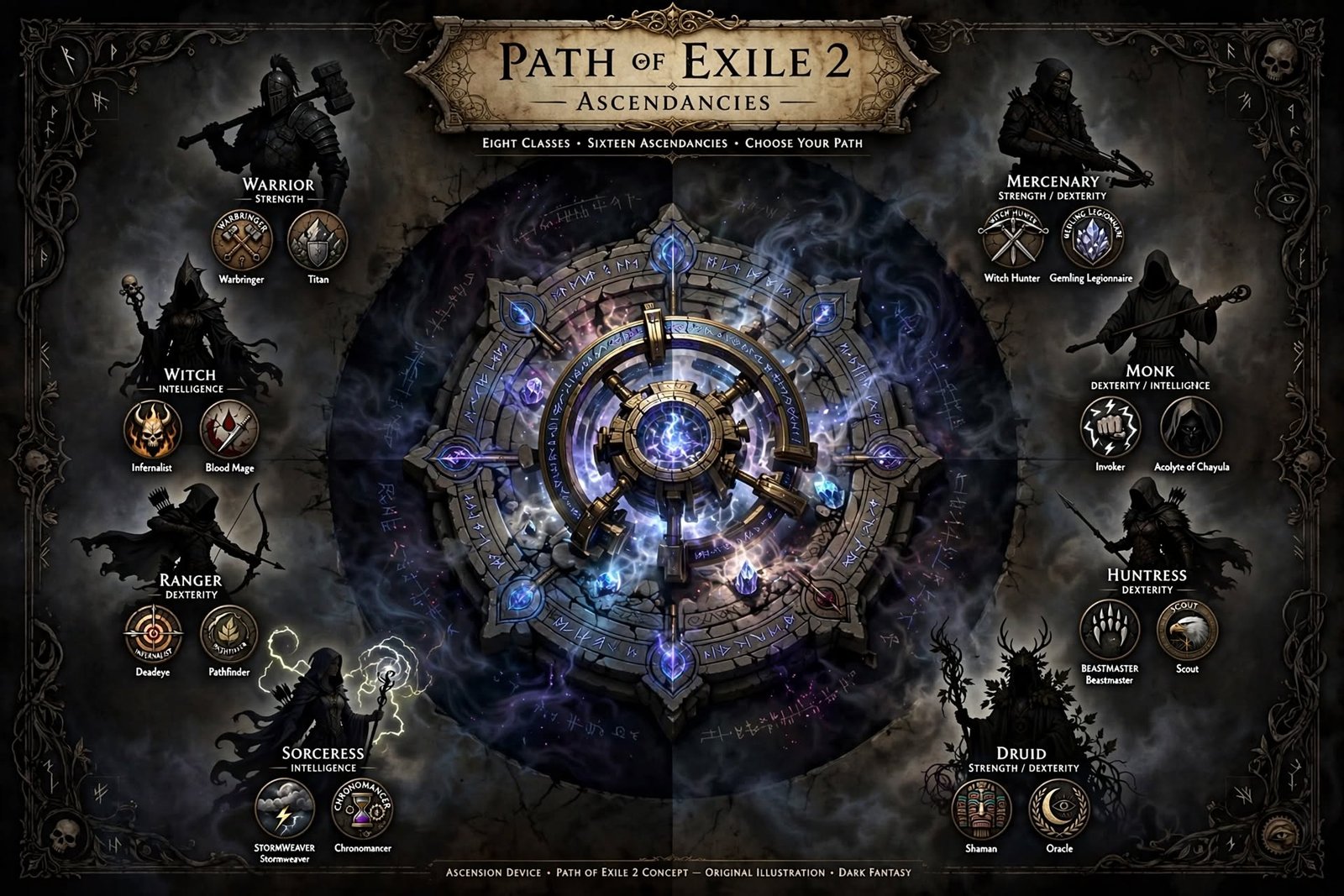
PoE 2 ascendancies are the subclass specializations that turn a starting class into a defined build. Each one adds its own Ascendancy passive tree, unlocked through Ascendancy Trials. As of patch 0.5.5 (Forbidden Rites), Path of Exile 2 has 8 playable classes and 22 Ascendancies, and you can earn up to 8 Ascendancy points.
Your pick shapes how your character spends resources, scales damage and survives. This guide lists every playable Ascendancy, explains how to unlock and respec them, and shows how to match one to your build.
Currentness note: this guide was checked against Grinding Gear Games’ official 0.5.5 patch notes and current community data in early October 2026. Path of Exile 2 reaches its 1.0 release on December 11, 2026, so details may change. Official facts and community analysis are labelled separately.
Table of Contents
What Are PoE 2 Ascendancies?
PoE 2 Ascendancies are subclasses that specialize your base class with a separate passive tree. You choose a class at character creation, and you later choose one Ascendancy belonging to that class.
The class decides where you start on the main passive tree and which Ascendancies you can access. The Ascendancy decides the rules of your build. It can add resources, companions, transformations, new defensive systems or changes to how gear works.
Ascendancy nodes are usually far more build-defining than normal passives. A normal passive might give increased damage. An Ascendancy notable can change how a skill works or how you pay for it.
Three points matter for beginners:
- Classes are not weapon-locked. A class suggests weapons and skills, but you can build around other skills if you meet the attribute requirements.
- The Ascendancy often defines the engine. Two characters with the same main skill can play very differently on different Ascendancies.
- It is a commitment, but not a permanent one. You can change it, with conditions covered below.
Complete List of PoE 2 Ascendancies (Patch 0.5.5)
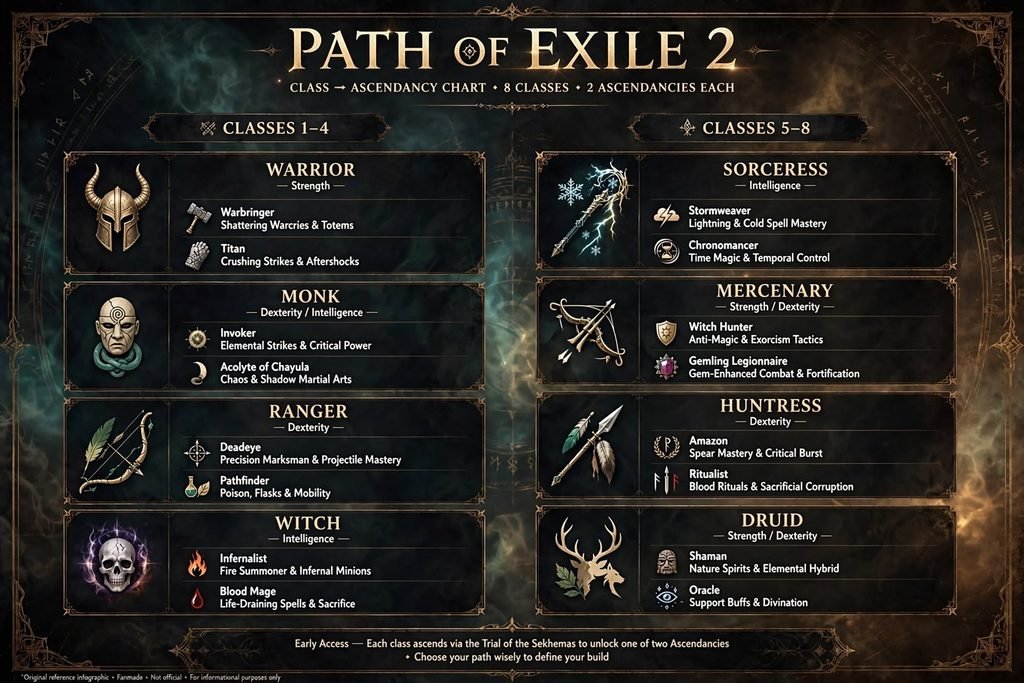
This is the full playable roster. Warrior, Sorceress, Witch, Monk, Mercenary and Huntress have three Ascendancies each. Ranger and Druid have two each.
| Base Class | Attributes | Ascendancies | Core Theme |
|---|---|---|---|
| Warrior | Str | Titan, Warbringer, Smith of Kitava | Heavy melee, Warcries, forged armour |
| Ranger | Dex | Deadeye, Pathfinder | Projectiles, flasks, poison |
| Sorceress | Int | Stormweaver, Chronomancer, Disciple of Varashta | Elemental spells, time, Djinn |
| Monk | Dex/Int | Invoker, Acolyte of Chayula, Martial Artist | Elements, Chaos, illusions and bells |
| Mercenary | Str/Dex | Witchhunter, Gemling Legionnaire, Tactician | Anti-caster, gem mastery, banners |
| Witch | Int | Infernalist, Blood Mage, Lich | Fire and demons, Life casting, curses |
| Huntress | Dex | Amazon, Ritualist, Spirit Walker | Crits, sacrifice, animal spirits |
| Druid | Str/Int | Oracle, Shaman | Fate-based spells, Rage and Runes |
Naming note: Some listings call the Witch’s third Ascendancy “Abyssal Lich” rather than “Lich.” This guide uses “Lich” and treats them as the same Ascendancy.
Not yet playable: The Duelist class, and its Ascendancies, arrive with 1.0. See the upcoming section below.
Read More: https://gamespuma.com/poe2-price-checker/
Every PoE2 Ascendancies by Class
The descriptions below summarize mechanics reported by official patch notes and current community guides. Beginner ratings are practical guidance, not a power ranking.
Warrior Ascendancies
Titan is the straightforward heavy hitter. It supports Slams and Aftershocks, rewards Stunning enemies and adds durability. It suits two-handed Mace builds and Armour stacking. Weakness: it needs attacks big enough to trigger its payoffs. Beginner friendliness: high.
Warbringer builds around Warcries, Totems, Armour Break, shields and Ancestral Spirits. It is the Warrior for players who like preparing enemies before the finishing blow. It has more moving parts than Titan, but they provide damage, control and utility together. Beginner friendliness: moderate.
Smith of Kitava turns your Body Armour into part of the Ascendancy, with forge-themed branches, a manifested weapon and fiery melee triggers. It suits players who enjoy planning around a specific armour piece. It is the most item-dependent Warrior option. Beginner friendliness: moderate to low.
Ranger Ascendancies
Deadeye is the speed-and-projectiles Ascendancy. It improves projectile behaviour, supports Marks and uses Tailwind to reward continuous action with speed and Evasion. It is an easy recommendation for a fast bow character. Speed does not replace a defence plan. Beginner friendliness: high.
Pathfinder specializes in flasks, Poison and concoctions. It sustains flask charges and converts them into offence. A 0.4.0 change also gave it Path Seeker, which lets it allocate passives from the Warrior or Sorceress starting areas. It demands more planning than Deadeye. Beginner friendliness: moderate.
Sorceress Ascendancies
Stormweaver is the conventional elemental caster, with Elemental Storms, Exposure, Arcane Surge and ailment tools. Despite the name, it is not limited to Lightning. It works best when you commit to one elemental interaction. Beginner friendliness: high.
Chronomancer manipulates time through cooldown resets, spell repeats, enemy control and the Temporal Rift rewind. It rewards active play and cooldown-based skills over passive stat scaling. Beginner friendliness: moderate to low.
Disciple of Varashta commands Djinn with Fire, Cold and sand-themed abilities, alongside Energy Shield and Mana defences. It is a Sorceress Ascendancy, not a Druid one. It is currently popular in the community (see the meta section). Beginner friendliness: moderate.
Monk Ascendancies
Invoker develops the Monk’s elemental side with ailments, Spirit, Meta Skill energy and hybrid Evasion and Energy Shield defences. It is usually the easiest Monk Ascendancy to understand. Beginner friendliness: high.
Acolyte of Chayula is the experimental Monk. It uses Darkness, the Flames of Chayula, Chaos damage, Volatility and unusual Leech. It does not improve every Quarterstaff build automatically. Choose it only with a clear Chaos or Darkness plan. Beginner friendliness: low.
Martial Artist arrived in patch 0.5.0. It uses Hollow Form illusions, ghostly bells, Combo, Rune sockets and a glove-transforming node called Way of the Stonefist. It has a high ceiling, and building around one engine first works better than mixing all of them. Beginner friendliness: low to moderate.
Mercenary Ascendancies
Witchhunter is the anti-magic specialist. It uses Decimating Strike and Culling Strike, protects with Sorcery Ward and punishes enemy casters. It suits direct-hit crossbow, grenade and weapon builds. Sorcery Ward should not be your only defence. Beginner friendliness: high.
Gemling Legionnaire makes the gem system itself the Ascendancy. It can add gem levels, quality and skill slots, ease attribute requirements and generate charges based on gem colours. It is extremely flexible but demands careful planning. Beginner friendliness: moderate.
Tactician controls the battlefield with Banners, Pin, Totems, Supporting Fire and artillery-style attacks. It provides group utility the other two Mercenary options do not. It is more positional than Witchhunter and less flexible than Gemling. Beginner friendliness: moderate.
Witch Ascendancies
Infernalist combines Fire damage, Demon Form, Infernal Flame and an Infernal Hound. A Demon Form build, a Pyromantic Pact build and a Hellhound build use different gear, so plan before you invest. Beginner friendliness: moderate to high.
Blood Mage pays for spells with Life and rewards maximum Life, critical hits, Life Remnants and Leech. It becomes sturdy once damage, cost and recovery are balanced. Recovery must stay reliable in low-density encounters. Beginner friendliness: moderate.
Lich specializes in Chaos damage, Curses and Energy Shield, with unusual defence rules that demand conditions be respected. It suits curse-heavy casters rather than pure minion armies. Beginner friendliness: moderate.
Huntress Ascendancies
Amazon is the direct attack Ascendancy, with accurate crits, elemental Surges, Marks and projectiles. It improves what the Huntress already does well, which makes it the easiest to slot into a conventional spear build. Beginner friendliness: high.
Ritualist draws power from sacrificed enemies, Charms and item interactions. It is the itemization-and-utility Huntress. Its value is less immediately visible than Amazon’s. Beginner friendliness: low to moderate.
Spirit Walker arrived in 0.5.0, calling on Stag, Owl and Bear spirits. Branches cover movement-generated Wisps, Dodge-timed Feathers, a Bear companion and beast taming. Focused builds usually prefer one primary engine. Beginner friendliness: moderate.
Druid Ascendancies
Oracle is the technical Druid, built on fate-themed mechanics that make outcomes more controllable. It suits spellcasting mixed with Primal skills. Beginner friendliness: moderate to low.
Shaman focuses on Rage, Spirit, Totems and Bonded Runes. It is the more direct Druid option for staying active in combat. Rage generation must stay consistent, because its benefits fade during downtime. Beginner friendliness: high.
How PoE 2 Ascendancy Passives Work
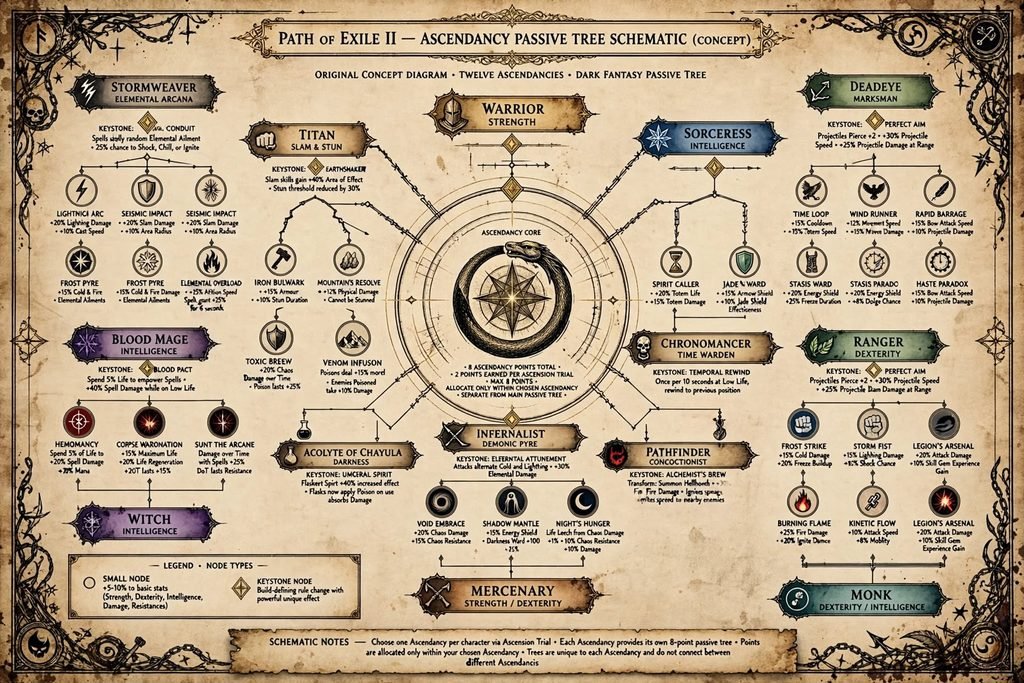
Example of an Ascendancy passive tree with branches
Ascendancy points are spent on a dedicated passive tree that is separate from the main tree. These nodes tend to fall into three kinds:
- Notables that rewrite a rule, such as changing how a resource works.
- Branches that commit you to one sub-engine inside the Ascendancy.
- Support nodes that improve defence, recovery or utility around the main engine.
With only eight points, you cannot take everything. The skill is choosing which branch is your engine, then using the remaining points to cover its weaknesses.
Pathing matters too. Some notables require earlier nodes, so a strong late node can cost several points to reach. Before spending, check what each notable requires, because refunds cost gold.
Changes can be significant. Since 0.4.0, official patch notes say Ascendancy-granted skills activate automatically when acquired, which removed manual toggling.
How to Unlock Ascendancies in PoE 2
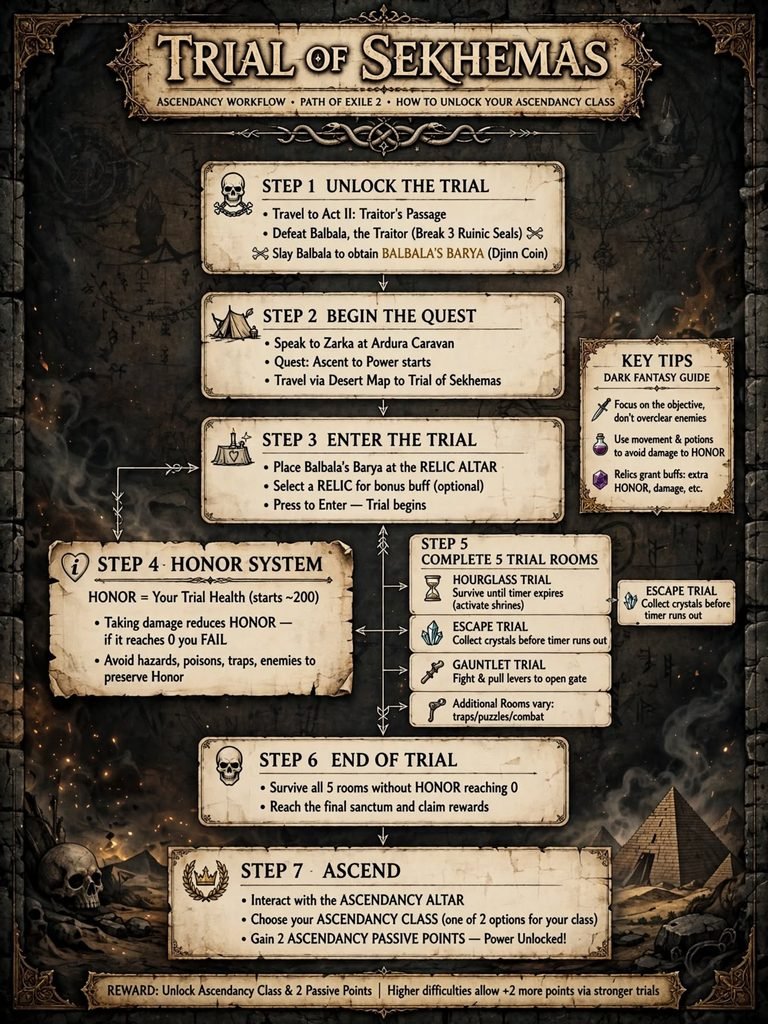
The unlock path is the same for every class:
- Reach Act 2. The Ascendancy system opens in the campaign.
- Pick your Trial. The Trial of the Sekhemas is reached by defeating Balbala in Traitor’s Passage in Act 2. The Trial of Chaos opens in Act 3.
- Complete the first Trial. You use a quest key item (Balbala’s Barya for the Sekhemas, an Inscribed Ultimatum for Chaos). Community guides report these quest keys can be retried until you succeed.
- Return to the Ascension device. After your first clear you choose an Ascendancy from your class’s options.
- Spend your points. The first completion grants the first two Ascendancy points.
- Earn the rest. Further points come from harder versions of the Trials, covered next.
Either Trial can grant all eight points. You can mix them, so choose the one your build handles better.
PoE 2 Ascendancy Trials
Trial of the Sekhemas is built around Honour, a second bar that drains when you take damage. If Honour hits zero you fail even with life remaining. Relics chosen before the run add buffs. It favours mobile characters who avoid hits.
Trial of Chaos is an Ultimatum-style gauntlet that uses your normal health. You clear rooms with escalating modifiers, and it scales with how strong your build is.
Official 0.5.5 notes made several Trial of Chaos improvements:
- You can leave a run at any point and resume from the same room later.
- Each room now ends with a reward chest, so dying is less punishing.
- Rewards are now only Currency and Soul Cores.
- A 10-Trial Inscribed Ultimatum can be continued twice without a new item, with an optional double-or-nothing wager.
- Modifiers show actual values and were rebalanced.
The Trial of Sekhemas now has inherent drop and monster bonuses from area level 65, as compensation for Atlas bonuses not applying inside it.
PoE 2 Ascendancy Points
You can earn a maximum of 8 Ascendancy points, in four pairs of two. Official 0.2.0f notes confirmed the Chaos pattern: a 7-chamber Trial grants up to 4 points and a 10-chamber Trial up to 6.
| Points | Source (community-reported structure) |
|---|---|
| 1–2 | First Trial, Act 2 (Sekhemas) or Act 3 (Chaos) |
| 3–4 | A longer Trial (7 Chaos rooms, or the next Sekhemas stage) |
| 5–6 | Endgame Trial: 10-room Ultimatum, or a 3-floor Djinn Barya |
| 7–8 | Hardest tier: 10 rooms plus the Trialmaster, or a 4-floor Djinn Barya plus the final boss |
Exact thresholds, item level requirements and boss names differ between community guides. Treat the table as the general shape, and check the in-game tooltip on the passive screen before farming keys.
Endgame Trial keys are consumed on use and can be traded. Failing an endgame run can cost you the key.
How to Choose the Best PoE 2 Ascendancy
The best Ascendancy depends on the build, not a universal ranking. Ask five questions:
- What is the engine? Start with the mechanic the build cannot function without, then find the Ascendancy that supplies it.
- What is your main skill and weapon? Slams point to Titan, bows to Deadeye, crossbows and grenades to Mercenary, spears to Huntress.
- How do you survive? Armour, Evasion, Energy Shield, Ward and minions are all different. Ascendancies often add one specific layer.
- How much gear dependency is acceptable? Smith of Kitava and Martial Artist’s glove node reward specific items.
- How much do you enjoy complexity? Gemling, Chronomancer and Acolyte of Chayula pay off with planning but punish improvisation.
Best PoE 2 Ascendancies for Beginners
This is a practical recommendation, not an absolute ranking. These Ascendancies present their core loop clearly: Titan, Deadeye, Stormweaver, Invoker, Witchhunter, Infernalist, Amazon and Shaman.
Minion-based options, such as Infernalist, can also be forgiving because companions share the pressure. Complex options such as Chronomancer, Acolyte of Chayula, Ritualist and Martial Artist are better after you understand skill tags and defensive layers.
PoE 2 Ascendancies by Playstyle
| Playstyle | Ascendancies that support it |
|---|---|
| Heavy melee | Titan, Warbringer |
| Fast ranged | Deadeye, Amazon |
| Elemental spells | Stormweaver, Invoker, Oracle |
| Poison and flasks | Pathfinder |
| Time and cooldowns | Chronomancer |
| Minions and companions | Infernalist, Spirit Walker, Disciple of Varashta |
| Flexible gem setups | Gemling Legionnaire |
| Boss-focused hits | Witchhunter |
| Shapeshifting and Primal | Shaman, Oracle |
| Complex melee | Martial Artist, Acolyte of Chayula |
Ascendancy Build Synergy
PoE 2 Ascendancies work best when four layers agree: the passive tree, the skill and support gems, your gear and the Ascendancy.
- Skills and supports: Gemling Legionnaire rewards a setup where extra gem levels or quality matter. Chronomancer rewards cooldown-based skills.
- Weapons: Spirit Walker’s companion nodes can connect companion damage to your main-hand weapon, so weapon upgrades matter even in a companion build.
- Attributes: Gem and gear requirements can make or break a hybrid build, which is why Gemling’s requirement-easing is valuable.
- Defence: Witchhunter’s Sorcery Ward protects against some damage but does not replace Armour, Evasion or resistances.
- Resources: Blood Mage spends Life, Infernalist can swap Mana for Infernal Flame, and Shaman scales off Rage. Each needs a plan for sustaining that resource.
Can You Change Your Ascendancy in PoE 2?
Yes, with conditions. Official notes from patch 0.2.0f introduced respec:
- You must have zero Ascendancy points allocated before changing.
- You can refund points by speaking to Balbala or the Trialmaster near the Ascension device.
- You then redo an Ascendancy Trial, but only one that would grant the number of points you already have.
- After that, you can choose a different Ascendancy of the same class at the Ascension device.
You cannot switch to another class’s Ascendancy. Community reports say refunds cost gold and cost more than normal passive refunds. Exact costs are not given in the official notes I reviewed. Patch 0.5.5 also fixed a client crash that could occur when changing Ascendancy class.
PoE 2 Ascendancies and the Current Meta
Fact: poe.ninja’s Forbidden Rites snapshot (reviewed in early October 2026) shows these shares of tracked characters.
| Ascendancy | Approximate share |
|---|---|
| Gemling Legionnaire | 36% |
| Martial Artist | 10% |
| Disciple of Varashta | 8% |
| Spirit Walker | 7% |
| Oracle | 7% |
| Deadeye | 6% |
Analysis: popularity is not the same as power. It reflects league-start behaviour, build guides and cost. Gemling’s popularity matches its flexibility, since many creators publish different skill setups on it. Some Ascendancies with low share, such as Invoker and Amazon, may be underplayed rather than weak. Tier lists vary by source, and several are published by commercial services. Treat any tier list as a snapshot that changes after patches.
Current Patch Changes to PoE 2 Ascendancies
Official, current (0.5.5):
- What changed: The official notes list no Ascendancy balance changes. Ascendancy-related fixes include the crash when changing Ascendancy, an Invoker passive not blocking certain Spirit Modifiers, and a Gemling tooltip for Advanced Thaumaturgy.
- Why it matters: Existing builds were not retuned this patch.
- Who is affected: Mostly players respeccing, and Invoker and Gemling builds.
Official, current (Trial changes): The Trial of Chaos improvements above make earning points easier to schedule and less punishing.
Historical:
- 0.5.0: Martial Artist and Spirit Walker were added, and several Ascendancies (including Acolyte of Chayula, Blood Mage, Gemling Legionnaire and Witchhunter) were adjusted.
- 0.4.0: A wide Ascendancy rebalance, including auto-active Ascendancy skills and Pathfinder’s Path Seeker.
- 0.2.0f: Ascendancy respec introduced.
Community note: A hotfix tracker lists a fix so only players in the instance when the boss dies can claim Trial of Chaos points. I could not confirm it on the official page, so treat it as community-reported.
PoE 1 vs PoE 2 Ascendancies
PoE 2 Ascendancies and Path of Exile 1 Ascendancies are separate systems from separate games.
| Feature | Path of Exile 1 | Path of Exile 2 |
|---|---|---|
| Classes | 7 base classes | 8 playable (Duelist coming in 1.0) |
| Ascendancies per class | 3 each | 2–3 each currently |
| Unlocking | Labyrinth | Trial of the Sekhemas and Trial of Chaos |
| Max points | Up to 8 of 12 or 14 available | Up to 8 |
| Class names | Slayer, Gladiator, Necromancer and others | Titan, Lich, Deadeye and others |
Do not carry PoE 1 assumptions over. An Ascendancy that exists in PoE 1 is not automatically in PoE 2, and a guide that mixes them is a red flag.
Upcoming PoE 2 Ascendancies (Not Yet Playable)
Duelist (Announced / Upcoming / Not Yet Playable).
- Status: Revealed by Grinding Gear Games at gamescom Opening Night Live in August 2026 as PoE 2’s first sword-wielding class.
- Availability: Arrives with the 1.0 release on December 11, 2026 (PST), per the announcement.
- Ascendancies: Reports indicate two, and their names will be revealed at ExileCon on November 7, 2026. No names have been confirmed.
- Unknown: Mechanics, names and balance. Any list of “Duelist Ascendancies” is speculation.
Whether Ranger or Druid gain a third Ascendancy has not been announced in the official sources I reviewed. Treat claims about that as rumour.
Common Beginner Mistakes with PoE 2 Ascendancies
- Picking before planning. Fix: decide your engine first.
- Copying a meta build blindly. Fix: learn why each Ascendancy node is there so you can adapt.
- Spreading points thin. Fix: commit to one branch.
- Mixing PoE 1 and PoE 2 information. Fix: check the game name and patch date on every guide.
- Following outdated guides. Fix: look for the patch number and a date within the last few weeks.
- Assuming one Ascendancy is best. Fix: compare tradeoffs for your build and budget.
- Ignoring patch changes. Fix: check official notes, especially before 1.0.
- Forgetting respec costs. Fix: test carefully before spending.
Conclusion: Choosing from PoE 2 Ascendancies
PoE 2 ascendancies are the most important build decision after your class. The current roster has 22, across 8 classes, with the Duelist’s Ascendancies still to come in 1.0. Pick the mechanic your build needs, confirm the node chain, and remember that respec exists if you change your mind. Before the 1.0 release, re-check official notes for changes.
F. FAQ
What are Ascendancies in PoE 2?
Subclasses that specialize your class with a separate passive tree, unlocked through Ascendancy Trials.
How many Ascendancies are in Path of Exile 2?
22, across 8 classes, as of patch 0.5.5.
What are the best PoE 2 Ascendancies?
It depends on your build. Gemling Legionnaire is the most-played on poe.ninja’s Forbidden Rites snapshot, but popularity is not proof of power.
How do you unlock Ascendancies in PoE 2?
Complete an Ascendancy Trial: the Trial of the Sekhemas in Act 2 or the Trial of Chaos in Act 3.
How do Ascendancy points work?
You earn up to 8, in pairs, from progressively harder Trial tiers. Either Trial can supply all 8.
Can you change Ascendancy in PoE 2?
Yes, within your class. Refund all points, redo a matching Trial, and choose again.
What is the easiest Ascendancy for beginners?
Practical picks include Titan, Deadeye, Stormweaver, Invoker, Witchhunter, Infernalist, Amazon and Shaman.
Which Ascendancy is best for my build?
Start with the mechanic your build needs, then match it using the table above.
What are the PoE 2 Ascendancy Trials?
The Trial of the Sekhemas (Honour-based) and the Trial of Chaos (Ultimatum-based).
Are PoE 1 and PoE 2 Ascendancies the same?
No. They differ in classes, unlocking and roster.
Are more PoE 2 Ascendancies coming?
The Duelist arrives with 1.0, and its Ascendancy names are due on November 7, 2026.
Sources Used
Official (Grinding Gear Games):
- 0.5.5 Patch Notes: pathofexile.com/forum/view-thread/4000864
- 0.2.0f respec announcement: pathofexile.com/forum/view-thread/3755277 and view-thread/3762865
- Early Access Ascendancy reveal: pathofexile.com/forum/view-thread/3592012
Community and secondary (labelled in the article):
- poe.ninja Forbidden Rites builds (usage share)
- Community trial/points guides (stratlore, timesaver, boostmatch)
- Roster and mechanics guides (expcarry, poe2path)
- Duelist and 1.0 news coverage (rpgsite, windowscentral, digitalcitizen)
- poepatchnotes.com (hotfix tracker)

Written by Daniel Carter
Daniel Carter is a dedicated gaming writer who enjoys turning complex gaming topics into clear, useful, and engaging content. He covers game guides, tips, reviews, features, and the latest developments across the gaming world. His approach focuses on research, accuracy, and practical value, helping readers discover new games, improve their gameplay, and stay informed about the industry. For Daniel, great gaming content is not just about information—it is about making every article genuinely worth reading.