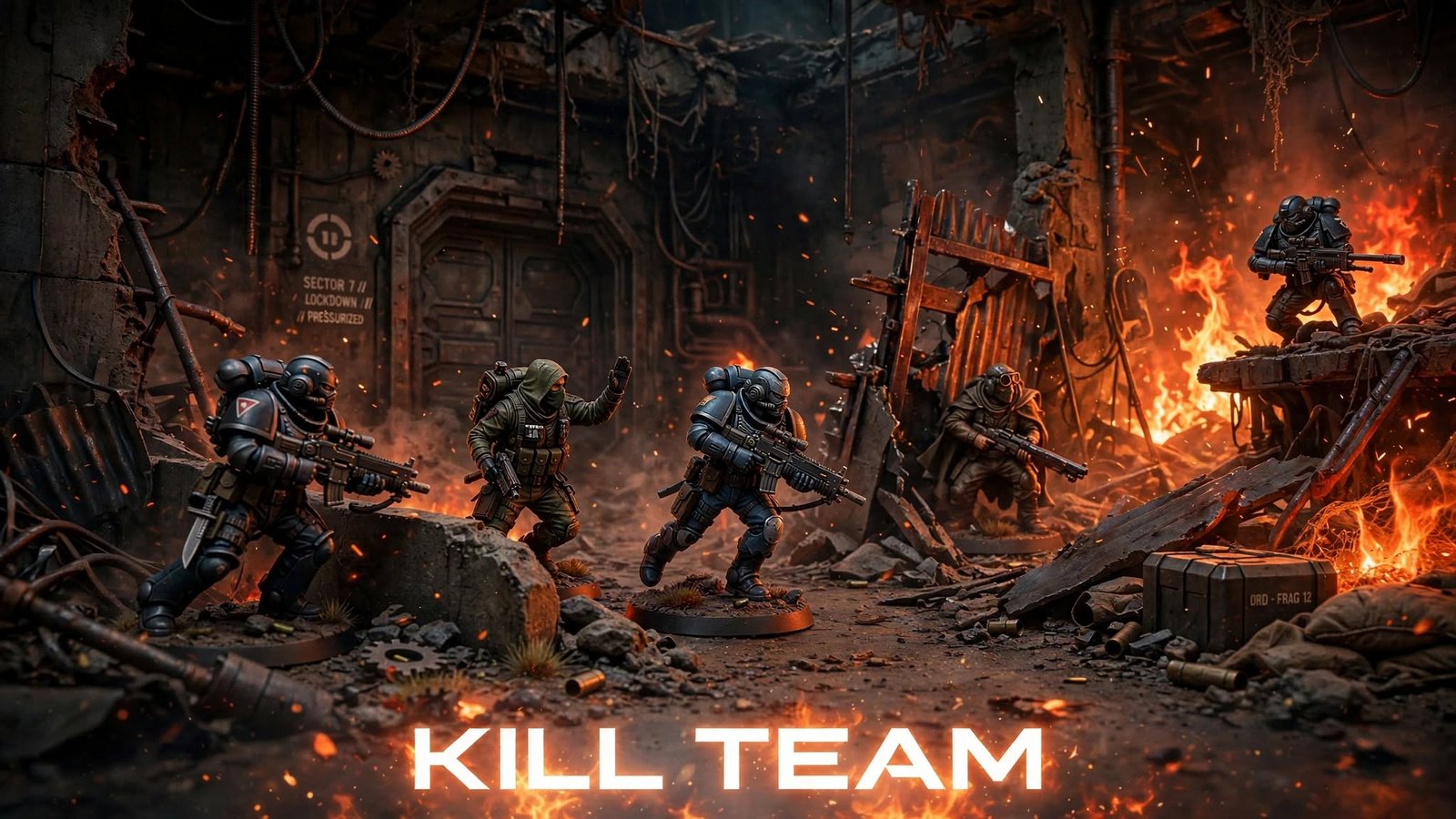
Kill Team is Warhammer 40,000: Kill Team, a standalone tabletop skirmish game where small squads of 6–14 specialist miniatures fight over objectives on a single dense battlefield. It uses the Warhammer 40,000 setting but its own streamlined rules, making it faster to learn, cheaper to start, and quicker to play than full-scale Warhammer 40,000. A new player needs one Kill Team box, some dice, a tape measure, and roughly an evening to learn the basics.
This guide covers what Kill Team is, how it differs from full Warhammer 40,000, how the current rules work, which teams suit beginners, what starter sets contain, what it costs to get going, and how to avoid the most common early mistakes — all based on the current ruleset generation that launched with Kill Team: Hivestorm in late 2024 and remains active today.
Note on currency: Warhammer 40,000: Kill Team is an ongoing product line that Games Workshop updates with new teams, boxes, and balance changes several times a year. Prices, box contents, and team rules below are described as accurately as possible as of this article’s last-checked date (see footer), but always confirm current details on Games Workshop’s official Kill Team pages and the Kill Team app before buying.
Table of Contents
What Is Kill Team?
Kill Team is a tactical skirmish miniature wargame set in the grim far-future of Warhammer 40,000. Instead of commanding an army of dozens of models across a large table, each player controls a single small team — a “kill team” — made up of individually named, individually powerful operatives. Games are won by completing missions and holding objectives, not simply by wiping out the enemy.
Key ideas that define the game:
- Specialist operatives, not armies. Every miniature is a named character with its own stats, weapons, and role — sniper, medic, gunner, close-combat bruiser, and so on.
- Dense, vertical terrain. Games are played on a single, heavily terrained board (a “killzone”) full of ruins, catwalks, and cover, which shapes almost every decision.
- Mission-driven play. Each game uses a mission pack defining objectives, deployment, and scoring — killing enemy operatives is often secondary to completing the mission.
- Fast turns, constant tension. Players alternate activating one operative at a time, so both sides are always making decisions, unlike games where one player acts while the other waits.
- Narrative and competitive play. Kill Team supports casual, story-driven campaigns as well as tournament-level matched play using the current Approved Ops mission system.
Kill Team is designed to be approachable: you don’t need to already understand Warhammer 40,000 lore or rules to play it, though fans of the wider setting will recognize the factions and characters involved.
Read More: https://gamespuma.com/kill-team-typhon/
Kill Team vs Warhammer 40,000
Kill Team and Warhammer 40,000 share a science-fiction setting but are different games with different rules, different miniature counts, and different costs of entry.
| Category | Kill Team | Warhammer 40,000 |
|---|---|---|
| Game scale | Skirmish — a handful of individual operatives | Mass battle — squads, vehicles, and characters |
| Miniatures needed | Roughly 6–14 per player, depending on team | Often 30–100+ per player |
| Board size | One dense killzone board, smaller footprint | Large open tables with varied terrain |
| Game duration | Roughly 60–90 minutes for an experienced pair | Often 2–4+ hours |
| Rules complexity | Streamlined; designed to be learned in one sitting | Deeper army-building and stratagem systems |
| Movement | Precise, inch-based, individual operative movement | Unit-based movement with more abstraction |
| Army/team construction | Select operatives and equipment from one team’s roster | Build a full army list from a faction’s codex |
| Tactical depth | Heavy focus on positioning, cover, and activation order | Focus on army composition, combined arms, and objectives |
| Terrain importance | Extremely high — cover and line of sight dominate play | Important, but games can play out on more open boards |
| Cost to begin | Lower — one box can contain everything needed | Higher — armies typically require many separate purchases |
| Painting workload | Lighter — fewer models per team | Heavier — larger armies take longer to paint |
| Competitive/narrative play | Both supported via Approved Ops (competitive) and campaign books (narrative) | Both supported via matched play and narrative campaigns |
If you want a faster, cheaper, more tactical introduction to the Warhammer 40,000 universe, Kill Team is generally the easier starting point. If you want large-scale battles with vehicles, monsters, and big army lists, full Warhammer 40,000 is the better fit — and many players eventually play both.
How Does Kill Team Work?
A game of Kill Team follows a consistent sequence:
- Set up the killzone. Players agree on or randomly determine terrain layout and the mission being played.
- Choose a mission. Missions define deployment zones, objectives, and scoring — from the introductory missions in a starter set to the current Approved Ops deck for matched play.
- Deploy operatives. Each player places their team within their deployment zone.
- Determine initiative. At the start of each Turning Point’s Strategy Phase, players roll off (or use abilities) to see who chooses initiative, and both sides generate Command Points.
- Activate operatives. In the Firefight Phase, players alternate activating one operative at a time until all operatives able to act have acted.
- Perform actions. Each activated operative spends its Action Point Limit (APL) on actions such as moving, charging, shooting, fighting, using equipment, or completing mission actions.
- Use ploys and equipment. Teams have access to Strategic and Firefight Ploys, plus universal or team-specific equipment, that modify what operatives can do.
- Score points. Objectives are scored throughout the game according to the active mission’s Tac Ops and Kill Ops.
- Repeat across four Turning Points, after which the mission ends and the higher-scoring player wins.
This cycle repeats every game, which is why new players typically pick it up within their first one or two matches.
Kill Team Rules Explained for Beginners
A handful of terms cover almost everything you need to follow a game:
- Operative: An individual miniature with its own datasheet — its stats, weapons, and abilities.
- Team rules: Faction-specific rules, ploys, and equipment options unique to your chosen kill team.
- Datasheet: The stat card for an operative, showing its movement, wounds, weapons, and any special rules.
- Turning Point: One full round of the game; current games run across four Turning Points.
- Strategy Phase / Firefight Phase: The two phases within each Turning Point — one for initiative and Command Points, one for activating operatives.
- Orders (Engage/Conceal): A stance each operative is given, generally trading offensive potential for staying hidden, or vice versa.
- Control Range: The roughly 1-inch bubble around an operative that determines engagement range and objective control.
- Cover and Obscuring: Terrain-based rules that reduce how easily an operative can be hit or spotted; the current rules specifically govern how obscured targets are still targetable but harder to hit cleanly.
- Line of sight: Whether one operative can see another, which determines if it can be targeted.
- Objectives and mission actions: Tasks defined by the mission — planting a charge, holding a marker, retrieving an item — that usually matter more than eliminating the enemy.
- Equipment: Optional gear (grenades, barricades, comms devices, and more) that operatives or teams can bring into a mission.
- Ploys: One-use tactical or strategic effects teams can trigger using Command Points.
Only current, officially published rules should be used for competitive or casual pickup games — older editions used different terminology (for example, “APL,” “Orders,” and current cover rules replaced earlier systems), so mixing rulebooks from different years will cause confusion.
Best Kill Team Teams for Beginners
No team is universally “best” — effectiveness depends on missions, terrain, your opponent, your own play, and ongoing balance updates. That said, some teams are consistently recommended for newer players based on model count, forgiveness of mistakes, and rules complexity:
- Elite teams (fewer, tougher operatives, like many Space Marine-based teams): easier to track in a game, quicker to paint, but punish positioning mistakes since losing one operative is a bigger loss.
- Horde teams (more, individually weaker operatives): more forgiving of mistakes since losing one operative matters less, but more models to learn, paint, and track.
- Ranged-focused teams: reward careful positioning and patience; good for players who like planning shots and holding lines.
- Melee-focused teams: reward aggressive, decisive play; good for players who prefer closing distance and committing to fights.
- Stealth-oriented teams: reward patience and map knowledge, using concealment to avoid retaliation; can be trickier for total beginners to pilot well.
- Flexible/generalist teams: a solid first pick, since they don’t force you into one playstyle while you’re still learning the core rules.
For a genuine first purchase, most current guides point toward whichever team comes in the current entry-level Kill Team: Starter Set (Space Marines and Plague Marines), since it’s designed and written specifically to teach the game step by step.
Kill Team Teams and Factions
Kill Team draws its teams from the wider Warhammer 40,000 setting, broadly grouped as:
- Imperium (Space Marines and allies): Multiple Space Marine kill teams (such as Angels of Death), Adeptus Mechanicus forces, Astra Militarum teams (such as Death Korps), Adepta Sororitas, and Inquisition-aligned teams.
- Chaos: Chaos Space Marine and Chaos Cult kill teams, drawing on the traitor legions and cults of the setting.
- Xenos: Orks, Aeldari (including Drukhari sub-factions such as Hand of the Archon), Necrons (including Canoptek and Hierotek-themed teams), Tyranids, T’au Empire, and Genestealer Cults.
Games Workshop maintains a rotating current lineup — some teams are actively supported with box releases and continue receiving quarterly balance updates, while others from earlier editions have been retired or folded into newer releases. Always check the current Kill Team app or Warhammer Community’s rules download page to confirm whether a specific team is still officially supported before building a collection around it, since discontinued or legacy teams may not have current, balanced rules.
What Do You Need to Start Playing Kill Team?
Required:
- A kill team — a set of miniatures for your chosen faction.
- Current rules — free to download via the Kill Team app or Warhammer Community.
- Your team’s specific rules, ploys, and equipment options.
- Dice (six-sided) and a tape measure or ruler marked in inches.
- Tokens or markers for tracking wounds, orders, and objectives.
- A killzone — a gaming surface with terrain.
Often included in starter products, but sometimes bought separately:
- Objective markers.
- Reference cards or a roster-tracking tool (paper, app, or online roster builder).
- Paints and hobby tools, if you plan to paint your miniatures (optional for playing, expected for most hobbyists).
- Storage and transport solutions (foam trays, cases) as your collection grows.
Some starter boxes bundle almost everything above — miniatures, terrain, dice, and an introductory rulebook — while individual team boxes typically only include the miniatures and expect you to already have rules, dice, and terrain.
Kill Team Starter Sets and Box Sets
Two current products define the entry points into the game:
Kill Team: Starter Set — the lighter, most beginner-focused current product. It pairs an Angels of Death (Space Marine) kill team against a Plague Marine (Death Guard) kill team, with push-fit miniatures, a dedicated introductory handbook that ramps up complexity mission by mission, slot-together MDF terrain, dice, and tokens. It’s built specifically to teach new players the game from zero knowledge.
Kill Team: Hivestorm — the larger boxed set that launched the current ruleset generation in 2024. It includes a full Core Rulebook, two complete kill teams (Tempestus Aquilons and Vespid Stingwings), a substantial terrain set, tokens, dice, and Approved Ops mission cards. It suits players who want the complete current rulebook and a bigger terrain collection in one purchase, not just an introductory teaching tool.
Beyond these, Games Workshop periodically releases new boxed sets pairing two teams together (such as Kill Team: Exodite, announced for 2026, pitting Aeldari against Orks), plus standalone team boxes for players who already own the core rules and terrain and simply want a new team to play. Always check a set’s release date and confirm on Games Workshop’s site whether it’s a current or discontinued/limited product, since older starter boxes (such as 2019’s or 2021’s Kill Team starters) use earlier rules and are not directly compatible with current datasheets without updated downloads.
How Much Does Kill Team Cost?
Costs generally fall into these categories:
- Starter or launch box set: the single biggest cost-saver, since it typically bundles two teams, rules, terrain, and accessories together.
- Individual team box: the ongoing cost of adding a new kill team once you already own rules and terrain.
- Rules: free — current Kill Team rules are downloadable from Warhammer Community and the Kill Team app.
- Terrain: either included in a starter/launch box or purchased separately as dedicated Killzone terrain sets.
- Dice and accessories: basic six-sided dice, a tape measure, and tokens; many starter sets include enough to begin.
- Paints and hobby tools: optional but common for most players; costs vary widely depending on how deep you go into the hobby side.
- Storage: foam trays or cases become relevant once your collection grows beyond one or two teams.
- Approved Ops / mission card decks: optional add-ons for structured matched play, sold separately from the core rules.
Exact prices vary by region, retailer, and current promotions, and Games Workshop periodically adjusts pricing across its range. Check official current pricing on Warhammer.com or your local retailer before budgeting, and don’t assume older reviews reflect today’s prices.
How to Choose Your First Kill Team
Work through these questions to narrow down a first team:
- Which faction appeals to you visually or thematically? You’ll be looking at these models a lot — pick something you actually want to paint and play.
- How many miniatures do you want to manage? Fewer, tougher operatives are simpler to track than a dozen or more.
- How much painting experience do you have? Some kit designs are simpler to assemble and paint than others.
- What playstyle do you enjoy? Ranged and patient, or melee and aggressive?
- What’s your budget? A bundled starter set is usually the most cost-efficient way to get two full teams, rules, and terrain at once.
- What’s available locally? Check what your local game store or community already plays — having opponents nearby matters more than picking the “best” team on paper.
- Casual or competitive goals? If you want to attend tournaments eventually, it’s worth checking current tier-list discussions, but remember that balance updates shift team strength over time.
Kill Team Painting and Hobby Tips
Painting is optional for playing but is a core part of the hobby for most Kill Team players. A basic beginner workflow looks like:
- Clean and assemble your miniatures, removing any mold lines.
- Prime the models so paint has something to grip.
- Base coat the main colors of the model.
- Wash or shade recessed areas to add depth.
- Layer highlights on raised details.
- Dry brush for quick texture on larger areas like armor or robes.
- Base the model with texture paint, static grass, or other basing materials.
- Keep your color scheme consistent across the whole team so it reads as a cohesive force on the table.
For specific step-by-step painting recipes, use Games Workshop’s own official painting guides and app, or reputable independent hobby creators — this article won’t reproduce any specific copyrighted color scheme as “official” without checking the current source directly.
Kill Team Roster Building
Building a roster for a game involves:
- Selecting your team from the kill teams you own and that have current, supported rules.
- Choosing operatives within that team’s allowed selection (many teams have restrictions on how many of a given operative type you can field).
- Assigning specialists, where relevant, to unlock specific abilities or roles.
- Selecting equipment from your team’s options, subject to any current restrictions.
- Validating your roster against the latest published team rules before a game, since balance updates can change what’s legal or effective.
- Sharing or printing your roster, either via a physical reference sheet or a digital roster tool.
Roster building in Kill Team is far simpler than full Warhammer 40,000 army list building — there’s no points-based army construction across multiple unit types, just selecting operatives and equipment from a single team’s roster. Some community-made and third-party apps exist for building and tracking rosters digitally; confirm any such tool is still actively maintained and reflects the current ruleset before relying on it for a match.
Kill Team Strategy Tips for Beginners
- Play the mission, not the kill count. Objectives usually win games, not eliminating every enemy operative.
- Use terrain aggressively. Cover and line of sight are central to survival — don’t cross open ground without a reason.
- Protect your most valuable operatives. Losing a key specialist early can cripple your options for the rest of the game.
- Plan your activation order. Since players alternate activating operatives, think ahead about which operative to activate and when.
- Manage objectives actively, not just at the end of the game — many missions score progressively across Turning Points.
- Avoid unnecessary exposure. Moving an operative into the open without a clear reason usually invites retaliation.
- Use specialists for their intended role rather than treating every operative the same.
- Coordinate team abilities and ploys rather than using them reactively without a plan.
- Measure carefully. Precise, inch-based movement rewards careful measuring over guesswork.
- Understand threat ranges. Know which enemy operatives can reach or shoot you before you move into their range.
- Adapt to your opponent’s team and mission, rather than playing the same way every game.
- Review your games afterward, including watching battle reports, to spot recurring mistakes.
No single tip or strategy guarantees a win — outcomes depend on the mission, terrain, your opponent’s choices, and ongoing balance changes.
Common Kill Team Beginner Mistakes
- Chasing kills instead of completing mission objectives.
- Moving operatives too far forward without support.
- Exposing operatives unnecessarily to enemy fire.
- Forgetting to use team-specific abilities or ploys.
- Misusing or forgetting equipment options.
- Failing to plan the order in which operatives are activated.
- Mixing up rules from older editions with the current ruleset.
- Buying miniatures without checking whether their current rules are supported.
- Choosing a team purely because it’s rated highly in a tier list, rather than because you enjoy playing it.
- Ignoring terrain and cover.
- Skipping the latest FAQs, errata, or balance dataslates before a game.
Frequently Asked Questions
What is Kill Team? Kill Team is Warhammer 40,000: Kill Team, a standalone skirmish tabletop wargame where small teams of specialist miniatures fight over mission objectives.
Is Kill Team part of Warhammer 40K? It’s set in the same universe and uses many of the same factions, but it has its own separate rules and is designed to be played independently of full-scale Warhammer 40,000.
Is Kill Team easier than Warhammer 40K? Generally yes — it uses fewer miniatures, a more streamlined rules system, and shorter games, making it a common recommendation for newcomers to tabletop wargaming.
How many miniatures do you need for Kill Team? Most teams field somewhere in the range of 6 to 14 operatives, depending on the specific team.
Can beginners play Kill Team? Yes — the current Kill Team: Starter Set was specifically designed to teach the game to complete beginners through a guided introductory rulebook.
What is the best Kill Team for beginners? There’s no single “best” team, but flexible, generalist teams — and specifically the teams included in the current beginner Starter Set — are commonly recommended as first picks.
Is Kill Team expensive to start? It’s generally cheaper to start than full Warhammer 40,000, especially with a bundled starter set, though ongoing costs (additional teams, terrain, paints) can add up over time. Check current official pricing before budgeting.
Do Kill Team boxes include rules? Current starter and launch boxes include rulebooks, and all current rules are also freely downloadable via Warhammer Community and the official Kill Team app. Individual single-team boxes typically don’t include a full rulebook.
Do you need terrain to play Kill Team? Yes, functionally — the game is built around dense terrain and cover. Starter and launch boxes typically include terrain; standalone team boxes generally do not.
Can Kill Team be played with friends at home? Yes — it’s commonly played casually at home using a starter set’s included terrain and missions.
Is Kill Team competitive? Yes — Games Workshop supports competitive matched play through the current Approved Ops mission system, and it has an active tournament scene.
Can Kill Team be played solo? The current ruleset includes cooperative Joint Operations missions against game-controlled non-player operatives (NPOs), which can support solo or cooperative play, though Kill Team is primarily designed as a two-player game.
Are Kill Team rules free? Yes — current core rules and every supported team’s rules are available as free downloads via Warhammer Community and the Kill Team app.
What is the difference between Kill Team and Combat Patrol? Combat Patrol is a small-scale entry format within full Warhammer 40,000, using that game’s core rules at a reduced size. Kill Team is a fully separate game with its own distinct ruleset, not a mode of Warhammer 40,000.
Can Warhammer 40K miniatures be used in Kill Team? Some full Warhammer 40,000 miniatures correspond to Kill Team operatives, but Kill Team requires its own specific team rules and datasheets — not every 40K unit has official current Kill Team rules, so check before assuming compatibility.
Do Kill Team teams use army lists? Kill Team uses team rosters, not the points-based army lists of full Warhammer 40,000 — roster building is simpler, generally involving selecting operatives and equipment from a single team’s options.
Which Kill Team should I buy first? For most new players, the current Kill Team: Starter Set is the most straightforward first purchase, since it’s specifically designed to teach the game and includes two complete teams.

Written by Daniel Carter
Daniel Carter is a dedicated gaming writer who enjoys turning complex gaming topics into clear, useful, and engaging content. He covers game guides, tips, reviews, features, and the latest developments across the gaming world. His approach focuses on research, accuracy, and practical value, helping readers discover new games, improve their gameplay, and stay informed about the industry. For Daniel, great gaming content is not just about information—it is about making every article genuinely worth reading.
2 thoughts on “Kill Team: Beginner’s Guide to Warhammer 40,000’s Skirmish Game”