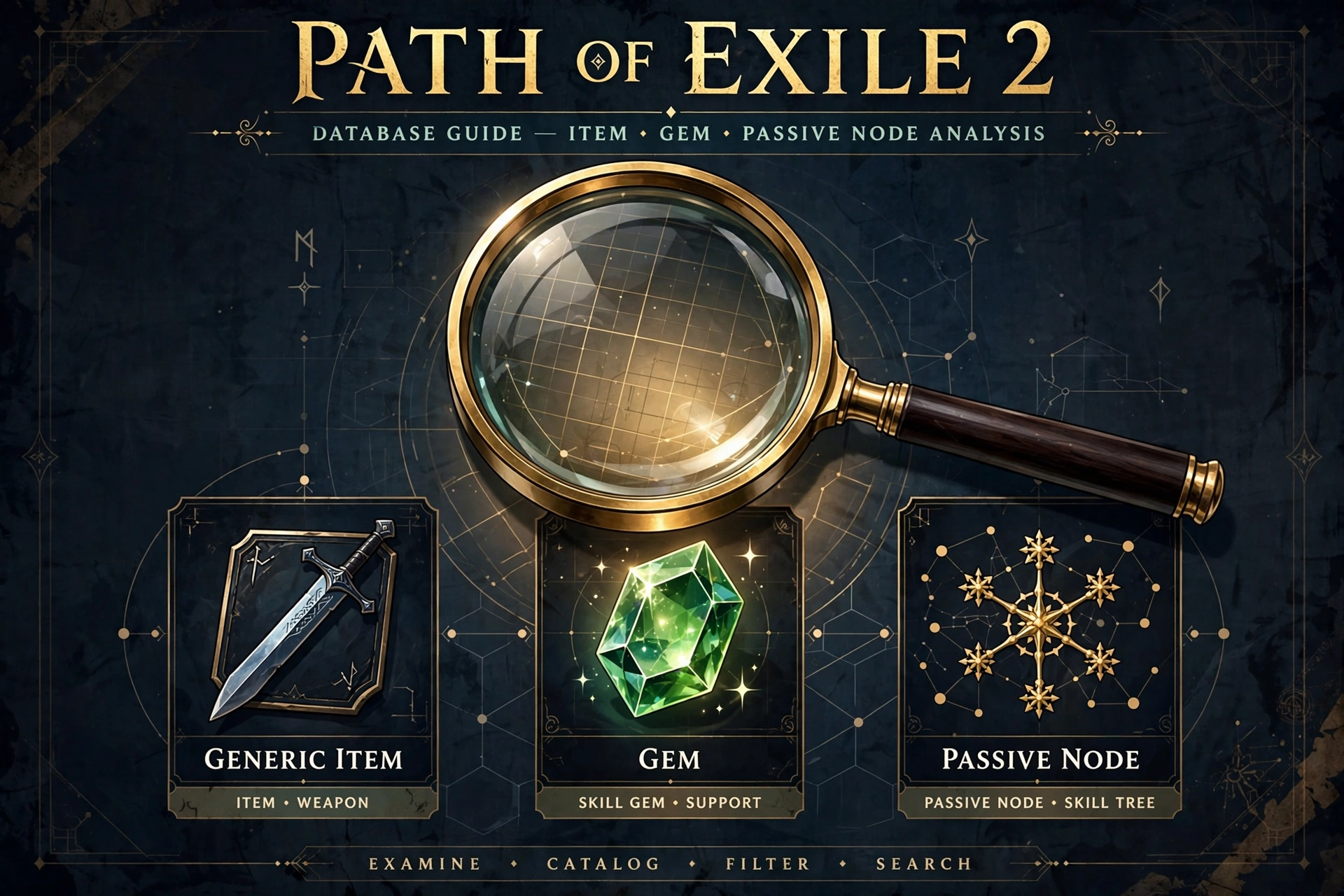
PoE 2 DB is the shorthand most players use for PoE2DB, a free, community-run database for Path of Exile 2 that lives at poe2db.tw. It is not an official Grinding Gear Games (GGG) website. If you type “PoE 2 DB” into a search engine, you are almost certainly looking for a place to check items, skill gems, support gems, modifiers, ascendancies, quests, and the passive tree without digging through the game client.
This guide explains what PoE 2 DB means, what the database covers, how to move around it, and where its limits are. It also separates a database from a build planner and a trading website, because players often mix those up. Everything here is written for Path of Exile 2 specifically, not the first game.
One note on method: the observations below come from the site’s own cached pages, its published disclaimer, and community write-ups. Where something could not be confirmed, the article says so.
What Is PoE 2 DB?
“PoE 2 DB” is a search phrase, not a registered product name. In practice it points to PoE2DB, the Path of Exile 2 sibling of the long-running PoE1 database at poedb.tw. Search results for the phrase are dominated by the poe2db.tw domain itself, by community discussion threads that link to it, and by guides written by other fan sites.
That makes the working definition simple. PoE 2 DB is a searchable reference site where players look up how things in Path of Exile 2 are defined: what an item base is, which modifiers can roll on it, what a skill gem does, and what an ascendancy offers. A Russian-language write-up describes it as a database, effectively a wiki, with detailed information on items, skills, monsters, and mechanics.
There is a naming wrinkle worth knowing about. Other pages use similar names for different things. One directory listing describes a “POE2db” with a skill tree planner and build guides, and a separate third-party site hosts its own Path of Exile 2 database section. Those are different resources. When this article says PoE 2 DB, it means the poe2db.tw database that players and fan guides most often reference.
Because the phrase is informal, treat PoE 2 DB as “the database people mean when they say it,” and always confirm the web address before you trust what you read.
What Can You Find Through PoE 2 DB?
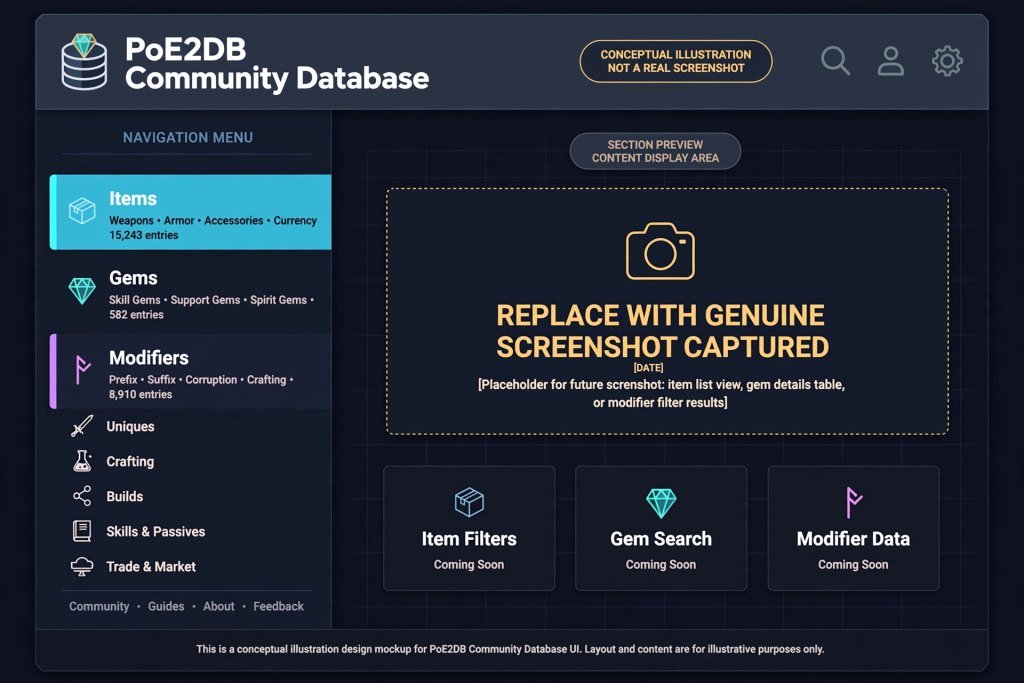
Not every database covers every part of a game, so it helps to list what has actually been observed. Cached copies of the site’s navigation menu show these top-level areas:
- Items: base items and unique items, including weapon and armour categories.
- Gems: skill gems, support gems, spirit gems, and a category labelled Lineage Supports.
- Modifiers: the affixes that can appear on gear, plus a Keywords section.
- Crafting: reference pages for crafting systems.
- Quests and Acts: campaign information, including quest rewards, according to community write-ups.
- Ascendancy classes and the passive skill tree: subclass and passive information.
- Waystones and Economy: endgame-related and economy-related sections.
The same navigation also exposes a language switcher. Cached pages list English, Traditional and Simplified Chinese, Korean, Russian, Japanese, French, German, Thai, Portuguese, and Spanish. A French-language guide singles out the on-page translation as a major strength, since you can see a skill’s name and description in the language you play in.
There is also a Data Table History page that lists internal game data tables, such as ActiveSkills and Achievements. Most players never need it, but it shows that PoE 2 DB exposes structured game data rather than only hand-written summaries.
Two cautions apply. First, this is a menu snapshot, and menus change as the game grows. Second, a section existing is not the same as a section being complete for the current patch. The accuracy section later in this article covers how to check.
How to Use PoE 2 DB
The steps below are based on the navigation structure that has been observed. They avoid describing buttons or filters that could not be confirmed.
- Open poe2db.tw and choose your language. Pick the English or other language version that matches your game client, so item and skill names line up with what you see in-game.
- Start from the category menu. Decide whether you are researching an item, a gem, a modifier, a quest, an ascendancy, or the passive tree, and open that section first.
- Drill down to the specific page. Community advice from a Steam discussion thread is a useful example. A player could not find the prefix and suffix breakdown for body armour, and the reply was to open the Modifiers area and then choose the specific armour type, such as strength body armours, rather than the general category.
- Read the whole page, not only the headline. Detail pages usually carry requirements, properties, and linked entries. Scroll before you decide you have found everything.
- Follow internal links. Items link to modifiers, and gems link to related support gems or keywords. This is often faster than going back to the menu.
- Cross-check anything important. If a decision costs currency or time, compare against the in-game tooltip or another source before you commit.
If you want a broader picture of how items change hands once you have identified what you want, the GamesPuma guide to Path of Exile 2 trade explains the trade systems in plain language.
How to Search for Items, Skills, or Game Information
The most reliable way to use PoE 2 DB is to match your question to the right section before you look for a keyword. A few practical patterns work well.
Looking up a skill. For PoE 2 skill gems, go to the Gems area and choose skill gems, support gems, or spirit gems depending on what you are chasing. Skill gem pages describe what the active skill does, and support gem pages describe how they modify a linked skill.
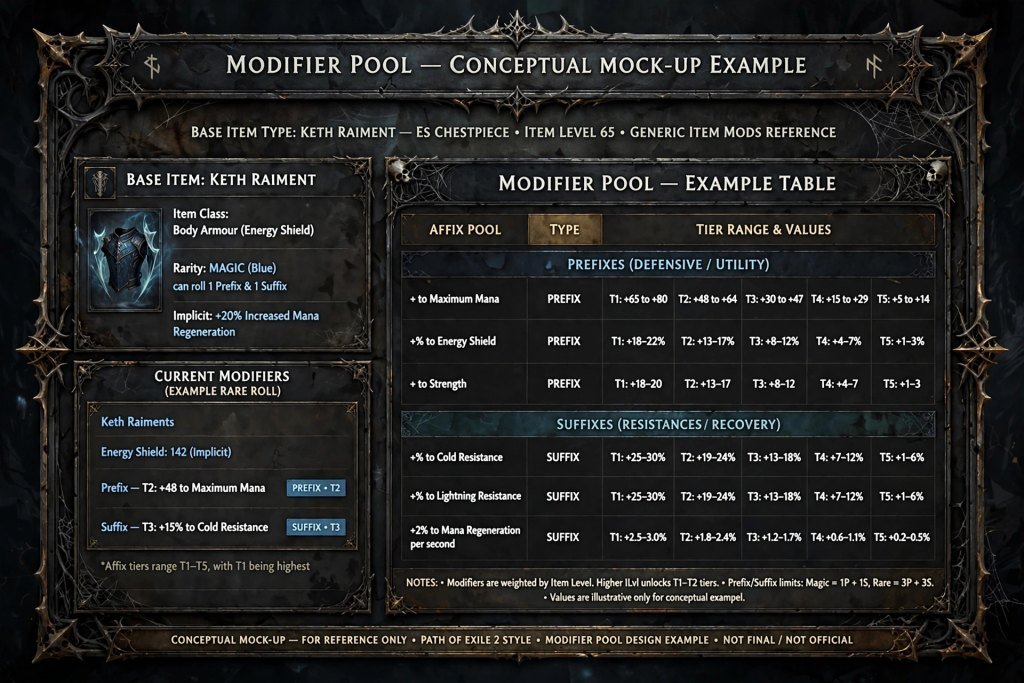
Looking up what can roll on an item. For PoE 2 modifiers, use the Modifiers section and select the base type. This is the route the Steam thread above recommends, and it is the cleanest way to answer “what could this item have?”
Looking up a unique. Open the Items area and find the unique item listings. Players have long watched these pages to see new uniques appear, which is how one Steam thread speculated about upcoming classes after new unique weapons were added to the site.
Looking up a class or ascendancy. Use the ascendancy and class sections, then compare against a dedicated explainer. GamesPuma’s Path of Exile 2 classes guide lists the playable classes, and the PoE 2 ascendancies guide covers subclasses and how you unlock them.
Looking up a term. If an item says something you do not understand, check the Keywords section. Path of Exile 2 uses precise terms, and the same word can behave differently from how it worked in the first game.
Whatever you search, write down the exact name you are researching. Many item and gem names look similar, and a one-word difference can mean a completely different effect.
PoE 2 DB for New Players
A new player’s biggest problem is not a shortage of information. It is knowing which information matters now. PoE 2 DB can help in a few specific ways.
First, it makes vocabulary less intimidating. When a tooltip mentions an unfamiliar term, you can look it up instead of guessing. That matters in Path of Exile 2 because several systems differ from the first game. A prominent example is the skill system: skill gems are placed in a dedicated skill panel, and support gems attach to individual skills, as described on the community wiki at poe2wiki.net.
Second, it helps you read gear. Seeing which modifiers can appear on a base type teaches you what a good roll looks like, which is a faster way to learn than trial and error with currency.
Third, it supports class choice. You can read about ascendancy options before committing, then pair that with a plain-language class overview. The current game build has eight playable base classes, as GamesPuma’s class guide explains for patch 0.5.5.
New players should also be careful. Do not assume that advice written for the first game applies here. If a result mentions mechanics you cannot find in Path of Exile 2, you may be reading a PoE1 page. Check the address before you act on it.
Finally, remember that reading is not the same as testing. A database tells you what is defined. It does not tell you whether a combination feels good to play.
PoE 2 DB for Experienced Players
Experienced players use PoE 2 DB less like a tutorial and more like a reference desk. The common tasks look like this.
Checking mod pools before crafting. Before you spend currency, you can look at the possible modifiers for the base type and judge whether the outcome you want is realistic. If you are still learning how currency items work, the GamesPuma PoE currency guide is a good companion.
Comparing options. When two uniques or two gems look similar, side-by-side reading of their pages shows differences in requirements and effects.
Verifying patch changes. After a patch, many players open the relevant database pages to see what moved. This is useful, but it works best together with the official patch notes. For the latest update summary, see the GamesPuma PoE2 patch notes page.
Reading raw definitions. Because the site includes a Data Table History page listing game data tables, advanced users can see that the underlying data is surfaced on the site. This is aimed at people comfortable with game data, not casual readers.
Finding tools. PoE 2 DB maintains a community tools page that lists third-party resources. Cached copies show categories such as loot filters, trade tools, and price history, with entries like NeverSink’s filter, Sidekick, PoE Overlay II, and Poe2 Scout. Inclusion on a list is not an endorsement from GamesPuma, so evaluate each tool yourself.
Database vs. Build Planner vs. Trading Website
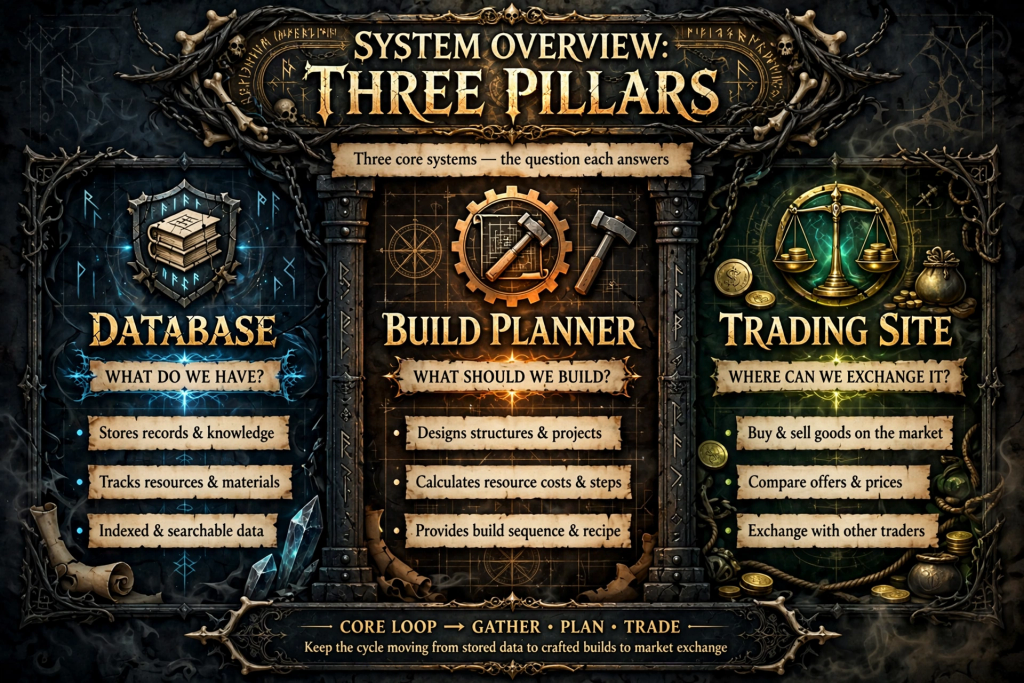
These three categories are easy to confuse, and each answers a different question.
| Tool type | Main question it answers | Example from this guide |
|---|---|---|
| Database | What exists in the game, and how is it defined? | PoE 2 DB (poe2db.tw) |
| Build planner | How do I assemble and test a character’s passives and gear? | Dedicated planner tools, which PoE 2 DB may link to |
| Trading website | Who is selling what, and at what price? | The official trade system, plus overlays such as Exiled Exchange 2 |
A database is a reference. It describes items, gems, and modifiers as the game defines them. It does not list live player prices in the way a market tool does.
A build planner is a tool for experimenting with a character. A database can inform your choices, but it is not a replacement for a planner.
A trading website connects buyers and sellers. In Path of Exile 2, the official trade site and in-game systems handle this, and GamesPuma explains them in the Path of Exile 2 trade guide. If you want price checking while you play, the Exile Exchange 2 guide covers the third-party overlay many players use.
The practical rule is simple. Use PoE 2 DB to understand what something is. Use a trade tool to learn what it costs. Use a planner to see whether it fits your character.
If you play both games, the broader Path of Exile trade guide covers PoE1 and PoE2 together, which helps you keep the two economies separate.
Is PoE 2 DB Official?
No. Based on the evidence found, PoE 2 DB, meaning PoE2DB at poe2db.tw, is a community-maintained resource rather than a GGG-operated site.
The site’s own General Disclaimer describes the database and wiki system as maintained by the community, and it states that GGG holds the copyrights and trademarks for Path of Exile. In other words, the site says the intellectual property belongs to GGG, while the maintenance is a community effort. A directory page for a similarly named “POE2db” also states that it is not affiliated with Grinding Gear Games, though that page appears to describe a different site.
What about the identity of the people who run the site? That could not be verified from the sources checked, so this article does not name an operator. If you need that information for editorial reasons, check the site’s own pages directly.
For official game facts, the safest sources are GGG’s own channels, including the official Path of Exile 2 website and the official patch notes. PoE 2 DB is best treated as a convenient community reference that sits alongside those sources, not above them.
How Accurate and Up to Date Is PoE 2 DB?
No database is guaranteed to be perfect, and this one is no exception. The honest answer is that PoE 2 DB appears actively maintained, but players should verify anything that matters.
Here is what supports its reliability. The site surfaces structured game data, including a Data Table History page. It is also widely used by the community. Fan discussions show players treating it as a first stop when new content appears, for example when new unique items showed up on the site ahead of launch details in an older Steam thread.
Here is what limits certainty. Path of Exile 2 is still evolving. The current build is patch 0.5.5, Forbidden Rites, which went live on September 4, 2026, with a smaller follow-up described by GamesPuma as 0.5.5e. When a game updates this often, any database can lag behind or contain details that change.
To judge freshness, use this checklist:
- Check the patch version mentioned on the page, if one is shown.
- Compare a key number against the in-game tooltip.
- Read the official patch notes for anything that changed recently.
- Be cautious with pages that look like they describe the first game.
- Treat community discussion as a prompt to verify, not as proof.
Do not assume the site updates in real time. No source reviewed for this article confirms real-time updating, so the safest assumption is that updates follow data availability and community maintenance.
Common Mistakes to Avoid
Mixing up the two games. Path of Exile 1 and Path of Exile 2 are separate games with their own mechanics, balance, and leagues. A skill or item with a familiar name can work differently. Always confirm you are on a Path of Exile 2 page.
Using the wrong site for the question. A database will not tell you live prices, and a trade site will not explain modifier pools. Match the tool to the task.
Trusting outdated information. An older forum post or video may describe how things worked several patches ago. Check the date and the patch.
Misreading requirements. Level and attribute requirements matter. The community wiki notes that gem and equipment requirements can be affected by effects such as increased attribute requirements, so read the entire page rather than a summary.
Copying a build from one page. A database page shows definitions, not synergy. Do not assume that two strong-looking entries will work well together.
Relying on an unverified lookalike. Because several sites use similar names, check the domain before you trust or share a link.
Best Practices for Getting Useful Results
Good habits turn PoE 2 DB from a bookmark into a real advantage.
- Bookmark the exact pages you use most, such as your class or gem section, so you do not rely on search each time.
- Switch languages deliberately. If you play in a non-English client, use the matching language version so names match.
- Use internal links. Following related entries often reveals requirements and connected effects you did not know to search for.
- Pair it with patch notes. After each update, read the notes first, then use the database to look at specifics.
- Keep a short verification routine. Compare one number against the game before you invest in a plan.
- Combine tools. Use PoE 2 DB for definitions, a price tool for costs, and a planner for testing. The GamesPuma guides to trade and currency can fill in the market side.
- Write down your questions first. A clear question, such as “which mods can roll on this base?”, leads you to the right section faster than browsing.
Frequently Asked Questions About PoE 2 DB
What does PoE 2 DB mean?
PoE 2 DB is the common search phrase for PoE2DB, a community-run Path of Exile 2 database at poe2db.tw. It is used to look up items, gems, modifiers, ascendancies, quests, and related game information.
Is PoE 2 DB an official website?
No. The site’s disclaimer describes it as community-maintained and says GGG holds the rights to Path of Exile. For official announcements and patch notes, use GGG’s own channels.
What can I look up in PoE 2 DB?
Cached navigation shows items, skill gems, support gems, spirit gems, modifiers, keywords, crafting, quests, ascendancy classes, the passive skill tree, and more. Availability of individual pages can change with patches.
Can PoE 2 DB help me find items?
It can help you identify items, base types, uniques, and the modifiers that can appear on them. It is a reference, not a marketplace, so for buying and selling you still need a trade tool.
Can I research skills and builds with PoE 2 DB?
You can research skill gems, support gems, ascendancies, and passive information. For testing a full character, a dedicated build planner is the better tool, and PoE 2 DB may help you decide what to plan.
How can I tell whether PoE 2 DB information is current?
Check the patch details, compare important numbers with the in-game tooltip, and read the official patch notes. Do not assume real-time updates.
Is PoE 2 DB the same as a trading website?
No. A database explains what things are, while a trading website shows what players are selling. GamesPuma’s trade guides explain how the trade side works.
Which resource should I use for my question?
Use PoE 2 DB for definitions, official GGG channels for announcements and patch notes, a trade tool for prices, and a planner for character testing.
Conclusion: Use PoE 2 DB as a Reference, Then Verify
PoE 2 DB is the phrase players use for PoE2DB, a community-run Path of Exile 2 database at poe2db.tw. It is a strong place to look up items, gems, modifiers, ascendancies, and game terms, and its language options make it accessible to many players. It is not an official GGG website, and it is not a trading platform or a build planner.
The best next step is practical. Open the section that matches your question, read the full page, and confirm anything important in the game or in the official patch notes. If you are new, start with the class and ascendancy guides linked above. If you are experienced, use PoE 2 DB to check modifier pools and compare options before you spend currency.
Used this way, PoE 2 DB saves time without replacing your own judgment. Keep the address handy, stay alert to patch changes, and treat every database, including PoE 2 DB, as a starting point for a decision rather than the final word.
Sources and verification notes
- poe2db.tw pages as indexed: Data Table History, General Disclaimer, community tools page (markdown_raw), navigation/language lists (cached copies)
- Steam Community discussion threads on PoE2DB and modifier lookups (player advice, not official)
- kami-labs.fr (French write-up on PoE2DB translation); dtf.ru (Russian write-up describing it as a database/wiki)
- poe2wiki.net, Skill gem page (community wiki; skill panel and support gem description)
- Patch 0.5.5 Forbidden Rites, Sept 4, 2026: kami-labs.fr, playnews.gg, allthings.how (secondary coverage; I did not open GGG’s official forum post)
- gamespuma.com homepage (internal URLs; 0.5.5e and eight-class claims come from GamesPuma’s own article summaries)
- eliteai.tools listing of a similarly named “POE2db” (used only to illustrate naming confusion)
- Not verified: site operator, real-time update behaviour, search/filter controls, current menu layout, any live SERP ranking or People Also Ask data.
Table of Contents

Written by Daniel Carter
Daniel Carter is a dedicated gaming writer who enjoys turning complex gaming topics into clear, useful, and engaging content. He covers game guides, tips, reviews, features, and the latest developments across the gaming world. His approach focuses on research, accuracy, and practical value, helping readers discover new games, improve their gameplay, and stay informed about the industry. For Daniel, great gaming content is not just about information—it is about making every article genuinely worth reading.