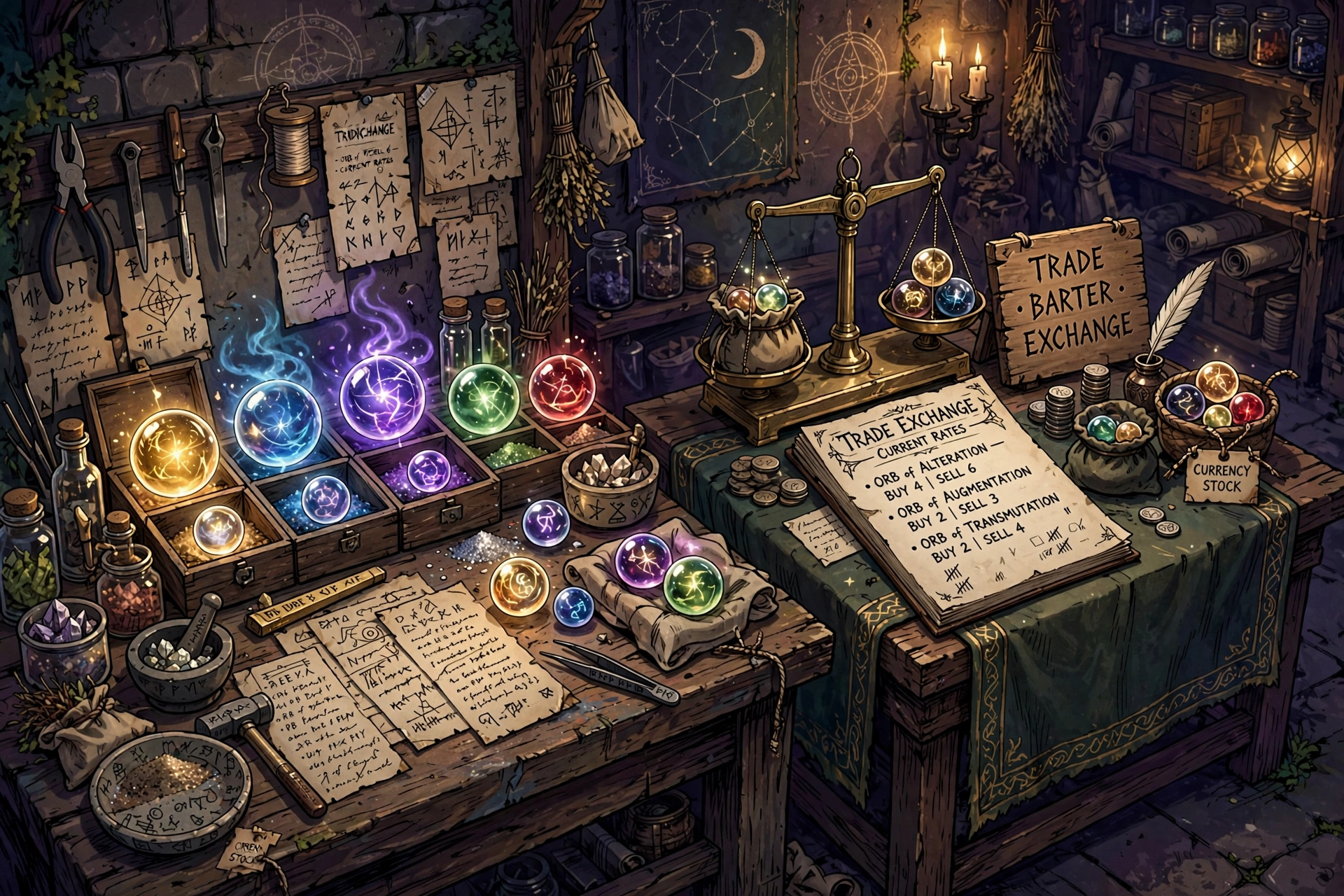
PoE Currency is the family of orbs, scrolls, shards and other stackable items that Path of Exile uses in place of a conventional gold coin. The same item you spend to change a piece of gear can also be handed to another player as payment, which is why PoE Currency sits at the centre of both crafting and trading in Path of Exile 1 (PoE 1) and Path of Exile 2 (PoE 2).
Introduction
Most action RPGs give you gold and a shop. Path of Exile does not. Instead, PoE Currency items such as the Chaos Orb, Exalted Orb and Divine Orb each have a real job in the game, and players agree between themselves how many of one item equal another. Understanding PoE Currency therefore means understanding two things at once: what an item does to your gear, and what other players will give you for it.
That second part is where many players slip up. PoE 1 and PoE 2 are separate games with separate economies, and an orb that shares a name across both can behave differently and be worth a very different amount. This guide explains what PoE Currency is, how the main currency items work, how to check values without guessing, how to trade, how to earn more, and which mistakes cost players the most. Where a point depends on the game or the league, the guide says so.
Table of Contents
What Is PoE Currency?
PoE Currency is any stackable item that players use to modify equipment, to pay for goods, or both. Orbs are the best-known examples, but scrolls, shards, fragments and many league-specific items also count in everyday conversation. The defining feature is the dual role: a currency item is a crafting tool first, and a unit of trade second, and the second role only exists because the first gives it a reason to be wanted.
That is why spending a currency item and trading it are very different acts. When you use an orb on a craft, the orb is gone and the total supply shrinks. When you trade it, the orb simply changes hands. Constant consumption through crafting is a major reason currency items hold value, whereas ordinary loot often does not.
Currency, gold and other resources
Gold is a different thing. In both games it is a resource used for services, and it is not something players trade to each other. In PoE 1 the community wiki describes gold as a non-tradable currency form that is shared between a player’s characters in the same league. In PoE 2 it is also used for fees, such as the cost of placing an order on the Currency Exchange. So when players search for PoE Currency, they almost always mean orbs and related stackable items, not gold.
Value from use versus value from scarcity
Not everything valuable is currency, and not every currency item is valuable. A rare piece of armour may sell for a lot because its modifiers are exactly what a build needs, yet it is not currency. A Scroll of Wisdom is currency, but it is cheap because it is common. Keep this distinction in mind: PoE Currency is valuable when many players need what it does and relatively few of it exist.
Types of PoE Currency
Currency items fall into broad groups. The groups below are explained by function, because function is what makes an item useful and what drives demand. Always confirm exact behaviour in the game or on a database, because crafting rules change between patches.
Basic crafting currency
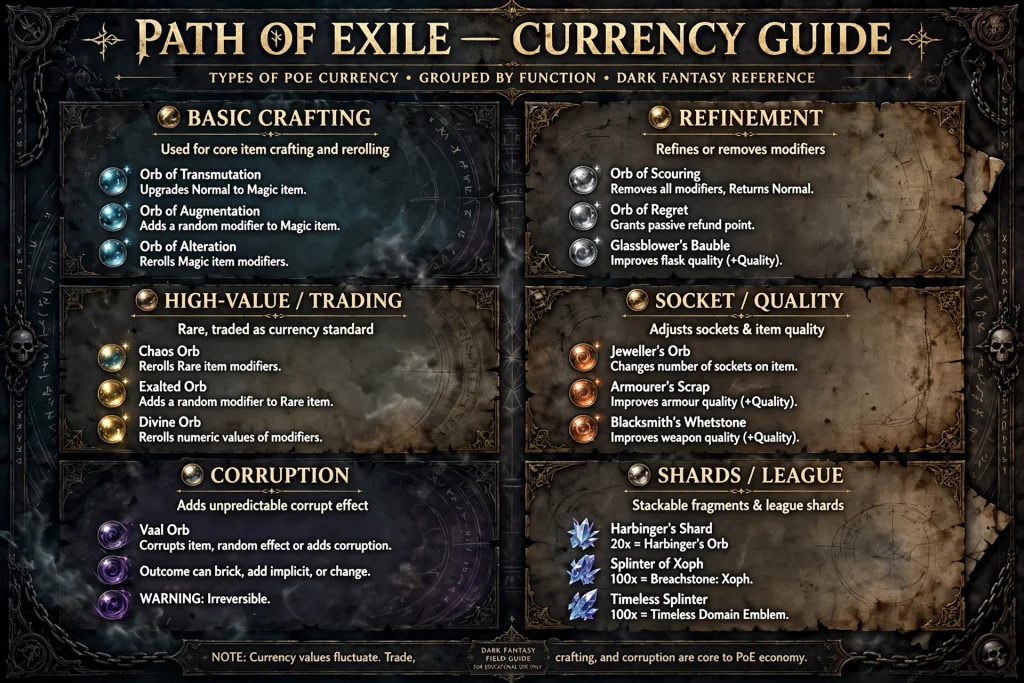
Basic crafting PoE Currency handles the early stages of making an item. The Orb of Transmutation upgrades a normal item to magic, and the Orb of Augmentation adds a modifier to a magic item. The Regal Orb upgrades a magic item to rare. In PoE 2 the Orb of Alchemy turns a normal item straight into a rare one. These items are cheap and are used constantly, so they have little trading value but real practical value. Beginners should use them freely to learn how modifiers work.
Rare-item refinement currency
Once an item is rare, refinement items take over. The Exalted Orb adds a new random modifier to a rare item in both games. The Chaos Orb is where the games diverge sharply: in PoE 1 it reforges a rare item with a new set of random modifiers, while in PoE 2 it removes one random modifier and adds a new one. The Orb of Annulment removes a random modifier, which can help or ruin an item, so it carries risk. The Divine Orb rerolls the numerical values of modifiers within their existing tiers, which makes it the usual tool for polishing a finished item.
High-value and trading currency
Some items matter more as units of trade than as crafting tools. In PoE 1 the Chaos Orb has long been a common pricing unit, and the Divine Orb is widely treated as the main high-value currency in recent leagues. In PoE 2, trading guides describe a barter system with no single universal currency. Players commonly use Exalted Orbs for smaller deals and Divine Orbs for larger ones. The Mirror of Kalandra, which duplicates an item, sits at the extreme top end of value. PoE 2 price trackers list a Mirror of Kalandra too, so do not assume it is a PoE 1 exclusive.
Socket, link and quality currency
PoE 1 has a long list of currency items that change sockets, links and quality. Examples include the Chromatic Orb, Jeweller’s Orb and Orb of Fusing for socket colours, count and links, and the Gemcutter’s Prism for gem quality. PoE 2 handles sockets differently, and its Jeweller’s and Artificer’s Orbs are described as socket-related items. Because the two games use different socket systems, a PoE 1 recipe should never be copied into PoE 2.
Corruption and special currency
The Vaal Orb corrupts an item, producing an unpredictable and permanent change. Fracturing Orbs, which lock a modifier in place, are listed among PoE 2 currency in recent guides. Corrupted items usually cannot be changed again, so this category suits experienced players who accept the risk.
Shards, fragments and league currency
Shards combine into full orbs, and many leagues add their own PoE Currency. PoE 2’s 0.5 era introduced new league currency, and such items can matter for a few months and then fade. Check how long a league item will stay relevant before you stockpile it.
PoE 1 Currency vs. PoE 2 Currency
PoE 1 and PoE 2 are separate games. Their economies, item systems, leagues and market values do not carry across, and you cannot move items or currency from one to the other. A shared item name does not mean a shared function or price. The table summarises the differences that have been verified in the sources consulted. It describes roles, not prices.
| Currency item | Role in PoE 1 | Role in PoE 2 | Important difference |
|---|---|---|---|
| Chaos Orb | Reforges a rare item with new random modifiers | Removes one random modifier and adds a new one to a rare item | Same name, very different crafting effect |
| Exalted Orb | Adds a random modifier to a rare item | Adds a random modifier to a rare item; widely used as a small-trade unit | Trade role differs by game and league |
| Divine Orb | Rerolls modifier values; widely treated as the main high-value currency | Rerolls modifier values; commonly used for larger trades | Market value is not comparable between games |
| Orb of Alchemy | Upgrades a normal item to rare | Upgrades a normal item to rare | Check current rules in each game |
| Mirror of Kalandra | Duplicates an item | Listed by PoE 2 price trackers | Confirm availability and use in your game |
| Gold | Non-tradable resource used for fees and services | Used for fees such as exchange orders | Not a trading currency in either game |
The practical lesson is simple. Before you read any guide about PoE Currency, any price list or any crafting tutorial, check which game it describes and which league it covers. The patch matters too. As of early October 2026, third-party reports place the PoE 2 Forbidden Rites update at patch 0.5.5 and PoE 1 at league 3.29, Curse of the Allflame. Confirm both on the official site, because release details change.
What Determines PoE Currency Value?
PoE Currency values come from supply and demand inside one game and one league. Several forces shape them.
- Supply and demand. An item that many players need and few players find becomes expensive. An item dropped in bulk becomes cheap.
- Crafting usefulness. Demand follows popular crafting methods. If a patch weakens a method, the currency behind it can lose value quickly.
- Patch and balance changes. Changes to drop rates, crafting rules or item behaviour move prices, which is why reading patch notes matters. The PoE2 patch notes on GamesPuma are one place to follow recent changes.
- League age. New leagues start with a fresh economy. Early prices swing hard as supply builds, and a rate that held on day one may be unrecognisable a month later.
- Progression and build demand. When many players need the same upgrade, the currency used to make it rises.
- Listing availability. A price based on a handful of listings is less reliable than one based on heavy trade volume.
- Convenience. Items that are easy to trade in bulk, such as stackable orbs, tend to have clearer prices than one-off gear.
No static article can promise a live price. As an illustration of how fast things move, one third-party tracker reported on 5 September 2026 that a Divine Orb was worth about 65 Exalted Orbs in the PoE 2 Forbidden Rites softcore league. Another third-party tracker reported on 7 October 2026 a figure of about 790 Exalted Orbs for the same league. Both are community estimates from commercial or independent sites, not official data, and both will be out of date by the time you read this.
How to Check Current PoE Currency Prices
Checking PoE Currency prices is a short routine rather than a lookup. Follow these steps every time the amount matters.
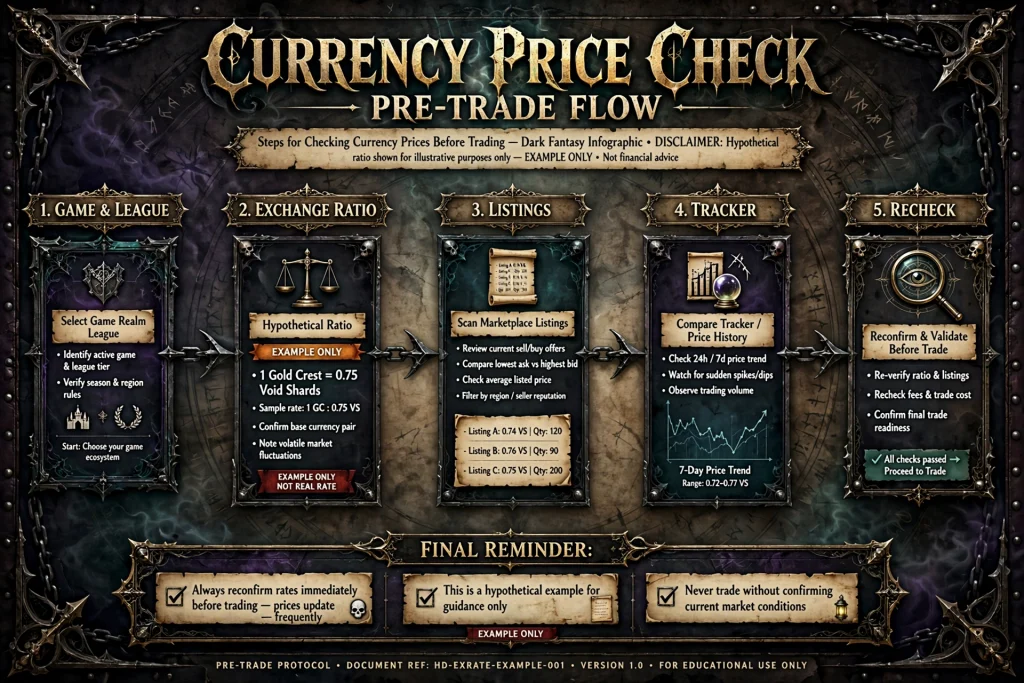
- Identify the correct game. PoE 1 and PoE 2 values are unrelated.
- Select the right league. Softcore, hardcore and Standard markets have separate prices, and each challenge league has its own economy.
- Use the in-game exchange where available. The Currency Exchange shows a market ratio for the pair you choose. In PoE 2, a “no data” result means that exact pairing has no recent trade history.
- Use the official trade site for items with modifiers. Stackable currency suits the exchange, whereas gear is searched on the official trade website.
- Add a community tracker for trends. Sites such as poe.ninja are independent, not official, and are best used to see direction over days rather than an exact current rate.
- Compare several listings. Do not trust a single listing, because one seller may be wrong or optimistic.
- Recheck before a large trade. A rate that looked fair an hour ago may have moved.
Price-checking helpers can speed this up. GamesPuma has a guide to choosing a PoE2 pricing tool and a separate Exile Exchange 2 price-checking guide. Treat any overlay or tracker as third-party software, read its rules and check Grinding Gear Games’ policy before using it.
If you cannot verify a number, do not guess. Check the game and league directly, because a believable figure copied from an old guide is worse than no figure at all.
Currency Exchange Rates and Ratios
An exchange ratio tells you how much of one currency you must give for one unit of another. A ratio of 10 to 1 between a Chaos Orb and a Divine Orb would mean that ten Chaos Orbs buy one Divine Orb. That figure is a hypothetical example for explanation, not a live price, and it does not apply to either game today.
The same ratio can differ for many reasons:
- Game. PoE 1 and PoE 2 have unrelated markets.
- League. Each league has its own economy.
- Date. Ratios drift through the life of a league.
- Transaction size. Large orders may be partly filled or move the price.
- Listing availability. A thin market can show a poor or missing rate.
- Supply and demand. The balance shifts with every patch and with player behaviour.
Fractions matter in PoE Currency exchange. A ratio of 1 to 0.9 can look tiny, yet on a large order the gap becomes a real amount of currency. Always read which currency is on which side before you confirm.
How to Trade PoE Currency
Trading PoE Currency means moving stackable items between players. The workflow differs by game, so each is covered separately. For a broader walkthrough of both games, see GamesPuma’s Path of Exile trade guide.
PoE 1 currency trading
In PoE 1, bulk trading is handled by the Currency Exchange Market, introduced in the Settlers of Kalguur league and later migrated to Standard, according to the community wiki. You reach it through the vendor Faustus, who appears from Act 6 and can later be placed in your hideout. You choose what you want and what you have, set a ratio and pay a gold fee, and the order can fill while you are away. For gear and other items, PoE 1 uses the official trade website, which lets you search for listed items in your league. Recent wiki entries also describe asynchronous item trading through Faustus and Merchant’s Tabs, so check what your league offers. GamesPuma’s PoE 1 trade guide covers the item-trading process in detail.
PoE 2 currency trading
PoE 2 has a Currency Exchange available once you reach Cruel difficulty. Guides differ slightly on which town characters offer it, so rely on what you see in the game. You open the exchange, select what you want and what you have, read the market ratio, place the order and collect your result. A gold fee applies when you place an order. The exchange covers stackable items, while gear is traded through the official PoE 2 trade site and direct player trades. GamesPuma’s PoE 2 trade guide explains these systems.
Steps that apply to every trade
- Find a suitable offer. Do not take the first one you see.
- Compare exchange ratios. Check at least one other source.
- Understand the quantities. Stack sizes and decimal ratios are easy to misread.
- Confirm the correct items and amounts. Read both sides before you accept.
- Avoid rushed deals. Pressure to hurry is a warning sign.
- Check the result. Confirm what arrived in your inventory or stash.
Do not treat any one method of PoE Currency trading as the only one available. Trading systems have changed between leagues and patches, and PoE 2 is still in development.
How to Farm or Earn PoE Currency
Earning PoE Currency comes down to doing content your character can clear efficiently and selling what you do not need. No guide can promise a currency-per-hour rate, because results depend on your build, gear, league and the market.
Common legitimate approaches include:
- Progression and endgame content. Maps in PoE 1 and the endgame in PoE 2 are the main sources of drops. Safe, fast clearing usually beats an occasional lucky drop.
- League mechanics. Current league content often yields its own currency and can be profitable early on.
- Selling valuable drops. Search the official trade site before you vendor something that looks plain.
- Trading wanted items. Sell items other players need, such as gear for popular builds.
- Collecting useful crafting currency. Pick up currency that you will use, not just whatever drops.
- Using a loot filter. A filter hides low-value drops so you can focus.
If a method becomes popular, supply rises and returns fall. Track how much value you gain per hour rather than how much drops.
Stay within the rules when you farm PoE Currency. Do not use exploits, bots, scripts that play for you or account-sharing schemes. They break the game’s terms and can cost you your account.
How to Spend Currency Wisely
Spending PoE Currency well is as important as earning it. Before you use a valuable item, ask what it is for and what else it could buy.
- Progression needs. Do not spend high-value currency on gear you will replace in an hour.
- Crafting risk. Some orbs can ruin an item, so know the worst outcome first.
- Opportunity cost. The same Divine Orb could buy a ready-made upgrade, so compare crafting against buying.
- Item upgrades. Spend on slots that matter most to your build.
- Budget management. Keep a reserve so that one bad craft does not end your session.
No single approach to PoE Currency suits every player or build. A player with a strong clear speed may craft, while a casual player may do better buying finished items.
Common PoE Currency Mistakes
Most losses come from a short list of habits. Each has a simple fix.
- Confusing PoE 1 and PoE 2 mechanics. Prevention: check which game a guide covers before you act on it.
- Using outdated prices. Prevention: check the date and league, and recheck before large trades.
- Trusting a single listing. Prevention: compare several listings and a second source.
- Misreading an exchange ratio. Prevention: read which currency is on which side and check decimals.
- Trading the wrong currency or amount. Prevention: confirm both sides in the trade window before you accept.
- Spending a valuable crafting item blindly. Prevention: read the item description and, if unsure, test the idea with cheap currency first.
- Assuming a rare item is automatically valuable. Prevention: search for similar listings before you price or vendor it.
- Relying on unverified third-party price data. Prevention: use official tools first and treat other sites as supporting evidence.
- Ignoring patch or league changes. Prevention: read the patch notes before a new season starts and again after big updates. The PoE 2 DB guide explains one community database that helps you look up item details, though it is not an official site.
Is PoE Currency Trading Safe?
Trading with other players inside the game’s own systems is generally safe when you stay careful. Safety with PoE Currency is about habits, not luck.
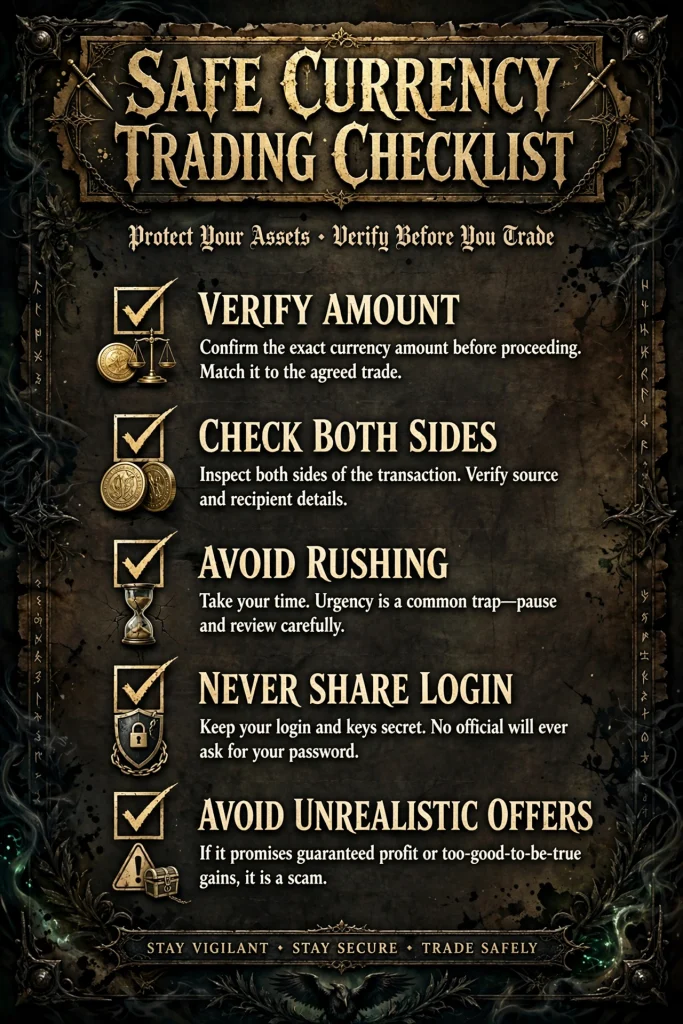
- Verify the currency type and quantity. Check the stack and the item name.
- Check both sides before accepting. Do not click accept until you have read everything.
- Beware of similar-looking items. Some items look alike, so read names, not just icons.
- Avoid suspicious websites and downloads. Type official addresses yourself.
- Never share account credentials. Real support will not ask for your password.
- Distrust unrealistic offers. If a deal looks too good, assume it is a trap.
Buying currency for real money is a separate question. Grinding Gear Games’ forum policy states that real-money trading of items or accounts is not allowed, and accounts involved can be punished. Many sites that rank for PoE Currency searches sell exactly this, and their claims of speed and safety do not change your account risk. No third-party service is risk-free.
Frequently Asked Questions
What is PoE Currency?
PoE Currency means the orbs, scrolls, shards and other stackable items that players use to craft gear and to pay each other. It is separate from gold.
What is the most useful currency in Path of Exile?
It depends on the task. The Divine Orb is widely used for high-value trades and finishing items, the Chaos Orb and Exalted Orb are common crafting tools, and cheap items such as the Orb of Transmutation matter early. Usefulness changes with the game and league.
How do I check current PoE Currency prices?
Use the in-game Currency Exchange for the market ratio, the official trade site for item listings, and an independent tracker for trends. Confirm the game and league first.
How do I trade currency in Path of Exile?
In both games, stackable PoE Currency can be traded through a Currency Exchange that charges a gold fee, and items with modifiers are traded through the official trade website and a trade window. Check how your own league handles it.
Is PoE 1 currency different from PoE 2 currency?
Yes. The two games have separate economies and mechanics. For example, the Chaos Orb works differently in each, and prices are not comparable.
Why do PoE Currency prices change?
PoE Currency prices follow supply and demand. Patches, new leagues, popular crafting methods and new farming strategies all shift them.
Should I spend or save valuable currency items?
Spend them when the upgrade clearly improves your character, and save or trade them when you are unsure. Avoid spending a high-value item on gear you will replace soon.
How can beginners earn currency?
Pick up useful currency, clear content you can handle safely, sell surplus items, and use a loot filter. Avoid spending valuable orbs on temporary gear.
Where can I find current currency exchange rates?
Check the in-game Currency Exchange first and the official trade site second. Independent trackers help with trends, but treat them as unofficial.
Summary: Key Takeaways
- PoE Currency is a set of stackable items that serve as both crafting tools and a means of trade.
- Crafting use creates demand, and trading use creates market prices.
- PoE 1 and PoE 2 must be treated as separate games, because mechanics, markets and values differ.
- Check current prices with the in-game exchange, the official trade site and independent trackers, and always confirm the game and league.
- Avoid the common mistakes: outdated prices, single listings, misread ratios and blind spending.
- Trade only through in-game systems, protect your account and avoid real-money offers.
Conclusion
Understanding PoE Currency turns trading from guesswork into a repeatable routine. Learn what each item does, confirm which game and league you are in, and compare more than one source before you trade. Because markets shift with every patch and league, verify current rates immediately before you spend or sell anything valuable.
Research and source-verification notes
Consulted (for facts used):
- GamesPuma.com homepage and existing /poe-currency/ page (to confirm the slug, existing links and site context)
- PoE Wiki: Gold, Currency Exchange Market, Asynchronous Trade (poewiki.net). Used for gold being non-tradable, Faustus from Act 6, gold fees, Standard migration and Merchant’s Tabs
- Maxroll PoE 2 trade guide (barter system, Exalted for small and Divine for larger trades) and PoE 1 Currency Exchange guide
- Mobalytics, Deltia’s Gaming, Prima Games and Gfinity guides for PoE 2 Currency Exchange steps (“I Want”/”I Have”, Market Ratio, “no data”, gold fee, Cruel unlock)
- Switchblade Gaming and Overgear PoE currency guides for orb functions (third party)
- timesaver.gg price pages and poe2pricecheck.com for the PoE 2 snapshot (third party, commercial/independent, not official)
- G2G page (a currency seller) only as a pointer for the PoE 1 3.29 launch date, which is unverified
- pathofexile.com forum thread 3675771, retrieved only as a search result; the RMT policy statement is taken from the existing GamesPuma page’s citation of pathofexile.com/forum/view-thread/98928, which I did not open myself

Written by Daniel Carter
Daniel Carter is a dedicated gaming writer who enjoys turning complex gaming topics into clear, useful, and engaging content. He covers game guides, tips, reviews, features, and the latest developments across the gaming world. His approach focuses on research, accuracy, and practical value, helping readers discover new games, improve their gameplay, and stay informed about the industry. For Daniel, great gaming content is not just about information—it is about making every article genuinely worth reading.