Diablo is Blizzard Entertainment’s long-running dark-fantasy action RPG franchise, built around fighting demons, collecting loot, and growing a hero from a weak newcomer into a walking weapon. In 2026 the series is celebrating 30 years, and it has more going on than at any point in its history: a new expansion for the latest game, a new class in several titles, a Nintendo Switch 2 release, a Netflix series in development, and the first official look at a fifth mainline game.
That much activity can make the franchise confusing for newcomers. This guide explains what the series is, how its games differ, which one suits which kind of player, and where to find trustworthy updates. It was researched on October 16, 2026, and wherever a fact can change, the relevant date or source is noted.
Table of Contents
What Is Diablo?
Diablo is an action role-playing game (ARPG) series developed and published by Blizzard Entertainment, in which players pick a hero class, fight through hordes of demons, and collect increasingly powerful equipment. It is often described as “hack and slash” because most of the moment-to-moment play is real-time combat rather than turn-based menus.
The franchise takes place in Sanctuary, a world caught between the High Heavens and the Burning Hells. The title character is the Lord of Terror and one of the Prime Evils. The first game sends a lone hero beneath the town of Tristram to stop him, and later games widen the conflict to include angels, demons, cults, and the half-angelic, half-demonic bloodline known as the Nephalem.
Blizzard states that more than 130 million players have entered Sanctuary across the franchise. You do not need to know any of this lore to enjoy the games, but the series rewards curiosity, and each entry stands reasonably well on its own.
What Type of Game Is Diablo?
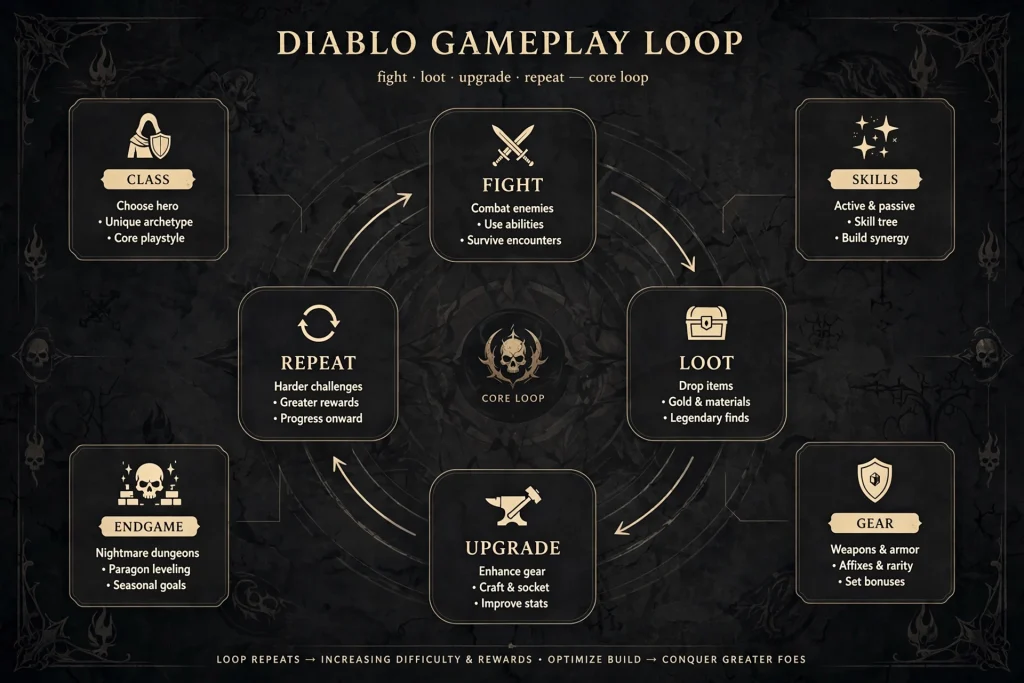
At its core, the series is a loot-driven ARPG. You pick a class, kill monsters, earn experience, unlock skills, and replace your gear with better drops. The loop is simple to describe and very hard to put down: kill, loot, upgrade, repeat.
Compared with other action RPGs, these games lean harder on atmosphere and immediacy. Dungeons are dark, gothic, and dangerous, and the design makes one more dungeon, boss, or rare drop always feel within reach.
How the Diablo Franchise Works
Every game in the series shares a handful of ideas, even though the details differ from title to title. Understanding them makes the whole franchise easier to approach.
Combat and Skills
Combat is fast and ability-driven. You attack with a primary skill, spend resources on stronger abilities, and manage defensive tools such as dodges, shields, or crowd control. In the newer games you also choose how your skills combine, so two players of the same class can feel completely different.
Older entries use a skill-point system where early choices can shape your character for the entire run. The newer games tend to be more forgiving and allow more respeccing, but the principle is the same: your skill choices define how your hero plays.
Loot and Equipment
Loot is the heart of the series. Enemies and chests drop weapons, armor, and jewelry in different rarity tiers, and the best items carry special properties that can reshape a whole character. This is why many players describe the genre as a hunt: you are always chasing the next piece of gear that unlocks a new way to play.
In the modern games, loot has more layers than raw numbers. The latest mainline game, for example, uses mechanics such as aspects, unique items, and, since its newest expansion, a built-in loot filter and a Horadric Cube crafting system. Those are features of that game, and they should not be assumed to exist in every other title.
Progression and Replayability
The story rarely marks the end. Most entries continue into an endgame, where you fight tougher enemies, chase rarer loot, and test your character against the hardest content. Many also reset the playing field through seasons or ladder resets, so players can start fresh characters on equal footing.
This replay structure is the reason a single game can hold someone’s attention for years. It also explains why guides, builds, and patch notes matter so much to the community.
Diablo Games Explained
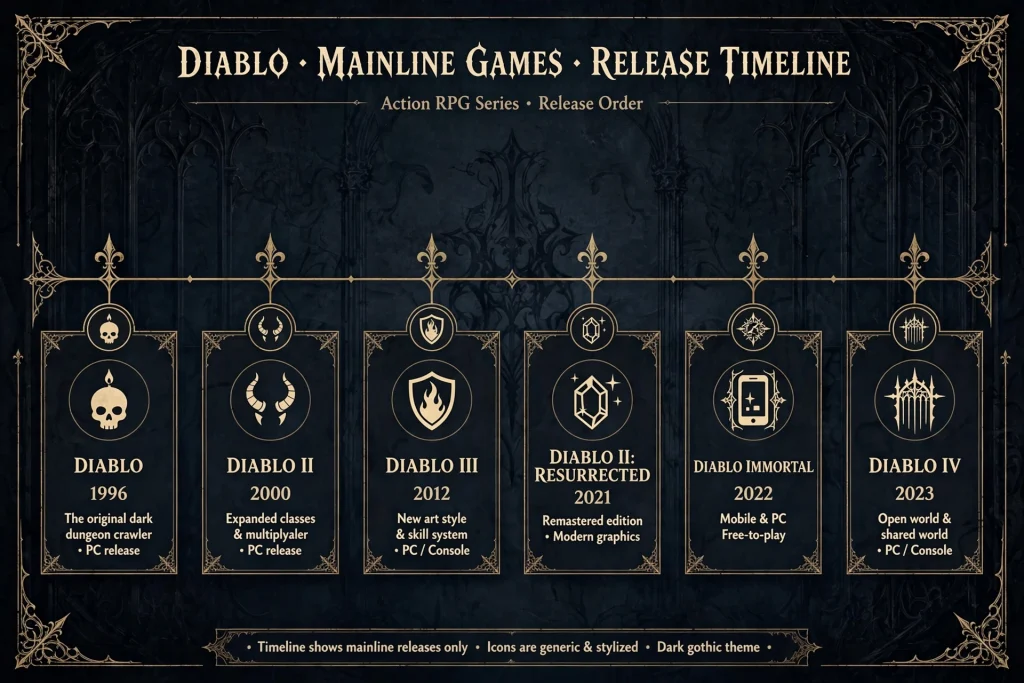
The franchise has four mainline games, one remaster, and one free-to-play spinoff. The table below summarizes the titles most readers are likely to ask about. Information reflects official Blizzard announcements and verified reporting as of October 16, 2026.
| Game | Type | Defining traits | Platforms | Best starting point for |
|---|---|---|---|---|
| Diablo (1996) | Original mainline game | Isometric dungeons, three original classes, the town of Tristram | PC (original release) | Franchise history and classic-game fans |
| Diablo II / Diablo II: Resurrected (2000 / 2021) | Mainline sequel and its remaster | Five-act story, deep skill and stat choices, runes and runewords, Warlock class added in 2026 | PC, consoles, Nintendo Switch (Resurrected) | Players who love classic, high-risk character building |
| Diablo III (2012) | Mainline sequel | Fast, colorful action, expansions Reaper of Souls and Rise of the Necromancer | PC and consoles at release | Players interested in the older, console-friendly entry |
| Diablo IV (2023) | Current mainline game | Open-world Sanctuary, seasons, expansions, eight playable classes | PC, PlayStation, Xbox, and Nintendo Switch 2 | Most new players |
| Diablo Immortal (2022) | Free-to-play spinoff | Mobile-first MMO-style ARPG with cross-platform play | iOS, Android, and Windows PC | Players who want free, quick-session play |
Two cautions apply. First, the two expansions for the latest game, Vessel of Hatred and Lord of Hatred, are add-ons, not separate games. Second, class names that repeat across games, such as the Barbarian or Necromancer, do not play identically from one title to the next.
Diablo IV and Its Current Content
The fourth mainline game launched in June 2023 and is the franchise’s current flagship. It is available on PlayStation 5, Xbox Series X|S, PlayStation 4, Xbox One, and PC through Steam and Battle.net, and it arrived on Nintendo Switch 2 on September 15, 2026 as the Age of Hatred Collection.
Expansions
The first expansion, Vessel of Hatred, released on October 7, 2024. It added the Spiritborn class and the jungle region of Nahantu.
The second expansion, Lord of Hatred, launched on April 28, 2026. According to Blizzard’s announcements, it added the Paladin and Warlock classes, the new region of Skovos, a War Plans endgame system, Echoing Hatred encounters, a loot filter, and a Horadric Cube crafting feature. Blizzard also reworked skill trees for every class, and that rework was made available to all players, not only expansion owners.
Lord of Hatred is framed as the conclusion of the Age of Hatred story arc, which follows Mephisto, the Lord of Hatred.
Seasons and Classes
The game runs on seasons, which are time-limited content cycles with their own mechanics, rewards, and fresh characters. The most recent one, Season of Hell’s Legacy, began rolling out on September 15, 2026. Blizzard describes it as a playable tribute to the series’ history, featuring the return of Deckard Cain and the Prime Evils, along with rewards inspired by earlier eras.
There are currently eight playable classes: Barbarian, Druid, Necromancer, Rogue, Sorcerer, Spiritborn, Paladin, and Warlock. Blizzard has also announced an Amazon class pack for the first half of 2027, but that content is not yet available.
Future Plans
Blizzard has confirmed that the Amazon is coming as the game’s first class pack, and that purchase details will be shared closer to release. Until then, treat it as announced, not released.
Diablo II: Resurrected and Other Franchise Entries
The Original Game
The first entry released in the mid-1990s and set the template for the genre. You play a lone hero descending through procedurally generated dungeon levels beneath Tristram, with Warrior, Rogue, and Sorcerer as the original classes. The Hellfire expansion added three more.
It is a historical landmark more than a modern recommendation, though it remains an interesting way to see where the series began.
The Remastered Sequel
The second mainline game is widely regarded as one of the defining ARPGs, and Resurrected is Blizzard’s 2021 remaster of it and its expansion, Lord of Destruction. It keeps the original’s slower, more deliberate feel while modernizing the visuals.
In 2026, Blizzard released Reign of the Warlock, a DLC for the remaster. It added the Warlock as the game’s first new class in decades, along with endgame updates, stash improvements, and a loot filter. The Infernal Edition bundles the base game, Lord of Destruction, and Reign of the Warlock together.
The Third Mainline Game
Released in 2012, the third game received the expansions Reaper of Souls and Rise of the Necromancer. It leans toward fast, colorful action, and many players see it as a stylistic bridge between the classic games and the modern one. Because its live-service status may have changed, check Blizzard’s official pages for current support details before buying.
The Free-to-Play Spinoff
Immortal is a free-to-play game on iOS, Android, and Windows PC, with cross-platform play. It takes place between the events of the second and third mainline games and supports solo play, co-op content, raids, and PvP. The Warlock class arrived there on June 17, 2026, as part of a major update.
It is free to start, but it includes optional purchases. Readers who are sensitive to monetization should review how progression and spending work before committing.
Diablo V: What Is Officially Known?
Blizzard announced the fifth mainline game at BlizzCon 2026 and says it is coming in Spring 2029. That is the only release window officially confirmed, and it should be treated as a target rather than a guarantee.
Blizzard’s description of the premise is notable: Sanctuary has fallen and the Lord of Terror has won. The company framed the game around the question of what a person must become when the world is already lost. It is a separate game, not an expansion for the current one.
Beyond that, official details are limited. No official information on classes, platforms, pricing, or specific gameplay systems should be assumed until Blizzard publishes it. Rumors, leaks, and community theories are not confirmation, and this guide does not treat them that way.
Blizzard also announced an animated series in development with Netflix. Few details were provided, and no release window has been given.
Classes, Builds, Skills, and Loot in the Diablo Series
Classes are the foundation of any character. Each class has its own fantasy, resource system, and skills, and its role within the game’s combat.
Because class lineups differ by game, it helps to remember which examples belong where. The latest game has the eight classes listed above. The remaster has its own classic set of heroes, now joined by the Warlock. Immortal has its own roster, which also gained a Warlock in 2026. The Warlock appears in three games, but Blizzard has said each one gives it a distinct interpretation.
What Is a Build?
A build is the combination of class, skills, gear, and upgrades that defines how a character fights. A build might focus on summoning demons, spinning through crowds with melee attacks, or casting area spells from a distance. Good builds work because the pieces reinforce each other.
For beginners, the useful advice is to start with a class that looks fun, play through the campaign, and then explore guides once the basics feel comfortable. Optimizing too early can take the joy out of discovery.
Skills, Gear, and Terms to Know
Skills are the active and passive abilities your hero uses. Gear provides stats and special effects, and rarity tells you how powerful an item might be. Endgame refers to the content that starts after the campaign, and a season is a limited-time cycle that resets progress for new characters.
Do not carry assumptions between games. A system that exists in one title might not exist in another, and the reverse is also true.
Which Diablo Game Should Beginners Play First?
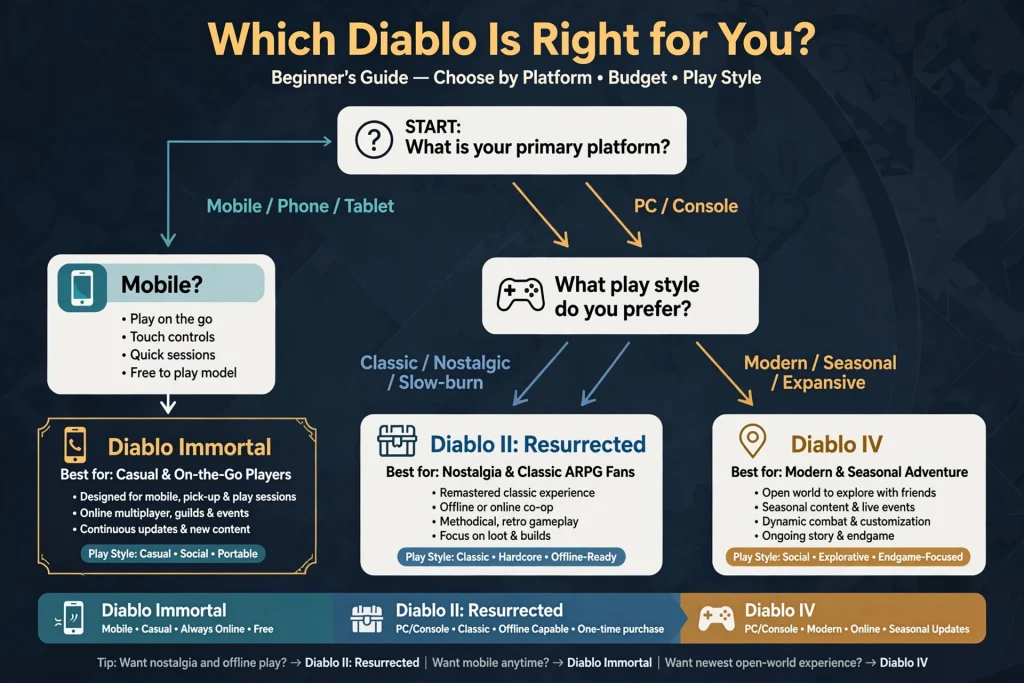
There is no universal answer, but the following recommendations match the most common preferences.
- Most new players: Diablo IV. It is the current mainline game, it has the largest ongoing support, and it is playable on PC, PlayStation, Xbox, and Switch 2. The Age of Hatred Collection bundles the base game with both expansions, but check current prices on your platform’s store before buying.
- Players who want a classic experience: Resurrected. It offers a slower, more punishing style with deep character-building rules. It is also available on Nintendo Switch.
- Players who want free, short sessions: Immortal. It runs on phones and PC and costs nothing to start, though purchases are available.
- Co-op players: The latest game and the free-to-play spinoff are both built with shared online play in mind, and the remaster is also a popular choice with friends.
- Players who enjoy long-term progression: Any of the three above can offer this, but seasons in the newest game and ladder resets in the remaster are the most structured ways to restart.
Diablo Updates, Expansions, and Seasonal Content
News can be confusing because several different kinds of updates exist. It helps to separate them.
A patch is a smaller update that fixes bugs or adjusts balance. A season is a time-limited content cycle, usually with new mechanics and rewards. An expansion is a large paid add-on, like Lord of Hatred. A class pack is a smaller paid addition that focuses on a single new class, which is how Blizzard describes the upcoming Amazon.
When you read an update, always check which game it applies to. A season for the newest game does not change the remaster, and a free-to-play update has nothing to do with either. Dates also matter. Seasons and patches are replaced regularly, so an article that was accurate in spring may be outdated by autumn.
As of October 16, 2026, the most recent season is Season of Hell’s Legacy, which began on September 15. Blizzard has also announced the Amazon for the first half of 2027, and the fifth mainline game for Spring 2029.
Where to Find Official Diablo News and Resources
For current information, official sources are the best place to start. The official Diablo IV website covers editions, platforms, and current content. Blizzard’s news site publishes patch notes, season overviews, and announcements, including its BlizzCon 2026 Opening Ceremonies recap, which is the primary source for the Amazon and fifth-game announcements.
Blizzard also maintains separate news feeds for the latest mainline game, the remaster, and the free-to-play spinoff. Using the right feed helps you avoid mixing up updates from different games.
Community sites are helpful for builds and discussion, but they are not official confirmation. When a claim sounds surprising, look for it on Blizzard’s channels before accepting it as fact.
Frequently Asked Questions About Diablo
What is Diablo?
It is a dark-fantasy action RPG franchise from Blizzard Entertainment. Players choose a hero class, battle demons, and collect loot across a series of games set in the world of Sanctuary.
Is Diablo an action RPG?
Yes. It is an action role-playing game, sometimes called a hack-and-slash game. Combat happens in real time, and character growth comes from skills, gear, and levels.
Which Diablo game should beginners play first?
Most new players should start with Diablo IV, because it is the current mainline game and has the most active support. Players who prefer classic design can try Diablo II: Resurrected, and those who want a free option can try Diablo Immortal.
Are the games connected by a story?
The mainline games are connected through the story of Sanctuary and the conflict between Heaven and Hell. Each game is understandable on its own, but playing in order adds context.
Is the latest game different from the remaster?
Yes. The newer game has an open-world structure, seasons, and modern systems. The remaster covers a 2000-era game with a more classic design.
Can Diablo be played solo?
Yes. The mainline games can be played alone, and the franchise also supports group play. The newest game and the free-to-play spinoff are online games, so an internet connection is required.
Which platforms support the relevant games?
The newest game is on PC, PlayStation, Xbox, and Nintendo Switch 2. The remaster is on PC and consoles, including Nintendo Switch. The free-to-play spinoff is on iOS, Android, and Windows PC. Always confirm on the official store page, because availability can change.
What is the latest Diablo game or update?
The latest released mainline game is the fourth, and its newest expansion is Lord of Hatred from April 2026. The latest season is Season of Hell’s Legacy, which began September 15, 2026.
What is officially known about Diablo V?
Blizzard says it is planned for Spring 2029 and is set in a Sanctuary where the Lord of Terror has won. No other gameplay details should be treated as confirmed.
Final Verdict
The series remains one of gaming’s most recognizable action RPG franchises because its core idea is so durable: fight monsters, find better gear, and build something powerful. After 30 years, Diablo offers a real choice of entry points, from the modern fourth game to the classic feel of the remaster and the free, mobile-friendly spinoff.
If you are new, Diablo IV is the most practical place to start, and it is also where the franchise’s current story and updates are happening. If you prefer a slower, older style, the remaster is a strong alternative. Wherever you begin, verify any date, price, or release claim on Blizzard’s official channels, and explore our related GamesPuma guides when you are ready to go deeper.
Sources and References
This guide was researched on October 16, 2026. The key facts come from the following sources, and readers should check them for any later changes.
Official Blizzard sources
- BlizzCon 2026 Opening Ceremonies Recap covers the fifth game, the Netflix series, the Amazon class pack, Season of Hell’s Legacy, and the Switch 2 release.
- Immortal Warlock class announcement covers the Warlock’s June 17, 2026 arrival.
- Official game website covers editions, platforms, and current content.
Supporting reports
- Gematsu on Lord of Hatred and the Warlock covers the expansion’s release date and new classes.
- Game Informer on the Warlock in the remaster covers Reign of the Warlock.
- Nintendo Life on the What’s Next panel covers the new season and the Amazon class timing.
- Variety on the Netflix series covers the animated series announcement.

Written by Daniel Carter
Daniel Carter is a dedicated gaming writer who enjoys turning complex gaming topics into clear, useful, and engaging content. He covers game guides, tips, reviews, features, and the latest developments across the gaming world. His approach focuses on research, accuracy, and practical value, helping readers discover new games, improve their gameplay, and stay informed about the industry. For Daniel, great gaming content is not just about information—it is about making every article genuinely worth reading.