Diablo 2 LOD is the common shorthand for Diablo II: Lord of Destruction, the official expansion Blizzard released for Diablo II in June 2001. It added a fifth act, two new classes (the Assassin and the Druid), more items, and a set of new systems that changed how characters are built. If you have seen the abbreviation in forums, build guides or store pages and wondered what it refers to, this guide explains it from the beginning.
This article covers what Diablo 2 LOD contains, how its story and classes work, how its itemization shaped the game, and whether you can still play it. It also explains how the classic expansion differs from Diablo II: Resurrected, the remaster released in 2021, and from the newer Reign of the Warlock DLC for that remaster.
If you are new to the series as a whole, GamesPuma’s Diablo franchise guide is a good starting point before you dive into the details below.
Table of Contents
What Does Diablo 2 LOD Mean?
LOD stands for Lord of Destruction. Diablo 2 LOD therefore means Diablo II: Lord of Destruction, the expansion to the original 2000 game. You will also see it written as “LoD” with a lowercase “o”, and some older communities used “D2X”, short for Diablo 2 eXpansion.
Players use the abbreviation because the full title is long and because the expansion matters so much to how Diablo II is played. In practice, when someone says they are playing Diablo 2 LOD, they usually mean the base game and the expansion together, since the expansion cannot run without the original. Lord of Destruction requires a full installation of Diablo II.
That dependency is the quickest way to answer a common question. Diablo 2 LOD is an expansion, not a standalone game. It builds on the original Diablo II and extends it.
What Is Diablo II: Lord of Destruction?
Diablo II: Lord of Destruction is a first-party expansion developed by Blizzard North. That detail is worth noting for fans of the series, because the first Diablo’s expansion, Hellfire, was not an official Blizzard product. Diablo 2 LOD was an official continuation of Diablo II, not a fan project or a third-party add-on.
The expansion picks up after the events of the base game. Diablo has been defeated, but his brother Baal has survived and moved into the Barbarian Highlands. The player is called back into the fight and follows Baal to Mount Arreat, which is where the new act takes place.
Reviewers at the time noted that the expansion did more than add content. It also changed how the existing game played, for solo and especially multiplayer sessions. That is why many players treat Diablo 2 LOD as the “real” version of Diablo II rather than an optional extra.
Be careful with claims about sales or influence. Marketing material from 2001 mentioned strong retailer orders, but exact figures and rankings vary by source, so this guide does not repeat them.
Diablo 2 LOD Features and Expansion Content
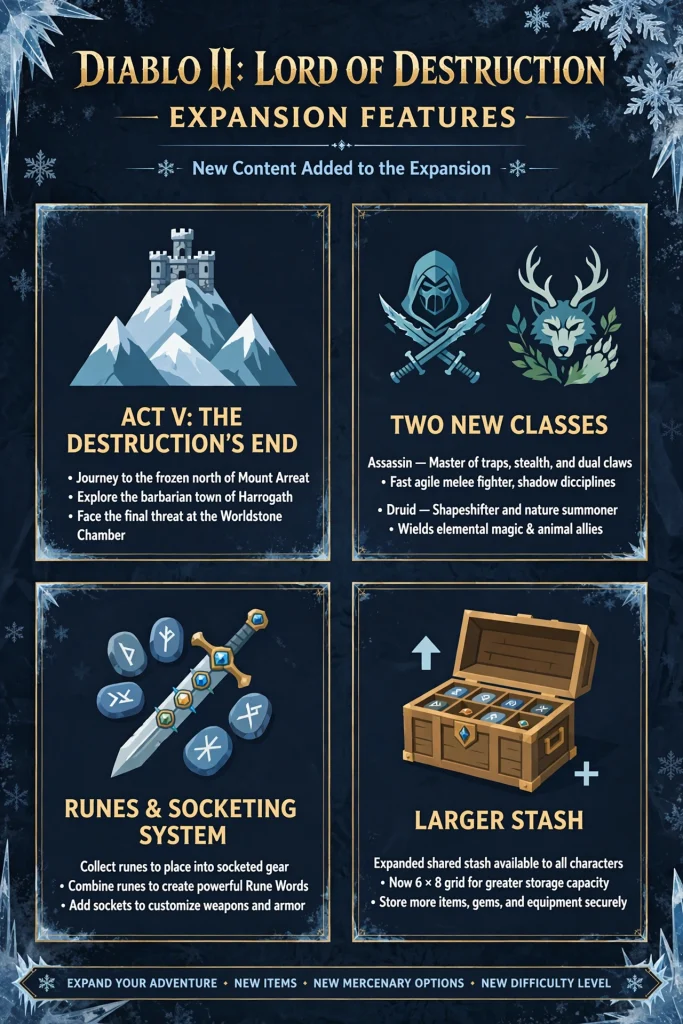
The Diablo 2 LOD expansion is best understood as a set of connected changes rather than a single new area. Each addition affects the others: new classes need new skills, new skills need new gear, and new gear needs new ways to find and customize it.
Act V and a new campaign
The headline addition is Act V, set in and around Mount Arreat in the northern Barbarian Highlands. It introduces a new town, new monsters, new quests and a final boss in Baal. Marketing at the time also promised more than 50 new monster classes and several new boss monsters across the expansion.
Two new classes
Diablo 2 LOD added the Assassin and the Druid, which expanded the roster from five classes to seven. Each came with its own skill trees, new item types and a distinct combat style. The class sections below explain how they play.
More items and more ways to use them
The expansion added a large amount of new equipment, including class-specific items, charms, crafted items, new socketable items and extra Horadric Cube recipes. It also improved set and unique items. For players, this meant that finding a good item was no longer only about raw stats. It could change which build was possible at all.
Larger storage and better hirelings
Players received a private stash twice the size of the one in the base game, which made it easier to keep gear for multiple builds. Mercenaries were also updated, and Act V introduced its own barbarian hireling. These changes are less glamorous than a new class, but they affect every session.
Patches changed the picture
This is where many guides go wrong. A good deal of what players now think of as Diablo 2 LOD arrived through later patches rather than the 2001 release. Patch 1.10, released on October 28, 2003, added skill synergies, seasonal ladder play, new items and unique charms, and a new world event. Anyone comparing old reviews with current play should remember that the game described in 2001 was not exactly the game people play now.
Act V and the Lord of Destruction Story
The story of Diablo 2 LOD begins in the Pandemonium Fortress. After the hero defeats Diablo at the end of Act IV, the archangel Tyrael summons them with an urgent message. Baal, the third of the Prime Evils, has taken his Soulstone and gone to Mount Arreat, and he intends to corrupt the World Stone.
Baal’s first attack falls on Sescheron, the Barbarian capital, and the story moves to Harrogath, the fortified town that serves as Act V’s hub. From there, the player fights through the highlands, rescues captive barbarians, deals with a betrayal in Harrogath, and climbs toward the Worldstone Keep. Act V is made up of six quests, which keeps the campaign tight compared with the earlier acts.
This guide keeps the details spoiler-light on purpose. The structure of the act is simple: prepare Harrogath, rescue the people you can, face the Ancients, and then confront Baal in the Worldstone Chamber.
Spoiler note: the ending of Diablo 2 LOD resolves Baal’s plot, so skip the next paragraph if you plan to play for the first time.
The confrontation takes place after the player fights through the Throne of Destruction and Baal’s minions. The expansion’s story is not the deepest in the series, and some reviewers at the time felt the plot was thin. Most players come to Diablo 2 LOD for the action and the loot rather than for narrative twists.
Diablo 2 LOD Classes Explained
The full roster in Diablo 2 LOD is seven classes: the five from the base game (Amazon, Barbarian, Necromancer, Paladin and Sorceress) plus the two added by the expansion, the Assassin and the Druid. Everything in the Diablo 2 LOD classes list is playable from level one, so you can start a new character of any type once the expansion is installed.
One practical point: characters created with the expansion are often called “expansion characters.” They can use LOD content, while classic characters cannot. If you plan to try the Assassin or Druid, you need to create an expansion character.
The Assassin
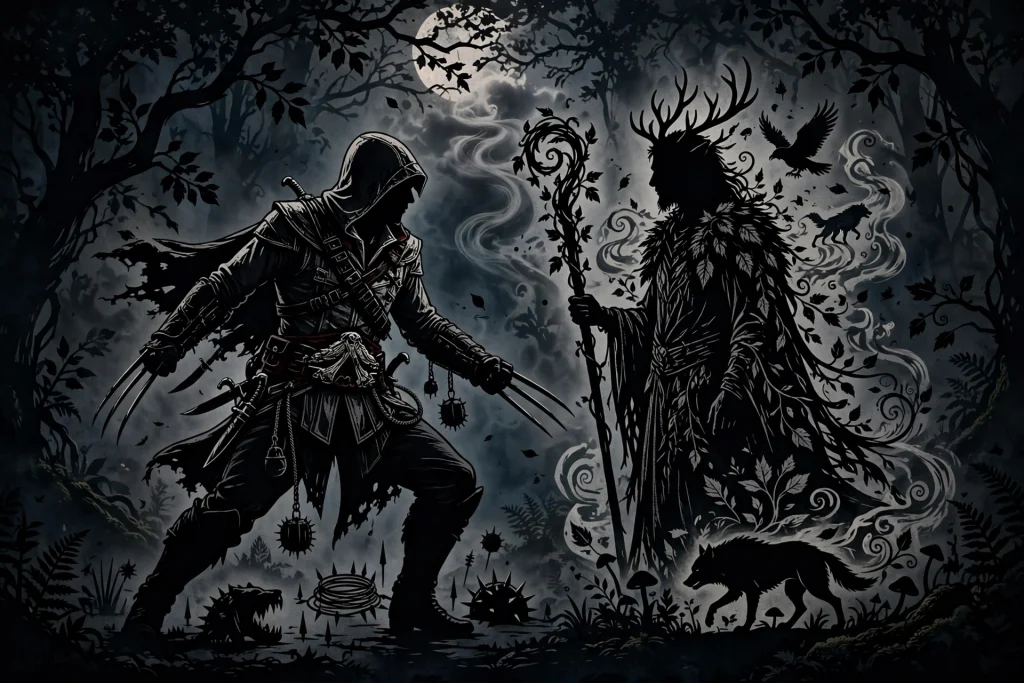
The Assassin is a martial artist who fights with wrist blades, often called claws. Her combat identity rests on two ideas: she lays passive traps that attack enemies for her, and she builds up charged martial arts attacks that finish them off.
Her skills are grouped into three categories: traps, martial arts and shadow disciplines. Traps reward positioning and planning, martial arts reward close-range pressure, and shadow disciplines offer support and defensive options. This makes her a class that can play either at a distance with traps or up close with charged strikes.
The Assassin is a good fit for players who like a hybrid approach and are willing to learn how her combo skills build up. She is less forgiving if you spread skill points across all three categories without a plan.
The Druid
The Druid is a hybrid class that can act as a caster, a shapeshifter or a summoner. Her skill categories are elemental, shapeshifting and summoning. The elemental tree covers wind and fire-based attacks, the shapeshifting tree lets the character turn into a werewolf or werebear, and the summoning tree provides animal companions and plant allies, including ravens and vines.
That flexibility is the Druid’s main appeal. A single character can lean toward a melee shapeshifter, a spell-focused caster or a support character with companions. A contemporary review warned players about network lag when using many summons in multiplayer, which is a reminder that some builds behave differently online and offline.
How the two classes differ
The Assassin favors precision and setup, while the Druid favors flexibility and versatility. The Assassin’s strengths come from timing her traps and charged attacks, and the Druid’s come from choosing a path in her three trees and sticking with it.
Neither class is “best” in the abstract. Their strength depends on the patch, the difficulty, the gear you can find and your own preferences, so any claim that one build is universally superior should be treated with caution.
Diablo 2 LOD Items, Runes, and Runewords
Equipment is the engine of Diablo 2 LOD. Items come in several tiers, including normal, magic, rare, set and unique, and many of them can have sockets. The expansion deepened this system with class-specific gear, charms, crafted items and new socketables.
Runes and jewels are the most important socketables. Runes are special items that can be placed in sockets, and jewels let you customize an item with extra properties. Together they let a player adjust gear toward a specific build instead of waiting for a perfect random drop.
Runewords
Runewords are the feature most players associate with Diablo 2 LOD runewords discussions. A runeword is a bonus granted to an item when specific runes are placed in a specific order in a socketed item of the right type. The result can be far stronger than the base item suggests.
A note on history: runewords are part of Diablo 2 LOD as it is played today, and patch 1.10 in 2003 added many of the item, charm and set improvements that shaped the later game. If you need to know exactly which recipe or effect belongs to which patch, check a specialist reference such as the Arreat Summit before relying on it. This guide does not list specific recipes because they are version-sensitive.
Horadric Cube recipes and crafting
The Horadric Cube lets players combine items to create new ones. In Diablo 2 LOD, the Cube gained new recipes, including crafting. These systems reward patience and planning, since the best results often depend on starting with the right base item.
Farming and gear progression
Gear progression in Diablo 2 LOD follows a familiar loop: play the content, collect drops, upgrade equipment, and push into harder content. Because drops are random, two characters of the same class can end up with different strengths. That variability is a large part of why Diablo 2 LOD remains replayable.
This guide does not give drop rates, trading prices or item statistics, because these change by version, patch and community. If you need exact numbers, consult an established Diablo II database and confirm which version it describes.
Diablo 2 LOD Builds and Character Progression
A build is the combination of skills, attributes and equipment that defines how a character plays. In Diablo 2 LOD, you spend skill points as you level, assign attribute points to strength, dexterity, vitality and energy, and then support those choices with gear.
The system rewards planning. Skill points cannot be freely reassigned in the classic game, so a poorly planned character can feel weak or awkward. Patch 1.10 added skill synergies, which give bonuses to a skill when you invest in related skills, and that encouraged more focused builds.
How to choose a build
Rather than copying a single “best” build, use a simple approach:
- Pick a class and a playstyle you enjoy, such as melee, ranged, summoner or trapper.
- Check that any guide you follow states the game version and difficulty it was written for.
- Compare gear requirements to what you can realistically obtain.
- Expect to adjust as you move from Normal to Nightmare and Hell difficulty.
The most common mistake is following a guide written for a different version. Classic Diablo 2 LOD, Diablo II: Resurrected, and modded versions can differ in balance and mechanics, so confirm the version before you spend points.
For a modern comparison of how build planning works in a current Diablo game, see our Diablo 4 builds guide. Its classes and systems belong to Diablo IV, so treat it as a reference for planning habits, not for Diablo 2 LOD mechanics.
Diablo 2 LOD Gameplay and Replayability
The core loop of Diablo 2 LOD is easy to describe: explore areas, fight monsters, collect loot and strengthen your character. Each difficulty level, Normal, Nightmare and Hell, makes the same campaign tougher, and completing them earns titles for your character.
Replayability comes from three places. The first is class variety, since seven classes and multiple skill paths mean a new character feels different. The second is randomized loot, which means no two runs produce the same gear. The third is long-term goals, such as building toward a particular item or runeword.
Later patches added end-of-game activities. Patch 1.10, for example, introduced a world event tied to the Hell difficulty, and later content included the Uber bosses and the items connected to them. Because these details are version-specific, check which version you are playing before planning around them.
It is fair to say that Diablo 2 LOD shows its age. The original interface and presentation are dated, and some conveniences that modern players expect, such as large shared storage, are missing from the classic version. Those limits do not erase the game’s strengths, but they are worth knowing before you buy.
Diablo 2 LOD vs Diablo II: Resurrected
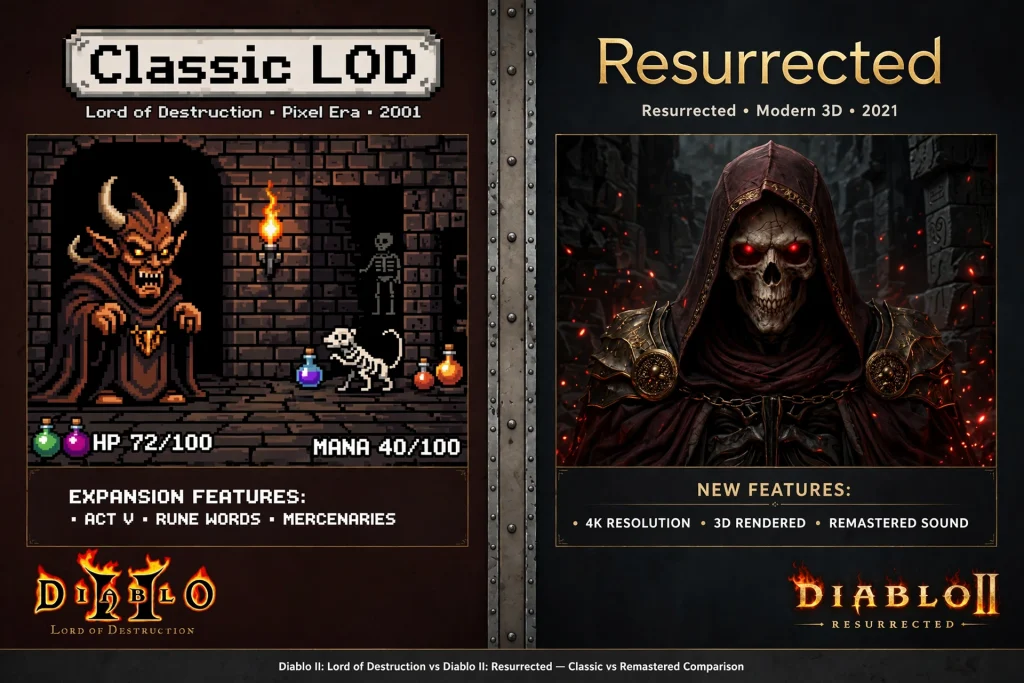
Diablo 2 LOD and Diablo II: Resurrected are related but not identical. Diablo II: Resurrected is Blizzard’s remaster of Diablo II and its Lord of Destruction expansion, released in 2021. It includes the content of the base game and the expansion in a modern package.
The table below summarizes the main differences. Always confirm the latest details on Blizzard’s official pages, since features and compatibility can change.
| Category | Diablo II: Lord of Destruction | Diablo II: Resurrected |
|---|---|---|
| Product identity | Classic 2001 expansion that requires the original Diablo II | Official modern remaster of Diablo II and its Lord of Destruction expansion |
| Visual presentation | Original-era presentation | Remastered presentation |
| Expansion content | Act V, Assassin, Druid and the expansion’s item systems | Includes the base game and LOD content in one remaster |
| Classes | Seven: Amazon, Assassin, Barbarian, Druid, Necromancer, Paladin, Sorceress | The same seven, plus the Warlock if you own Reign of the Warlock |
| Quality-of-life features | Classic feature set, with a stash twice the size of the base game’s | Modern features, including loot filters and extra stash tabs with Reign of the Warlock |
| Compatibility | Check Blizzard’s current install and support guidance | Check Blizzard’s current platform guidance |
| Additional content | Patches such as 1.10 added synergies, ladder seasons and new items | Reign of the Warlock (February 2026) added the Warlock and endgame updates |
Reign of the Warlock is not a Lord of Destruction feature
Reign of the Warlock is a paid DLC for Diablo II: Resurrected, released in February 2026. It adds a new class, the Warlock, along with Terror Zone updates, a new Colossal Ancients fight, reworked difficulty scaling and quality-of-life additions. Blizzard also sells it bundled as Diablo II: Resurrected – Infernal Edition.
None of that belongs to the original Diablo 2 LOD. If a guide mentions the Warlock, loot filters or Colossal Ancients, it is describing Diablo II: Resurrected with the DLC, not the classic expansion.
Mods are a separate category
Community mods are also distinct from the official expansion. For example, Project Diablo 2 is a free, fan-made mod that runs on top of Diablo II: Lord of Destruction and requires you to own the original games. If you want to see how a mod extends Diablo 2 LOD, read our Project Diablo 2 guide.
Can You Still Play Diablo 2 LOD?
Yes, with some conditions. Blizzard’s support site has an article explaining how to install Diablo II and Diablo II: Lord of Destruction outside the Battle.net app, using the original CD keys. The page says the installer sets up version 1.14b and that launching the game and logging in to Battle.net prompts a patch to version 1.14d.
Blizzard also notes that these installers and patches are provided “as is.” Customer Service cannot assist with issues you may encounter, so you may need community resources if something goes wrong. That is an important caveat for anyone planning to rely on the classic version.
Ownership requirements
You need legitimate copies of both Diablo II and Diablo 2 LOD, because the expansion requires the base game. If you have the original CD keys, you can use them with Blizzard’s installers. If you do not, check Blizzard’s official shop for what is currently offered, since availability and pricing change.
For players using discs on a Mac, Blizzard’s support site says that older disc installs use a Classic Environment application that will not install on more recent versions of macOS. In that case, a digital version is needed, and the CD keys can be added to a Battle.net account to download the client. Blizzard also explains that older 16-digit Diablo II keys are upgraded to the 26-character format used for digital downloads.
Compatibility and system requirements
The original 2001 requirements for Diablo 2 LOD on Windows listed a 233 MHz Pentium, 32 MB of RAM and 650 MB of drive space. Those figures describe the original release, not a guarantee of how the game runs on a current operating system. This guide cannot confirm how well the classic game runs on every current version of Windows or macOS, so check Blizzard’s support documentation before you install.
Do not use pirated downloads, cracks or unofficial installers. They are unsafe and violate the game’s terms, and Blizzard’s official route is the only recommended way to install Diablo 2 LOD.
Is Diablo 2 LOD Worth Playing Today?
The answer depends on what you want. Diablo 2 LOD offers deep itemization, flexible character building, a dark atmosphere and a classic action RPG loop. Players who enjoy theorycrafting, farming and long-term goals often find the expansion rewarding.
It also has limits. The interface is dated, storage is tight compared with modern games, and the installation route is a manual process that Blizzard does not support directly. Some players will find those hurdles frustrating, and that is a reasonable reaction rather than a flaw in the player.
Who will enjoy it most? Classic purists, players who want the original presentation and anyone who prefers the older balance may prefer Diablo 2 LOD. Players who want modern conveniences, official platform support and newer content are likely to prefer Diablo II: Resurrected.
If you are curious about the series from the very beginning, our Diablo 1 guide covers the original game and how to play it today. These are subjective preferences, not objective rankings, so choose the version that fits how you like to play.
Frequently Asked Questions About Diablo 2 LOD
What does LOD stand for in Diablo 2?
LOD stands for Lord of Destruction. Diablo 2 LOD is shorthand for Diablo II: Lord of Destruction, the expansion to the original Diablo II.
Is Diablo 2 LOD an expansion or a separate game?
It is an expansion. Diablo 2 LOD requires the original Diablo II to be installed, and it builds on that game rather than replacing it.
What does Lord of Destruction add to Diablo II?
It adds Act V, the Assassin and Druid classes, new items and socketables, a larger private stash, new Horadric Cube recipes, updated mercenaries and more monsters. It also changed how the base game plays.
Which classes were added in Diablo 2 LOD?
Two classes were added: the Assassin and the Druid. They joined the Amazon, Barbarian, Necromancer, Paladin and Sorceress for a total of seven.
Does Diablo 2 LOD include Act V?
Yes. Act V is the expansion’s new campaign, set around Mount Arreat and the town of Harrogath, and it ends with the fight against Baal.
Are runewords part of Diablo 2 LOD?
Yes, runewords are a feature of Diablo 2 LOD as it is played today. Some item systems were expanded by later patches, so check which version a recipe applies to.
Is Diablo 2 LOD the same as Diablo II: Resurrected?
No. Diablo II: Resurrected is a remaster that includes the base game and the expansion’s content. Diablo 2 LOD is the original expansion, and newer additions such as the Warlock belong only to the remaster.
Can you still play the original Diablo 2 LOD?
Yes, if you own legitimate copies. Blizzard’s support site describes how to install Diablo II and Lord of Destruction with the original CD keys, but it says these installers are provided as is and not supported by Customer Service.
Does Lord of Destruction require the original Diablo II?
Yes. Diablo 2 LOD is an expansion and needs a full installation of the original Diablo II to run.
Is Diablo 2 LOD worth playing today?
It can be, especially for fans of classic action RPGs and deep itemization. Players who want modern features and official platform support may prefer Diablo II: Resurrected.
Final Verdict
Diablo 2 LOD is Diablo II: Lord of Destruction, the official expansion that added Act V, the Assassin, the Druid and a broad set of item and character systems. Its biggest contribution was depth: it gave players more ways to build characters and more reasons to keep playing.
The classic expansion still appeals to players who value its atmosphere, its itemization and its original presentation. Diablo 2 LOD remains playable through Blizzard’s installation route, although that route comes with limited support and some compatibility uncertainty.
In short, choose Diablo 2 LOD if you want the original experience, and choose Diablo II: Resurrected if you want the same foundation with modern presentation and newer official content.
Sources and Verification Notes
Sources actually consulted in this session:
- Blizzard Support, “How to Install Diablo II and Diablo II: Lord of Destruction” (installation with original CD keys, versions 1.14b and 1.14d, “as is” support note): https://support.blizzard.com/article/13867
- Blizzard Support, “Classic Environment Not Supported” (older Mac disc installs, digital download, key format): https://support.blizzard.com/en/article/31754
- Blizzard news, “Diablo Now Available on GOG.COM” (states Diablo II and Lord of Destruction were available in the Battle.net Shop at the time of that post): https://news.blizzard.com/en-us/article/22887361/diablo-now-available-on-gog-com
- Diablo II: Resurrected product listing on Nintendo’s site, reproducing Blizzard’s description of the Infernal Edition and Reign of the Warlock: https://www.nintendo.com/en-gb/Games/Nintendo-Switch-games/Game-2042555.html
- Wikipedia, “Diablo II: Lord of Destruction” (expansion identity, Blizzard North, features, six Act V quests): https://en.wikipedia.org/wiki/Diablo_II:_Lord_of_Destruction
- Giant Bomb, “Diablo II: Lord of Destruction” (story premise, items, mercenaries, patch 1.10 additions): https://www.giantbomb.com/games/3030-15589/
- Macworld, “Diablo II: Lord of Destruction goes gold” (2001 release information, expansion requires Diablo II, stash size, monster counts): https://www.macworld.com/article/161778/diablo2-5.html
- Neowin, “Diablo II 1.10 Patch” (patch 1.10 released October 28, 2003): https://www.neowin.net/news/diablo-ii-110-patch
- MobyGames, “Diablo II: Lord of Destruction” (premise and patch history): https://www.mobygames.com/game/4451/
- RPGamer review archive (period review commentary on classes and network lag): https://archive.rpgamer.com/games/diablo/diablo2/reviews/diablo2xrdrev1.html
- Press Start AU and GamesMarket coverage of Reign of the Warlock (February 2026 release, Warlock, loot filters, Terror Zones): https://press-start.com.au/news/2026/02/12/diablo-is-adding-warlock-to-all-current-titles/ and https://www.gamesmarket.global/diablo-ii-resurrected-reign-of-the-warlock/
- GamesPuma, Project Diablo 2 guide (internal link check and mod description): https://gamespuma.com/project-diablo-2/
- Search-result excerpts of the Arreat Summit’s patch 1.10 notes (skill synergies): https://classic.battle.net/diablo2exp/beta/patchchanges.shtml

Written by Daniel Carter
Daniel Carter is a dedicated gaming writer who enjoys turning complex gaming topics into clear, useful, and engaging content. He covers game guides, tips, reviews, features, and the latest developments across the gaming world. His approach focuses on research, accuracy, and practical value, helping readers discover new games, improve their gameplay, and stay informed about the industry. For Daniel, great gaming content is not just about information—it is about making every article genuinely worth reading.