
If you’re searching for path of exile help, you’re probably stuck on something — a weak character, a confusing skill tree, resistances that won’t cooperate, or simply not knowing where to start. This guide covers the most important sources of Path of Exile help, plus practical, step-by-step solutions for the problems that send most players searching in the first place.
This article focuses on the original Path of Exile help (often shortened to PoE), currently running its 3.29 Curse of the Allflame league. A dedicated section further down explains exactly how Path of Exile 2 differs, so you can tell which game your problem actually belongs to.
Table of Contents
What Does “Path of Exile Help” Actually Cover?
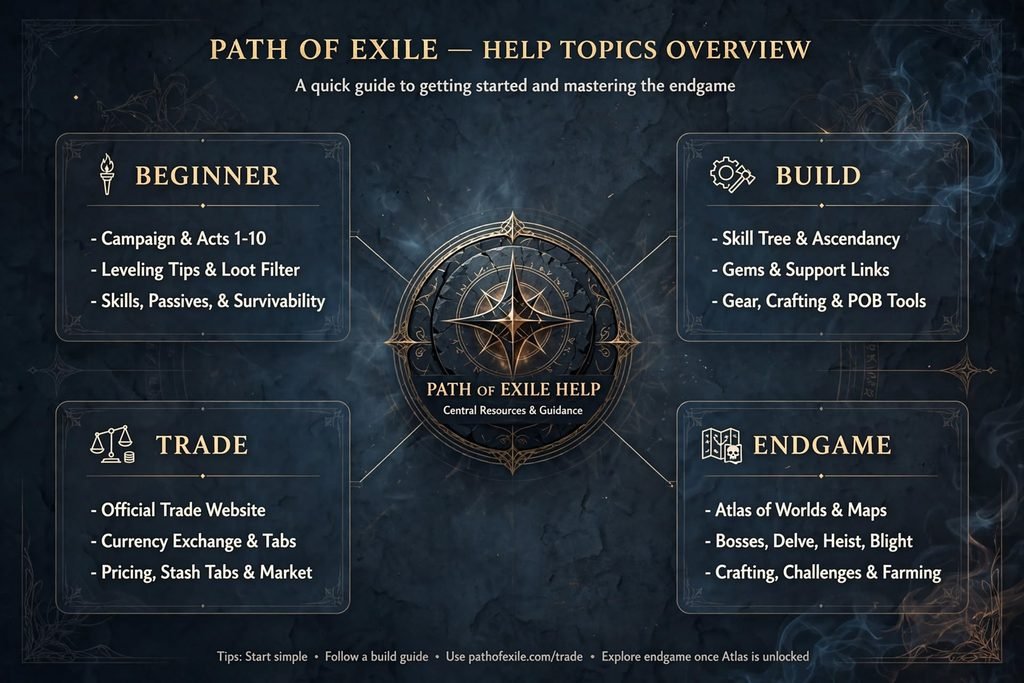
Path of Exile help spans a wide range of topics because the game itself is unusually deep. When people search for it, they’re typically looking for one of a few things:
- Beginner orientation — understanding classes, skills, and the passive tree for the first time
- Build troubleshooting — a character that feels weak, dies too often, or can’t clear content
- Gear and crafting guidance — knowing whether an item is good and how to improve it
- Trading help — using the official trade site to buy and sell
- Endgame and map help — understanding the Atlas once the campaign ends
- Technical support — client crashes, connection issues, or account problems
Below, each of these is covered in enough depth to actually solve the problem, not just describe it.
Where to Get Path of Exile Help
How do I get help in Path of Exile? Start with the official Grinding Gear Games resources, then use trusted community tools for anything the official channels don’t cover in depth.
Official sources:
- The official Path of Exile Help and Information forum, where Grinding Gear Games staff and experienced players answer gameplay and account questions
- The official support portal for account, purchase, and technical issues
- Patch notes, published on the official site for every league and balance update — the single best source for what has actually changed
- The in-game
/verifycommand, which generates a verification code so a support ticket can be tied to your account
Community sources worth trusting:
- The Path of Exile Wiki, maintained by the community and cross-referenced against game data
- Established build-guide sites that update every league (rather than leaving old information live)
- poe.ninja, for checking current item and currency prices and popular builds
- The official Discord and subreddit, useful for quick, specific questions
Use official sources first for anything related to your account, purchases, or confirmed mechanics. Use community resources for build advice, pricing, and anything that changes too often for a static help page to track.
Read More: https://gamespuma.com/poe-2-builds/
Path of Exile Help for Beginners
If you’re new, the game front-loads a lot of unfamiliar systems. Here’s the fundamental vocabulary and how the pieces fit together.
Classes. Path of Exile has seven classes (Marauder, Duelist, Ranger, Shadow, Witch, Templar, Scion). Unlike many RPGs, a class does not lock you into specific skills — any class can use almost any skill gem. What a class actually determines is your starting position on the passive skill tree and which Ascendancy subclasses you can access.
Skills and support gems. Active skills come from skill gems you socket into your gear. Support gems modify those skills — adding damage types, extra effects, or altered behavior — when linked to them in the same item. As of the current 3.29 league, Grinding Gear Games removed the requirement to match socket colors: any gem now fits any socket on an item, and only matching the item’s remaining socket color grants a small quality bonus. This is a major simplification compared to older guides, so if you’ve read that you need specific colored sockets to link gems, that information is outdated.
Attributes. Strength, Dexterity, and Intelligence each unlock skills and passive nodes gated behind them, and Strength additionally boosts life.
Life, energy shield, and mana. Life is your primary health pool. Energy shield is a secondary pool that depletes before life on many builds and regenerates over time. Mana powers most active skills.
Resistances. Fire, Cold, Lightning, and Chaos resistance reduce incoming damage of that type. This is one of the single most important stats in the entire game — more on this below.
Flasks. Consumable items that recover life or mana, or grant temporary buffs, refilled by killing monsters.
Currency. Path of Exile has no traditional gold. Items like the Chaos Orb and Divine Orb function as currency, are used to modify equipment, and are the backbone of trading.
Stash. Your account-wide item storage, expandable with additional stash tabs.
New players should focus on following one clear leveling build for their first character rather than improvising, since it removes most of the early guesswork around skills and the passive tree.
How to Build a Strong Character (Diagnosing a Weak Build)
How do I fix a weak character? Check these three areas in order: damage, defense, and passive tree efficiency. Most “my character is bad” problems trace back to one of these.
Damage. Confirm your main skill is actually being supported correctly — every support gem linked to it should meaningfully boost that skill’s damage type, not a different one. Check that your weapon or spell scaling matches your skill (a build that scales off spell damage gets little benefit from a big physical weapon, for example). Make sure your skill gems are leveled up, not left at a low level from earlier in the campaign.
Defense. A character that dies constantly is rarely a damage problem — it’s a defense problem. Review life or energy shield totals for your level, whether all four resistances are reasonably capped, and whether you have any recovery (life regeneration, leech, or flask uptime) to survive sustained damage.
Passive tree. Look for wasted pathing (nodes you took just to reach something else, with no real benefit), missing life or defensive clusters near your path, and whether you’ve met the attribute requirements for your gear and gems without over-investing.
There is no single “best” build in Path of Exile — different skills and playstyles trade off clear speed, single-target damage, survivability, and cost. A build that’s well-optimized for its own goals will always outperform a “meta” build played incorrectly.
Understanding the Passive Skill Tree
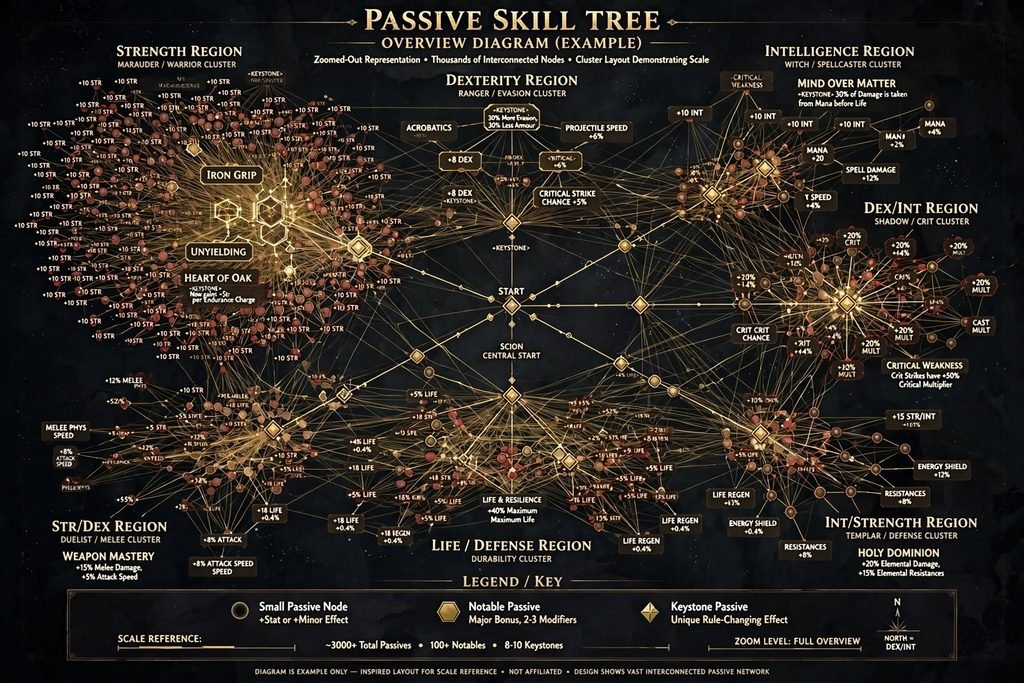
How do I understand the passive skill tree? Treat it as a map you navigate toward specific destinations, not something to fill in randomly.
- Identify 2–3 major clusters your build needs (life nodes, a damage cluster relevant to your skill, and any keystone that defines the build).
- Path toward the nearest cluster first, picking up small life or attribute nodes along the way rather than skipping them.
- Avoid taking a node purely because it’s “on the way” if it offers nothing your build uses — extra pathing costs points you could spend elsewhere.
- Recheck your tree after major level milestones. What made sense at level 20 may need adjusting by level 60.
If the tree feels overwhelming, following a published build’s passive tree order for your first few characters is the fastest way to learn it without redesigning from scratch.
Choosing Skills and Support Gems
Pick a main skill that fits the damage type and playstyle you enjoy (melee, ranged, minions, or spells), then support it with gems that amplify what it already does well rather than gems chosen at random. A common beginner mistake is linking supports that increase mana cost or add effects the build doesn’t need, which weakens the skill instead of strengthening it. Keep a secondary skill on hand for situations your main skill handles poorly — for example, a fast single-target option if your main skill is better at clearing groups of monsters.
Improving Your Gear
How do I know what gear to use? Prioritize survivability first, then damage.
When evaluating any item, check:
- Resistances — does it help close a gap in your fire, cold, lightning, or chaos resistance?
- Life or energy shield — does it add to your core health pool?
- Relevant damage modifiers — does it boost the damage type and skill category your build actually uses?
- Attributes — does it help meet a requirement you’re currently short on?
- Sockets and links — can you fit your skill and its supports into this item?
Rare items usually offer the most customizable stat combinations, while unique items often provide a specific, powerful effect that can define an entire build around it. Neither is automatically better — it depends on whether the unique’s effect fits your build and whether a rare item can match its stats elsewhere. When two items are close, favor the one that fixes your weakest current stat (usually a missing resistance) over one that adds more of a stat you already have plenty of.
Fixing Resistances and Survivability
How do I fix low resistances in PoE? This is one of the most common reasons a character suddenly starts dying. Elemental damage in Path of Exile scales up significantly as you progress, and uncapped resistances let that damage through almost unmitigated.
Practical steps:
- Open your character screen and check all four resistance values.
- Identify which resistance is lowest or negative, and prioritize gear or crafting that raises it first.
- Remember that chaos resistance behaves differently from the elemental resistances for many builds and is often lower by design — don’t panic if it lags behind the others early on.
- If you’re respeccing or replacing several items at once, replace one at a time and recheck resistances after each swap, since losing one resistance-heavy item can suddenly leave you exposed.
Beyond resistances, survivability also depends on your life or energy shield pool, your armour or evasion rating, and any recovery you have through regeneration, leech, or flasks. A character with capped resistances but a low life pool is still fragile — treat these as a checklist, not a single fix.
Leveling and Campaign Help
How do I level efficiently? Follow the story quests in order, upgrade your main skill gem whenever a higher-level version becomes available, and don’t skip vendor recipes or quest rewards that offer resistance or life items — they’re often the fastest way to patch early gaps before you can trade effectively.
A few practical leveling habits:
- Replace weapons regularly during the campaign; early weapon damage scales quickly between acts.
- Keep flasks filled with a mix of life recovery and a utility effect (like removing status ailments).
- Re-check your passive tree every few levels rather than only at the end of an act.
- If a boss fight feels impossible, it’s almost always a gear or resistance problem rather than a “skill issue” — pause and check your character screen before retrying repeatedly.
Avoid following very old leveling routes without checking they still match the current campaign structure, since acts and zones are occasionally adjusted between major updates.
Currency and Trading Help
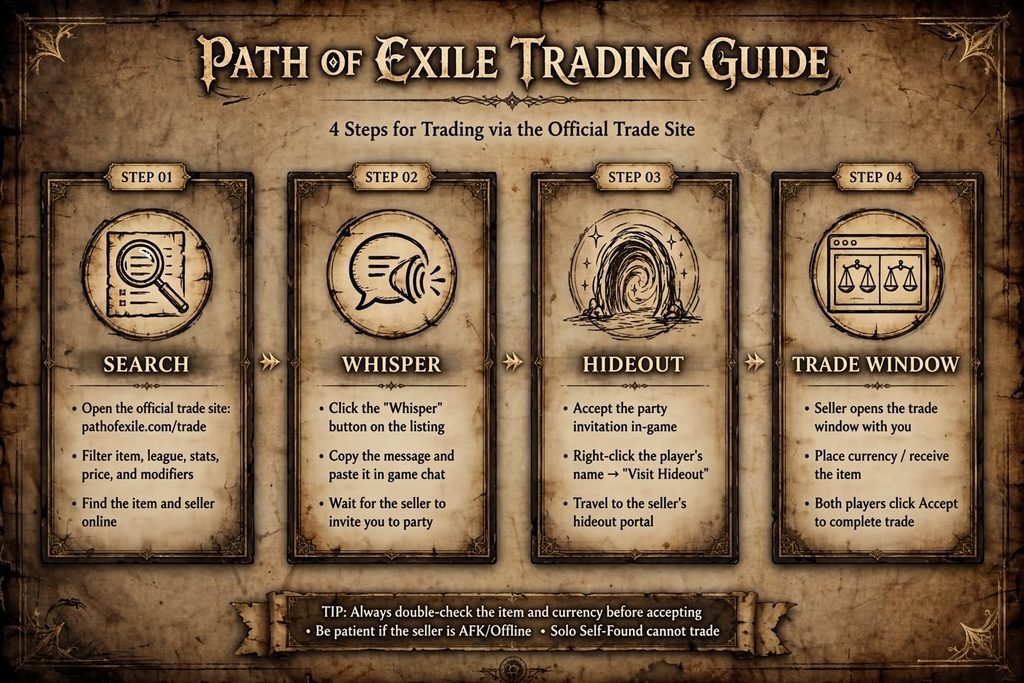
How does PoE trading work? Path of Exile has no in-game auction house. Instead, players list items through their stash, and the official trade site indexes those listings for anyone to search.
Basic trading steps:
- Go to the official trade site linked from pathofexile.com/trade.
- Search for the item or stats you need using the filter system.
- Use the site’s built-in “whisper” feature to message the seller directly in-game.
- Meet in the seller’s hideout (or invite them to yours) and complete the trade through the in-game trade window.
- Always verify the item’s exact stats in the trade window before confirming — don’t rely only on what was listed.
Common trading mistakes: offering less than a fairly priced listing without acknowledging it, not verifying the item still matches what was searched, and forgetting that players in Solo Self-Found leagues cannot trade at all. Basic trade etiquette — replying promptly, honoring the listed price unless negotiating openly, and not wasting a seller’s time — goes a long way in a player-driven economy.
Crafting Help
Crafting in Path of Exile means using currency items to add, remove, or reroll the modifiers (affixes) on an item, rather than assembling gear from raw materials. Common currency used for crafting includes orbs that add a random modifier, reroll all modifiers, or change an item’s rarity.
For beginners, a simple decision rule helps: craft when you have currency to spend and can’t find the exact item you need on the trade site; buy when a close-enough item is already cheaply available. Early on, buying is almost always faster and cheaper than crafting from scratch, since crafting good items usually requires currency and knowledge that build up with experience. As you learn specific crafting methods for your build, you can start crafting upgrades other players haven’t already made available.
Maps and Endgame Help
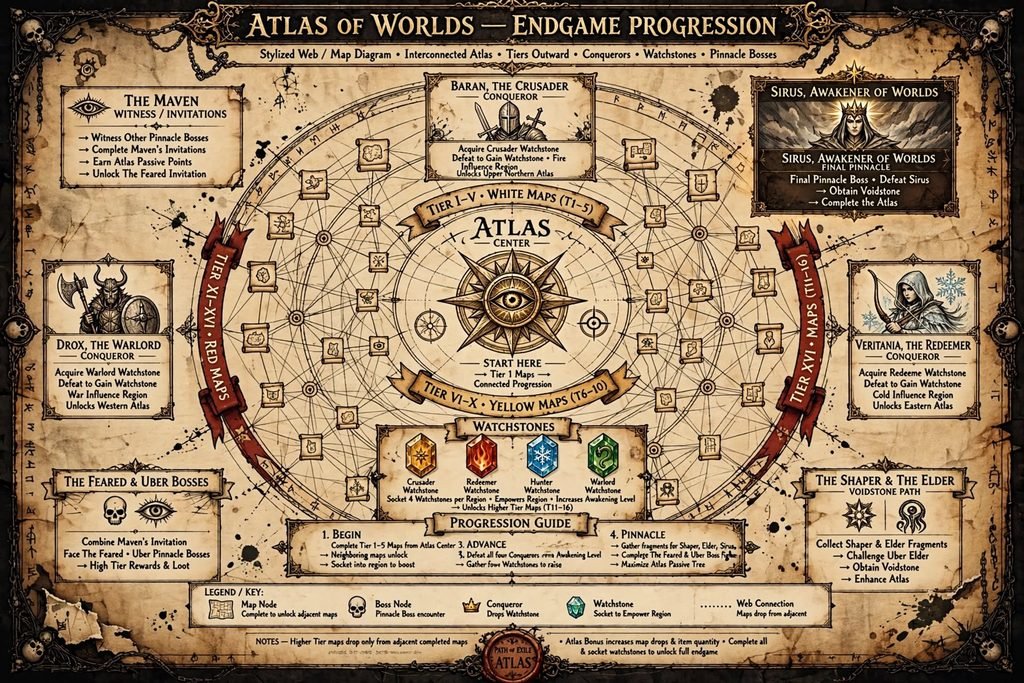
Once the campaign ends, Path of Exile shifts into its endgame, built around the Atlas — a large web of maps you unlock and upgrade. Each map is a self-contained level with its own layout, monsters, and optional modifiers that increase difficulty and rewards.
Endgame help essentials:
- Progress the Atlas gradually; jumping to high-difficulty maps before your character can handle them is the most common cause of frustration at this stage.
- Treat map modifiers as a difficulty and reward slider — added modifiers increase risk, so only add them once your character’s damage and defenses can handle the increase.
- Continue checking resistances and life totals as you push into harder maps; endgame monsters hit significantly harder than campaign monsters.
- Use currency earned from maps to fund gear upgrades rather than hoarding it, since better gear is what allows progression into harder content.
Common Path of Exile Problems and Solutions
| Problem | Likely Cause | Fix |
|---|---|---|
| Character feels weak overall | Damage and defense not scaled with the passive tree | Recheck main skill supports and nearby tree clusters |
| Dying too quickly | Uncapped resistances or low life/ES | Prioritize resistance and life gear immediately |
| Low damage | Wrong supports or under-leveled gems | Re-link supports; level up skill gems |
| Confusing gear upgrades | Comparing too many stats at once | Fix your worst stat (usually resistance) first |
| Can’t progress the campaign | Gear or resistance gap for the current act | Check character screen before repeating the fight |
| Maps feel too difficult | Progressing the Atlas too quickly | Slow down modifier difficulty until gear catches up |
| Trade messages go unanswered | Common with underpriced or highly specific listings | Try a slightly different price or check if the seller is offline |
| Game performance issues | Client or hardware related, not a build problem | Check official technical support resources first |
For anything not covered above — including account access, purchases, or suspected bugs — go directly to official support rather than guessing at a fix, since those categories often require account-specific verification.
Useful Path of Exile Tools and Resources
Beyond official channels, a small set of long-maintained community tools cover most remaining help needs:
- Path of Exile Wiki — mechanics reference and item data
- poe.ninja — current currency exchange rates and build popularity data
- Community build-guide hubs — full leveling and endgame builds updated each league
- In-game
/verifycommand — for generating a support verification code
Treat any third-party tool as a convenience layer on top of the official trade site and patch notes, not a replacement for them, since third-party sites can lag behind after a major update.
Path of Exile vs Path of Exile 2: What’s Different?
Is Path of Exile 2 the same as Path of Exile? No. They are two separate games from Grinding Gear Games that currently run in parallel.
- Path of Exile (PoE1) is the original, fully released game, currently on its 3.29 Curse of the Allflame league.
- Path of Exile 2 launched into early access in December 2024 and is still being actively built out, with its full 1.0 release scheduled for December 11, 2026. It uses a reworked combat and skill system, a different campaign, and its own separate trade site.
- Trading is handled on separate official sites for each game: pathofexile.com/trade for PoE1, and pathofexile.com/trade2 for PoE2.
- Progress, currency, and characters do not carry over between the two games — they are independent economies and separate accounts data within the same platform.
- If a guide or forum thread doesn’t clearly say which game it’s discussing, check for terminology clues (Ascendancy structure, campaign act names, or specific skill names) before applying its advice, since mechanics that work in one game frequently don’t apply to the other.
If most of your questions are about builds, trading, or the passive tree as described in this article, you’re almost certainly looking for PoE1 help. If you’re playing the newer, early-access title with a different campaign and combat feel, search specifically for “Path of Exile 2” help instead, since the two games’ communities and resources are largely separate.
Final Tips
- Fix defense before chasing more damage — a dead character deals zero damage.
- Check patch notes every league; mechanics you learned previously can change, as the 3.29 socket-color removal shows.
- Use the official trade site and Wiki as your baseline truth, and treat community guides as supplementary.
- Follow one build to completion before improvising your own, especially for your first few characters.
- When stuck, work through the problem in order: resistances, life/ES, damage supports, then passive tree — most issues live in that sequence.
Path of Exile rewards patience with its systems more than raw reflexes. Getting comfortable with resistances, the passive tree, and the trade site solves the overwhelming majority of problems players search for help with.
FAQ
How do I get help in Path of Exile? Start with the official Help and Information forum and support portal, then use the Path of Exile Wiki and community build guides for anything mechanics-related that changes often.
Is Path of Exile difficult for beginners? Yes, relative to most action RPGs — the passive tree, resistances, and trading system all require some upfront learning. Following a published leveling build for your first character significantly flattens that learning curve.
How do I improve my PoE character? Check resistances and life or energy shield first, then confirm your skill’s support gems match its damage type, then review your passive tree for wasted pathing.
How do I know what gear to use? Prioritize items that fix your weakest resistance or add life, then look at damage modifiers relevant to your specific skill.
How do I fix low resistances in PoE? Identify your lowest resistance on the character screen and prioritize gear, crafting, or flasks that raise it before chasing any other upgrade.
How do I improve my damage? Confirm your main skill is linked to supports that boost its actual damage type, level up your skill gems, and check that your passive tree includes damage nodes relevant to that skill.
Where can I find Path of Exile builds? Established, regularly updated build-guide sites and the official forums are the most reliable sources; check that a guide has been updated for the current league before following it.
How does PoE trading work? Players list items through their stash, and the official trade site indexes those listings so buyers can search, whisper sellers, and complete trades in-game.
Where can I find the official PoE trade site? At pathofexile.com/trade for the original game, and pathofexile.com/trade2 for Path of Exile 2.
What is the best way to learn Path of Exile? Follow one complete leveling build through your first character, use the official Wiki for anything confusing, and fix resistances and life before optimizing anything else.
Is Path of Exile 2 the same as Path of Exile? No — they’re separate games with separate campaigns, systems, and trade sites, running in parallel from the same developer.
Sources Used
- Official Path of Exile Help and Information forum (pathofexile.com)
- Official Path of Exile news page (pathofexile.com)
- Official Path of Exile 2 support page (pathofexile2.com)
- Path of Exile Wiki trade guide (poewiki.net)
- PoE Vault beginner guide (poe-vault.com)
- League and patch tracking pages (arpg-timeline.com, seasondex.com, ggseason.com)
- Path of Exile 2 trade explainer (pcgamesn.com)

Written by Daniel Carter
Daniel Carter is a dedicated gaming writer who enjoys turning complex gaming topics into clear, useful, and engaging content. He covers game guides, tips, reviews, features, and the latest developments across the gaming world. His approach focuses on research, accuracy, and practical value, helping readers discover new games, improve their gameplay, and stay informed about the industry. For Daniel, great gaming content is not just about information—it is about making every article genuinely worth reading.
1 thought on “Path of Exile Help: Complete Guide for Beginners and Struggling Players”