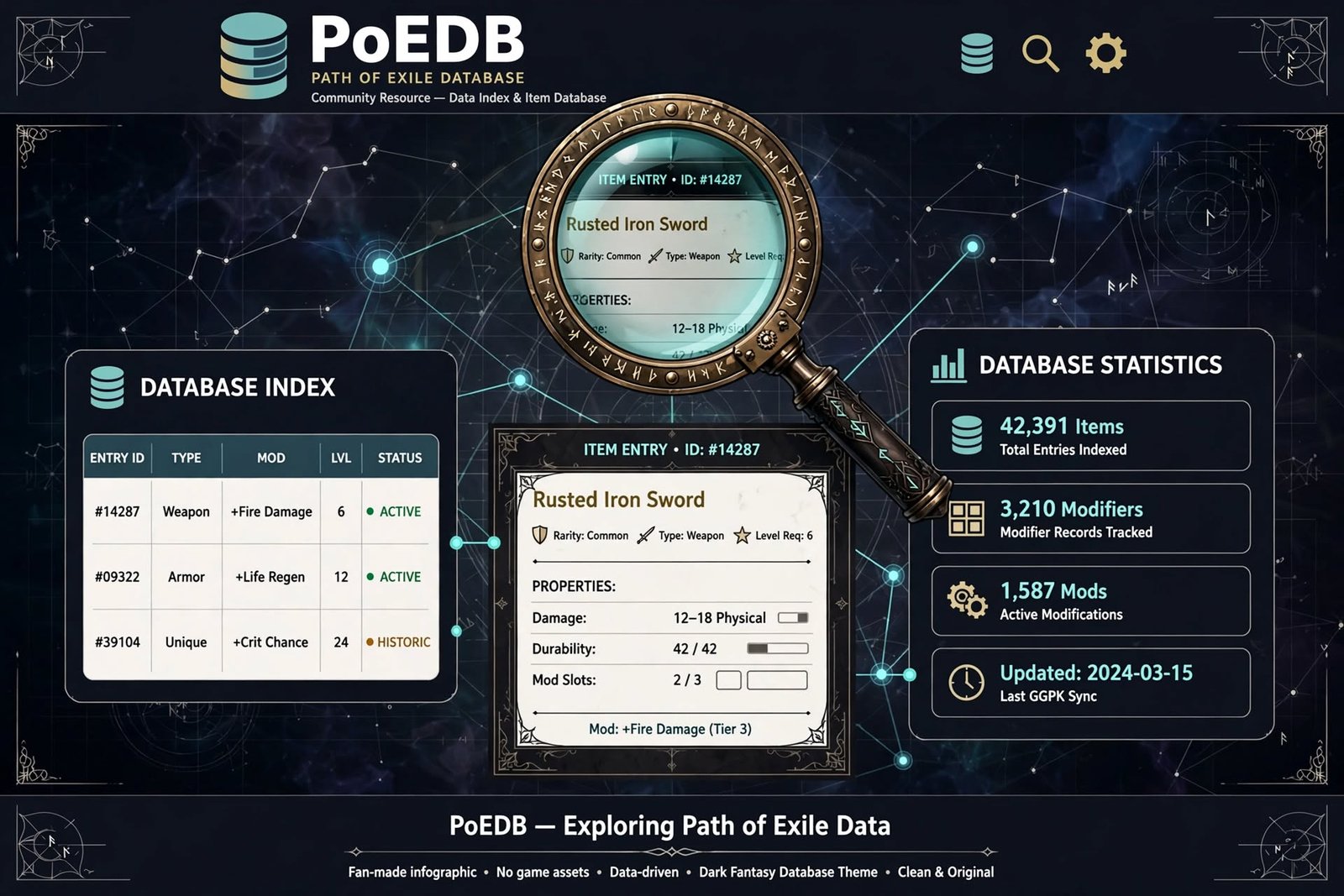
If you’ve spent any time deep in a Path of Exile build guide, a crafting thread, or a Discord conversation about item modifiers, you’ve probably run into a link to poedb. It’s one of those tools that experienced players treat as second nature and newer players stumble across without much explanation. This guide covers exactly what poedb is, what it can do for you, how it differs between Path of Exile and Path of Exile 2, and how to actually get useful answers out of it.
In short: PoEDB is a free, community-built database that pulls information directly from the Path of Exile game files, covering items, modifiers, skill gems, monsters, maps, and mechanics in far more raw detail than the average wiki article. It isn’t an official Grinding Gear Games product, but it’s widely used because the data comes straight from datamining the client rather than being written by hand.
Table of Contents
What Is PoEDB?
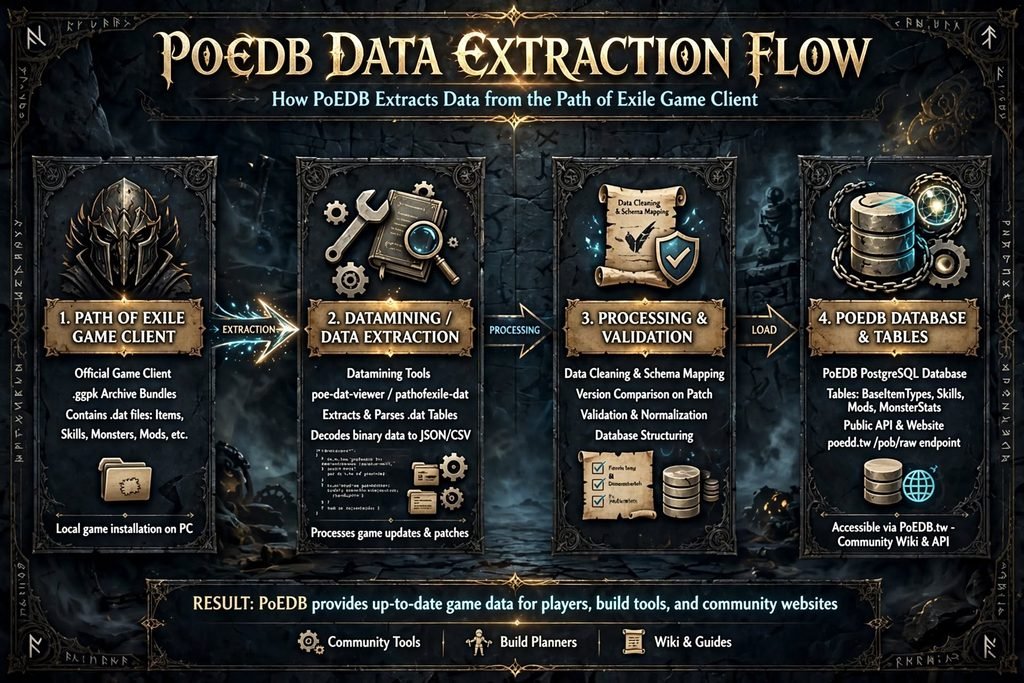
PoEDB is a searchable, wiki-style website that presents datamined Path of Exile information in structured tables rather than prose. Instead of reading a paragraph describing an item, you look up the item and see its exact numeric ranges, tiers, requirements, and related entries laid out as data.
A few things define what PoEDB actually is:
- It’s data-first, not narrative-first. Where a traditional wiki explains a mechanic in sentences, PoEDB shows you the raw tables — modifier weights, tiers, ilvl requirements, stat ranges — the way the game engine itself stores them.
- It’s maintained by the community, not by Grinding Gear Games. The site’s own disclaimer states plainly that the wiki-system is community-maintained, even though the underlying content is naturally affiliated with Grinding Gear Games’ game and intellectual property.
- It updates through datamining. When a patch lands, the site’s maintainers extract the new game files and republish the tables, which is why the numbers tend to be very precise but can occasionally lag a few hours or days behind a brand-new patch.
- It requires no account, download, or installation. You open it in a browser like any other website and start searching.
Who actually uses it? Mostly players who’ve moved past “just play the game” and into optimization: crafters checking which modifiers a base can roll, build theorycrafters comparing gem scaling at different levels, and anyone trying to verify a claim they saw in a guide against the actual game data.
PoEDB vs PoE2DB — Two Separate Databases
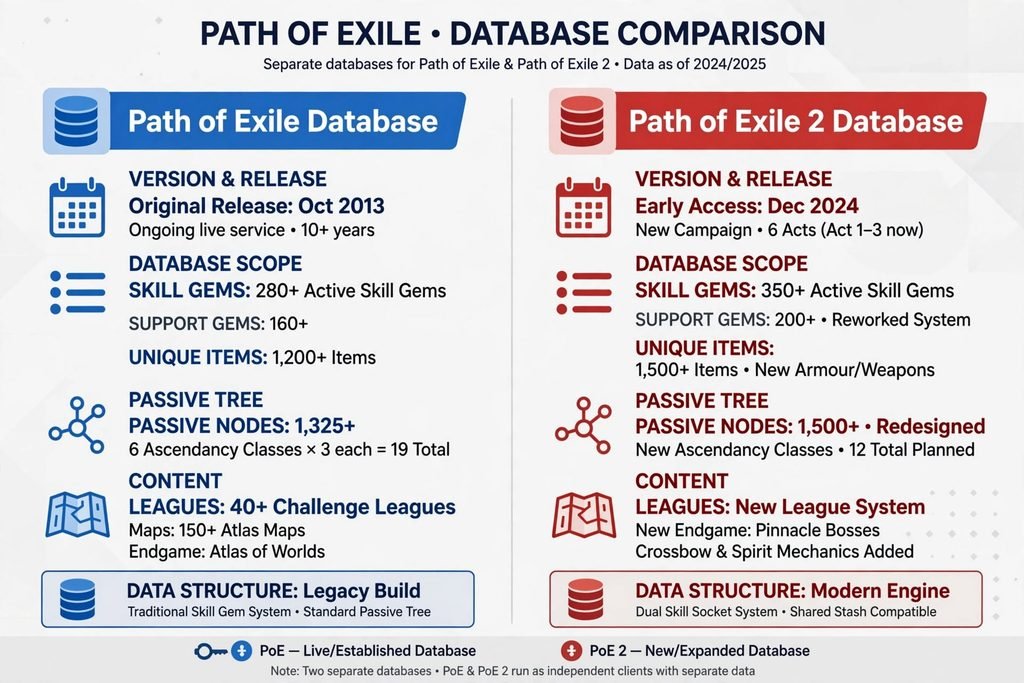
This is one of the most important things to understand before you go searching, because it trips up a lot of people: PoEDB for the original Path of Exile and the database for Path of Exile 2 are hosted as two separate sites. The Path of Exile 1 database lives on the .tw domain associated with “poedb,” while Path of Exile 2 has its own dedicated equivalent site with a similar name and layout but a different address and a different underlying dataset.
Why does this matter?
- Path of Exile 1 and Path of Exile 2 are different games with different item systems, different skill-gem structures, different passive trees, and different crafting mechanics. A modifier that exists in one game may not exist, or may work completely differently, in the other.
- Searching the wrong database gives you wrong answers. If you’re playing Path of Exile 2 and you search a term on the Path of Exile 1 database (or vice versa), you may get a page for a similarly named but mechanically unrelated item, gem, or modifier.
- The two sites share a visual style and navigation pattern (top navigation for Items, Gems, Modifiers, Quests, and so on), which is convenient once you know which one you’re on, but can create confusion if you land on the wrong one from a search engine result.
Practical rule of thumb: if you’re playing original Path of Exile, you want the “poedb” site. If you’re playing Path of Exile 2, you want the Path of Exile 2–specific equivalent (commonly referred to as “poe2db” or “PoE2DB” in community shorthand). Always check which game’s logo and navigation you’re looking at before trusting a number.
What Can You Find on PoEDB?
PoEDB’s coverage is broad. Based on the site’s own navigation and the categories it exposes, here’s what’s realistically available:
- Items — name, icon, base item level, possible modifiers with tiers and ranges, and how the item changed across patches.
- Unique items — full stat lines, flavor text, and acquisition context where documented.
- Skill gems and support gems — per-level stats, quality bonuses, attribute and level requirements, and gem tags (the keywords that determine which supports can interact with a skill).
- Modifiers, prefixes, and suffixes — which item types a modifier can roll on, its tiers, its required item level, and which crafting methods can produce it.
- The passive skill tree — node data, keystones, and notable passives.
- Monsters — stats such as life, resistances, and damage, along with known drops and specific attacks.
- Maps and areas — associated monsters, layout information, and league-mechanic tie-ins for a given zone.
- League and mechanic information — data tied to specific game systems and expansions as they’re datamined.
Every entry tends to be cross-linked. An item page links to the monsters that drop it; a monster page links to the map it spawns in; a gem page links to related support gems. That interconnected structure is one of PoEDB’s biggest practical strengths — you rarely have to leave the site to follow a thread of research.
Read More: https://gamespuma.com/poe-wiki/
How to Use PoEDB
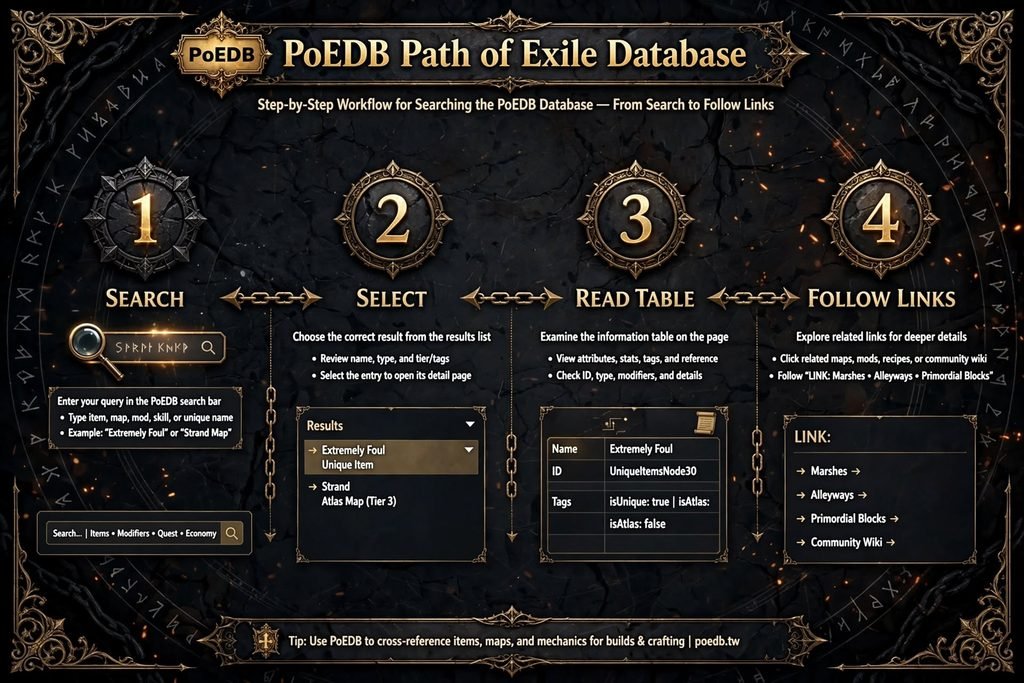
You don’t need an account or any setup. Here’s a simple, repeatable way to get answers fast:
- Open the correct site for your game. Confirm you’re on the Path of Exile 1 database if you play PoE1, or the Path of Exile 2 database if you play PoE2.
- Use the search bar at the top of the page. Type the specific thing you want — an item name, a gem name, a monster name, or a mechanic keyword.
- Pick the matching result. Search suggestions typically show the entity type (item, gem, monster, modifier) next to the name, so you can confirm you’ve picked the right category before clicking through.
- Read the table, not just the headline stat. Most pages show ranges, tiers, and requirements rather than a single number — the “best possible roll” is usually near the bottom or the highest tier row.
- Follow the internal links. If you’re looking at an item and want to know where it drops, click through to the linked monster or map page rather than searching again from scratch.
- Cross-check anything patch-sensitive. If a mechanic feels off compared to what you remember, check the page’s version history section or compare against recent official patch notes before assuming the site is wrong.
This workflow covers the majority of real use cases: “what does this item actually do,” “what can this modifier roll on,” and “what does this monster hit for.”
PoEDB for Item Research
Item research is probably the single most common reason players open PoEDB. A few realistic scenarios:
- Checking a unique item before committing currency to it. Instead of trusting a screenshot from a forum post (which might be an old or bugged version), you can pull the current stat line directly.
- Verifying a rare item’s modifier pool. If you’re evaluating whether a rare item you found (or are considering crafting) can roll a specific combination of stats, the item’s base-type page will show which prefixes and suffixes are actually possible on it.
- Confirming base requirements. Level, attribute, and class requirements for a base item are listed plainly, which matters when you’re deciding whether an item is even usable by your current character.
- Comparing tiers. Since modifiers are shown with their full tier list, you can see exactly how far a given roll is from the theoretical maximum, which is far more precise than eyeballing it in-game.
Because none of this is invented — it’s the exact data the game engine uses — PoEDB tends to be more reliable for numeric questions than secondhand guide text, which can go stale after balance patches.
PoEDB for Crafting
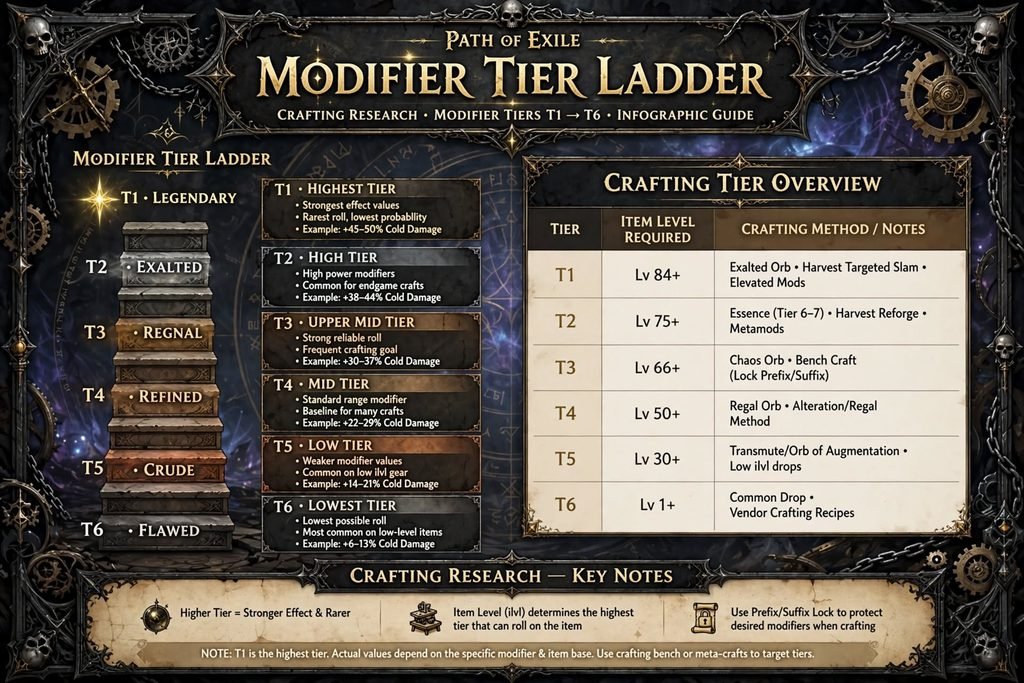
Crafting in Path of Exile lives and dies by modifier pools, weights, and tiers — exactly the kind of information PoEDB is built to expose. When you’re planning a craft, the database can help you:
- Check which prefixes and suffixes are eligible on the specific base type you’re using.
- See required item levels for higher tiers, so you know whether your base needs to be upgraded before a top-tier modifier can even appear.
- Understand mod pool overlap, which matters when a crafting method (like using an essence, a fossil, or a bench craft) restricts or boosts specific modifier groups.
- Sanity-check “is this combination even possible” before spending currency — a surprising number of failed crafts come from trying to combine two modifiers that occupy the same prefix or suffix slot, or that simply can’t coexist on that base.
PoEDB doesn’t run crafting simulations for you the way a dedicated crafting calculator might, but it gives you the raw modifier data those calculators are themselves built on — so understanding it makes you better at reading any crafting tool you use.
PoEDB for Skills, Gems, and Build Planning
Build planning depends on precise gem scaling, and this is another area where PoEDB’s raw-table approach pays off:
- Per-level gem stats — how a skill’s damage, area, duration, or other scaling numbers change as the gem levels up.
- Support gem requirements and interactions — which gem tags a support gem needs to affect a skill, so you can tell in advance whether a support will actually apply.
- Quality bonuses — what a gem gains from quality, since this varies enormously between gems and is easy to get wrong from memory.
- Attribute and level requirements — useful when a build is trying to stay within reach of a particular class or attribute allocation.
For deeper build planning — actually simulating total DPS, defenses, and passive tree pathing — most players pair PoEDB’s raw data with a dedicated build-planning tool. PoEDB answers “what does this gem/item/modifier actually do,” while a build planner answers “what happens when I combine all of these together.”
PoEDB and Path of Exile 2
Path of Exile 2 has its own dedicated database, separate from the original Path of Exile site, reflecting the fact that it’s a different game with a different itemization and skill system. As of this writing, Path of Exile 2 is still in its early access period, with Grinding Gear Games continuing to release content updates and challenge leagues on that branch of the game.
A few things worth knowing about PoE2 coverage specifically:
- Terminology differs. Path of Exile 2 introduces mechanics like waystones (instead of PoE1’s maps) and a reworked passive and skill-gem structure, and the database reflects those PoE2-specific names rather than PoE1 terms.
- Because the game is still in active early access, expect more frequent data changes than you’d see on the more mature Path of Exile 1 side, simply because balance and itemization are still being iterated on.
- Don’t assume a modifier, keystone, or mechanic works the same way it does in Path of Exile 1. Even when the name looks familiar, always check the Path of Exile 2–specific page rather than relying on PoE1 knowledge.
If you swap between the two games, it’s worth bookmarking both database sites separately rather than trying to use one for both — the underlying data genuinely isn’t interchangeable.
PoEDB vs Other Path of Exile Resources
PoEDB isn’t trying to be everything, and it helps to understand what it’s for versus other well-known tools in the ecosystem:
- Official Path of Exile resources (Grinding Gear Games’ own site and patch notes) are the authoritative source for intended mechanics, official announcements, and confirmed balance changes. PoEDB reflects what’s in the game files, which is usually consistent with official information but is not itself an official communication channel.
- Build-planning tools are designed around simulating a full character — passive tree, gear, and skill combination — rather than presenting raw per-item or per-gem data. They often pull from datamined sources similar to what PoEDB exposes.
- Economy and market-tracking tools focus on prices, trends, and what other players are trading — a different job entirely from looking up an item’s possible stat rolls.
- The official trade site is for actually buying and selling items, not for researching what modifiers exist or how they’re weighted.
None of these tools replaces PoEDB, and PoEDB doesn’t replace them. A typical research session might involve checking a modifier on PoEDB, then plugging what you learned into a build planner, then checking prices on a market tool before finally buying on the trade site.
Is PoEDB Official?
No. Based on the site’s own general disclaimer, PoEDB explicitly describes itself as a community-maintained wiki system, distinct from Grinding Gear Games itself, even though the game content it documents is naturally the intellectual property of Grinding Gear Games. In other words:
- Grinding Gear Games develops Path of Exile and Path of Exile 2 and owns all associated copyrights and trademarks.
- PoEDB is a third-party, fan-run project that extracts and republishes information from the game’s files. It is not run by, and does not speak officially for, Grinding Gear Games.
This distinction matters when you’re deciding what to trust as “the official word” on a controversial balance question versus what to trust as “an accurate technical reference.” For raw numbers, PoEDB is generally very reliable because it comes from the game’s own files. For statements about developer intent, roadmap, or upcoming changes, you should rely on Grinding Gear Games’ own announcements and patch notes instead.
PoEDB Accuracy and Limitations
PoEDB earns trust because its data comes from datamining rather than manual guesswork, but that doesn’t make it flawless. Keep these limitations in mind:
- Patch lag. Immediately after a new patch or league launch, there can be a short delay before every page reflects the latest numbers, since the maintainers need to re-extract and re-publish updated game files.
- Technical presentation. The site is described even by enthusiastic users as more of a technical manual than a tutorial — it shows you the data, but doesn’t always explain in plain language what that data means for your build or your crafting plan.
- Limited language support. PoEDB is generally available in English and Traditional Chinese, with no broader localization, which can be a real barrier for players who aren’t comfortable reading technical English terminology.
- Domain unfamiliarity. Because the site uses a
.twdomain rather than a more familiar.comaddress, some first-time visitors are initially unsure whether the site is legitimate. It’s a long-established, widely used resource within the Path of Exile community, but the unfamiliar domain is worth calling out for newcomers. - PoE1/PoE2 separation is easy to miss. As covered above, treating the two games’ databases as interchangeable is the single most common accuracy mistake new users make — not because the site is wrong, but because they’re reading the wrong site.
If a number ever looks surprising, especially right after a patch, it’s worth cross-checking against current official patch notes before assuming either the game or the database is “bugged.”
Common Problems When Using PoEDB (and How to Fix Them)
“I can’t find the item/gem/monster I’m searching for.” Double-check you’re on the correct database for your game (PoE1 vs PoE2), and try a shorter or partial search term — very specific or misspelled full names sometimes miss the autocomplete suggestions.
“The numbers don’t match what I remember from a guide.” Guides can go stale after balance patches; PoEDB reflects current datamined values, so trust the database over an older written guide when the two disagree, and check the patch history section on the page if one’s available.
“I’m not sure if this is a PoE1 or PoE2 page.” Check the site’s branding, logo, and top navigation categories — PoE2’s terminology (like waystones) is a quick giveaway that you’re on the Path of Exile 2 side.
“The site looks unfamiliar or suspicious because of the domain.” The .tw domain is unusual-looking to newcomers but is the long-standing, community-recognized address for this project — it isn’t evidence of anything unsafe on its own, though you should always practice normal browser-safety habits regardless of which site you’re on.
“I found conflicting information between two pages.” Prioritize the more specific, more recently updated page (check any visible patch/version history), and if the discrepancy involves a mechanic rather than a number, verify against official Grinding Gear Games patch notes.
Conclusion
PoEDB has earned its place in the Path of Exile community because it does one job extremely well: turning the game’s own datamined files into a searchable, cross-linked reference for items, modifiers, gems, monsters, and mechanics. It isn’t an official Grinding Gear Games product, and it isn’t trying to teach you how to play — it’s a technical reference for players who already know roughly what they’re looking for and want the exact numbers behind it. The one habit worth building early is checking which game’s database you’re actually on, since Path of Exile and Path of Exile 2 are covered by separate sites with separate data. Once that’s second nature, poedb becomes one of the fastest ways to verify an item, plan a craft, or double-check a gem’s scaling before you commit currency or time to a build.
F. FAQ Section
What is PoEDB? PoEDB is a free, community-maintained website that presents datamined Path of Exile information — items, modifiers, gems, monsters, maps, and mechanics — as structured, searchable tables.
Is PoEDB an official Path of Exile website? No. It’s a third-party, community-run project. The underlying game content belongs to Grinding Gear Games, but the wiki-system itself is maintained by the community, not by the developer.
What can you find on PoEDB? Items and unique items, skill and support gems, modifiers with tiers and requirements, passive tree data, monster stats, map and area information, and league/mechanic details, all cross-linked to related pages.
Does PoEDB support Path of Exile 2? Yes, but through a separate, dedicated database site rather than the same site used for the original Path of Exile. The two games have different itemization and mechanics, so their databases are kept apart.
How do I search for items on PoEDB? Use the search bar at the top of the correct site (PoE1 or PoE2), type the item’s name, and select the matching result from the suggestions, which typically indicate the entity type.
Can PoEDB help with crafting? Yes. It shows which modifiers are eligible on a given base type, their tiers, and their item level requirements, which is exactly the information crafting decisions depend on.
Can I use PoEDB for build planning? It’s excellent for looking up exact gem scaling, item stats, and modifier data that feed into a build, though most players pair it with a dedicated build planner for simulating a full character.
Is PoEDB free to use? Yes. It requires no account, download, or payment — you access it directly through a web browser.
How accurate is PoEDB? Very accurate for raw numbers, since the data comes from datamining the game client rather than manual write-ups. There can be a short delay after brand-new patches before every page is fully updated.
What’s the difference between PoEDB and the official Path of Exile website? The official site is Grinding Gear Games’ own channel for announcements, patch notes, and the trade marketplace. PoEDB is an independent reference for the underlying game data and is not an official communication channel.
Sources Used
- PoEDB — Path of Exile Wiki (poedb.tw) — General Disclaimer page (community-maintained status)
- PoE2DB — Path of Exile 2 Wiki (poe2db.tw) — homepage/navigation structure
- Path of Exile official forum — general community discussion referencing poedb
- Path of Exile 2 Wiki (poe2wiki.net) — Equipment/Crafting resources page (context on PoE2DB’s role)
- Path of Exile 2 Wiki (poe2wiki.net) — Challenge Leagues page (current PoE2 league/version data)
- PoE Wiki (poewiki.net) — Hardcore/league mechanics page (current PoE1 league data)
- News coverage confirming Path of Exile 1’s “Curse of the Allflame” (patch 3.29, July 24, 2026) as the current league at time of writing, and Path of Exile 2’s continued early-access status
- PoE Vault — About page (used only for contextualizing third-party PoE resource types, not quoted)

Written by Daniel Carter
Daniel Carter is a dedicated gaming writer who enjoys turning complex gaming topics into clear, useful, and engaging content. He covers game guides, tips, reviews, features, and the latest developments across the gaming world. His approach focuses on research, accuracy, and practical value, helping readers discover new games, improve their gameplay, and stay informed about the industry. For Daniel, great gaming content is not just about information—it is about making every article genuinely worth reading.