If you’ve searched “poe wiki”, you’re almost certainly trying to do one of two things: find the right Path of Exile wiki resource, or figure out how to actually use it once you get there. This guide covers both. It explains exactly which PoE wiki is the current, community-maintained reference site, why more than one “PoE wiki” shows up in search results, and how to use it to research items, skill gems, the passive tree, crafting, and endgame content — whether you’re brand new to Wraeclast or you’ve been playing for years.
Path of Exile is a large, mechanically dense action RPG from Grinding Gear Games, and no single tooltip in the game explains everything. That’s the entire reason a PoE wiki exists: it’s where the community-documented details live.
Table of Contents
What Is the PoE Wiki?
The PoE wiki is a community-edited reference database that documents Path of Exile’s items, skills, mechanics, passive tree, crafting systems, monsters, quests, and lore in searchable article form. It works the same way any wiki does: individual pages, cross-linked to each other, built and updated by contributors, and organized so you can jump straight to the exact piece of information you need instead of reading a full guide.
A Path of Exile wiki is different from a written guide in one important way. A guide (like a leveling walkthrough or a build breakdown) is opinionated and narrative — it tells you what to do and why. A wiki entry is closer to a spec sheet: it tells you what something is, what its numbers are, and how it interacts with other systems, without necessarily recommending anything.
It’s also different from the official Path of Exile website. Grinding Gear Games’ own site (pathofexile.com) hosts official tools such as the live Passive Skill Tree, the Atlas Skill Tree, Ascendancy class pages, the item-filter database, patch notes, and the trade site. The PoE wiki, by contrast, is where the community writes explanatory articles, records historical data, documents interactions the tooltips don’t spell out, and keeps searchable pages for essentially every item, gem, and mechanic in the game.
Where to Find the Path of Exile Wiki
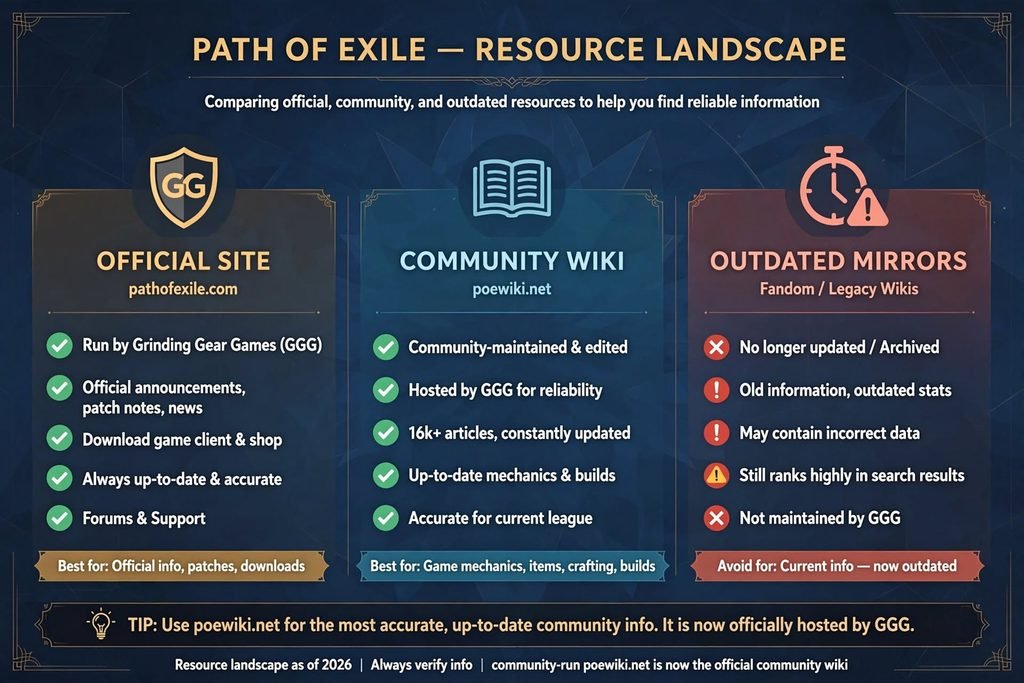
This is the part most searches for “poe wiki” are actually trying to resolve, because for years multiple competing wikis ranked for the same query and pointed to conflicting or outdated information.
As of this writing, the current, actively maintained Path of Exile wiki lives at poewiki.net. You can confirm this directly from Grinding Gear Games’ own website: the official navigation menu on pathofexile.com includes a “Community Wiki” link, and it points to poewiki.net.
A short history explains why this matters. The Path of Exile wiki originally lived on Fandom (pathofexile.fandom.com). In 2023, the wiki’s editors and maintainers moved the project off Fandom to its own independent domain, poewiki.net, largely because of long-standing community complaints about Fandom’s intrusive ads, poor mobile performance, and lack of editorial control. The old Fandom pages were left behind and are now stale — some still reference years-old game versions. Unfortunately, the abandoned Fandom pages continued to rank well in search for a long time afterward, which is why players sometimes land on outdated information without realizing a newer, actively updated wiki exists elsewhere.
If you want the current, correct poe wiki database, use poewiki.net. If a search result sends you to pathofexile.fandom.com, treat that as outdated and cross-check anything important against the active wiki instead.
Read More: https://gamespuma.com/poe2-trading/
Is the PoE Wiki Official?
This deserves a precise answer rather than a simple yes or no.
Short answer: The PoE wiki is community-maintained, not written or controlled by Grinding Gear Games — but it is publicly linked from Path of Exile’s official website as the “Community Wiki,” and the wiki itself is hosted by Grinding Gear Games’ infrastructure.
Here’s the distinction that matters:
- Official Path of Exile resources — the pathofexile.com website, in-game data (the live Passive Tree tool, Atlas Tree tool, Ascendancy pages, item filters, trade site), and official patch notes — are written and controlled directly by Grinding Gear Games.
- The community wiki (poewiki.net, and its sister site for the sequel) is written and edited by volunteer contributors from the player community. Grinding Gear Games hosts the wiki and links to it from its own site, which is a meaningful form of endorsement, but the studio does not author the individual articles.
In practical terms: treat the wiki as an excellent, GGG-endorsed reference maintained by experienced players, and treat pathofexile.com’s own pages and official patch notes as the final word when something is time-sensitive or contested, such as a very recent balance change.
Why There Are Multiple “PoE Wikis” Online
Because Path of Exile has existed since 2013 and has an enormous, engaged fanbase, several different sites have hosted “PoE wiki”-style content over the years:
- poewiki.net — the current, actively maintained community wiki for the original Path of Exile, linked from the official site.
- pathofexile.fandom.com — the old Fandom-hosted wiki. The community migrated away from it in 2023, and it’s no longer actively kept up to date.
- poedb.tw — a separate, independently run community database. It isn’t a wiki in the traditional editable sense, but a data-mined reference tool covering items, gems, passive tree data, and league mechanics, and many players use it alongside the wiki.
- pathofexile2.wiki.fextralife.com — an unofficial, third-party wiki for Path of Exile 2 run by Fextralife, unrelated to the GGG-linked community wiki project.
Knowing this landscape helps explain why two people searching “poe wiki” on the same day can land on completely different sites with different levels of accuracy.
What Can You Find on the PoE Wiki?
The PoE wiki documents nearly every system in the game. The main categories players search for include:
- Items — unique items, rare item bases, equipment stat ranges, requirements, implicit and explicit modifier pools, and drop-source information.
- Skills and gems — skill gems, support gems, their scaling formulas, tags, and how they interact with other mechanics.
- The passive skill tree — individual passive nodes, notable passives, and keystones, plus how they connect to each class’s starting location.
- Classes and Ascendancies — the base classes and their Ascendancy specializations, including Ascendancy-specific passive nodes.
- Crafting — currency items, prefixes and suffixes, crafting benches, and item-modification systems.
- Maps and the endgame Atlas — map types, map modifiers, Atlas passive trees, pinnacle bosses, and league-specific endgame mechanics.
- Mechanics — damage types, defenses, resistances, ailments (like Bleed, Ignite, and Chill), buffs, debuffs, and other scaling systems.
- NPCs, quests, and lore — quest steps, vendor rewards, and the story of Wraeclast.
Because the game is patched frequently, not every page updates at the same speed — more on that in the reliability section below.
How to Search the PoE Wiki for Items
Item research is one of the most common reasons players open the wiki. A practical workflow looks like this:
- Search the exact item name. Unique item names (for example, a specific named weapon or armor piece) usually return an exact page match.
- Check the infobox first. Most item pages open with a summary box showing base stats, implicit modifiers, level requirement, and item class.
- Read the “modifiers” or “notes” section for anything the in-game tooltip doesn’t fully explain, such as how a unique interacts with a specific mechanic.
- Check “obtained from” if you’re trying to figure out where an item drops, since the wiki typically lists known drop sources, vendor recipes, or crafting methods.
- Cross-check item level requirements when you’re evaluating whether an item is craftable at your current progress, since many modifiers are gated behind item level.
Treat wiki-listed numbers as a strong reference point, but be aware that any value can shift with a balance patch — if a number seems off compared to what you see in-game, the wiki page may not yet reflect the newest patch.
How to Research Skills and Support Gems
Skill and gem pages typically include the gem’s tags, mana or other resource cost, base damage or effect values at different gem levels, and a list of which support gems can and cannot apply to it. For build planning, this is usually more useful than a build guide alone, because it lets you verify claims a guide makes rather than taking them on faith.
A useful habit: when a build guide tells you “this support gem works with this skill,” open the skill gem’s wiki page and check its tags against the support gem’s requirements yourself. Gem interactions are one of the most common areas where written guides go out of date faster than the underlying wiki data.
How to Use the Wiki for the Passive Skill Tree and Ascendancies
The in-game Passive Skill Tree tool (hosted directly on pathofexile.com) is the authoritative, always-current source for the tree’s exact current layout. The wiki complements this by explaining what individual keystones and notable passives actually do in more detail than the in-game tooltip sometimes conveys, and by documenting how specific passives interact with specific mechanics (for example, how a keystone changes how a defense or damage type is calculated).
For Ascendancy classes, wiki pages typically break down each Ascendancy’s passive skill nodes, explain thematic playstyles associated with the Ascendancy, and note any unusual mechanical interactions tied to that Ascendancy’s unique nodes.
How to Research Crafting and Modifiers
Crafting is one of Path of Exile’s most complex systems, and it’s also one of the areas where the wiki earns its keep. Typical research steps:
- Look up a currency item’s page to understand exactly what it does mechanically (not just the flavor text).
- Check an item base’s modifier pool to see which prefixes and suffixes are actually possible on that base at your current item level.
- Review crafting bench options, since certain crafts are only available through specific unlocked bench recipes rather than currency alone.
- Cross-reference tags, since many modifier pools are restricted by hidden tags tied to the item base rather than the item’s visible category.
Because crafting systems get adjusted with almost every major patch, always sanity-check crafting mechanics against the most recent official patch notes if the outcome you’re seeing in-game doesn’t match the wiki description.
How to Use the PoE Wiki for Maps and Endgame
For endgame content, the wiki is useful for looking up individual map types and their layouts, understanding specific map modifiers, researching Atlas passive tree nodes, and getting background on pinnacle and unique bosses. League-specific endgame mechanics (temporary systems tied to a specific challenge league) are also documented, though these pages are naturally most useful while that league mechanic is still active or has been folded into the core game.
Campaign content (the story acts) and endgame content (the Atlas and maps) are documented separately on the wiki, so it’s worth being specific in your search terms — searching just a boss name, for example, can sometimes return both a campaign-story version and an endgame pinnacle version of an encounter.
Using the Wiki Alongside a Build Guide
The PoE wiki is a reference source, not a build guide. It won’t tell you “play this,” but it will let you verify every claim a build guide makes. A good workflow when following someone else’s build:
- Look up each recommended skill gem on the wiki to confirm its current mechanics.
- Check any keystone or notable passive the build relies on to make sure you understand exactly what it changes.
- Verify unique item modifiers directly, especially for older guides, since unique items occasionally get rebalanced.
- Use the crafting and modifier pages to understand why a recommended item modifier matters mechanically, not just that it’s recommended.
This turns the wiki into a fact-checking layer that protects you from following outdated or slightly wrong build advice.
How Current and Reliable Is the PoE Wiki?
Because the wiki is community-maintained, its update speed varies by page. High-traffic pages — popular skills, current league mechanics, commonly used uniques — tend to get updated quickly after a patch, often within days. Niche or rarely used items and mechanics can lag behind, sometimes for weeks, especially in the period right after a major expansion when there’s a large volume of new content to document at once.
A few practical rules for reliability:
- If a wiki page and your in-game observation disagree, check the current patch notes on pathofexile.com — patch notes are the definitive record of recent changes.
- Pages for very recently released content (a brand-new league mechanic or a just-launched expansion) are the most likely to be incomplete in the first days after release.
- Historical information (older league mechanics, past game versions) is generally well preserved and is useful for understanding how a system has evolved, but should not be assumed to reflect the current version unless the page explicitly says so.
Overall, the wiki is a strong, generally trustworthy reference — it just isn’t instantaneous, and it’s not infallible the way a live, developer-controlled data feed would be.
PoE Wiki vs. Official Path of Exile Resources vs. Other Tools
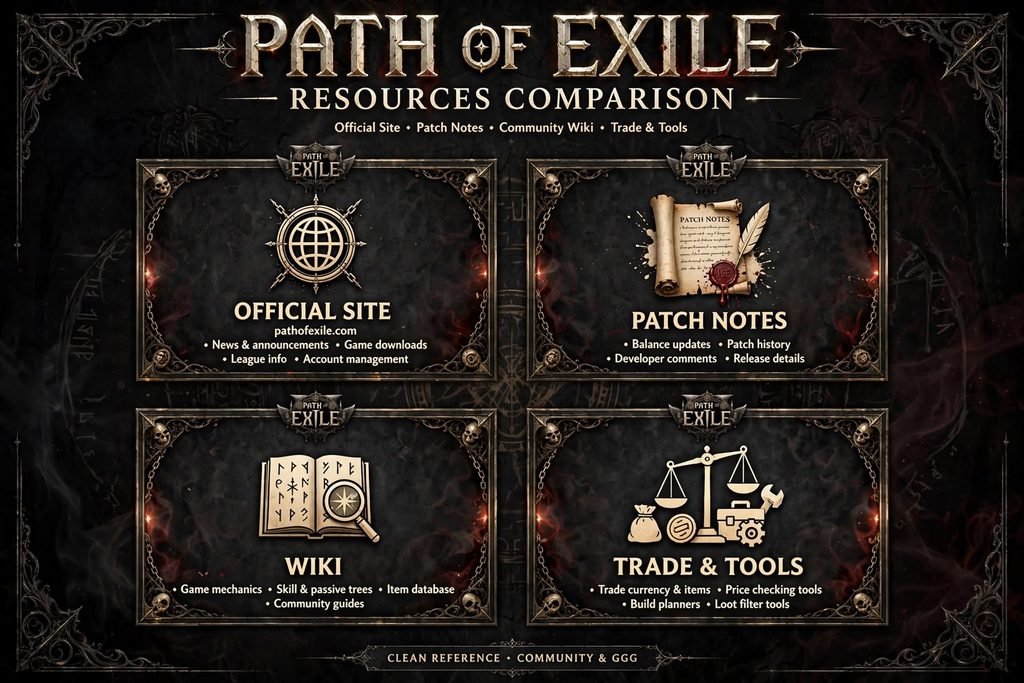
Different Path of Exile resources serve different purposes. Here’s how they compare:
| Resource | Maintained By | Best Used For |
|---|---|---|
| pathofexile.com (official site) | Grinding Gear Games | Official announcements, live Passive/Atlas Tree tools, item-filter data, developer-authored patch notes |
| Patch notes | Grinding Gear Games | Confirming exactly what changed in the most recent update |
| PoE wiki (poewiki.net) | Community, hosted by GGG | In-depth reference on items, skills, mechanics, crafting, passive tree, lore |
| Official trade site | Grinding Gear Games | Buying and selling items with other players |
| poe.ninja and similar community tools | Independent community developers | Live market prices, build statistics, character-data lookups |
None of these resources replaces the others — they’re complementary. The wiki is where you go to understand how something works; the official site and patch notes are where you confirm what’s currently true; trade and pricing tools are where you go to act on that information economically.
PoE Wiki vs. PoE2 Wiki
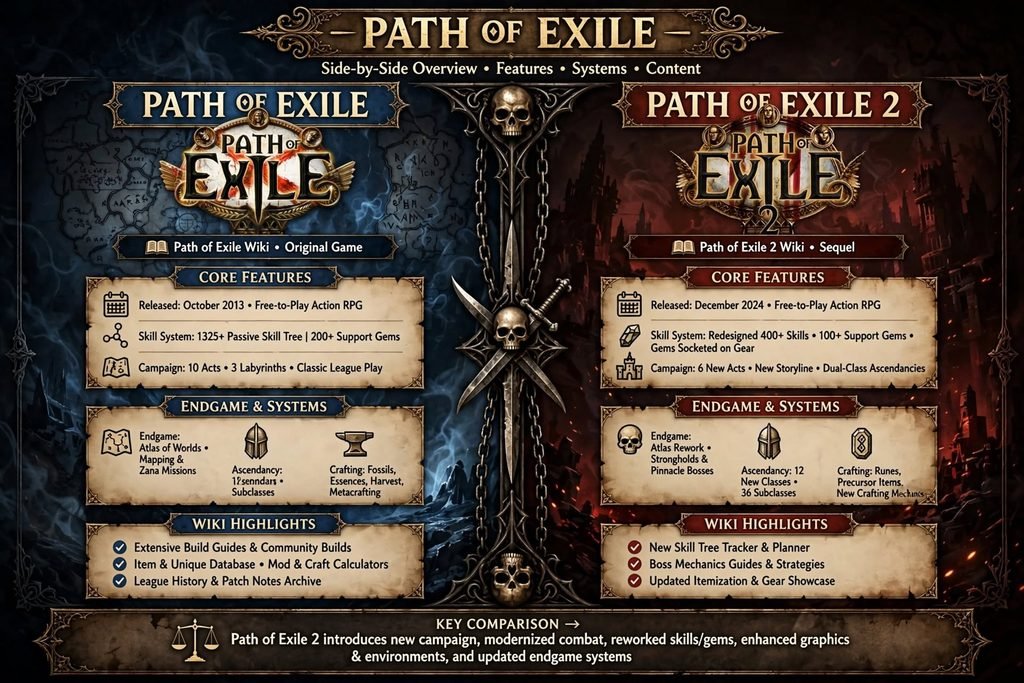
Path of Exile 2 is a separate game from the original Path of Exile, currently in Early Access, and it has its own dedicated wiki project rather than sharing pages with the original game’s wiki.
- The Path of Exile wiki (poewiki.net) covers the original Path of Exile — its classes, skill gems, passive tree, items, and mechanics as they exist in that game.
- The Path of Exile 2 wiki is described by its own maintainers as a “sister wiki project” to the original, hosted separately (on its own poe2wiki.net domain) because PoE2’s classes, Ascendancies, skill and gem systems, and itemization differ substantially from the original game.
This separation matters because Path of Exile and Path of Exile 2 do not share identical mechanics. Classes, Ascendancy names, gem systems (PoE2 uses separate systems such as Spirit gems and gemcutting mechanics not present in the original game), and itemization rules differ between the two titles. If you’re playing Path of Exile 2, make sure you’re reading the PoE2 wiki rather than the original PoE wiki — a passive keystone, skill gem, or crafting mechanic that exists in one game may not exist, or may work differently, in the other.
Because Path of Exile 2 is still in Early Access, its wiki content is being actively expanded, and it’s reasonable to expect gaps in coverage for the newest content until the community has time to document it.
Common Mistakes When Using the PoE Wiki
- Using the old Fandom wiki without realizing it’s outdated. If a page still references a game version from years ago, you’re likely on the abandoned Fandom fork rather than the current site.
- Mixing PoE1 and PoE2 information. These are two separate games with separate wikis; a mechanic name that sounds familiar may work completely differently between them.
- Treating every number as permanently current. Balance patches happen regularly — always check the date and version context on a page, especially for recently changed skills or items.
- Skipping the infobox and going straight to prose. Most item, skill, and passive pages put the core numbers in a structured box at the top; reading that first saves time.
- Assuming the wiki is an official Grinding Gear Games publication. It’s community-written and GGG-linked, not developer-authored — useful context when weighing a wiki claim against an official patch note.
FAQ
What is the PoE wiki? The PoE wiki is a community-maintained, searchable reference database covering Path of Exile’s items, skills, passive tree, crafting, mechanics, and lore.
Where can I find the Path of Exile wiki? The current, actively maintained wiki is at poewiki.net. It’s the resource officially linked from pathofexile.com under “Community Wiki.”
Is the PoE wiki official? It’s community-written rather than authored by Grinding Gear Games, but it’s hosted by GGG and linked directly from the official Path of Exile website, making it the studio’s recognized community reference.
What can I find on the PoE wiki? Items, unique equipment, skill and support gems, the passive skill tree, Ascendancy classes, crafting systems and currency, maps and Atlas mechanics, monster and boss information, quests, and game lore.
Can I use the PoE wiki to look up items? Yes. Item pages typically list stats, modifiers, requirements, item level information, and known sources.
Can I find skill gem information on the PoE wiki? Yes. Skill and support gem pages document tags, scaling values, and which gems can combine with each other.
Can the PoE wiki help with crafting? Yes. It documents currency items, prefixes, suffixes, crafting bench recipes, and modifier pools for specific item bases.
Is the PoE wiki updated regularly? Popular pages are usually updated quickly after a patch, but niche or brand-new content can lag behind for a period after a major release since the wiki depends on volunteer contributors.
Is there a PoE2 wiki? Yes. Path of Exile 2 has its own separate wiki project, run as a sister site to the original Path of Exile wiki, because the two games differ in classes, gems, and itemization.
What’s the difference between the PoE wiki and the official Path of Exile website? The official website is authored directly by Grinding Gear Games and includes tools like the live Passive Tree, Atlas Tree, and trade site. The wiki is community-written reference content that’s linked from, but not authored by, the official site.
Conclusion
The poe wiki is one of the most useful tools available to a Path of Exile player, but only if you’re using the current, correctly maintained version of it. The active Path of Exile wiki lives at poewiki.net, is linked directly from Grinding Gear Games’ own site as the “Community Wiki,” and covers everything from item modifiers and skill gem scaling to crafting systems and endgame Atlas mechanics. If you’re playing the sequel, remember that Path of Exile 2 has its own separate wiki project rather than sharing pages with the original game. Bookmark the correct PoE wiki, use it to fact-check build guides and crafting decisions, and cross-reference it against official patch notes whenever something feels out of date — and you’ll have one of the most reliable research habits any Exile can build.
SOURCES USED
- Path of Exile official website navigation (pathofexile.com), confirming the “Community Wiki” link target
- poewiki.net homepage content (Path of Exile Wiki), describing itself as community-maintained and GGG-hosted
- poe2wiki.net homepage content (Path of Exile 2 Wiki), describing itself as a sister project to the original wiki
- Path of Exile official forum thread discussing the wiki migration away from Fandom
- Wikidata entry for Path of Exile, listing the official wiki URL
- General background on the Fandom-to-independent-domain migration pattern seen across several game wikis

Written by Daniel Carter
Daniel Carter is a dedicated gaming writer who enjoys turning complex gaming topics into clear, useful, and engaging content. He covers game guides, tips, reviews, features, and the latest developments across the gaming world. His approach focuses on research, accuracy, and practical value, helping readers discover new games, improve their gameplay, and stay informed about the industry. For Daniel, great gaming content is not just about information—it is about making every article genuinely worth reading.
1 thought on “PoE Wiki: The Complete Guide to the Official Path of Exile Wiki”