In this article
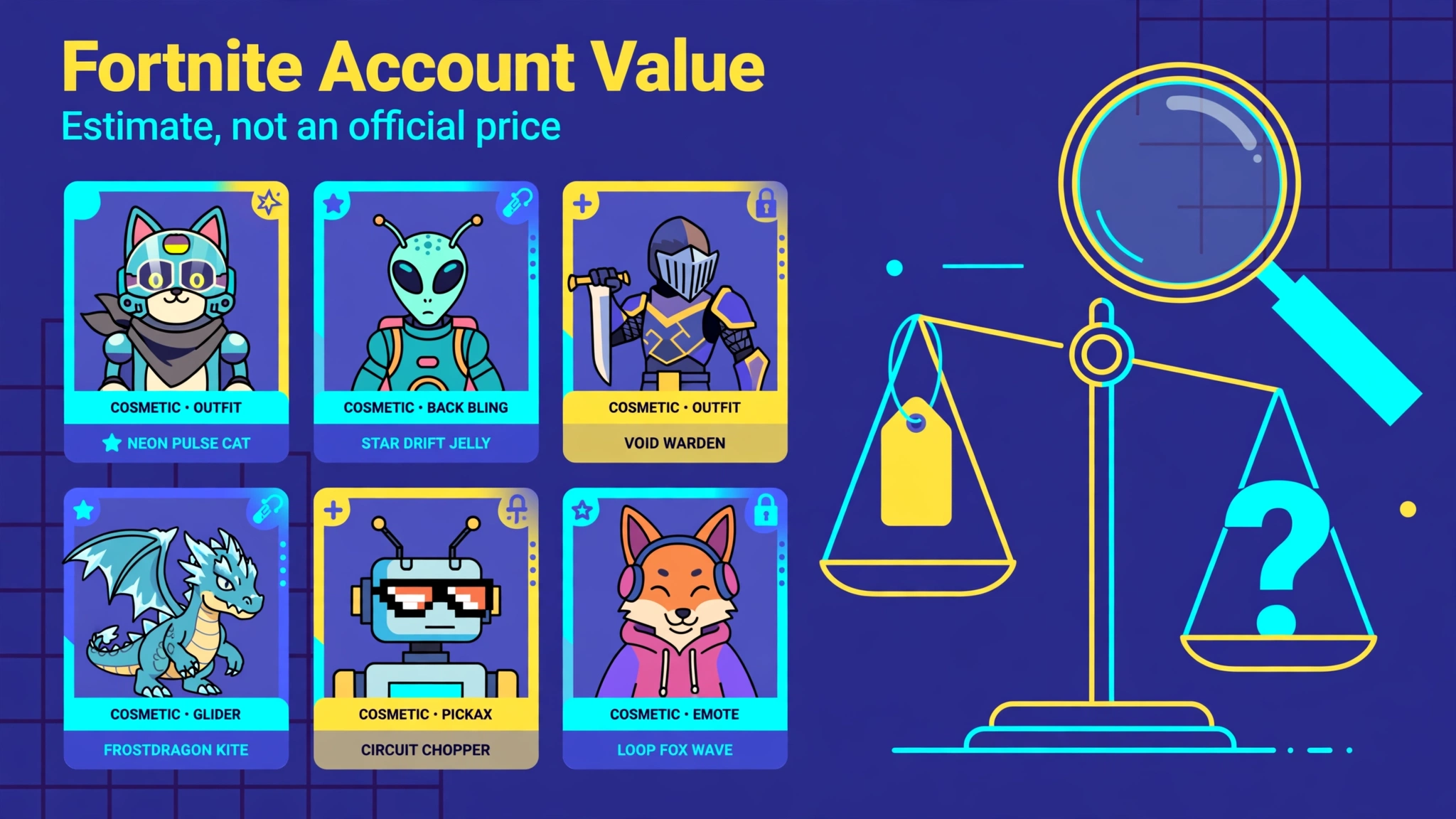
Fortnite account value has no official number. Epic Games does not price lockers, does not publish a resale rate, and its Terms of Service do not allow an account to be sold, so every dollar figure you see online is somebody’s estimate rather than a fact. What you can work out honestly is a replacement cost (what similar cosmetics would cost to buy today), a total of what you have spent, and a collector-style rarity estimate. This guide separates those ideas, shows a safe way to run each one, and explains why fake “locker checker” sites have become a common way to steal Epic logins.
So, how much is a Fortnite account worth? In Epic’s eyes, nothing in cash terms. To a player comparing collections, the answer depends mostly on which items are genuinely hard to obtain, not on how many skins are in the Locker. And as a resale price, the answer cannot be given, because Epic prohibits the transaction that would set one.
Table of Contents
What Is Fortnite Account Value?
Fortnite account value is an informal phrase, not an Epic Games term. Players use it to describe how impressive, expensive or scarce their cosmetic collection is. The trouble is that the phrase quietly mixes four different measurements, and most confusing advice online comes from treating them as one number.
Official value
This is whatever monetary worth Epic itself assigns. As the next section shows, that figure is zero, because Epic treats cosmetics as licensed content and V-Bucks as a closed-loop currency.
Estimated value
This is a calculation by a third party, such as a calculator or a database, based on the items you enter. It can be useful for comparing lockers, but it reflects the builder’s assumptions. It is never an Epic valuation.
Resale value
This is what a buyer might hypothetically pay. Because Epic’s rules forbid selling accounts, no legitimate market exists to measure it, and any published “average sale price” comes from sources that cannot be verified from the outside.
Replacement value
This is the cost of re-buying comparable items from the Item Shop at today’s V-Bucks prices. It is the only one of the four that can be reasoned about with published official prices, and even then it only works for items that can still be bought.
Keeping these four apart is the single most useful habit when you think about Fortnite account value. Whenever you see a number, ask which of the four it is. A headline claiming a fixed fortnite account value almost always blends several of them.
Does Fortnite Have an Official Account Value?
No. Several parts of the current Epic Games Terms of Service, last updated on September 10, 2026, point the same way.
First, the terms say that Fortnite content is licensed to you rather than sold, so you do not own the cosmetics in your Locker in the way you own a physical object. Second, the terms describe V-Bucks as a type of credit and state in capital letters that credits are not the same as cash, and cannot be exchanged for real currency or anything outside Epic’s ecosystem. Third, players are told they may not convert in-game content into value outside the game, such as money or goods. Fourth, Epic reserves the right to take actions that change the perceived value or purchase price of credits and in-game content at any time.
Taken together, these clauses mean Epic gives no monetary meaning to the contents of an account. If the account is terminated, the terms say the holder loses games, credits, in-game content and account balances, generally without a refund. An official Fortnite account value therefore does not exist, and a tool claiming to show “Epic’s price” for your locker is misdescribing how the system works.
How Much Is a Fortnite Account Worth?
There is no single answer for fortnite account value, and the honest reason is structural: the items that move a collector’s interest are exactly the items that cannot be priced from Epic’s side. A Battle Pass reward from an early season was never sold for V-Bucks as a standalone item, and a promotional outfit given away with a phone was never sold at all. You cannot compute replacement cost for something that has no shop price.
What you can do is place your account on a range using three public reference points.
| Reference point | What it tells you | Where the number comes from |
|---|---|---|
| Money spent | What you actually paid over the years | Your Epic Games account transaction history and your console store records |
| Replacement cost | What comparable shop items cost now | Item Shop prices multiplied by current V-Bucks pack rates |
| Collector-style estimate | How scarce your key items are | A calculator or database, clearly labelled as unofficial |
On replacement cost, the arithmetic is straightforward because Epic published its current pack sizes. Since March 19, 2026, the $8.99 pack gives 800 V-Bucks, the $22.99 pack gives 2,400, the $36.99 pack gives 4,500 and the $89.99 pack gives 12,500. Dividing price by V-Bucks gives the following cost per 1,000 V-Bucks. These are derived figures, not Epic-published rates.
| Pack | V-Bucks received | Approximate cost per 1,000 V-Bucks |
|---|---|---|
| $8.99 | 800 | $11.24 |
| $22.99 | 2,400 | $9.58 |
| $36.99 | 4,500 | $8.22 |
| $89.99 | 12,500 | $7.20 |
Take an item the shop lists at 1,500 V-Bucks, which is the listed price of several outfits in the current Item Shop. Re-buying it would cost roughly $10.80 if you used the largest pack and roughly $16.86 if you used the smallest. Epic also advertises Epic Rewards credit of about 20 percent on V-Bucks purchased through its own payment system, which softens the effective cost, but that credit is spendable only inside Epic’s ecosystem.
Now notice what this number does not capture. It prices an ordinary shop outfit; it says nothing about a retired Battle Pass skin, because that skin has no shop price to multiply. That gap is why a replacement-cost total can look large for a locker full of recurring shop items and tiny for a locker whose best items are the irreplaceable ones.
Why do websites give such different numbers?
Because they answer different questions with different baselines. One marketplace-style page claims resale usually lands at roughly 30 to 40 percent of a locker’s V-Bucks total at retail prices, while another says accounts resell for 11 to 19 percent of its own internal valuation. Those percentages are applied to different starting numbers, and neither site publishes sale records that a reader could check. When two sources disagree by more than double and cannot show their data, the sensible conclusion is that the figure is marketing, not measurement.
What Makes a Fortnite Account More Valuable?
Collectors and calculators generally look for a short list of qualities when they discuss fortnite account value. The table below summarises them with the caveat that matters for each, because none of them carries a fixed dollar multiplier.
| Factor | Why it may matter | Important caveat |
|---|---|---|
| Closed Battle Pass rewards | The items were earned inside a specific season and are not sold as separate shop items | Epic’s rules on pass items changed; later passes may return to the shop after a waiting period |
| Promotional or platform exclusives | Some outfits were handed out through hardware, subscription or partner promotions | Epic can rerun a promotion or add a bundle; scarcity is not a promise |
| Original-owner styles | A style can mark who bought an item the first time, even when the base item later returned | Only counts if the style appears on the outfit in your Locker |
| Long-absent shop items | Gaps of several years make an item rare in practice | A single Item Shop return resets the gap |
| Total cosmetic count | A big locker shows time and spending | Volume is not scarcity; many items are recurring |
| Account age | Suggests a long history | Age alone proves nothing about what is inside |
| Platform and region | May affect what was purchasable or redeemable | No verified evidence that either sets a price |
| V-Bucks balance | Spendable inside the game | Not cash; cannot be withdrawn or transferred |
| Competitive results | Reflect skill and history | No reliable link to cosmetic or monetary worth |
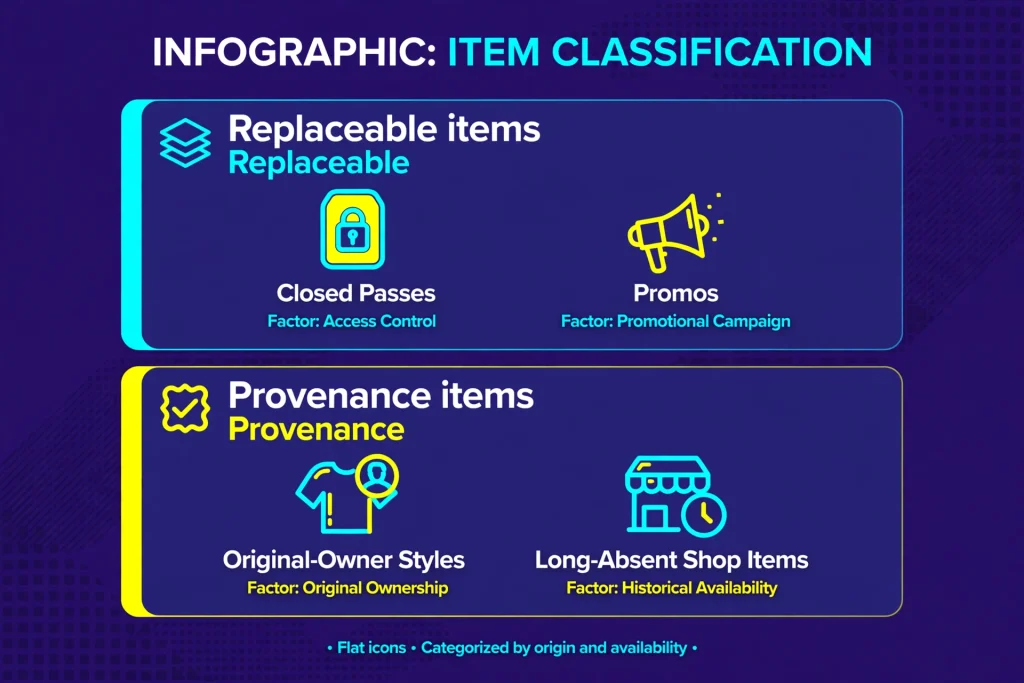
A useful mental model is to think of a locker as having two layers. The base layer is replaceable: anything Epic still sells or is likely to sell again. The top layer is provenance: items whose acquisition path is closed, plus styles that prove when you bought. Estimates that treat both layers the same way will mislead you in one direction or the other.
Reports from Fortnite coverage also describe how Epic loosened its older exclusivity promise in August 2024. According to FRVR’s coverage, Battle Pass items from Chapter 5 Season 4 onward may reach the Item Shop at least 18 months after their pass ends, which would make recent pass items a weaker foundation for scarcity than older ones. Treat that as reported rather than guaranteed, and check Epic’s own announcements before relying on it.
Are Rare Fortnite Skins Actually Worth More?
Not automatically. Rare does not mean expensive, and expensive does not mean rare. Five separate ideas get blended together under the word “rare,” and pulling them apart removes most of the confusion about Fortnite account value.
- In-game rarity label. This is a tier Epic attaches to an item as part of its own design and pricing structure. It describes how the item is classified, not how many players own it or whether it can come back.
- Scarcity. How many copies exist across all players. Epic does not publish ownership counts for cosmetics, so scarcity is usually inferred, not measured.
- Availability. Whether you can obtain the item today. This is the factor that changes most often, and it is the one a locker total cannot see.
- Demand. Whether people want the item. Collaboration characters and nostalgic items attract attention for reasons unrelated to the label on them.
- Monetary valuation. What someone would pay, which cannot be established for accounts because the sale is prohibited.
The best evidence that labels do not decide worth is how often long-absent items return. FRVR’s tracking of the Item Shop notes that Skull Trooper and Ghoul Trooper came back repeatedly after their first appearances, and that a pack not sold for almost eight years returned in June 2026. Each return converts a once-scarce item into an ordinary one, while the styles reserved for original buyers keep their meaning.
A different problem appears in V-Bucks totals. A review on WePC of the commonly used Fortnite.gg locker method pointed out that rare Battle Pass skins carry no shop price and so contribute little to a V-Bucks total, while expensive-looking shop skins inflate it. In other words, summing original prices can rank a recent shop-heavy locker above one that contains genuinely unobtainable items.
Common misconceptions worth dropping:
- “Old means valuable.” An old skin that was sold in the shop many times is simply old.
- “High tier means high price.” The label reflects Epic’s classification, not collectors’ demand.
- “More skins means more value.” Quantity raises replacement cost slightly but says little about scarcity.
- “Spent a lot means worth a lot.” Spending is a history, which the later section on money spent covers.
How to Estimate Your Fortnite Account Value
A responsible estimate is a process, not a formula. Any formula that multiplies rarity by a fixed dollar figure is invented, because there are no verified market prices to calibrate it against. Instead, work through these steps and treat the output as a personal reference point.
- Inventory your Locker. Open each tab in the game and count outfits, pickaxes, gliders, emotes, wraps and back items. Write down anything you suspect is unusual, such as a style variant or a promotional item.
- Pull your spending history. Your Epic Games account has a transaction history, and console stores keep their own. Together they show how much real money went into V-Bucks and passes.
- Check availability. Look at the official Item Shop on fortnite.com to see whether an item is currently sold, read Epic’s seasonal announcements for any recent return, and cross-check item details in a Fortnite database.
- Verify provenance. For each notable item, confirm how and when it was obtainable. A style that proves you bought early is different from a base outfit that was later rerun.
- Separate scarce from ordinary. Mark which items Epic could realistically sell again and which came from closed channels.
- Calculate replacement cost for the ordinary group. Use the pack-rate arithmetic above to build a low and high range.
- Add a collector estimate, if you want one. Run the closed-channel items through a transparent calculator and label the result “unofficial.”
- Do not convert any of this into a price. The number describes your collection; it does not authorise a sale.
- Never share credentials. No valuation step requires your password, a verification code, or recovery information.
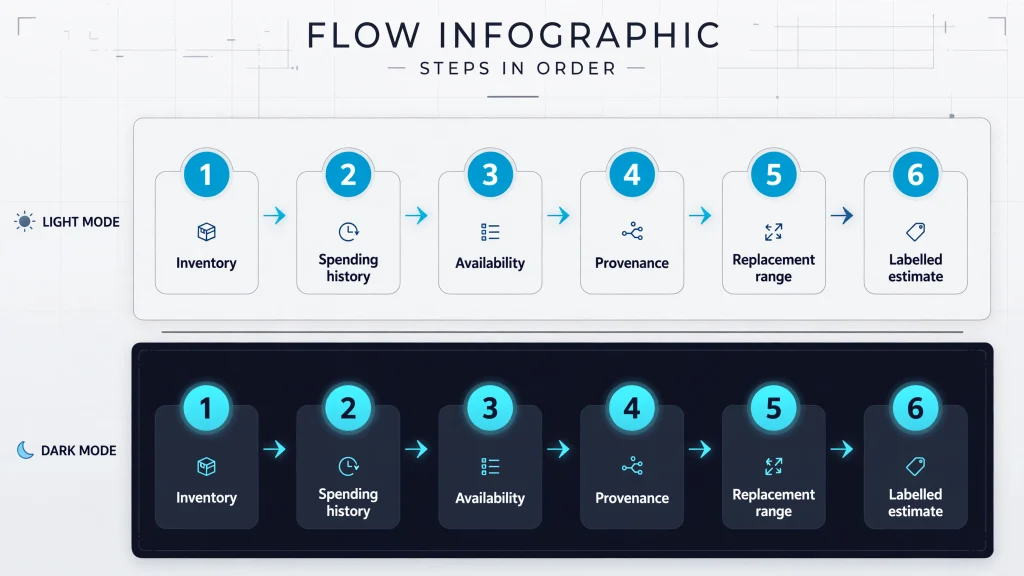
The output of this process is a short paragraph, not a figure: for example, “replacement cost of the shop items sits in a certain range, and my collector-style items are these four.” That framing is sturdier than a single dollar value, and it stays honest about what Fortnite account value can and cannot mean.
Fortnite Account Value vs V-Bucks
V-Bucks are a currency, and a currency balance is not an account’s worth. Epic’s help pages state that purchased V-Bucks are added to the account that made the purchase and cannot be gifted to other accounts, and the Terms of Service state they cannot be exchanged for real money. An unspent balance therefore adds spending power, but it does not establish a resale price for anything.
Refunds matter here because they change what “spent” really means. Epic offers a Cancel Purchase option for Item Shop buys made with V-Bucks within 24 hours, as long as the item has not been used. After that, a Return Ticket can undo eligible purchases made within the previous 30 days. Each account begins with three tickets and earns one more every 365 days, up to a cap of three held at a time. Passes, pass levels, gifted items and Save the World loot items are excluded. In practice, most older purchases cannot be reversed, which is one more reason spending history does not translate into cash.
Fortnite Account Value Calculators
Several tools claim to estimate fortnite account value. I checked what each publishes about its method and whether it asks for sign-in details. None of them is an Epic product.
FRVR’s Fortnite account value calculator (frvr.com) runs in the browser and asks you to type in cosmetic counts, the earliest Battle Pass you bought, your V-Bucks balance and any rare items. The page states that it needs no Epic login, stores no data, and labels the result an unofficial estimate. It also states that every rarity weight is an editorial assumption by the publisher rather than a figure from real sales, which is the kind of disclosure that makes a tool easier to trust.
Series Calculator’s Fortnite account value calculator (seriescalculator.com) describes itself as a purchase-cost estimator. According to its own page, it multiplies your item counts by an average V-Bucks price that you set, then converts the total to dollars using Epic’s published pack prices. It says explicitly that Epic does not set a resale price and that Epic’s terms prohibit account sales. I read its published method but did not independently test the tool.
Fortnite.gg’s My Locker is a database approach rather than a calculator. Several outlets describe the current method as adding your owned cosmetics manually and reading the V-Bucks total, which you can then convert into dollars at a pack rate you choose. Outlets also report that an earlier feature that connected an Epic account was discontinued. I could not load the site directly, so I am relying on those reports and cannot confirm today’s interface. The limitation noted earlier applies: totals are based on original prices.
A Fortnite tracker is a different kind of tool: it follows gameplay stats, which are separate from what your locker is worth.
Marketplace-operated valuation pages also appear in search results. These are run by businesses that sell accounts, and they typically publish resale ranges without sale records. Given Epic’s rules, they are not recommended here.
| Tool or approach | Potential benefit | Risk or limit |
|---|---|---|
| Browser-only calculator with disclosed weights | Quick comparison without sharing anything sensitive | Weights are the publisher’s opinion |
| Purchase-cost calculator | Transparent arithmetic with official pack prices | Ignores scarcity entirely |
| Manual locker database | Maps each owned item to its original V-Bucks price | Undervalues unobtainable items and inflates recent shop skins |
| Marketplace valuation page | Gives a headline number | Resale claims cannot be checked, and it promotes a prohibited activity |
| Any site that asks for Epic login | None | Credential theft |
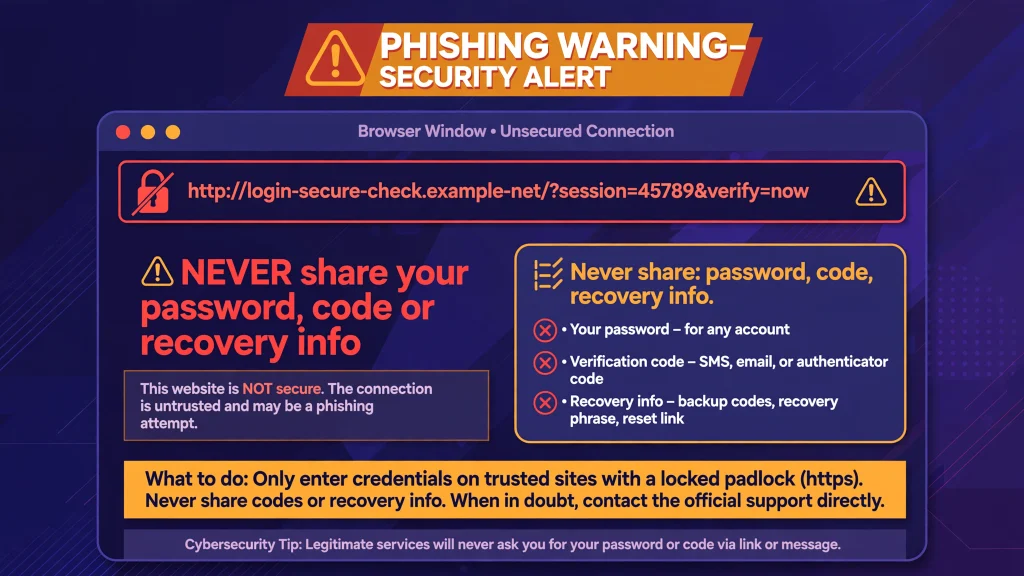
Never give your Epic Games password, authentication code, recovery information, or session credentials to a website simply because it claims to calculate account value. A legitimate calculator never needs them.
Can you check your account value by username?
Not through Epic. A fortnite account value check by username does not work because lockers are not public, according to FRVR’s coverage, so a site that says it can read your cosmetics from a username alone is either guessing or collecting something else.
Are Fortnite Account Value Calculators Accurate?
They are accurate at what they measure, which is rarely what readers think they measure. A calculator that sums original V-Bucks prices is accurate at telling you what you would have paid in the shop. A calculator with editorial weights is accurate at ranking two lockers against each other if you accept those weights. Neither one is accurate at predicting what a stranger would pay, because the sale is not permitted and the data does not exist.
The practical limits are consistent across the tools above. Results depend on what you enter, so omitting one closed-channel item can change a ranking more than omitting fifty shop items. Styles are easy to mislabel when you only count outfits. Estimates are a snapshot of the Item Shop as it stands today, so one return can quietly erase a premium. Finally, a tidy-looking number can create false confidence. Use any Fortnite account worth calculator the way you would use a thermometer in the next room: it tells you something real, but not the temperature where you are standing.
Can You Sell a Fortnite Account?
No. Epic’s current rules are explicit, and this is the part of Fortnite account value that matters most to anyone tempted to turn a collection into cash.
- The Terms of Service say you may only use an Epic account registered to you, that you cannot sell it, give it away or trade it, and that you cannot use someone else’s account even with their permission.
- Epic’s help article on the subject says account buying, selling and sharing is not allowed and is against its Terms of Service.
- The terms say sharing an account may result in suspension or termination, with loss of access to Epic’s products.
- If an account is terminated, the terms say the holder loses licensed content, credits and balances, generally with no refund.
- Epic’s ecosystem rules allow actions ranging from warnings to permanent termination, and a permanently banned player is told not to try to evade the ban with a new account.
- In competitive play, Epic’s announcement from September 2021 states that entering a tournament on a purchased, gifted or transferred account violates both the Terms and the official competitive rules.
- The arbitration section lists claims about the transfer or sale of accounts among the disputes Epic can take to court, rather than only to arbitration, which signals that Epic treats the activity seriously.
- On PlayStation, the terms add a line forbidding off-platform sales or exchanges of in-game content.
This article does not explain how to buy, sell or transfer an account, and nothing here should be read as encouragement. As for legality, the sale of an account is, on Epic’s side, a breach of contract rather than something described as a crime, but laws differ by country, and this is not legal advice. The practical risk lands on both sides: a seller can lose the account and everything in it, and a buyer has nothing Epic recognises as a lawful transfer. Secondary reporting also notes that purchased accounts can be reclaimed or banned, leaving the buyer with no recourse.
Fortnite Account Value and Scam Risks
The highest-volume risk around Fortnite account value is not an angry buyer; it is a fake checker. Security researchers have documented a family of sites that present themselves as locker value tools and then push visitors to an Epic-looking sign-in page. MalwareTips and GridinSoft have named several domains in this network, including FortLobby, FortImpact and FortMux, and Malwarebytes reported in July 2026 that scam pages offering “what your locker is worth” lead to the same fake login as fake reward pages. The tool is a prop; the login form is the product.
How the typical flow works, in plain terms: a page promises a fast valuation, asks you to sign in with Epic to “connect” your locker, and records the email and password you type. If you use two-factor authentication, the page may then ask for your current code and pass it along in real time. A code typed into the wrong site can still be used by someone else within its short lifespan.
Other scams in the same orbit:
- Fake giveaways and rewards. Offers of cash or free items tied to a collaboration, ending at a login form.
- “Rare account” bait. Messages that flatter your locker and invite you to a private conversation or a special site.
- Impersonated Epic support. Messages claiming your account is flagged and demanding sign-in details or a code.
- Software “scanners.” Programs that promise to read your inventory but install something unrelated.
- Fake buyers and middlemen. Strangers who offer to purchase an account and ask you to move the conversation, prove ownership or accept a payment you cannot verify. Payment-reversal and cryptocurrency scams follow this general pattern across online account trading, though I did not find a Fortnite-specific report for every variant.
What these have in common is urgency and a request for something an honest valuation never needs. If a page, message or person asks for a password, a code, recovery details, a remote-access program or your email login, stop.
How to Protect Your Fortnite Account
Epic’s own security guidance and the researchers above agree on a short list.
- Use a unique password. Pick one that you do not use on any other service, and consider a password manager to store it.
- Turn on two-factor authentication. Epic recommends enabling it, and also recommends securing any linked accounts such as Xbox, PlayStation, Nintendo, Facebook or Google, because those can be a route into your Epic account.
- Protect your email. Use an address you expect to keep for the long term and verify it, since losing the mailbox can block recovery.
- Never share codes. A verification code belongs only on the official sign-in page you opened yourself.
- Check the address bar. Sign in only at epicgames.com. Epic-looking pages on other domains are fakes.
- Do not install unknown “checker” software and do not send screenshots that show your account ID, email or payment details.
- If you already typed credentials into a suspicious site, go directly to epicgames.com yourself, change your password, turn on two-factor authentication, and do not reuse the old password anywhere.
If something looks wrong, report it through Epic Games Support rather than through a link in a message.
Does Money Spent Equal Fortnite Account Value?
No. “I spent $2,000 on Fortnite” does not mean “my account is worth $2,000.” Money spent is a record of the past; value, in any of the four senses above, is a statement about the present.
| Concept | What it means |
|---|---|
| Money spent | Real money paid over the account’s life, including items now owned, items returned and items that were later offered again |
| Replacement value | What comparable shop items would cost today, ignoring items with no shop price |
| Estimated value | A third-party figure that depends on its builder’s assumptions |
| Resale value | Not measurable, because Epic does not allow sales |
| Official value | None assigned by Epic |
Several reasons keep spending and worth apart. Currency purchases cannot be turned back into cash, and the terms explicitly bar converting content into outside value. The price of V-Bucks changed on March 19, 2026, so a dollar spent in 2019 and a dollar spent in 2026 bought different amounts of currency. Items that were expensive when you bought them may have been sold again since, and the terms say Epic can change the perceived value of in-game content at any time. A person who spent heavily on recurring shop outfits holds a collection that is easy to rebuild; a person who spent little but joined early may hold items nobody can buy.
What About OG Fortnite Accounts?
“OG” usually points to Chapter 1, which covers 2017 to 2019, and to the earliest seasons. But OG status does not guarantee that a particular skin is scarce. Treat each item as its own question.
What can be verified from Fortnite coverage:
- Season 1 had no Battle Pass; the first one arrived in Season 2, and its Tier 70 reward was Black Knight.
- Renegade Raider and Aerial Assault Trooper returned through the OG Season Shop on December 20, 2024 and again the following December, so the base outfits are no longer unique. Players who bought them in 2017 received exclusive Black & Gold styles in 2025 that separate original owners from later ones.
- Epic also gave a Reality Warrior style to 2019 buyers of The Paradigm after an accidental shop return in August 2024.
- Galaxy and IKONIK were carrier-linked promotions that FRVR reports have never appeared in the Item Shop.
Myths to avoid: that account age alone proves what is inside, that every Chapter 1 skin is irreplaceable, and that a one-off screenshot of an old date is proof of ownership. A player who bought an early pass but stopped at a low tier never unlocked the rarest reward. In short, an OG label is a starting question, and only the actual items answer it.
Fortnite Account Value: Quick Answer
How much is a Fortnite account worth? Epic assigns no monetary value, so Fortnite account value is only an estimate, and a resale price cannot be established because Epic prohibits selling accounts.
Nine facts to remember:
- Epic does not value, price or authorise valuation of accounts.
- The four kinds of value are official, estimated, resale and replacement.
- V-Bucks are not cash and cannot be gifted or withdrawn.
- Rare is a label; scarcity is about availability.
- Replacement cost works only for items still sold.
- Calculators reflect their builders’ assumptions.
- Epic’s Terms of Service forbid selling, trading, giving away or sharing an account.
- Fake locker checkers are a documented route to credential theft.
- Never share a password, code or recovery detail with a valuation site.
Frequently Asked Questions
How much is my Fortnite account worth?
There is no official figure. You can estimate replacement cost from current V-Bucks pack prices and add a labelled, unofficial collector estimate, but a resale price cannot be established.
Is there an official Fortnite account value?
No. Epic’s terms describe cosmetics as licensed and V-Bucks as non-cash, and they bar converting in-game content into outside value.
How do I check my Fortnite account value?
Count your Locker items in-game, review your transaction history, check which items the Item Shop currently sells, and use a transparent calculator that never asks for your Epic login.
Is there a Fortnite account value calculator?
Yes, several third-party tools estimate fortnite account value, including browser-based calculators with disclosed methods. None is made by Epic, and each reflects its builder’s assumptions.
What makes a Fortnite account valuable?
Items from closed channels, original-owner styles and long-absent shop items draw the most collector interest and shape fortnite account value the most. Item count and account level matter much less.
Are OG Fortnite skins worth more?
Only when the specific item remains hard to obtain. Several early outfits have returned to the shop, which is why styles reserved for original buyers carry more meaning than the base outfit.
Does the number of skins increase Fortnite account value?
Slightly, because extra skins mainly raise replacement cost and barely move fortnite account value. Volume does not equal scarcity, because many skins return to the Item Shop.
Does money spent on Fortnite equal account value?
No. Spending is history, V-Bucks cannot be cashed out, and current availability can change what an item is worth to collectors.
Can I sell my Fortnite account?
No. Epic’s Terms of Service and help centre say accounts cannot be bought, sold, traded, given away or shared, and violations can lead to suspension or termination.
Are Fortnite account value calculators safe?
A browser-only tool that asks for item counts is low risk. Any fortnite account value site that requests your password, verification code or recovery details is a scam, and several such sites are documented.
Conclusion
Fortnite account value is best understood as a set of questions, not a price tag. Epic assigns no monetary worth, forbids selling accounts, and treats V-Bucks as a closed-loop currency. What remains is useful but modest: a replacement-cost range built from official pack prices, a clear record of what you spent, and an unofficial collector estimate that you can use to compare lockers. The items that matter most to collectors are exactly the ones that resist pricing, which is why honest estimates come with ranges and caveats.
The safest takeaway about fortnite account value is also the simplest. Enjoy your collection, estimate it for curiosity, keep your credentials to yourself, and treat any tool that wants your Epic login as a threat. For anyone who wants more Fortnite context on GamesPuma, the Fortnite age rating guide pairs naturally with this one, and the Fortnite colored pages are a no-spend way to enjoy the game’s characters.
Sources and References
- Epic Games Terms of Service (last updated September 10, 2026): https://legal.epicgames.com/epicgames/tos
- Epic Games Help, “Can I buy, sell or share an Epic Games account?”: https://www.epicgames.com/help/c-1/a000090985?lang=en-US
- Epic Games Help, “Securing your Epic Games account” (search excerpt): https://www.epicgames.com/help/en-US/fortnite-c75/c140/a000084730
- Epic Games Help, “How to Cancel or Refund Fortnite Item Shop Purchases Made with V-Bucks”: https://www.epicgames.com/help/c-34254770/a12400524?lang=en-US
- Epic Games Help, “Why have I not received my V-Bucks after purchase?”: https://www.epicgames.com/help/fortnite-battle-royale-c-202300000001636/a202300000014525
- Fortnite, competitive rules notice on buying and sharing accounts (September 16, 2021): https://www.fortnite.com/news/it-is-a-competitive-violation-to-buy-a-fortnite-account-for-sale-or-to-share-an-account
- Fortnite Item Shop: https://www.fortnite.com/item-shop
- Insider Gaming, V-Bucks price changes effective March 19, 2026: https://insider-gaming.com/fortnite-v-bucks-prices-will-increase-this-month/
- Neowin, V-Bucks pack changes: https://www.neowin.net/news/epic-is-hiking-fortnite-in-game-currency-prices-to-help-pay-the-bills/
- FRVR, Fortnite account value calculator and methodology (updated November 5, 2026): https://frvr.com/blog/game-guides/fortnite-account-value-calculator/
- Series Calculator, Fortnite account value calculator: https://seriescalculator.com/calculator/fortnite-account-value-calculator/
- WePC, how to check Fortnite account value (limitations of V-Bucks totals): https://www.wepc.com/gaming/fortnite-account-value-guide/
- Gfinity Esports, locker value method: https://www.gfinityesports.com/guides/how-much-is-my-fortnite-account-worth-how-to-check-and-other-details/
- Screen Rant, discontinued locker sync feature: https://screenrant.com/fortnite-calculate-locker-cost-cosmetics-vbucks/
- Malwarebytes, fake Fortnite rewards stealing accounts (July 31, 2026): https://www.malwarebytes.com/blog/scams/2026/07/fake-fortnite-rewards-are-stealing-players-accounts
- MalwareTips, FortLobby.com scam analysis: https://malwaretips.com/blogs/fortlobby-com-scam-fake-fortnite-locker-checker/
- GridinSoft, FortLobby.com scam warning: https://blog.gridinsoft.com/fortlobby-com-scam/
- IsThisAScam, Fortnite scams overview: https://isthisascam.to/blog/fortnite-scams
- Marketplace valuation pages compared for SERP analysis only, not used as factual evidence: https://playplex.com/blog/how-much-is-my-fortnite-account-worth/ and https://lolvalue.com/fortnite-account-value

Written by Daniel Carter
Daniel Carter is a dedicated gaming writer who enjoys turning complex gaming topics into clear, useful, and engaging content. He covers game guides, tips, reviews, features, and the latest developments across the gaming world. His approach focuses on research, accuracy, and practical value, helping readers discover new games, improve their gameplay, and stay informed about the industry. For Daniel, great gaming content is not just about information—it is about making every article genuinely worth reading.