In this article
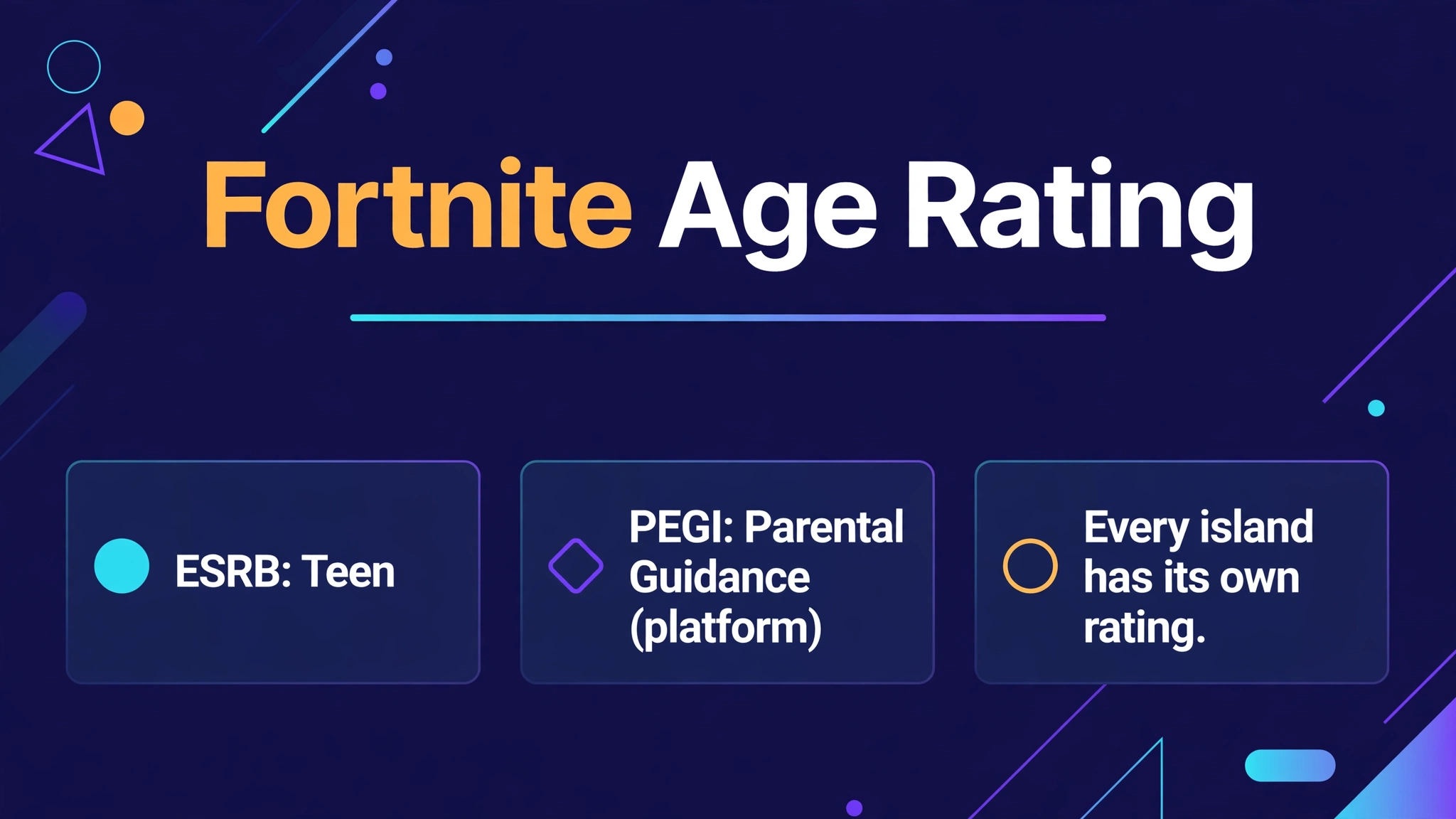
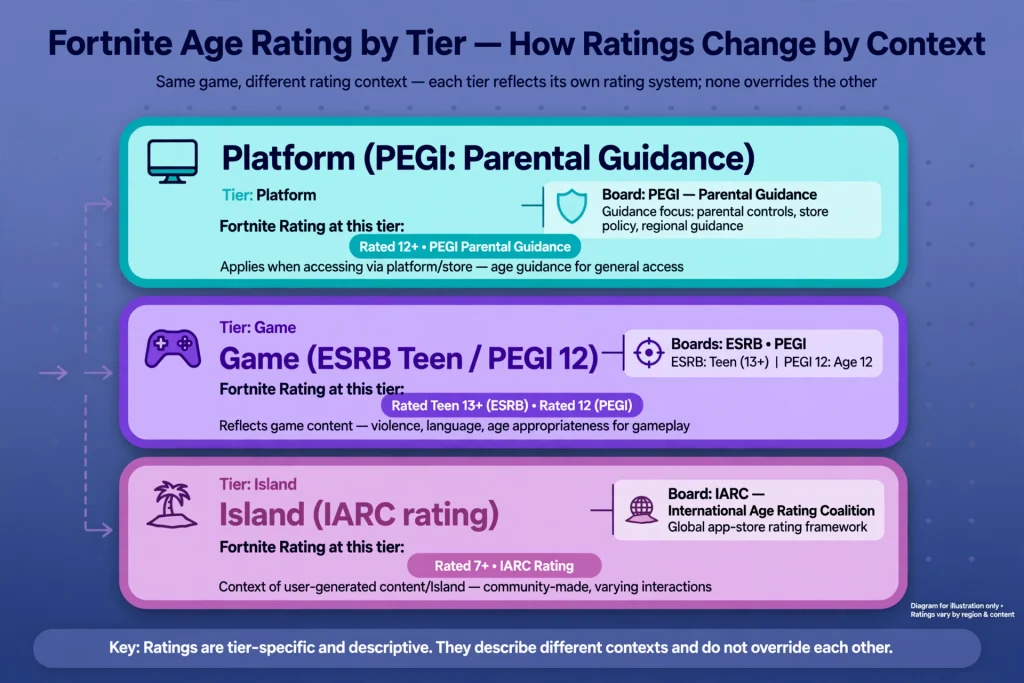
The Fortnite age rating depends on who is doing the rating. In North America, the ESRB rates Fortnite Battle Royale T for Teen, which points to ages 13 and up. In Europe and the UK, PEGI gives the Fortnite platform a Parental Guidance label, while the individual games inside it carry their own scores, such as PEGI 12 for Battle Royale and PEGI 7 for LEGO Fortnite. Inside the game itself, every island also carries a separate rating. This guide pulls those layers apart so you can see which Fortnite age rating applies to the exact thing your child wants to play.
Table of Contents
What Is the Fortnite Age Rating?
There is no single worldwide Fortnite age rating. There are several, each issued by a different body, and each describes something slightly different. Here is the direct answer, organization by organization:
- ESRB (United States and Canada): Fortnite Battle Royale is rated T for Teen.
- PEGI (Europe and the UK): the Fortnite platform listing carries the Parental Guidance label, and Fortnite Battle Royale as a game is PEGI 12.
- Epic Games (inside Fortnite): every published island has its own rating, and parents can block anything above a level they choose.
If you only need one number for the main battle royale mode, the two most common figures are 13+ (ESRB Teen) and 12+ (PEGI 12). Treat them as two separate opinions from two separate boards rather than one agreed-upon figure, because a Fortnite age rating from one board never overrides the other.
The ESRB Fortnite age rating in North America
The Entertainment Software Rating Board lists Fortnite Battle Royale as T for Teen. Its current listing covers PC, PlayStation, Xbox, Nintendo Switch, and Nintendo Switch 2, and it names four content descriptors: Animated Blood, Lyrics, Suggestive Themes, and Violence. Two interactive notices sit alongside them, Users Interact and In-Game Purchases. ESRB defines its Teen category as content generally suitable for ages 13 and up. That is the ESRB Fortnite age rating in practical terms: a recommendation from an industry board, not a law.
ESRB rates other Fortnite titles on their own. LEGO Fortnite is E10+ for Fantasy Violence, and Fortnite Save the World is rated T. Players curious about that mode’s missions and schematics can browse the unofficial community database explained in this Fortnite DB guide.
The PEGI Fortnite age rating in Europe and the UK
On 16 November 2023, PEGI announced a change. It concluded that Fortnite had grown into an ecosystem with diverse content rather than a single game, so the PEGI 12 label for the platform was replaced by its Parental Guidance label, an exclamation-mark icon with the text “parental guidance recommended.” PEGI uses that label for apps that behave like platforms, where the selection of content is broad and keeps changing. The message to parents is that suitable content may be available, but the platform can also reach content that is not right for children.
The same announcement said individual games on Fortnite would begin receiving their own PEGI ratings. That is why anyone checking the PEGI Fortnite age rating today finds two legitimate answers: Parental Guidance for the platform listing, and a specific score for each game inside it.
Fortnite rating systems at a glance
| Rating Organization | Region | Current Fortnite Rating | Key Meaning |
|---|---|---|---|
| ESRB | United States, Canada | T for Teen (Battle Royale) | Generally suitable for ages 13+; descriptors include Animated Blood, Lyrics, Suggestive Themes, Violence |
| ESRB | United States, Canada | E10+ (LEGO Fortnite) | Generally suitable for ages 10+; Fantasy Violence |
| PEGI | Europe, UK | Parental Guidance label (Fortnite platform) | Varied, changing content; some of it may be unsuitable for younger children |
| PEGI | Europe, UK | PEGI 12 (Battle Royale, Save the World, Fortnite Festival) | Moderate violence in Battle Royale and Save the World; bad language and sexual lyrics in Festival |
| PEGI | Europe, UK | PEGI 7 (LEGO Fortnite) | Non-realistic violence in a child-friendly setting |
| Epic Games with IARC | Inside Fortnite, by region | A separate rating for each island | Every published island is rated before players can open it |
Fortnite Age Rating by Country and Rating System
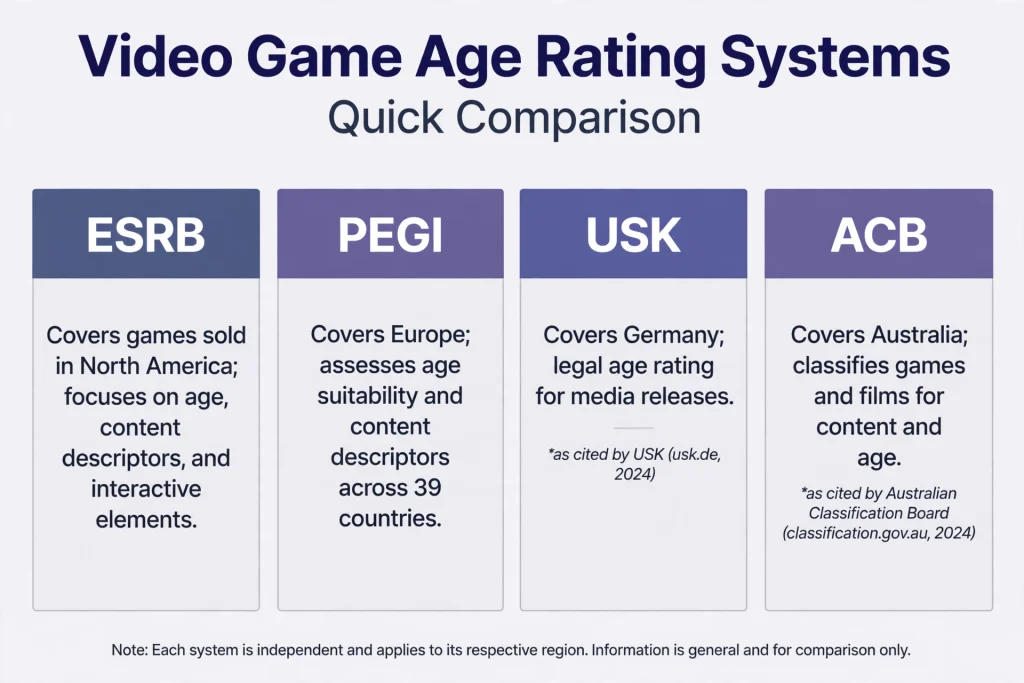
Rating boards do not share a scale, so the numbers never line up neatly. ESRB’s Teen category and PEGI’s 12 category sit close together, but they are written by different organizations with different criteria. The table below lists only the systems where a source could be confirmed.
| Rating System | Region/Country | Fortnite Rating | What It Means |
|---|---|---|---|
| ESRB | United States, Canada | T (Battle Royale); E10+ (LEGO Fortnite) | Age categories for the specific game, plus descriptors and interactive notices |
| PEGI | Europe, UK | Parental Guidance (platform); PEGI 12 (Battle Royale); PEGI 7 (LEGO Fortnite) | Platform label plus a separate age score per game |
| USK | Germany | 12 overall, as reported by Aktion Jugendschutz Baden-Württemberg in February 2026 | German release classification; the same report points to chat, strangers, and purchases as risks |
| ACB | Australia | M, as cited by New Zealand’s Classification Office | Advisory category; violence and online interactivity are the listed concerns |
| New Zealand Classification Office | New Zealand | No local classification | Online-only games are not classified there; the office points to PEGI and Australian ratings |
A few cautions help when comparing any Fortnite age rating across countries. A country using ESRB or PEGI does not mean Fortnite carries the same label there on every storefront. Console, PC, and mobile listings can differ in wording and in which version of the game they describe. Where a rating for a country could not be confirmed from a rating body or a government source, it is left out instead of guessed.
Why Does Fortnite Have This Age Rating?
Both main rating boards anchor the Fortnite age rating in the same core activity: players use weapons against each other until one person or team remains. They describe it differently, though.
PEGI’s reasoning for Battle Royale centers on moderate violence. Its listing describes a survival action game where up to 100 players fight each other, using scavenged and crafted weapons in a battle to the death. It also notes that physical reactions are unrealistic: no blood or injuries are depicted, damage appears as numbers, and defeated characters disappear from the field.
ESRB’s summary is wider. It lists pistols, shotguns, sniper rifles, machine guns, and melee weapons such as axes and swords, and it mentions fast-paced combat with realistic gunfire and impact sounds. It adds that some sequences switch to a first-person view of combat, and that defeated enemies burst into colorful light effects before vanishing. Beyond the shooting, ESRB flags a handful of outfits with animated blood, such as black handprints and liquid splatter, a character shown with deep cleavage and partial breast exposure, and song lyrics that contain profanity and references to marijuana.
Epic’s own creator documentation frames the violence in similar terms. It describes Battle Royale as violence against human and non-human characters without blood or gore, and uses that description as a worked example for creators filling out a rating questionnaire. In other words, the cartoon styling softens the presentation, but every board still treats the combat itself as the main reason for the Fortnite age rating.
What Content Affects Fortnite’s Age Rating?
Four areas shape the Fortnite age rating more than anything else: violence, lyrics and themes, online interaction, and spending. Only the first two are about what is on screen. The last two are about what surrounds the game.
Violence
Violence is the single descriptor that sits behind every Fortnite age rating issued by a major board. ESRB lists it, and PEGI cites it as the basis for PEGI 12. The weapons are modeled on real firearms and blades, but the results are bloodless and stylized. A useful way to explain this to a child is that the fighting is real in intent but cartoonish in effect.
Lyrics, language, and suggestive themes
ESRB’s current listing includes Lyrics and Suggestive Themes, which are less obvious than the gunplay. Both come from specific cosmetic and audio content, not from the core mechanics. PEGI’s treatment of Fortnite Festival, the music mode, shows how seriously audio content counts: that game received PEGI 12 for bad language and song lyrics of a sexual nature, even though it has no combat focus at all.
Online interaction and purchases
ESRB’s Users Interact notice warns of possible exposure to unfiltered user-generated content, including communication between players. In-Game Purchases warns that real money can be spent on extra content. PEGI makes the same point in its Fortnite entries, noting that parents should check what is on offer before buying anything for a child, and that the game can still be played without purchasing items.
Fortnite content considerations for parents
| Factor | What Parents Should Know |
|---|---|
| Combat | Weapon-based player-versus-player fighting is the main reason for the Teen and PEGI 12 labels in Battle Royale |
| Outfits and cosmetics | ESRB mentions a handful of outfits with animated blood and one character with suggestive visuals |
| Music and lyrics | ESRB lists Lyrics; PEGI rated Fortnite Festival 12 largely because of its song content |
| Chat | Voice and text chat can expose players to other people’s language; Epic offers controls to limit it |
| Spending | Cosmetics and currency can be bought, though the game can be played without buying |
| User-made islands | Content varies by island, so each island’s own rating matters |
Fortnite Island Age Ratings Explained
This is the part most guides skip, and it is the reason a single number never tells the whole story. Fortnite is no longer one game. PEGI describes it as an online platform containing both user-created experiences and professionally produced games such as Battle Royale. Every playable experience inside it needs its own rating, which means the Fortnite age rating you see on a store page is only the top layer.
How a Fortnite island age rating is created
Epic partnered with the International Age Rating Coalition, or IARC, and announced the system in 2023. When a creator wants to publish an island, they complete an IARC questionnaire about the content before the island goes to Epic’s moderators. IARC then assigns age ratings and content descriptors for each region, drawing on participating authorities such as ESRB in North America, PEGI in Europe, ACB in Australia, USK in Germany, and ClassInd in Brazil.
According to Epic’s documentation, each rating has three parts, and the Fortnite island age rating you see before entering follows the same structure as the ESRB and PEGI labels: a rating category such as Teen, content descriptors such as Mild Fantasy Violence, and interactive elements such as Users Interact. Players and parents see the rating before they open an island. Epic reviews submissions and can reject an island if the questionnaire answers do not match its content, and participating rating authorities also check published islands and can correct ratings. Creators who answer inaccurately risk rejection and, for repeat violations, restrictions on publishing and monetization.
The highest rating Epic allows, by region
Epic does not permit any island to exceed a regional ceiling. According to its creator documentation, an island whose rating goes above the maximum in every region cannot be published until it is changed.
| Rating Authority | Region | Maximum Island Rating |
|---|---|---|
| ESRB | North America | Teen |
| PEGI | Europe and UK | PEGI 16 |
| ACB | Australia | Mature |
| ClassInd | Brazil | 16 |
| USK | Germany | 16 |
| GRAC | South Korea | 12+ |
| Russia | Russia | 12+ |
| DGSC | Taiwan | PG 12 |
| GMedia | Saudi Arabia | 16 |
| IARC General | Rest of the world | IARC 16+ |
This table describes a ceiling for islands, not the rating of Battle Royale. It also shows why ratings alone do not settle comparisons between regions: the ESRB ceiling is Teen, while the PEGI ceiling is listed as 16.
Why an island rating can differ from the overall Fortnite age rating
The overall Fortnite age rating describes either a flagship game (ESRB’s Teen for Battle Royale) or the platform as a whole (PEGI’s Parental Guidance). An island rating describes one experience. Because each island is rated on its own questionnaire, a quiet building map and a combat map can carry different labels in the same session, and a family-oriented LEGO island can sit beside a Teen-rated shooter in the same menu.
What players and parents see
If an island is rated above the level a parent set, it appears with a lock icon and needs the parent’s PIN to open. If a parent chooses Teen as the limit, no PIN is needed, since Teen is the highest ceiling in North America. Some watchdog groups have raised doubts about individual rating decisions: the Norwegian child-safety organization Barnevakten published a January 2024 report arguing that some PEGI ratings on Fortnite looked misleading. The takeaway is that a rating is a starting point, and checking the actual island is still worthwhile.
Is Fortnite Appropriate for Kids?
The honest answer depends on which part of Fortnite, which child, and which settings. The Fortnite age rating for Battle Royale sets a baseline of roughly 12 to 13. That baseline reflects the weapon combat, the lyrics and themes, and the presence of online interaction. It does not describe the other people your child will meet, and it does not describe how a particular child reacts to competitive pressure.
Younger children do play. Epic lets players under 13 have accounts, and it gives them a restricted account type until a parent grants permission. Families who want a screen-free way to share the Fortnite theme with younger kids sometimes start with Fortnite colored pages, which involve no online play at all. LEGO Fortnite carries a lower rating than Battle Royale from both ESRB (E10+) and PEGI (7), which shows that Epic itself separates experiences by audience.
How much weight a family gives the Fortnite age rating is a personal call, and a balanced view looks at four questions. What exactly is the child playing? Who can they talk to? Can they spend money? How long are they on? The rating answers the first question only in part. The parental controls described below answer the other three.
Fortnite Age Rating vs Minimum Account Age
Many parents assume the age on the rating and the age to hold an account are the same thing. They are not. A Fortnite age rating is a content recommendation. An account rule is a policy enforced by Epic.
Epic’s account system treats a player as a Cabined Account when they indicate they are under 13, or under their country’s age of digital consent if that is higher. In that state, voice chat and free text chat are switched off, real-money purchases are blocked, and some other features are limited until a parent gives permission. The restrictions lift when a parent completes the setup or when the player reaches 13 or the local consent age. Cabined Accounts can still play Fortnite.
Other age thresholds sit elsewhere. Epic’s competitive event rules require players to be at least 13, or older where local law demands it, and players aged 13 to 17 need a parent’s permission to take part. Parental controls also cap chat options by age: under 10 is limited to Friends Only, and under 13 is limited to Friends, team members, and connections.
| Term | What It Means | Who Controls It |
|---|---|---|
| Fortnite age rating (ESRB, PEGI) | Content recommendation for a game or platform | Rating boards |
| Island age rating | Content rating for one published experience | Creator’s questionnaire, Epic review, IARC authorities |
| Cabined Account | Restricted account for players under 13 or the local consent age | Epic, until a parent grants consent |
| Chat age caps | Maximum chat options by age bracket | Epic’s parental control system |
| Competitive eligibility | 13+ to enter events; parental permission for ages 13 to 17 | Epic’s competitive rules |
| Console and store limits | Spending and play limits on the device | Platform owner and parent |
Fortnite Parental Controls
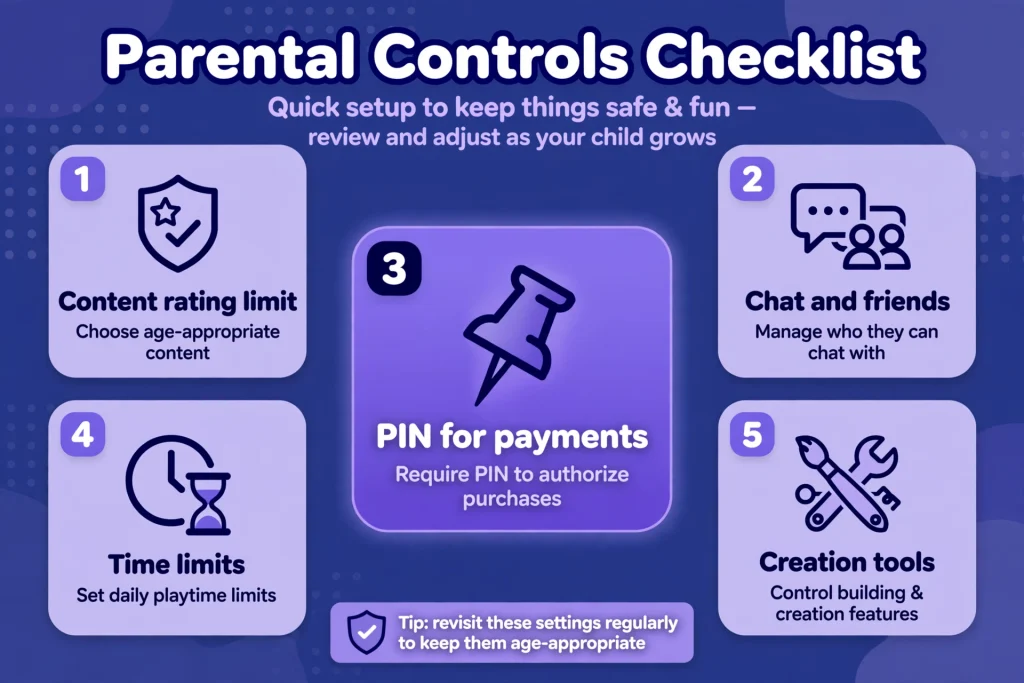
Epic’s parental controls are what turn the Fortnite age rating from a suggestion into something you can enforce. They live in the child’s Epic Games account. They are set from the Epic Account Portal or from inside Fortnite, and a six-digit PIN protects changes. Epic’s safety page says the controls cover Fortnite, Rocket League, and Fall Guys.
Content rating limits
This is the setting that connects directly to the Fortnite age rating. Parents choose the highest rating of island their child can open. As Epic’s example puts it, choosing Everyone 10+ means the PIN is needed to unlock Teen experiences, while choosing Teen leaves everything open. Epic adds a note about its store: if the store rating limit is set to Everyone or Everyone 10+, a child can still download Fortnite but can only open islands within that threshold, which excludes Teen-rated Battle Royale.
Chat and friends
Parents can set who the child may speak to by voice or text. Epic caps the maximum by age, as described above. Voice reporting is always on for players under 18, and so is text reporting. A mature-language filter replaces profanity with heart symbols, and it is always on for players under 13 and in island-specific game channels. A separate setting requires the PIN before the child sends or accepts a friend request.
Spending
A PIN setting can be required for payments through Epic’s own payment system. Epic states plainly that this does not affect purchases made through PlayStation, Steam, Xbox, or Nintendo, and it does not affect V-Bucks already in the account. For players who say they are under 13, a daily spending limit of 100 US dollars applies to Epic payments, with the PIN needed to go above it. Where paid random items exist, a separate setting controls whether V-Bucks can be spent on them. Parents who wonder what a locker full of cosmetics is worth can read why Epic offers no official tool for it in this guide to Fortnite account value.
Time limits and creation tools
Epic lets parents set a daily time limit or specific play windows, with a notice when 30 minutes remain, and it offers weekly time reports. Another setting controls whether the child can use Creative and Unreal Editor for Fortnite. Epic warns that while designing, players may encounter content that has not yet been submitted for moderation and therefore has not been rated.
Platform-level settings
Epic’s controls apply to Epic-owned experiences on any device, but not to the console itself. Epic notes that turning off voice chat in Fortnite may not stop a child using the console’s built-in chat, so the platform’s own settings need review too.
How Parents Can Make Fortnite More Age-Appropriate
Rating labels help, but setting up the account is where the real protection happens. A practical order of operations:
- Set a PIN first. Everything else depends on it, and it should not match any PIN the child already knows.
- Choose a content rating limit that matches the child. This is where you decide what Fortnite age rating your household will accept without a PIN. Everyone 10+ keeps Teen experiences behind the PIN. Look at individual islands the child asks for and unlock them one at a time.
- Narrow the chat settings. Decide whether voice and text should be Friends Only, off, or open, and keep the mature-language filter on.
- Require the PIN for payments and friend requests. Check platform-level spending settings on the console or phone as well.
- Set time limits and read the time reports. The reports show daily totals, which gives you something concrete to discuss. Stat-lookup sites can show gameplay numbers too, but check how Fortnite Tracker works before entering any account details anywhere.
- Play a session together. Watching a match reveals more about tone and pressure than any rating summary.
- Review the settings regularly. Epic updates controls over time, and a child’s needs change as they grow.
Does the Fortnite Age Rating Change?
Yes, and it has already shifted in verifiable ways. In November 2023, PEGI replaced its platform-wide PEGI 12 for Fortnite with Parental Guidance and began rating individual games. That same month, Epic introduced IARC ratings for all published islands, announced to begin on 14 November. ESRB’s current Battle Royale listing also names more descriptors than an older ESRB entry for the same game, which lists Lyrics and Violence only and does not include Nintendo Switch 2. The newer listing adds Suggestive Themes and, in the latest version, Animated Blood.
Outside those changes, no recent rating shift has been confirmed here. Because boards can correct ratings, creators can update islands, and Epic keeps adding experiences, the safest habit is to check the rating shown in the game and on the ESRB or PEGI site rather than rely on a figure remembered from an older article.
Is Fortnite Safe for Younger Players?
No honest guide can answer that with a plain yes or no. Fortnite is made of many experiences, and safety depends on the experience, the settings, and the child.
Factors that point toward a more comfortable fit: choosing a lower-rated experience such as LEGO Fortnite, keeping the content rating limit low, restricting chat to friends, requiring a PIN for spending, and keeping play sessions visible. Factors that call for more caution: open voice chat, unrated content encountered while creating, unrestricted spending, and a child who has just discovered a Teen-rated island through a friend.
Whether any of this suits a particular child is a parental judgment. The Fortnite age rating informs that judgment but does not replace it, and no label can predict who your child will meet online.
Fortnite Age Rating: Quick Answer
Here are five facts worth remembering about the Fortnite age rating:
- ESRB: Fortnite Battle Royale is T for Teen, generally suitable for ages 13 and up.
- PEGI: the Fortnite platform has the Parental Guidance label; Battle Royale is PEGI 12 and LEGO Fortnite is PEGI 7.
- Islands: every published island has its own rating, and parents can lock anything above a chosen level with a PIN.
- Accounts: under-13 players get restricted Cabined Accounts, which is an account policy and not a content rating.
- Controls: chat, spending, friends, time, and creation tools can all be managed through Epic’s parental controls.
Frequently Asked Questions
What is the Fortnite age rating?
It depends on the rating body. ESRB rates Fortnite Battle Royale T for Teen. PEGI gives the platform a Parental Guidance label and rates Battle Royale PEGI 12. Individual islands carry their own ratings.
What age is Fortnite suitable for?
The official Fortnite age rating for the main battle royale mode points to about 12 or 13 and up. Other experiences, such as LEGO Fortnite, are rated for younger players. Suitability for a specific child still depends on maturity, chat settings, and supervision.
What is Fortnite’s ESRB rating?
T for Teen. The listing names Animated Blood, Lyrics, Suggestive Themes, and Violence, plus the notices Users Interact and In-Game Purchases.
What is Fortnite’s PEGI rating?
For the platform, PEGI uses a Parental Guidance label. For individual games, Battle Royale and Save the World are PEGI 12, Fortnite Festival is PEGI 12, and LEGO Fortnite is PEGI 7.
Is Fortnite appropriate for a 10-year-old?
The Fortnite age rating for the main battle royale mode sits above that age with both ESRB and PEGI. LEGO Fortnite is rated E10+ by ESRB and PEGI 7 by PEGI. Parents of 10-year-olds can use the content rating limit and chat controls to decide what to allow.
Is Fortnite appropriate for a 12-year-old?
For a 12-year-old, the Fortnite age rating lands at the PEGI 12 threshold for Battle Royale but just under ESRB’s Teen threshold. That gap is a reason to look at the specific experience and the chat and spending settings rather than rely on one label.
Does Fortnite have age restrictions?
Yes, in several forms. Under-13 players receive restricted Cabined Accounts, chat options are capped by age, and competitive events require players to be at least 13 with parental permission for ages 13 to 17.
Do Fortnite islands have separate age ratings?
Yes. Every island published in Fortnite requires an IARC rating, so the Fortnite age rating for one island can differ from another, and the rating is shown before the island is opened.
Can parents control what their child plays on Fortnite?
Yes. Parents can set a content rating limit, and anything above it needs the parental PIN. They can also restrict chat, friend requests, spending, time, and the creation tools.
Is the Fortnite age rating the same in every country?
No. ESRB, PEGI, and other authorities each publish their own ratings, and Epic displays region-specific ratings for islands. The numbers differ because the boards use different systems.
Conclusion
The most accurate way to read the Fortnite age rating is as a set of layers, and the clearest answer always names the board, the game, and the island. ESRB says Teen for Battle Royale, PEGI labels the platform Parental Guidance while scoring games individually, and Epic rates each island separately. Account rules for younger players and the parental controls sit on top of that, and they answer questions that no rating label can.
For most families, the useful sequence is simple: look up the rating for the experience in question, set the content rating limit, narrow chat and spending, and check in again as the game and the child change.
Sources and References
- ESRB, Fortnite Battle Royale rating page: https://www.esrb.org/ratings/41678/fortnite-battle-royale/
- ESRB, Fortnite Battle Royale (other listings): https://www.esrb.org/ratings/40278/fortnite-battle-royale and https://www.esrb.org/ratings/39684/fortnite-battle-royale/
- ESRB, LEGO Fortnite rating pages: https://www.esrb.org/ratings/39690/lego-fortnite/ and https://www.esrb.org/ratings/40358
- ESRB, Fortnite Save the World rating page: https://www.esrb.org/ratings/41680/fortnite-save-the-world/
- ESRB, Ratings Guide (category definitions): https://www.esrb.org/ratings_ratings_guide
- PEGI, “PEGI Changes Rating Advice for Fortnite” (16 November 2023): https://pegi.info/uk/node/81
- PEGI, Fortnite search results and game entries: https://pegi.info/cs/search-pegi?q=fortnite
- Epic Games Safety, Parental Controls: https://safety.epicgames.com/parental-controls
- Epic Games, Cabined Accounts: https://www.epicgames.com/site/en-US/cabinedaccounts and https://safety.epicgames.com/cabined-accounts
- Epic Games Developer Documentation, IARC Overview and FAQs in Fortnite Creative: https://dev.epicgames.com/documentation/en-us/fortnite/iarc-overview-and-faqs-in-fortnite-creative
- Epic Games, “Introducing IARC Ratings in Fortnite”: https://www.epicgames.com/site/news/introducing-iarc-ratings-in-fortnite-paving-the-way-for-a-multi-game-ecosystem
- Epic Games Help, Fortnite competitive event age eligibility: https://www.epicgames.com/help/en-US/c-Category_Fortnite/a000084634
- New Zealand Classification Office, “What is Fortnite and how can I talk with my child about the game”: https://classificationoffice.govt.nz/news/blog-posts/what-is-fortnite-and-how-can-i-talk-with-my-child-about-the-game
- Aktion Jugendschutz Baden-Württemberg, newsletter on Fortnite (February 2026): https://www.ajs-bw.de/media/files/02_2026_spfh_newsletter_fortnite.pdf
- Barnevakten, “Misleading PEGI ratings on the Fortnite gaming platform” (January 2024): https://www.barnevakten.no/wp-content/uploads/2024/01/Misleading-PEGI-ratings-on-the-Fortnite-gaming-platform.pdf

Written by Daniel Carter
Daniel Carter is a dedicated gaming writer who enjoys turning complex gaming topics into clear, useful, and engaging content. He covers game guides, tips, reviews, features, and the latest developments across the gaming world. His approach focuses on research, accuracy, and practical value, helping readers discover new games, improve their gameplay, and stay informed about the industry. For Daniel, great gaming content is not just about information—it is about making every article genuinely worth reading.