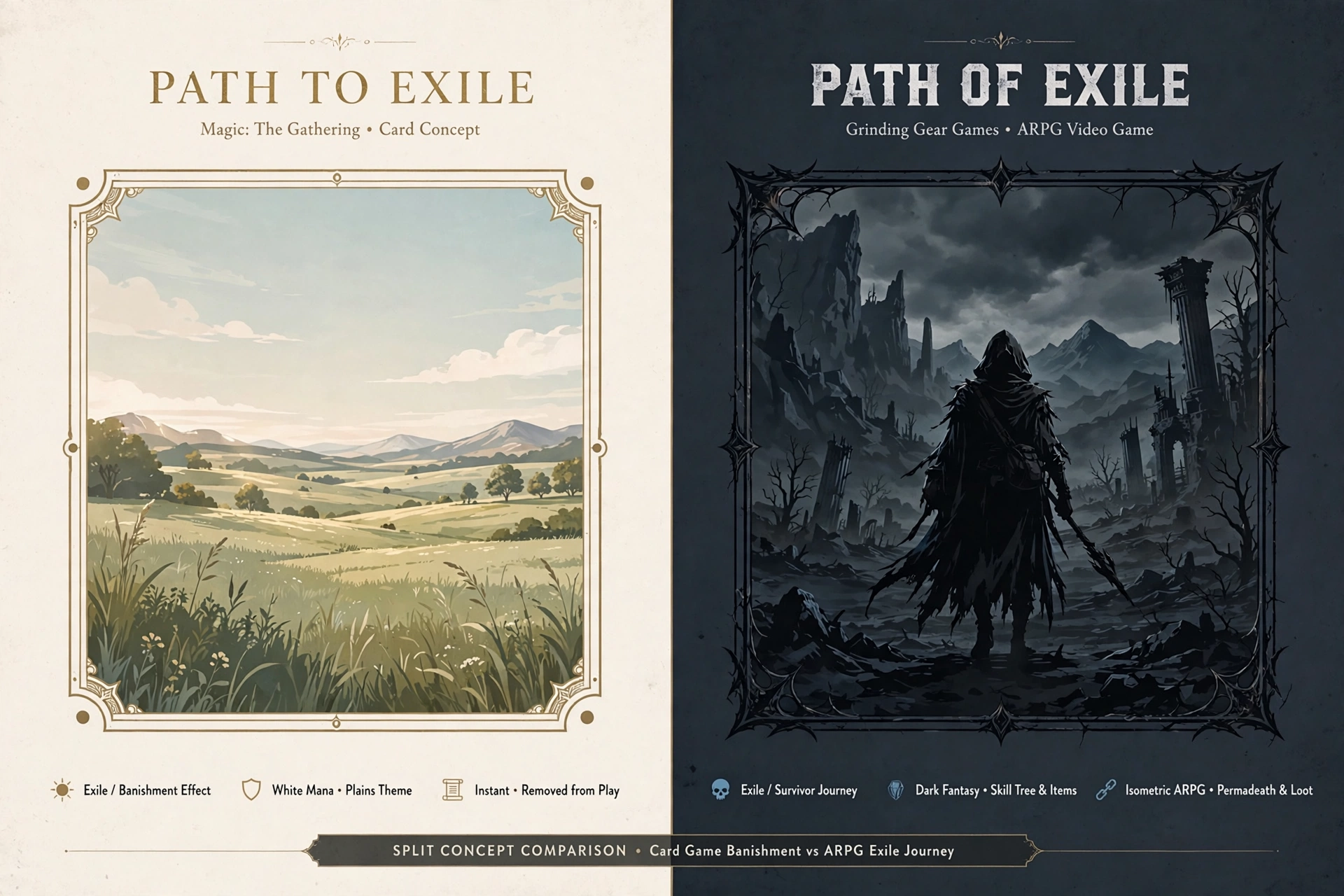
Path to Exile is, first and foremost, a Magic: The Gathering card: a one-mana white instant that exiles a creature. The action RPG many people have in mind is spelled Path of Exile, with “of” instead of “to.” This guide explains both, so you can tell in under a minute which Path to Exile you were searching for.
If you want the card, the next few sections cover it and point to our full MTG guide. If you want the video game, skip ahead to the Path of Exile sections, which explain the original game, its sequel, and where to find official information.
Table of Contents
Path to Exile Quick Answer
- Path to Exile (exact spelling): a card in Magic: The Gathering, made by Wizards of the Coast.
- Path of Exile (official game title): a free-to-play action RPG made by Grinding Gear Games.
- Path of Exile 2: a separate sequel from the same studio, not an expansion of the first game.
- Official game websites: pathofexile.com for the original and pathofexile2.com for the sequel.
Is It Path to Exile or Path of Exile?
Both names are real, and they belong to different products. Path to Exile, with “to,” is the Magic card. Path of Exile, with “of,” is the video game. The names differ by a single word, which is why people mix them up.
When we searched the exact phrase Path to Exile, the results that came back were card database and retailer pages for the Magic card, not the game. That suggests the exact spelling mostly points to the card. It does not mean nobody types it while looking for the game, and plenty of players clearly do.
There is nothing embarrassing about the slip. Both names are short, both sound similar, and the word “exile” is central to each. The video game is about exiles, people cast out to the dark continent of Wraeclast. The card is about exiling creatures from the battlefield.
So the question of whether it is Path to Exile or Path of Exile has a simple answer. If you play on a screen with a character, a passive tree, and loot, you want Path of Exile. If you play with a deck of cards, you want Path to Exile.
What Is Path to Exile in Magic: The Gathering?
In Magic: The Gathering, Path to Exile is a white instant that costs one white mana. Its text reads: exile target creature, and its controller may search their library for a basic land card, put it onto the battlefield tapped, then shuffle.
The card first appeared in the set Conflux, released on February 6, 2009. It is an uncommon in that set, with artwork by Todd Lockwood. Since then it has been reprinted many times in Commander products, special sets, and crossover releases.
Path to Exile earned its reputation for three reasons. It is cheap, it can be cast at instant speed, and it removes almost any creature you can target. Because the creature is exiled rather than destroyed, many death triggers and graveyard tricks never happen.
The catch is the land. The creature’s controller may fetch a basic land, so the spell gives an opponent extra mana. That trade-off is the heart of every discussion about Path to Exile.
For a deeper treatment of the card, including its history, printings, and alternatives, read our full Path to Exile MTG card guide.
How the Path to Exile Card Works
Path to Exile is an instant, so you can cast it on your own turn or during your opponent’s turn. It also targets, which matters for several rules interactions.
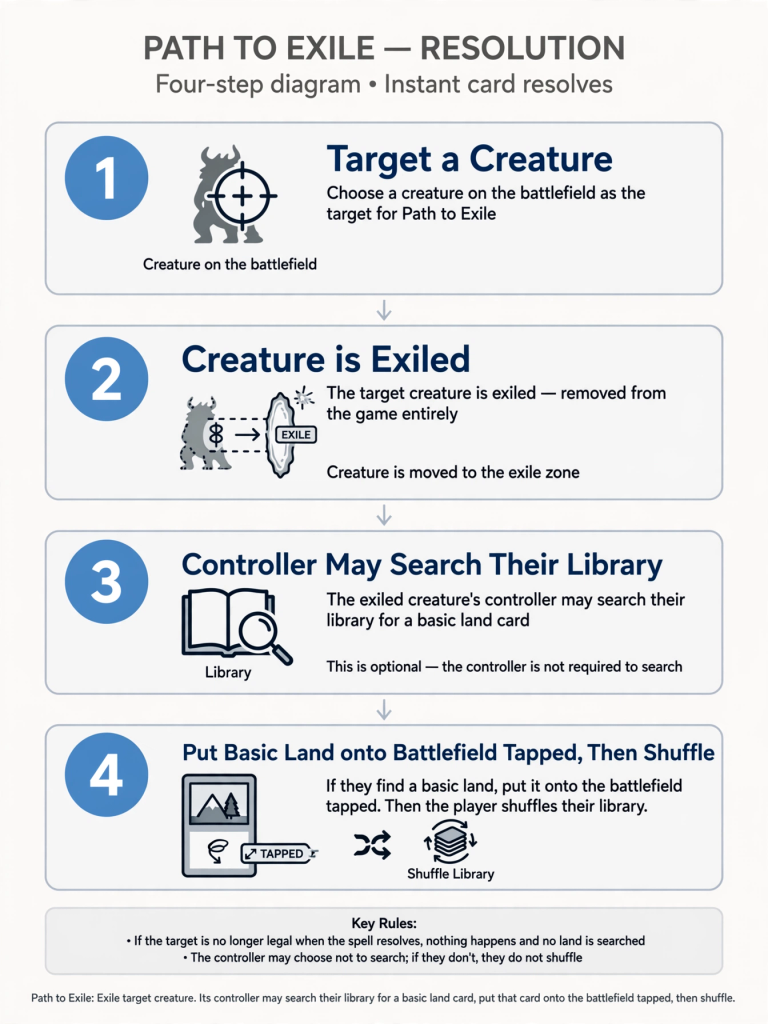
Here is the sequence when it resolves:
- You choose a creature on the battlefield as the target.
- If the target is still legal, the creature is exiled.
- The creature’s controller may search for a basic land card.
- If they do, the land enters the battlefield tapped, and they shuffle.
Two details cause most of the confusion. First, the word “may” means the controller can decline the land. Second, if the target becomes illegal before the spell resolves, the spell does nothing and nobody searches. The official card rulings, as mirrored in card databases, confirm both points.
Because the land goes to the creature’s controller, you can also use Path to Exile on your own creature as a rough ramp spell. That is an unusual play, but it is legal.
Is Path to Exile Legal? Formats at a Glance
Legality changes as formats update and banned lists are revised, so always confirm before building a deck. Based on the mtg.wtf card database listing we checked, Path to Exile is legal in Modern, Legacy, Vintage, Commander, Historic, Brawl, and Timeless. It was not listed as legal in Standard or Pioneer when we researched it.
In practice, the card is best known as a Commander staple and as a Modern removal option. Newer cards have changed how often it appears in tournament decks, so treat any older metagame claim as a snapshot rather than a current ranking.
If you are building a deck, our MTG card guide walks through format-by-format use and comparable removal spells. Check the official Wizards of the Coast banned and restricted list on the day you build.
What Is Path of Exile, the Game People Confuse With Path to Exile?
Path of Exile is a free online action RPG developed and published by Grinding Gear Games, a studio based in New Zealand. It launched on Windows in October 2013 and later arrived on Xbox One, PlayStation 4, and macOS. The official site describes it as an online action RPG set in the dark fantasy world of Wraeclast.
The official description highlights three things: a strong online item economy, deep character customisation, and competitive modes such as ladder races. It also states that the game is free and will never be “pay to win.”
If you came looking for Path to Exile and landed on the game, think of it as a dark, loot-driven dungeon crawler. You control a single exile, fight through randomly generated areas, collect items, and grow your character over hundreds of hours if you want to.
The game borrows heavily from the Diablo series, particularly Diablo II, but it has its own identity. Its skill gems, its enormous passive skill tree, and its currency-based economy set it apart from most action RPGs.
How Path of Exile Gameplay Works
Path of Exile plays from a top-down isometric view. You click to move, use skills on hotkeys, and fight large groups of monsters. Combat is fast, and the real depth lives in how you build your character.
Progress comes from three connected loops. You complete the story campaign, you move into the endgame map system, and you improve your character with better gear and passive points along the way.
Areas are instanced and randomly generated for your party. That means every run through a zone looks a little different, right down to the monsters and the loot they carry. Replayability is a stated design goal on the official game page.
Skills are not tied to your class. Instead, you find or buy skill gems and socket them into equipment. Support gems then modify those skills, and up to five support gems can affect a single skill according to the official description. This is why two characters of the same class can play completely differently.
If you searched Path to Exile hoping for something easy to start, the first hour of Path of Exile is approachable. The complexity builds later, so you do not need to understand everything on day one.
Path to Exile Searchers’ Guide: Path of Exile vs. Path of Exile 2
Path of Exile 2 is a separate game, not a patch or expansion for the first one. Grinding Gear Games develops both, and launch coverage of the official Steam description says both are meant to keep receiving content. Treat them as two games that share a world and a developer.
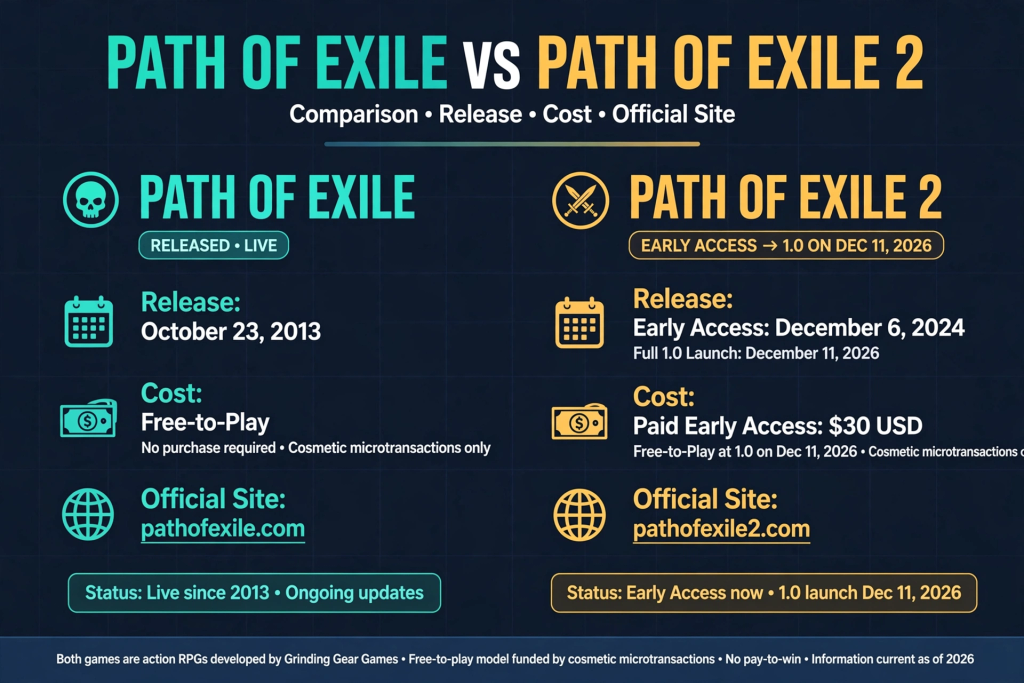
Path of Exile 2 entered paid early access on December 6, 2024. Its full 1.0 release is scheduled for December 11, 2026, when it is set to become free to play on PC, Steam, PlayStation, Xbox, and the Epic Games Store. The 1.0 launch is also reported to add the Duelist class and the final campaign acts.
Compared with the first game, Path of Exile 2 puts more weight on challenging boss fights that need precise timing and positioning, and it reworks the skill gem system. The details are still evolving, so check the official site before relying on any mechanic.
| Feature | Path of Exile (PoE 1) | Path of Exile 2 (PoE 2) |
|---|---|---|
| Developer | Grinding Gear Games | Grinding Gear Games |
| Release | October 23, 2013 (Windows) | Early access December 6, 2024; 1.0 planned December 11, 2026 |
| Cost | Free to play | Paid early access until 1.0, then free to play |
| Playable classes | Seven | Eight in the current patch; Duelist planned for 1.0 |
| Official site | pathofexile.com | pathofexile2.com |
A simple way to remember it: if the reader typed Path to Exile and wants the sequel, they want Path of Exile 2. If they want the older game with years of leagues behind it, they want Path of Exile.
Never mix class names, items, or mechanics between the two. A build guide written for one game will not work in the other.
Classes, Skills, and Character Builds
Path of Exile has seven classes: Marauder, Duelist, Ranger, Shadow, Witch, Templar, and Scion. Each class starts at a different place on the shared passive skill tree, but any class can travel across the tree to pick up passives from other areas.
On top of that, each class has Ascendancy options that unlock special passive trees and powerful bonuses. You can review the official Ascendancy classes page on the game’s website for the current list.
Path of Exile 2 uses a different roster. As of patch 0.5.5, our own class guide lists eight playable classes: Warrior, Monk, Sorceress, Witch, Ranger, Mercenary, Huntress, and Druid. Our Path of Exile 2 classes guide explains each one, and our PoE 2 Ascendancies guide covers the subclass system.
A build is simply the combination of your class, Ascendancy, main skill, passive points, and gear. Beginners often copy a build from a trusted guide, then adjust it as they learn. If you want to see what other players are running, our PoE Ninja builds guide explains how to read that third-party tool.
Because Path to Exile is such a common mistyping, many readers land here before they have chosen a game at all. If that is you, start with the original Path of Exile for a mature, well-documented experience, or with Path of Exile 2 if you want the newer systems.
Items, Equipment, and Character Progression
Items are the core of Path of Exile. The official page states that the game is “completely designed around items,” from flasks to endgame maps. Almost anything that can be an item with random properties is one.
Gear drops with random modifiers, so a single weapon can be a throwaway or a build-defining find. Rarer items have more modifiers, and unique items carry special effects that can shape an entire build.
There is no gold currency in the original game. Instead, the economy runs on orbs that change items in different ways, and players trade those orbs with each other. This is one of the biggest differences from other action RPGs.
Understanding currency is a major step in progression. Our PoE currency guide explains the main currency items in both games. When you are ready to buy and sell, our Path of Exile trade guide covers both games, and the narrower PoE 1 trade guide focuses on the original.
For the sequel, see the separate Path of Exile 2 trade guide, because its trading systems are not identical to the first game’s. Do not assume a trading tip for one game applies to the other.
Players who want a data reference for the sequel can read our PoE 2 DB guide, which explains a community-run database that is not an official Grinding Gear Games website.
Leagues, Updates, and Endgame Content
Leagues are a defining feature of Path of Exile. The official page describes them as separate game worlds with their own ladders and economies, from short races to months-long seasons. They let players start fresh without constantly resetting the main economy.
Wikipedia’s summary adds that there is a Standard league as the default, plus seasonal challenge leagues that introduce special mechanics for their duration. That structure is why many players return whenever a new league launches.
As of our research, the current Path of Exile 1 league is Curse of the Allflame, patch 3.29, which began on July 24, 2026. That date appears in the official patch notes for 3.29 and in a third-party league tracker. League information changes quickly, so verify it on the official site before planning.
For Path of Exile 2, our patch notes coverage lists patch 0.5.5, Forbidden Rites, released on September 4, 2026, followed by the small 0.5.5e update on October 5, 2026. See our PoE2 patch notes page for the latest summary. These details can be superseded by newer patches, and the full 1.0 release is scheduled for December 11, 2026.
Endgame in the original game revolves around the Atlas of maps, with systems that change each season. Because endgame mechanics are reworked regularly, any guide older than a few months may be out of date.
Where to Find Official Path to Exile and Path of Exile Information
Official resources keep you safe from outdated advice. Here is where to look.
- Path of Exile (original game): pathofexile.com for news, account creation, patch notes, the passive tree, and the official trade site.
- Path of Exile overview page: pathofexile.com/game for the official description of skill gems, items, and leagues.
- Path of Exile 2: pathofexile2.com, which is the registration and information site for the sequel according to launch coverage.
- Patch notes: posted on the official forum under the patch notes section of each game’s website.
Community tools are helpful, but they are not official. The Path of Exile wiki, the PoE2DB database, price-check overlays, and build trackers are all run by players, not by Grinding Gear Games. Use them for convenience and verify important facts against official notes.
If your search for Path to Exile was really about the card, the official sources are different: Gatherer on the Wizards of the Coast site for rulings, and the official format banned lists for legality.
Is Path of Exile Free to Play?
Yes, the original Path of Exile is free to play. The official page states that the game is completely free and will never be “pay to win.” Money is spent on cosmetic items and supporter packs, not on power.
Path of Exile 2 is different right now. It is currently in paid early access, and Grinding Gear Games has announced that the full 1.0 release on December 11, 2026 will make it free to play. Until then, access requires an early access purchase.
Always confirm pricing on the official site or your platform’s store before buying, because terms can change. Do not assume the original game and the sequel share identical terms on every platform.
The Magic card works differently. Path to Exile the card is a physical or digital trading card, so you pay for printings, and prices vary by edition. That is a separate market from the free-to-play game.
Beginner Tips for New Players
Whether you chose the game by accident or on purpose, these tips help you start well. They apply to the original Path of Exile unless stated otherwise.
- Pick one skill and stay with it. Do not try to learn every system at once.
- Ignore the whole passive tree at first. Follow a simple leveling plan and add points as you go.
- Read the official patch notes for your league. Mechanics change between leagues, and older videos may mislead you.
- Learn currency early. Knowing what orbs do saves you from wasting valuable items.
- Use the official trade site carefully. Check prices against several listings before buying or selling.
- Play with others if you can. Groups make the campaign easier and the game friendlier.
For the Magic card, the beginner advice is different. Save Path to Exile for a creature that truly matters, because giving away a land early can hurt. Late in a game, the extra land often matters much less.
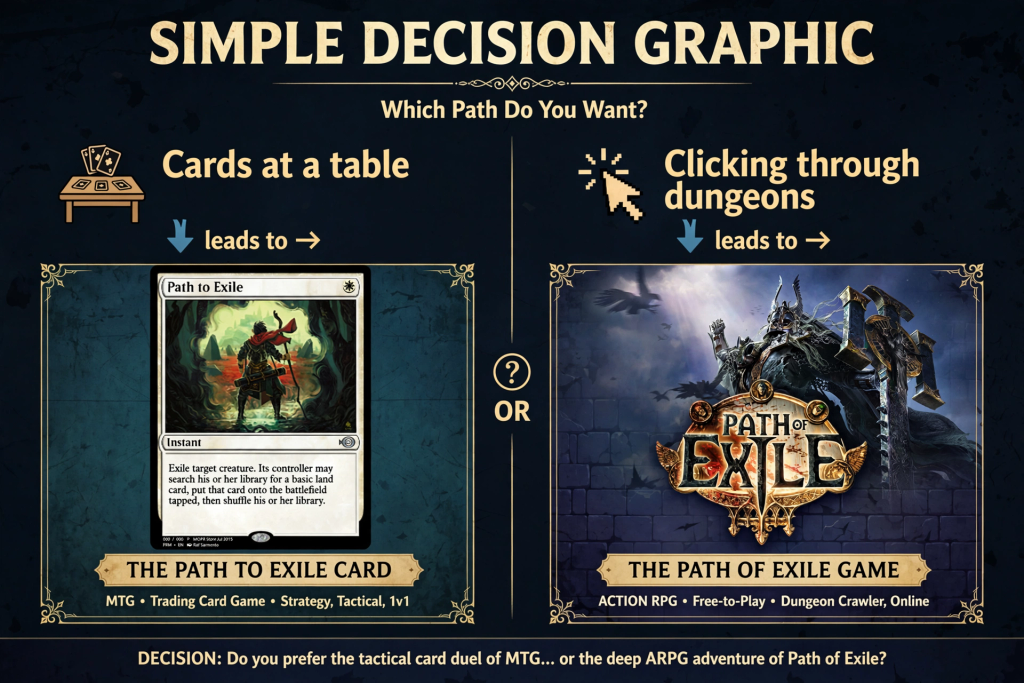
If you are still unsure which Path to Exile you want, ask yourself whether you want to click through dungeons or sit at a table with a deck. That one question settles the choice.
Frequently Asked Questions About Path to Exile
Is Path to Exile the same as Path of Exile?
No. Path to Exile is a Magic: The Gathering card made by Wizards of the Coast. Path of Exile is a free-to-play action RPG made by Grinding Gear Games. The spelling differs by one word, but the products are unrelated.
What is the official name of Path to Exile?
The card’s official name is Path to Exile. The game’s official name is Path of Exile. If you are looking for the video game, use “of” in your search.
Where can I find the official Path of Exile website?
The original game’s official site is pathofexile.com. The sequel’s registration and information site is pathofexile2.com. Both are run by Grinding Gear Games.
Is Path of Exile free to play?
Yes, the original Path of Exile is free to play. Path of Exile 2 is in paid early access and is scheduled to become free to play at 1.0 on December 11, 2026.
What is the difference between Path of Exile and Path of Exile 2?
They are separate games from the same developer. Path of Exile launched in 2013, while Path of Exile 2 entered early access in December 2024. Each has its own classes, systems, and content, so guides for one do not automatically apply to the other.
Is Path to Exile legal in Modern and Commander?
At the time of our research, the Magic card was listed as legal in Modern, Legacy, Vintage, and Commander, but not in Standard or Pioneer. Check the current banned and restricted lists before building a deck.
Is Path of Exile available on PC?
Yes. The official site lists PC and Mac versions, plus Xbox One and PS4 versions of the original game. Path of Exile 2 is scheduled for PC, Steam, PlayStation, Xbox, and the Epic Games Store at 1.0.
Where can I find builds and game information for Path to Exile players who want the game?
Start with the official sites, then use community resources. Our guides on Path of Exile trade, PoE currency, and PoE Ninja builds are good next steps. Always check that a guide matches the game version you are playing.
Conclusion
Path to Exile, spelled with “to,” is a Magic: The Gathering card, and the action RPG is Path of Exile, spelled with “of.” Knowing the difference saves time and keeps you away from guides written for the wrong product.
If you wanted the card, read our full Path to Exile MTG guide for rules, legality, printings, and alternatives. If you wanted the game, begin at pathofexile.com for the original or pathofexile2.com for the sequel, and remember that Path of Exile 2 reaches version 1.0 on December 11, 2026.
Whichever Path to Exile you meant, the next step is simple: pick the right product, check the official source, and start playing.
Sources and Verification Notes
Verified directly (fetched): official Path of Exile game page (pathofexile.com/game: free, never pay to win, skill gems, shared passive tree with seven starting locations, items, leagues, PC/Mac/Xbox One/PS4 listings); mtg.wtf card page (text, Conflux, Feb 6 2009, Todd Lockwood, legalities, rulings); GamesPuma homepage and MTG guide.
From search results, not fetched in full: PoE2 1.0 date of December 11, 2026 and free-to-play switch (reported by Poe-Vault, One More Game, MMOBomb, Nerd Wire, allthings.how, DLCompare, all citing the gamescom announcement); Duelist and final acts at 1.0; PoE2 early access date of December 6, 2024 (Wikipedia); PoE1 3.29 Curse of the Allflame (official forum patch notes, plus third-party arpg-timeline start date of July 24, 2026); Wikipedia for the seven PoE1 classes, 2013 Windows launch and league structure.
Not independently verified: PoE2 patch 0.5.5 / 0.5.5e dates and the eight-class list (taken from GamesPuma pages); the end date of the current PoE1 league (third-party estimate, deliberately omitted from the article); pathofexile2.com as fetched page; current MTG banned lists; MTG prices (not stated in the article).

Written by Daniel Carter
Daniel Carter is a dedicated gaming writer who enjoys turning complex gaming topics into clear, useful, and engaging content. He covers game guides, tips, reviews, features, and the latest developments across the gaming world. His approach focuses on research, accuracy, and practical value, helping readers discover new games, improve their gameplay, and stay informed about the industry. For Daniel, great gaming content is not just about information—it is about making every article genuinely worth reading.